
A research report earns citations on UK news websites by providing exclusive data, clear regional relevance, expert methodology, and timely cultural hooks. Journalists reference primary datasets that validate breaking news trends, support consumer stories, or offer quantifiable market insights.
Core Media Value Criteria
Journalists at UK national and regional outlets evaluate incoming data against strict editorial guidelines. To secure a citation, a report must fulfill specific journalistic requirements:
- Primary Data Ownership: Original survey results, proprietary platform data, or Freedom of Information (FOI) requests that do not exist elsewhere online.
- Methodological Transparency: Sample sizes exceeding 1,500 UK respondents, documented demographic split data, and clear statistical margins of error.
- Geographic Localization: Breakdown of data by UK regions, such as London, the North West, Scotland, and Wales, allowing regional journalists to localized national trends.
- Editorial Timeliness: Alignment with active seasonal hooks, upcoming legislation, or macroeconomic changes affecting UK readers.
Structural Requirements for Journalists
Newsrooms operate under rapid publishing schedules. Reports engineered for media coverage format information so journalists can extract key figures within seconds. Key structural components include executive summaries, high-resolution chart embeds, bulleted statistical highlights, and downloadable raw data files.
How does the citation process work across 15 UK news outlets?
The citation process operates through targeted media relations, digital PR distribution, and technical asset optimization. Outreach teams package raw data into news stories, pitch beat-specific journalists, and secure editorial backlinks directly within published digital articles.
Phase 1: Data Strategy and Formatting
The process begins with identifying data gaps within specific UK market sectors. Research teams design surveys or aggregate public datasets to uncover non-obvious consumer behavior or economic shifts. Data analysts evaluate the figures to extract 3 to 5 distinct news angles.
Phase 2: Media Asset Creation
PR strategists translate raw metrics into newsroom-ready press releases. A standard media asset package contains:
- A news headline matching the editorial style of target publications.
- Three core statistical takeaways highlighted in bold text.
- Expert commentary from qualified industry spokespeople.
- A hosted landing page containing the full report and attribution guidelines.
Phase 3: Targeted Outreach and Distribution
Outreach campaigns target specific journalists covering sectors such as personal finance, business, lifestyle, and technology across 15 selected UK publications. Personalised pitches deliver the story angle alongside direct access to the underlying dataset.
Phase 4: Citation Indexing and Syndication
When an editor approves the story, the publication prints the article online with a direct hyperlink or brand mention referencing the original source report. Syndication networks across regional news groups, such as Reach plc or Newsquest, often replicate the story, expanding the initial placement across multiple local domains.
Which 15 UK news websites frequently cite industry reports?
Major UK news websites frequently cite external industry reports to add authority, context, and statistical validation to their reporting. These 15 high-authority publications regularly link to third-party research studies within their digital editorial content:
- BBC News: Requires rigorous methodology, non-promotional data, and academic-grade primary sources.
- The Guardian: Prioritises socio-economic datasets, environmental research, and consumer rights studies.
- The Telegraph: Focuses on personal finance, property market trends, business analytics, and UK enterprise data.
- The Times: Demands institutional-grade economic research, corporate performance data, and political opinion metrics.
- The Independent: Cites lifestyle trends, digital technology developments, social issues, and consumer behavior studies.
- Daily Mail Online (MailOnline): Focuses on high-volume consumer surveys, human interest statistics, health studies, and pop-culture trends.
- The Express: Utilises personal finance insights, retirement data, property valuations, and weather-related statistics.
- The Mirror: Looks for relatable consumer spending studies, workplace statistics, and cost-of-living impacts.
- Evening Standard: Demands London-specific economic metrics, commuter data, property trends, and urban lifestyle research.
- City A.M.: Concentrates on financial service data, fintech metrics, London market updates, and corporate growth research.
- Sky News: Cites real-time economic indicators, national consumer sentiment, technology studies, and breaking health data.
- The Sun: Focuses on clear, actionable consumer advice, travel trends, family budget metrics, and entertainment statistics.
- Insider UK: Cites business transformation data, startup trends, workforce management statistics, and tech adoption reports.
- The Scotsman: Requires region-specific data regarding Scottish business, economic shifts, local politics, and environmental studies.
- WalesOnline: Prioritises regional economic statistics, Welsh infrastructure data, and local community survey results.
- Explore More Expert Insights:
- How to Brief a UK Publisher for Sponsored Content That Feels Like Real Journalism
- Sponsored Content Across 10 Verticals: UK Engagement Benchmarks 2026
What specific report components trigger backlinks from journalists?
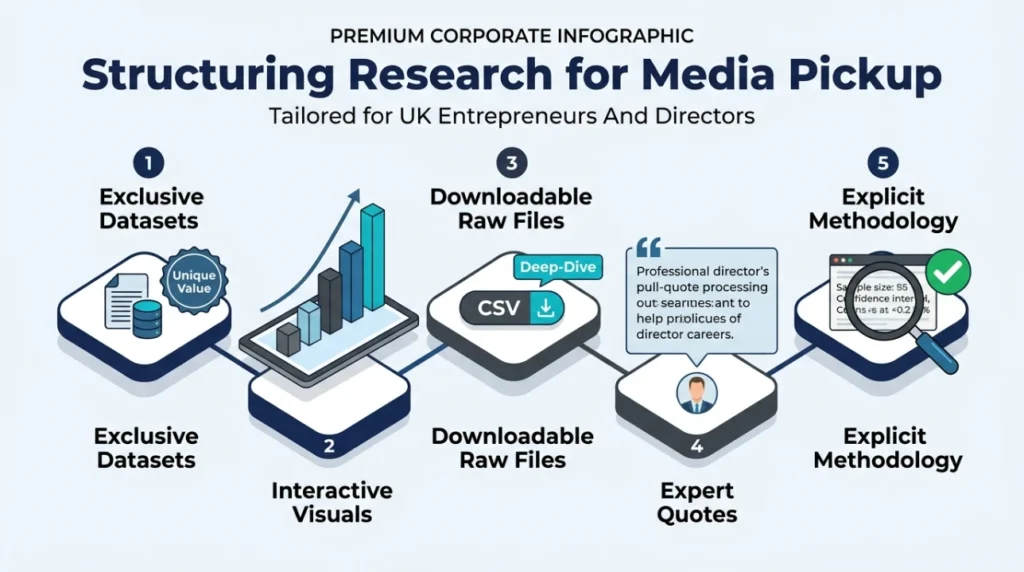
Journalists link to reports that contain exclusive datasets, interactive visuals, downloadable raw files, expert quotes, and explicit methodology sections. These components provide immediate verification, saving journalists time during article drafting and fact-checking.
Proprietary Datasets and Indices
Original data points create an authoritative requirement for a backlink. If a news article relies entirely on a custom metric, such as a “UK Remote Work Stress Index,” the journalist must cite the original source to justify the claim to readers and editorial managers.
Expert Quotes and Reaction Statements
Citing a data point requires context. Including pre-approved commentary from industry directors, academics, or senior analysts within the report gives journalists ready-made quotes, increasing the likelihood of an editorial citation.
Visual Data Assets
Journalists frequently embed static or interactive charts into online articles to increase reader engagement. Offering downloadable, unbranded infographics along with embeddable HTML code encourages media outlets to credit the parent report as the visual source.
Detailed Methodology Documentation
High-authority domains like BBC News and The Times enforce strict attribution standards. A dedicated methodology block detailing survey dates, sample demographics, weighting procedures, and margin of error calculations ensures the report passes editorial compliance.
Why are UK media citations critical for SEO and brand authority?
UK media citations drive search engine rankings by passing high domain authority, generating relevant referral traffic, establishing entity relevance, and validating E-E-A-T signals. Search engines evaluate media backlinks as trusted indicators of real-world brand prominence.
Authority and Link Equity Transfer
National UK news outlets hold Domain Authority (DA) and Domain Rating (DR) scores ranging from 80 to 95. A direct follow or editorial link from these domains passes significant equity to the cited site, accelerating overall search engine visibility.
Entity Validation for Search Engines
Search algorithms use artificial intelligence and semantic graphs to understand real-world entities. When 15 separate UK news publications reference a brand alongside specific industry topics, search engines map that brand as a recognized expert entity in that niche.
E-E-A-T Signal Strengthening
Google emphasizes Experience, Expertise, Authoritativeness, and Trustworthiness (E-E-A-T). Media citations serve as third-party verification that an organization produces reliable, fact-checked information worthy of citation by mainstream newsrooms.
High-Intent Referral Traffic
Readers who click on citations within news articles possess high informational intent. Securing links across mainstream publications directs engaged UK readers directly to targeted landing pages.
How do brands overcome common outreach challenges in the UK market?
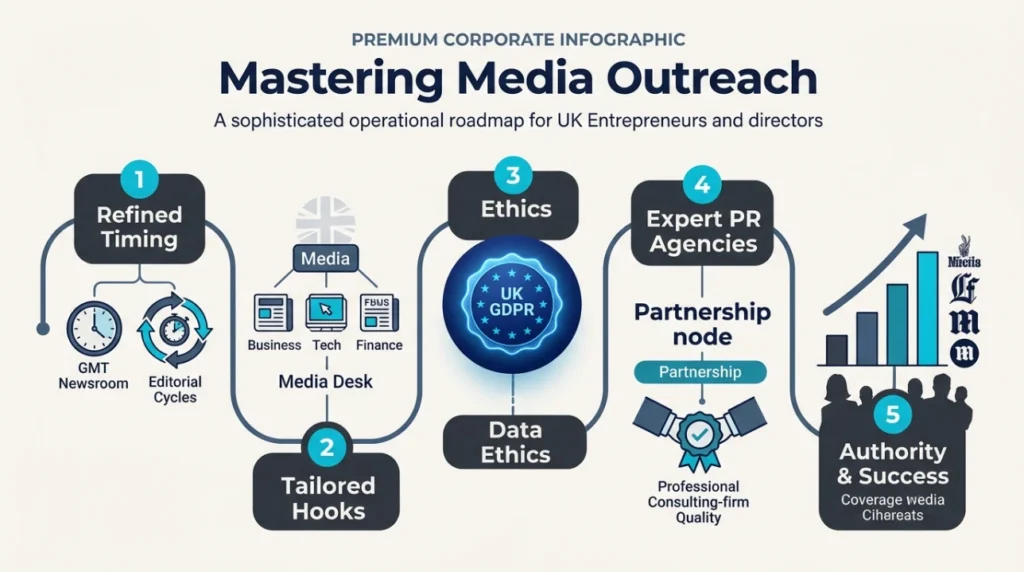
Brands overcome outreach challenges by refining pitch timing, tailoring hooks to specific media desks, adhering to strict data ethics, and using specialized Digital PR media agencies. Precise alignment with newsroom workflows increases overall citation placement success rates.
Managing Newsroom Timing and Cycles
Journalists manage dozens of emails daily and work under strict print and digital deadlines. Successful outreach targets early morning hours before morning editorial meetings occur. PR teams avoid sending reports during major breaking news cycles or political crises when news desks freeze non-essential feature publishing.
Avoiding Promotional Rejection
Commercial bias causes immediate rejection from news editors. Reports designed to promote a specific commercial product without providing wider societal or market value fail to earn coverage. To secure citations, the data must focus on broad industry insights rather than internal product features.
Securing Direct Hyperlinks Versus Plain Text Mentions
News organizations often prefer unlinked brand mentions over direct hyperlinks due to internal linking policies. To convert brand mentions into active backlinks, media teams execute post-publication outreach, offering additional supporting assets or updated datasets in exchange for a full source link.
Organizations looking to establish foundational campaign awareness can learn how to build research assets through a How Research Reports Earn Citations Across 15 News Sites framework. For businesses ready to execute data campaigns directly with specialized PR partners, evaluating a structured Get Your Report Cited With Time Intelligence Media Group pathway delivers measurable media link placements across top-tier UK news sites.
What metrics measure the success of a news report campaign?
A news report campaign is measured through total earned backlinks, domain authority of referring sites, brand search volume growth, keyword ranking improvements, and referral traffic. Quantitative tracking confirms the direct ROI of the research asset.
Key Performance Indicators (KPIs)
- Total Earned Citations: Count of unique news domains publishing a link or brand mention referencing the report.
- Average Referring Domain Rating: The authority score of news outlets covering the research story.
- Organic Search Performance: Ranking shifts for targeted semantic keywords following link indexation.
- Unlinked Brand Mention Conversion Rate: Percentage of plain text brand mentions converted into active backlinks via follow-up outreach.
- Referral Sessions: The volume of organic web traffic entering the site directly via news article citations.
Executing a structured data-led campaign transforms static research into a dynamic digital PR asset. By understanding the specific data needs, editorial standards, and citation workflows of these 15 UK news websites, brands consistently secure authoritative coverage that strengthens organic search visibility and industry authority.