
Trend report distribution across UK news sites is the systematic media relations process of syndicating data-driven research to national, regional, and trade publications. It secures earned media coverage, editorial backlinks, and brand authority across digital news networks.
Data-driven journalism forms the backbone of digital news production in the United Kingdom. National newspapers like The Guardian, trade journals such as Marketing Week, and digital regional publishers like Reach plc rely heavily on external research to fuel daily news coverage. Trend report distribution bridges the gap between raw market research and editorial publishing pipelines.
Understanding the Syndication Pipeline
The distribution pipeline transforms complex datasets into press-ready editorial assets. When an organization conducts research, the raw findings must be formatted into concise media angles. UK journalists process hundreds of pitches daily; structured trend distribution ensures that key statistical insights reach the correct desk editor at the optimal publishing time.
The Role of Digital Press Releases
Press releases built around trend reports differ from standard corporate announcements. They focus entirely on fresh statistical insights, consumer behavior shifts, and market forecasts. These releases act as factual summaries, providing journalists with pre-verified data points, expert commentary, and downloadable visual assets to accelerate their writing process.
How Does the UK Media Ecosystem Process Data and Trend Reports?
UK news sites process trend reports through automated wire networks, direct editorial pitches, and digital press offices. Desk editors evaluate the methodology, geographic relevance, sample size, and visual assets before assigning journalists to write the news story.
The UK press landscape operates under strict editorial guidelines and tight publication deadlines. Publishers prioritize data that offers strong regional relevance or clear national economic implications. Understanding these internal editorial workflows determines whether a trend report achieves widespread syndication or remains unpublished.
National vs. Regional Desk Workflows
National outlets prioritize macro-economic shifts, national demographic trends, and industry-wide disruptions. In contrast, regional publishers—such as The Manchester Evening News or The Scotsman—require localized data breakdowns. Distributing trend reports effectively involves segmenting data by geographic regions (such as Scotland, Wales, and English administrative regions) to appeal directly to local desk editors.
Wire Services and Direct Pitching
Syndication across UK media relies on a dual-channel strategy:
- Commercial Wire Services: Platforms like Press Association (PA Media) broadcast research directly into newsroom terminals across the country.
- Targeted Direct Outreach: Media strategists deliver personalized pitches directly to specialized beat reporters, offering exclusive commentary or early access under embargo.
What Are the Key Steps in Distributing a Trend Report to UK News Outlets?
Distributing a trend report involves five core steps: auditing data quality, crafting targeted press hooks, setting embargoes, pitching niche desk journalists, and tracking digital syndication across news syndicates and aggregator platforms.
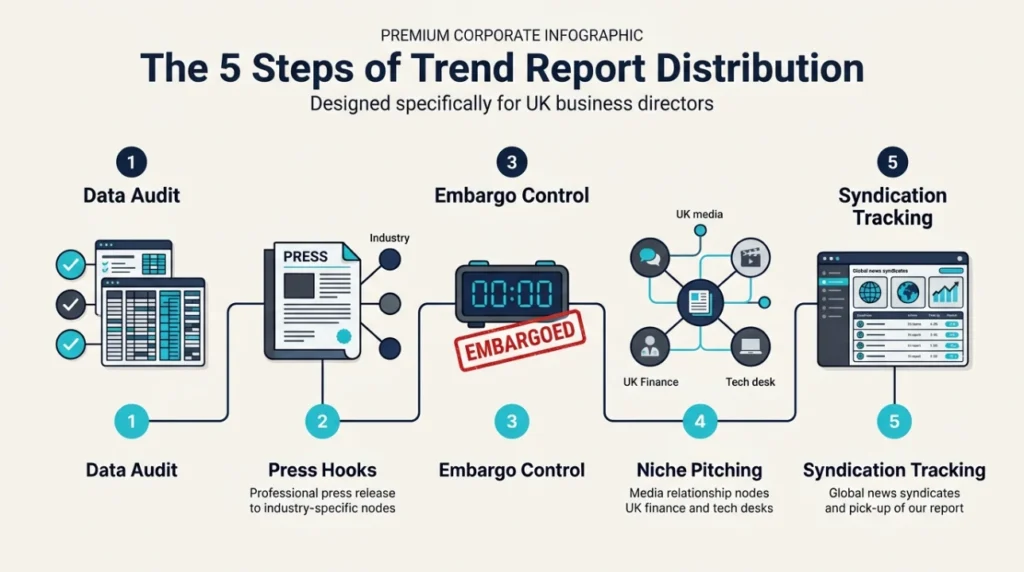
To secure publication across tier-one UK media, distribution campaigns must follow a structured, execution-focused workflow that satisfies strict journalistic standards.
1. Data Validation and Methodology Formatting
UK national newsrooms require rigorous statistical validation. Reports must clearly define their sample size, demographic split, and research timeframe. A sample size of 2,000 UK adults represents the standard baseline for consumer survey data intended for national publication.
2. Press Package Preparation
Before initiating outreach, media teams assemble a complete press kit. This includes:
- An embargoed press release featuring bulleted statistical highlights.
- High-resolution graphics, charts, and infographics optimized for web display.
- Executive commentary directly addressing the broader implications of the findings.
- A downloadable PDF link to the full trend report for editorial verification.
3. Embargo Management and Pitch Strategy
Distributing content under a strict embargo gives journalists time to analyze the data, interview experts, and draft balanced articles. Pitching typically begins 3 to 5 business days before the official public release date.
4. Direct Pitching to Targeted Beat Reporters
Pitching focuses on beat-specific journalists—such as technology editors, financial reporters, or retail correspondents. Personalized communications highlight the precise data point most relevant to that specific journalist’s recent coverage.
5. Post-Release Syndication and Follow-Up
Once the embargo lifts and the anchor story publishes, the release circulates via wire networks to trigger secondary syndication. Media teams monitor publication feeds, track coverage, and manage follow-up requests for secondary commentary.
Explore More Expert Insights:
How to Brief a UK Publisher for Sponsored Content That Feels Like Real Journalism
Sponsored Content Across 10 Verticals: UK Engagement Benchmarks 2026
What Components Make a Trend Report Pitch Successful in the UK?
A successful UK trend report pitch requires an authoritative dataset, a timely news hook, regional or sector-specific data breakdowns, pre-cleared executive quotes, and clear visual representations of the underlying metrics.
Editorial teams evaluate pitches based on news value, accuracy, and ease of production. Including structured assets directly within the initial pitch significantly increases adoption rates across busy newsrooms.
Data Accuracy and Sample Quality
Unsubstantiated claims are rejected by UK news desks. Research methodologies must be fully transparent, detailing the exact dates of data collection and the surveying platform utilized.
The News Hook and Market Context
Data alone rarely makes the news; it requires context. A successful report connects internal findings to current societal discussions, economic developments, or cultural shifts. Linking consumer spending metrics to inflation trends or retail changes provides the necessary context for news desk pick-up.
Essential Elements Checklist
- Sample Size: Minimum 2,000 respondents for general consumer trends; 500+ verified professionals for B2B sector reports.
- Executive Commentary: Direct, factual statements explaining what the data means for the market.
- Visual Assets: Vector graphics, data charts, and publication-ready imagery licensed for digital print.
- Regional Granularity: Data tables broken down by UK regions and major cities.
What Are the Benefits of Distributing Trend Reports for Brand Authority?
Distributing trend reports establishes brand authority, generates high-tier editorial backlinks, drives qualified referral traffic, and positions the publishing organization as an primary source of market intelligence.
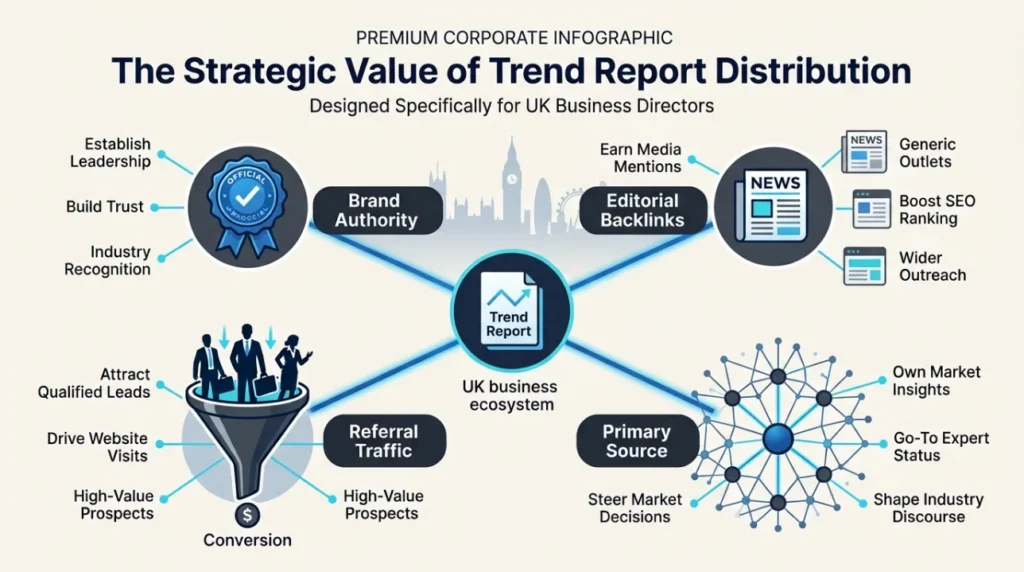
Executing a media distribution campaign transforms proprietary data into a long-term asset that benefits public relations, search engine visibility, and lead generation pipelines.
Securing Editorial Backlinks and Digital Authority
When top-tier news sites reference a trend report, standard editorial practice includes citing the source via a digital hyperlink. These high-authority press mentions signal trust and topical relevance to search engines, lifting organic domain authority.
To maximize overall campaign impact, media teams often align media outreach with broader digital intelligence strategies. Understanding broader market shifts through a comprehensive What Trend Reports Reveal About UK Markets in 2026 helps frame data distribution in alignment with real-time industry demands.
Enhancing Media Relations and Thought Leadership
Consistently providing reliable, publication-ready research turns an organization into a trusted media resource. Journalists regularly return to sources that historically deliver clean, accurate, and compelling datasets.
Supporting the Full Conversion Funnel
While media distribution primarily targets awareness, it impacts all stages of the marketing funnel:
- Top-of-Funnel: Drives high-volume reach through widespread news coverage.
- Middle-of-Funnel: Builds market credibility as prospects encounter your research cited in industry trade publications.
- Bottom-of-Funnel: Validates technical competence during purchasing decisions. Organizations seeking direct, high-impact campaign execution frequently deploy dedicated services like Trend Reports by Time Intelligence Media Group 2026 to scale their earned media footprint effectively.
How Do UK News Outlets Measure the Value of Distributed Trend Data?
UK news outlets measure trend data value using audience engagement metrics, reader retention times, social sharing volumes, and the uniqueness of the statistical insights provided by the research.
Digital news publishers monitor real-time analytics to determine which stories resonate with their readership. Understanding these publisher metrics allows media strategists to refine future report structures for maximum pickup.
Real-Time Editorial Analytics
Modern newsrooms monitor story performance through real-time analytics platforms like Chartbeat or Parse.ly. Articles built around data trends perform exceptionally well because distinct statistics encourage social shares, discussion, and extended dwell time on the page.
Exclusivity and News Freshness
Outlets assign higher editorial value to exclusive datasets. Offering an exclusive first-look to a major publication like The Times or The Telegraph secures prominent initial placement before broader syndication across trade platforms and regional networks.
What Are Common Use Cases for Trend Report Syndication in the UK?
Common use cases include B2B lead generation campaigns, annual industry benchmark releases, corporate reputation management, consumer behavior mapping, and public policy advocacy initiatives.
Organizations across various sectors deploy trend report syndication strategies to achieve specific corporate and communication objectives.
B2B Market Education
B2B companies use data distribution to highlight emerging industry challenges, shifting buyer preferences, or technology adoption rates. Publishing authoritative benchmarks educates target business buyers while generating high-value earned media.
Consumer Insights and PR Campaigns
Consumer-facing brands leverage survey data to map changing lifestyle habits, spending patterns, and seasonal preferences. These reports generate lighthearted or lifestyle-focused media coverage across consumer magazines, national tabloids, and lifestyle blogs.
Corporate Reputation and Policy Influence
Trade associations and non-profit organizations distribute trend reports to inform public policy debates, highlight market failures, or advocate for regulatory changes across government and institutional media channels.
Summary of UK Trend Report Distribution Strategy
Effective trend report distribution across UK news sites relies on rigorous data validation, precise media targeting, clear press kit construction, and strategic embargo management. By aligning research findings with the operational needs of UK journalists, organizations secure consistent earned media coverage and lasting digital authority.
Navigating the UK media ecosystem requires a structured, factual approach to data syndication. When datasets offer genuine market insights and adhere to professional editorial standards, they reliably earn placements across national, regional, and trade news networks.