
Trend reports in 2026 reveal that UK markets are undergoing structural shifts driven by automated commerce, stringent environmental regulations, shifting household budgets, and rapid digital integration. These data points provide critical benchmarks for understanding consumer behavior and industry direction.
Key Economic Drivers in the UK Market
Trend analysis highlights distinct economic indicators across the United Kingdom. Inflation stabilization at specific targets, alongside shifts in central bank interest rates, directly shapes consumer spending power. UK households demonstrate prioritized spending on essentials, health, and energy-efficient products, while non-essential retail experiences altered demand patterns.
Regional Market Variations
Data indicates that market behavior varies across UK regions:
- London and the Southeast: High adoption rates of digital-first services, fintech solutions, and premium subscription models.
- The Midlands and Northern England: Increased focus on regional manufacturing investments, supply chain localization, and commercial real estate adaptation.
- Scotland, Wales, and Northern Ireland: Targeted growth in green energy infrastructure, localized tourism, and sustainable agriculture sectors.
Understanding how data propagates across media platforms illuminates broader market movements. Industry analysts often examine distribution across news sites to track how economic insights reach public and corporate sectors.
How do consumer behavior trends shape UK retail and e-commerce?
UK retail and e-commerce in 2026 are defined by hybrid shopping patterns, privacy-first data collection, friction-free checkout systems, and heightened demand for sustainable sourcing. Retailers adapting to these core shifts report higher customer retention and stable operational margins.
The Evolution of Omnichannel Commerce
Physical stores in the UK function increasingly as fulfillment nodes and experiential centers rather than simple transactional hubs. Retail data highlights three main operational shifts:
- Micro-Fulfillment Networks: Urban stores utilize backroom space for rapid local delivery processing.
- App-Integrated In-Store Navigation: Shoppers use store mobile applications to locate inventory, view real-time stock levels, and bypass physical checkouts.
- Unified Inventory Management: Real-time sync between e-commerce stock and store shelves prevents over-promising during peak sales events.
Sustainable and Ethical Purchasing Factors
UK consumers evaluate brand sustainability through verified certifications rather than self-reported marketing claims. Metrics show increased scrutiny on scope 3 emissions, recyclable packaging, and fair labor practices within global supply chains. Products bearing third-party environmental credentials achieve higher sell-through rates compared to non-certified alternatives.
What are the primary digital transformation trends across UK industries?
Digital transformation across UK industries centers on applied artificial intelligence, enterprise cybersecurity architecture, cloud cost optimization, and automated data processing. Organizations leverage these technologies to reduce operational overhead and ensure compliance with UK data protection laws.
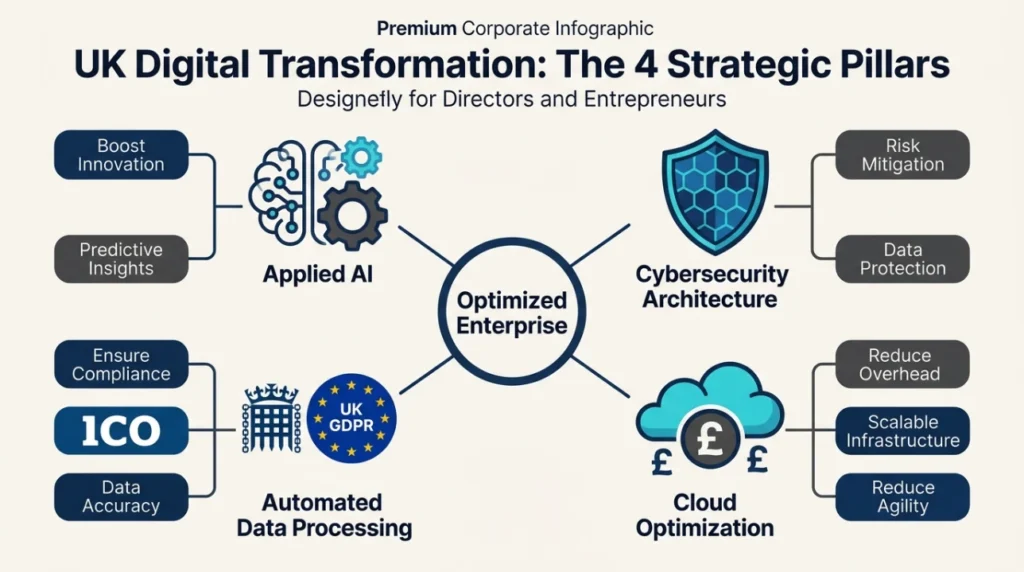
UK enterprise adoption of artificial intelligence has moved from exploratory testing to core integration. Key operational metrics include:
Enterprise AI and Automation Adoption
- Automated Customer Operations: Resolution of tier-one customer service inquiries through natural language processing systems without human intervention.
- Predictive Supply Chain Analytics: Reduction of inventory holding costs through real-time demand forecasting.
- Algorithmic Risk Assessment: Financial institutions utilize automated models to evaluate credit applications and detect fraudulent transactions.
Cybersecurity and Compliance Frameworks
UK businesses allocate higher portions of IT budgets to zero-trust architecture and regulatory compliance. The enforcement of updated UK digital safety standards mandates strict access controls, continuous network monitoring, and mandatory reporting procedures for data breaches.
Explore More Expert Insights:
How Fintech Companies Acquire Users Using Banner Ads
How Finance Brands Promote Credit Cards Using Display Campaigns
How do regulatory and environmental trends impact UK business strategy?
Regulatory frameworks and environmental mandates in 2026 dictate UK corporate governance, supply chain compliance, and financial reporting standardizations. Businesses align operational strategy with net-zero targets and legal requirements to mitigate financial risk and retain market access.
Net-Zero Carbon Targets and Corporate Compliance
UK legislation enforces rigorous corporate reporting on greenhouse gas emissions. Companies track carbon expenditures across three distinct categories:
Organizations that fail to audit Scope 3 emissions risk financial penalties and exclusion from public procurement tenders.
Labor Market Regulations and Workforce Dynamics
UK employment trends show structured changes in working arrangements. Legal frameworks govern remote worker rights, right-to-disconnect guidelines, and flexible working requests. Companies implement structured hybrid policies to balance physical office utilization with remote productivity metrics.
What components make up an effective UK market trend report?
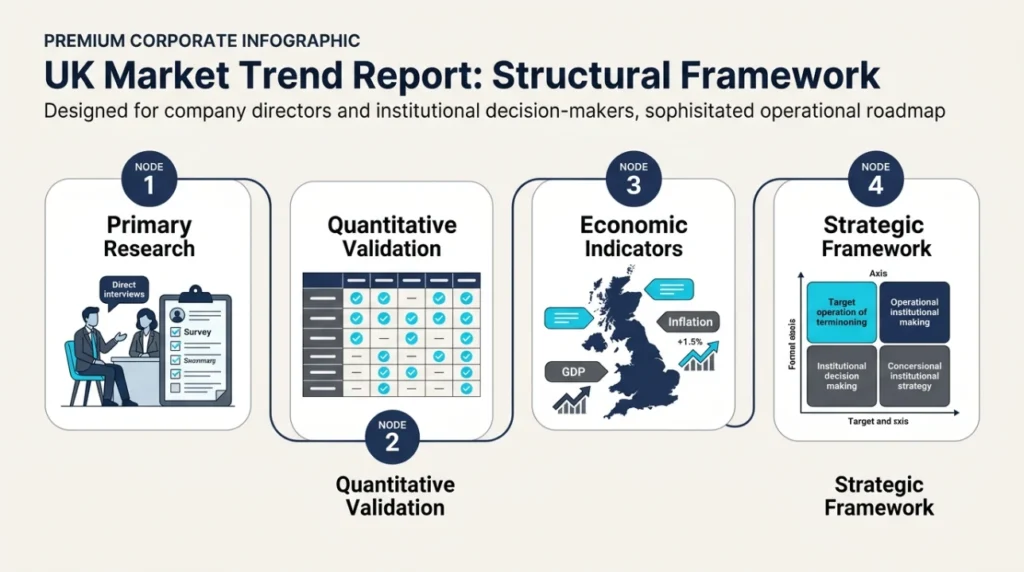
An effective UK market trend report comprises primary research methodologies, quantitative data validation, economic indicator analysis, and actionable strategic frameworks. These structural elements ensure the research provides accurate insight for institutional decision-making and market evaluation.
Quantitative and Qualitative Research Methodologies
Robust market intelligence relies on balanced research inputs:
- Quantitative Inputs: Sample surveys, transaction data analysis, macroeconomic datasets, and website analytics.
- Qualitative Inputs: Executive interviews, focus group recordings, expert panels, and field observation notes.
Data validation processes filter out statistical anomalies and ensure sample populations accurately represent UK demographic distributions.
Structuring Insights for Decision Makers
Standardized trend reports follow a logical data hierarchy to allow rapid extraction of actionable findings:
- Macro-Environment Evaluation: Analysis of political, economic, social, and technological factors affecting the UK market.
- Sector-Specific Indicators: Granular data covering market size, growth velocity, competitive density, and margin expectations.
- Risk Factors and Scenarios: Modeling of potential market disruptions, currency fluctuations, and regulatory changes.
Strategic planners utilize these documented insights alongside specialized commercial tools such as industry analysis reports to formulate multi-year operational roadmaps.
How will macro-trending data shape future business strategies in the UK?
Macro-trending data shapes future UK business strategies by defining capital allocation priorities, directing research and development investments, identifying market expansion vectors, and establishing competitive differentiation standards across mature and emerging commercial sectors.
Long-Term Strategic Planning Models
UK corporate entities use longitudinal trend data to shift from reactive adjustments to predictive market positioning. Multi-year planning integrates four core dimensions:
Organizations evaluate shift cycles across 3-year, 5-year, and 10-year horizons to ensure capital deployments align with structural economic transitions rather than short-term market noise.
Capital Allocation and Investment Directions
Investment strategies reflect data-backed growth projections across specific UK sectors:
- Renewable Energy Infrastructure: Directing capital toward offshore wind farms, grid modernization, and battery storage solutions.
- Healthtech and Biotechnology: Allocating funds to genomic research, personalized medicine platforms, and digital diagnostic devices.
- Advanced Manufacturing: Investing in robotics, additive manufacturing, and automated quality control hardware.
By systematically tracking trend reports, UK organizations maintain operational resilience and capitalize on structural market shifts in a clear, measurable manner.