

Financial research distribution in UK news media is the systematic process of delivering market analysis, economic data, and corporate reports to journalists, editorial desks, and financial news syndication networks across the United Kingdom to secure authoritative media coverage.
Financial research serves as the factual foundation for market reporting in the United Kingdom. National newspapers, trade publications, and digital financial outlets rely on structured data from institutions, brokerages, and research firms to explain market movements to retail and institutional audiences.
Understanding how this material enters the editorial pipeline requires examining the core structures of the UK media landscape.
The Structure of the UK Financial Media Ecosystem
The UK financial press operates across three distinct tiers:
- National News Outlets: Publications such as The Financial Times, The Telegraph, and The Guardian cover macroeconomics, monetary policy, and FTSE 100 developments.
- Trade and Institutional Media: Outlets including Investment Week, Portfolio Adviser, and Financial News focus on fund management, wealth management, and wholesale markets.
- Syndication and Digital Aggregators: Platforms including Bloomberg, Reuters, and Dow Jones distribute real-time research notes directly to institutional terminals and digital syndication networks.
For professionals seeking broader context on establishing industry presence, exploring [market authority] [Insert Link to TOFU Article] provides foundational insights into how institutions build public trust before scaling media distribution.
How does the financial research distribution process work?
The financial research distribution process works by transforming dense analytical data into structured news releases, validating regulatory compliance, selecting targeted media channels, and transmitting the materials directly to specialized newsrooms and financial content wire services.
Step 1: Research Optimization and Narrative Formatting
Raw financial reports contain complex charts, extensive datasets, and technical terminology. Editorial desks reject unstructured PDFs. Institutional research teams extract 3 key data points, convert technical findings into concise executive summaries, and highlight actionable market implications.
Step 2: Regulatory and Compliance Clearance
UK financial media distribution must adhere to strict regulatory standards enforced by the Financial Conduct Authority (FCA). Compliance teams review all research assets to ensure statements do not constitute unapproved investment advice or contain misleading performance projections.
Step 3: Targeted Channel Selection and Media Pitching
Distribution teams segment media lists by beat, target market, and audience tier. Wire services distribute mass announcements, while personalized outreach delivers exclusive data points to senior financial correspondents.
Step 4: Syndication and Publication Tracking
Once embargoes lift, research content disseminates across syndicated networks, news terminal databases, and online news portals. Distribution systems track pickups, readership metrics, and downstream citation frequency.
What channels distribute financial research across the UK?
Financial research distributes across the UK using financial wire services, direct editorial outreach, institutional media networks, RSS feeds, and digital syndication portals that connect research producers directly to journalists, terminal operators, and news readers.
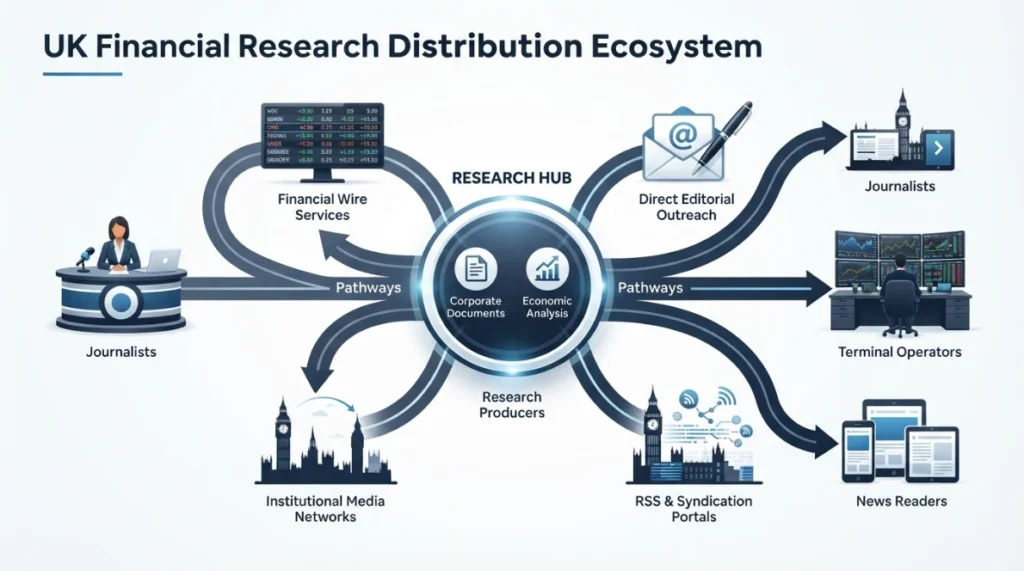
Financial Wire Services
Commercial wire services transmit press releases and research summaries directly into newsroom content management systems. These platforms ensure broad, simultaneous public disclosure.
- PR Newswire reaches UK national desks and international terminal networks.
- Business Wire targets institutional investor networks and trade publications.
- Regulatory News Service (RNS) handles mandatory corporate disclosures and market-sensitive research.
Direct Editorial Pitching
Direct pitching bypasses automated syndication. Communication teams send tailored research findings directly to specific UK financial journalists. Exclusive distribution agreements give tier-1 publications advance access under strict embargo rules, increasing the probability of front-page placement.
Specialized Financial Media Networks
Independent media networks and institutional intelligence platforms curate research for specialized audiences. Organizations evaluating specialized distribution partners can review dedicated [research distribution platforms] [Insert Link to BOFU Article] to understand operational frameworks and commercial network capabilities.
What components make financial research news-worthy for UK journalists?
Financial research becomes news-worthy for UK journalists when it contains proprietary quantitative data, addresses current economic conditions, includes clear expert commentary, adheres to regulatory guidelines, and provides immediate local relevance to UK markets.
[Proprietary Data] + [Timely Macroeconomic Context] + [FCA Compliance] = Editorial Placement
Proprietary Quantitative Data
UK newsrooms prioritize unique primary data over aggregated secondary opinions. Datasets featuring survey results from over 500 institutional investors or proprietary transaction tracking generate higher coverage rates than opinion-based commentary.
Alignment with Economic Timelines
Research must align with active news cycles. Reports analyzing interest rate adjustments gain higher traction when released 48 hours before the Bank of England Monetary Policy Committee announces rate decisions.
Key factors that elevate research news-worthiness include:
- Proprietary Datasets: Exclusive data points unavailable from public databases.
- Executive Quotes: Direct commentary from qualified Chief Economists or Analysts.
- Local Market Relevance: Direct connections to UK GDP, inflation, housing, or FTSE indices.
- Visual Assets: High-resolution charts and infographics formatted for print and digital layout.
What regulatory rules govern financial research distribution in the UK?
Regulatory rules governing financial research distribution in the UK include the Financial Services and Markets Act 2000, FCA Conduct of Business Sourcebook rules, and Market Abuse Regulations that restrict misleading promotions and insider information leaks.
The Financial Conduct Authority Framework
The FCA regulates how financial information reaches public domain channels. Section 21 of the Financial Services and Markets Act 2000 (FSMA) controls financial promotions. Unregulated research entities cannot distribute content that invites or induces investment activity without approval from an FCA-authorized firm.
MiFID II Research Unbundling Rules
Markets in Financial Instruments Directive II (MiFID II) altered how investment firms distribute and consume research. The framework requires asset managers to pay explicitly for third-party research rather than bundling execution fees with analytical content. This shift raised the quality threshold required for distributed material across the UK.
Market Abuse Regulation (MAR) Compliance
Distributing research containing inside information requires strict compliance with UK MAR. Prematurely disclosing price-sensitive data before public dissemination violates federal securities laws and incurs severe financial penalties.
Why do UK media outlets rely on third-party financial research?
UK media outlets rely on third-party financial research to supplement newsroom resources, access specialized market expertise, verify statistical data, and provide audiences with objective analysis of complex global economic developments.
Newsroom Resource Efficiency
Editorial budgets across UK media organizations face structural constraints. Specialist data science desks are costly to maintain. Third-party research provides newsrooms with pre-verified statistical analysis, enabling journalists to produce data-driven stories without conducting internal primary research.
Specialized Domain Expertise
Financial markets encompass complex sub-sectors, including renewable energy infrastructure, structured credit, and biotech venture capital. External research firms provide specialized knowledge that generalist reporters leverage to explain technical market shifts accurately.
Enhanced Editorial Credibility
Citing institutional research from recognized market participants strengthens narrative authority. Readers trust economic reports supported by verified data points from established research houses and financial distribution networks.
How do organizations measure the impact of distributed financial research?
Organizations measure the impact of distributed financial research by tracking media pick-up volume, audience reach, domain citation frequency, reader engagement metrics, and qualified lead generation across UK media channels.
Quantitative Media Metrics
Quantitative measurement establishes the physical reach of a research campaign across print, digital, and broadcast channels.
| Metric Type | Primary Indicators | Evaluation Method |
| Coverage Volume | Total article placements, syndicate republications | Automated media monitoring software |
| Audience Reach | Monthly Unique Visitors (MUV), print circulation | Audit Bureau of Circulations (ABC) data |
| Digital Authority | High-authority backlinks, brand mentions | SEO authority tracking platforms |
Qualitative Impact Analysis
Measuring brand authority requires assessing placement quality alongside volume. An exclusive feature article in The Financial Times delivers higher strategic value than 20 automated content aggregators. Compliance teams also measure sentiment alignment to ensure media coverage accurately reflects original research findings without misrepresentation.
What challenges affect financial research distribution in the UK?
Challenges affecting financial research distribution in the UK include intense newsroom competition, strict FCA promotional compliance, shrinking journalist staff counts, and information overload from automated PR distribution tools.
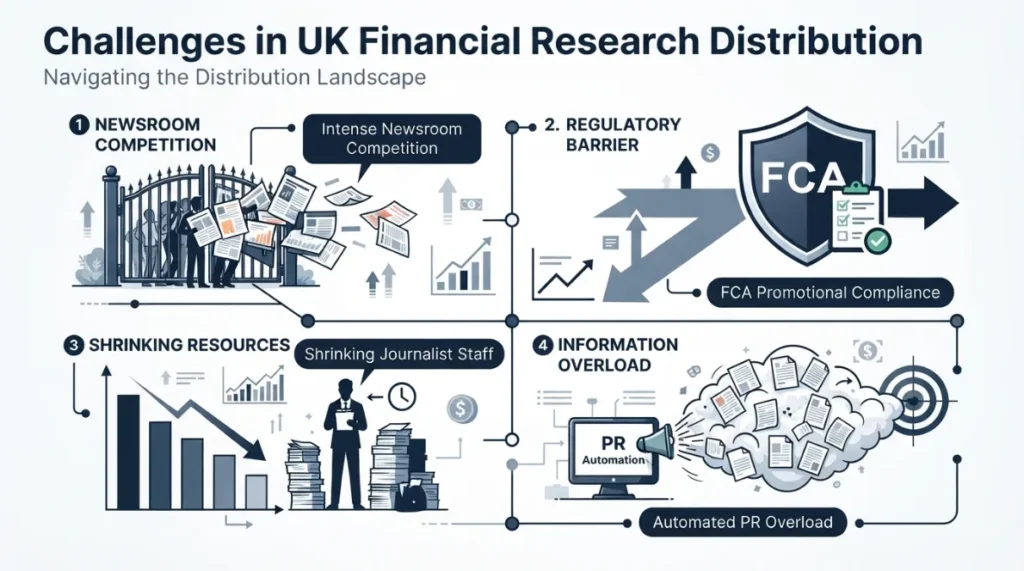
Newsroom Pitch Volume
UK financial journalists receive hundreds of research summaries daily. Automated, non-targeted distribution lists result in high deletion rates. Pitch emails lacking clear, data-driven subject lines fail to capture editorial attention.
Balancing Compliance with Communication
Compliance requirements often conflict with public relations objectives. Regulatory teams frequently add disclaimers or request technical language that weakens news-worthiness. Successful distributors balance legal compliance with direct, accessible storytelling.
Evolving Digital Distribution Algorithms
Search engines and AI discovery platforms continually update how they crawl, index, and cite news content. Financial research distributors must optimize formats for traditional journalists while structuring digital assets for search indexing and automated AI citation systems.
Explore More Expert Insights:
How Food Chains Increase Purchase Consideration Using Display Ads
How Restaurants Build Trust Using Review-Based Banner Campaigns
Summary of UK Financial Research Distribution
Distributing financial research across UK news media requires structured execution, strict regulatory oversight, and clear editorial alignment. By organizing dense financial data into news-worthy formats, institutions securely transmit market analysis to national newspapers, trade publications, and digital syndication platforms.
Maintaining compliance with FCA standards, selecting appropriate distribution channels, and targeting specific journalists ensures research achieves broad media coverage and long-term industry impact.



