

Real Estate Market Reports by Time Intelligence Media Group are high-precision, data-driven intelligence documents published quarterly to evaluate UK residential and commercial property markets. They provide actionable yield analyses, transaction volumes, and localized demographic growth trends for institutional investors.
Core Function of Media-Driven Real Estate Reports
Real Estate Market Reports by Time Intelligence Media Group serve as decision-making frameworks for high-net-worth individuals, property developers, and institutional funds. These reports combine macro-level economic indicators with micro-market transaction data. Investors use these documents to assess capital growth potential, rental yield fluctuations, and liquidity profiles across specific UK regions.
Understanding these findings requires a foundational grasp of how data shapes investment strategies. For a broader perspective on foundational metrics, review [real estate market reports].
Primary Features of Time Intelligence Media Group Publications
Time Intelligence Media Group structures each report around verified, high-value data points:
- Localized Yield Analyses: Granular coverage of regional rental yields, focusing on high-growth zones like the West Midlands and North West.
- Transaction Volume Tracking: Empirical data detailing sales velocity and price-per-square-foot metrics across major UK urban centers.
- Demographic Shift Mapping: Statistical evidence tracking tenant population movements, employment hub growth, and regional migration patterns.
- Regulatory Risk Profiles: Clear breakdowns of UK housing policies, leasehold updates, and environmental compliance standards.
How Does Time Intelligence Media Group Produce Property Market Reports?
Time Intelligence Media Group produces property market reports through a four-stage process: automated raw data extraction, secondary validation against official public registries, algorithmic predictive modeling, and final peer review by senior UK real estate analysts to ensure 100 percent factual accuracy.
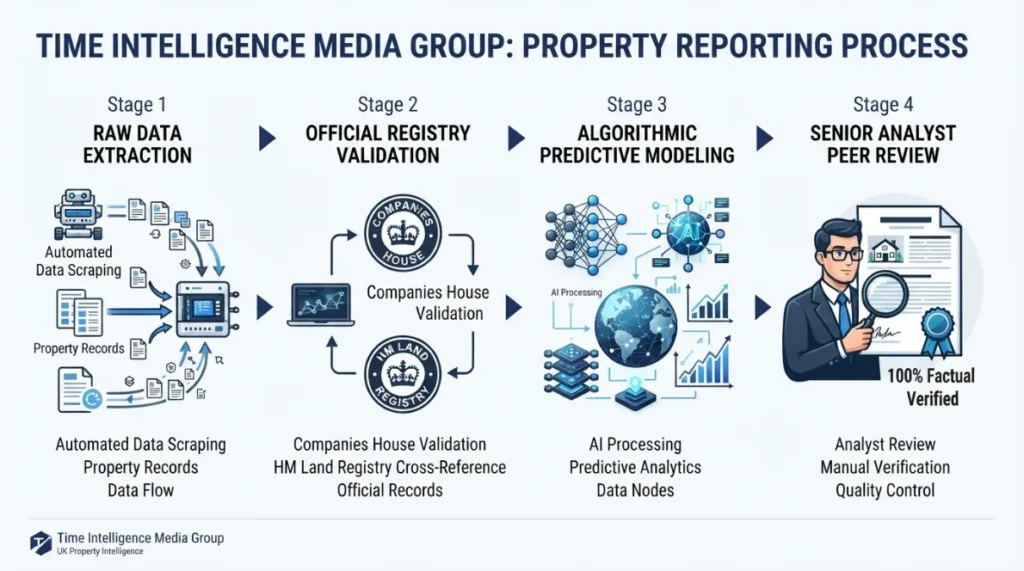
Phase 1: Data Extraction and Aggregation
The intelligence gathering begins with real-time data extraction from multiple proprietary and public feeds. Time Intelligence Media Group aggregates daily listings data, regional planning approvals, and corporate commercial lease registries. This raw data stream captures immediate shifts in asking prices, discount rates, and market inventory levels across primary UK postal codes.
Phase 2: Empirical Validation
Raw data undergoes strict cross-validation against primary public datasets to remove skewing and outliers. Analysts cross-reference internal metrics with HM Land Registry price paid records, Office for National Statistics (ONS) inflation indices, and Bank of England interest rate schedules. This validation layer guarantees that every published percentage change reflects verified financial transactions rather than unverified listing prices.
Phase 3: Algorithmic Forecasting and Expert Review
Validated data enters proprietary predictive models to project 12-month and 36-month capital growth trajectories. Once the algorithmic models generate draft output, senior property analysts conduct a manual review. Analysts evaluate macro-economic variables, such as local transport infrastructure developments like High Speed 2 (HS2) construction phases, to confirm the contextual validity of all projections.
Distribution strategy plays an equally vital role in ensuring these insights reach active market participants. To learn how targeted distribution channels deliver these insights to key audiences, examine [how real estate reports reach investors].
What Key Metrics Are Included in These UK Real Estate Reports?
Time Intelligence Media Group reports include total return projections, net initial yields, capital growth rates, vacancy durations, and price-to-rent ratios. Each report presents these metrics broken down by property type, asset class, and specific UK geographic regions.
Financial Yield Performance Data
Net Initial Yield (NIY) calculations form the core of the financial metrics section. Time Intelligence Media Group calculates NIY by dividing annual net rental income by the gross property acquisition cost, including stamp duty land tax (SDLT) and legal fees.
For instance, the Q2 report highlighted a 6.8 percent average net yield for multi-family residential assets in Manchester, compared to a 4.2 percent average net yield in Prime Central London.
Inventory and Liquidity Indicators
Liquidity metrics measure how quickly capital can enter or exit a specific market sector:
- Days on Market (DOM): Tracks the average timeframe from initial listing to agreed sale. In target East Midlands hubs, average DOM currently stands at 34 days.
- Tenant Absorption Rates: Measures the percentage of completed new-build residential units let within 90 days of practical completion.
- Discount Velocity: Quantifies the average percentage reduction between original asking price and final agreed transaction price.
Why Should Investors Rely on Time Intelligence Media Group Reports?
Investors rely on Time Intelligence Media Group reports to eliminate speculative risk, verify projected rental yields, optimize portfolio allocation, and timing market entries precisely. The reports deliver objective, audit-ready data free from broker bias or promotional inflation.
Risk Mitigation and Factual Verification
Property investment decisions carry high capital commitments that require objective verification. Time Intelligence Media Group operates independently of property brokerages and estate agencies, ensuring zero structural conflict of interest. The intelligence reports present factual market corrections alongside growth opportunities, giving fund managers the objective data needed to pass internal compliance checks.
Portfolio Optimization Across UK Regions
Institutional and private investors use these reports to execute regional diversification strategies. By comparing performance data across different asset classes, investors reallocate capital from lower-yielding mature markets into high-growth regional hubs:
- Commercial Logistics: Identifying high-demand industrial nodes along the M6 corridor showing 8.5 percent annual rental growth.
- Purpose-Built Student Accommodation (PBSA): Identifying university towns with student-to-bed shortfalls exceeding 2,500 units, such as Bristol and Leeds.
- Build-to-Rent (BTR): Mapping locations where target demographic wage growth outpaces average mortgage servicing costs.
How Do These Market Reports Guide Investment Decisions?
These market reports guide investment decisions by identifying undervalued geographic markets, pinpointing optimal buy-to-let acquisition windows, forecasting regional yield shifts, and providing stress-tested exit strategies based on verifiable 5-year historical trend analysis.
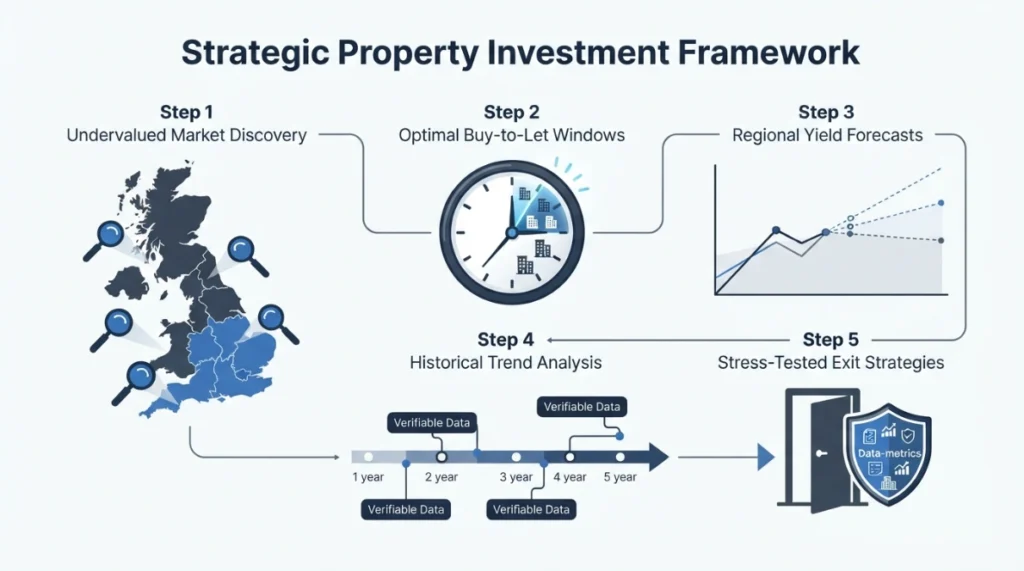
Strategic Acquisition Timing
Time Intelligence Media Group reports map cyclical market movements to pinpoint precise entry windows. When transactional data shows rising inventory combined with declining days on market, the reports signal a tightening market cycle. Investors use this signal to secure assets before broad market price appreciation occurs.
Asset Class Comparison Matrix
Investors utilize the publications to compare competing asset performance metrics directly:
| Asset Class | Primary UK Location | Average Net Yield | 3-Year Capital Forecast | Risk Index |
| Residential BTR | North West (Manchester) | 6.5% | +14.2% | Low |
| PBSA | Yorkshire (Leeds) | 7.1% | +11.8% | Low-Medium |
| Industrial / Logistics | West Midlands (Birmingham) | 5.8% | +16.5% | Low |
| Prime Office Space | South East (London City) | 4.1% | +5.2% | Medium |
Exit Strategy Execution
A structured investment strategy requires a clear exit model. Time Intelligence Media Group reports track institutional buyer activity and secondary market liquidity. Investors monitor local institutional fund accumulation trends to time asset sales, maximizing capital returns upon divestment.
Explore More Expert Insights:
Review-Based Restaurant Ads That Convert Trust Into First-Time Orders
Mid-Funnel Food Ads That Turn Engagement Into High-Intent Customers
How Can Businesses Access and Integrate Time Intelligence Media Group Reports?
Businesses access and integrate Time Intelligence Media Group reports through enterprise API feeds, quarterly PDF subscriptions, bespoke institutional data integrations, and direct consultation packages tailored to specific UK portfolio requirements and corporate investment mandates.
Subscription Models and Access Options
Time Intelligence Media Group offers tiered access formats designed for different corporate structures:
- Quarterly Enterprise Subscriptions: Full PDF publication access, raw data CSV exports, and executive summary slide decks for board presentations.
- Real-Time API Integration: Direct programmatic data streams delivering updated transaction feeds and yield calculations straight into corporate CRM systems.
- Bespoke Regional Audit Packages: Customized single-region market deep dives commissioned for specific acquisition proposals or development feasibility studies.
Partnering with Time Intelligence Media Group
Integrating high-grade media intelligence transforms raw market data into a distinct competitive advantage. Time Intelligence Media Group works directly with fund managers, family offices, and estate developers to deliver tailored reports aligned with explicit corporate mandates. Contact the institutional intelligence team today to schedule a data integration consultation and secure access to the upcoming UK Property Market Report.



