

Launching a product in the UK requires more than announcing its availability. Brands need to communicate the product’s purpose, value, relevance and evidence to defined audiences. Sponsored content provides a controlled publishing format that combines commercial messaging with editorial-style information.
Sponsored content is paid media content created around a brand, product, service or campaign. It appears through a publisher or media platform and is clearly identified as sponsored or commercial content. During a product launch, this format gives brands structured space to explain a new product in greater depth.
For businesses evaluating launch communication options, understanding:
How Sponsored Content Supports UK Product Launches helps clarify its role within a wider marketing strategy. It works alongside public relations, search marketing, social media, email campaigns and other promotional channels.
What is sponsored content for a UK product launch?
Sponsored content is paid media designed to explain a product launch through structured, informative content that reaches a defined audience. It gives brands controlled space to present product features, applications, evidence, positioning and launch information within established media environments.
Unlike a standard advertisement, sponsored content provides room for detailed information. A product launch article can explain the problem addressed by the product, identify its target market, describe key features and provide supporting evidence.
The UK market also contains distinct audience groups. These include consumers, procurement teams, business decision-makers, investors, industry professionals and specialist communities. Each group requires different information.
How does sponsored content differ from traditional advertising?
Traditional advertising generally focuses on concise promotional messages. Sponsored content supports longer explanations. It can contain several sections covering product information, market context, use cases and supporting evidence.
For example, a UK technology company launching an enterprise software platform can use sponsored content to explain its functionality, implementation process, security features and business applications.
Why does controlled messaging matter?
Product launches involve multiple information points. These include launch dates, product specifications, pricing, availability, target users and differentiating features.
Sponsored content gives the brand control over how these details are presented. This reduces reliance on short-format advertising messages and creates a dedicated environment for product education.
Businesses assessing the wider role of launch content can first review:
Sponsored content supports UK product launches to understand its position within the broader awareness stage.
How does sponsored content amplify product launch visibility?
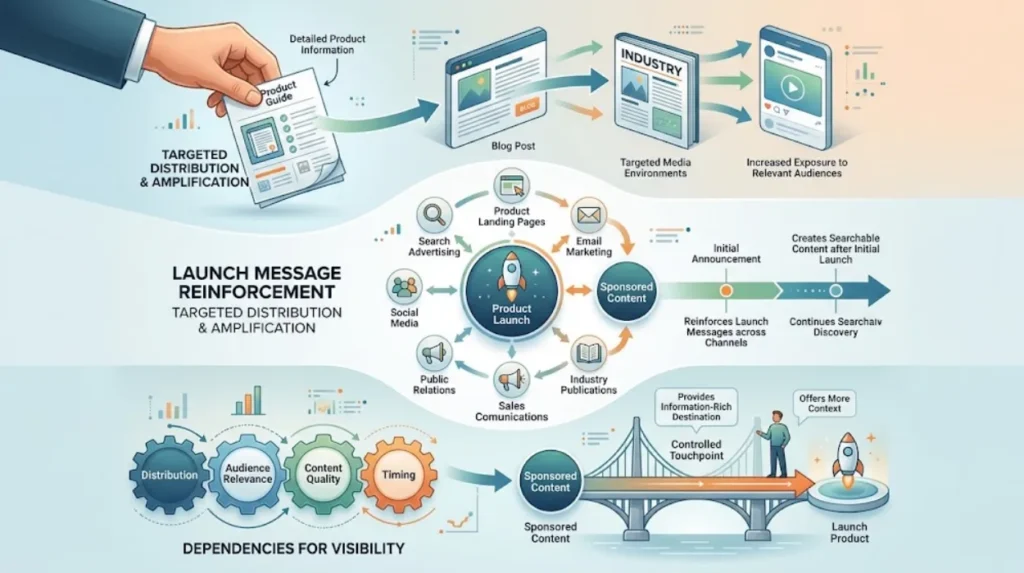
Sponsored content amplifies product launch visibility by placing detailed product information in targeted media environments, increasing exposure among relevant audiences, reinforcing launch messages across channels, and creating searchable content that continues supporting discovery after the initial announcement.
Visibility depends on distribution, audience relevance, content quality and timing. Sponsored content contributes by creating another controlled touchpoint between the product and potential customers.
A launch campaign often uses several communication channels. These include:
- Product landing pages
- Search advertising
- Email marketing
- Social media
- Public relations
- Sponsored content
- Industry publications
- Sales communications
Sponsored content connects with these channels by providing an information-rich destination for audiences seeking more context.
How does publisher relevance affect visibility?
Publisher relevance determines whether the audience matches the product category. A healthcare product requires different media environments from a construction technology product.
For example, a UK construction software launch gains stronger contextual relevance through business, technology or construction-focused media than through an unrelated entertainment publication.
Relevant placement also improves message consistency. The surrounding editorial environment establishes the subject context before the audience reaches the sponsored article.
How does repetition strengthen launch recognition?
Product launches require consistent communication. Sponsored content creates an additional opportunity to repeat the product name, category, key proposition and supporting information.
Repeated exposure across relevant channels helps audiences connect different campaign messages. A product mentioned in an email campaign can also appear in sponsored media content, creating a consistent information trail.
What components make sponsored product launch content effective?
Effective sponsored product launch content combines a clear product definition, audience-specific messaging, evidence, practical applications, credible supporting information, relevant media placement, search-friendly structure and a precise call to action that matches the launch objective.
Each component serves a defined communication function. The content must explain what the product is before presenting its commercial value.
What product information belongs in sponsored content?
Core product information includes:
- Product name and category
- Launch date
- Target audience
- Primary problem addressed
- Key features
- Main applications
- Availability
- Pricing information where relevant
- Supporting evidence
- Next-step information
The sequence matters because audiences need context before evaluating benefits.
Why does evidence strengthen product launch content?
Evidence gives factual support to product claims. Examples include customer results, product testing, certification, research findings, performance data and documented use cases.
For example, a software company can present implementation data from an existing deployment. A consumer technology company can explain verified technical specifications.
Claims require accuracy. Sponsored content must distinguish factual product information from promotional statements.
How does SEO structure support sponsored content?
Search-friendly sponsored content uses clear headings, relevant terminology and logically connected information. Semantic terms help search engines identify the product category and its relationship to relevant topics.
A product launch article for renewable energy technology can naturally include terms such as energy efficiency, renewable technology, carbon reduction, energy management and UK energy transition.
This structure also supports AI systems because clear definitions and direct factual statements make individual information points easier to identify and interpret.
How can sponsored content support different stages of a UK product launch?
Sponsored content supports product launches before, during and after launch by building product awareness, explaining the proposition, answering audience questions, reinforcing market positioning, supporting search discovery and providing persistent information beyond short-lived campaign communications.
The format fits different launch stages because the information requirement changes over time.
What happens before launch?
Pre-launch content focuses on market problems, product categories and emerging needs. It establishes context before the product becomes available.
For example, a financial technology company preparing to launch a business payment platform can publish content explaining payment efficiency, transaction visibility and financial management challenges.
The product itself remains central, but the content gives audiences information needed to understand its relevance.
What happens during launch?
Launch-stage sponsored content provides specific product information. It can introduce the product, explain features, identify target users and provide availability details.
This stage benefits from consistent messaging across the product page, press materials, social media and sponsored publication.
What happens after launch?
Post-launch content supports continued discovery. It can focus on customer applications, industry use cases, product updates and practical implementation.
This creates a longer information lifecycle. The content remains accessible after the initial launch campaign ends.
How does sponsored content support UK B2B product launches?
Sponsored content supports UK B2B product launches by giving professional audiences detailed information about business applications, implementation, operational value, technical capabilities and evidence before they enter longer evaluation or procurement processes.
B2B purchasing involves multiple stakeholders. A product can require evaluation by procurement teams, technical specialists, finance departments and senior management.
Sponsored content provides a single environment for explaining different decision factors.
What information do B2B buyers need?
B2B audiences often require information about:
- Business use cases
- Integration requirements
- Implementation processes
- Compliance considerations
- Technical specifications
- Cost structure
- Performance evidence
- Supplier expertise
- Customer outcomes
The content must address these requirements directly.
For example, a UK cybersecurity platform launch can explain threat detection, deployment requirements, compliance considerations and operational applications. This information supports early-stage evaluation without replacing detailed technical documentation.
How does sponsored content support complex products?
Complex products require more explanation than short advertisements provide. Sponsored content allows the brand to organise information into defined sections.
A business automation platform, for example, can explain workflow automation, system integration, reporting functionality and user roles within one article.
This structure helps different stakeholders identify the information relevant to their responsibilities.
How can brands measure sponsored content performance during a product launch?
Brands can measure sponsored content performance through publication reach, page views, engagement, referral traffic, conversions, assisted interactions, search visibility and audience actions, using campaign tracking to connect content exposure with wider product launch objectives.
Measurement begins with defined objectives. Awareness campaigns require different metrics from lead-generation campaigns.
Which metrics indicate awareness?
Awareness-focused campaigns commonly monitor:
- Impressions
- Unique page views
- Audience reach
- Engagement time
- Content interactions
- Referral traffic
These metrics indicate whether the sponsored article attracts and retains relevant audiences.
Which metrics indicate commercial interest?
Commercial indicators include:
- Product page visits
- Brochure downloads
- Demo requests
- Enquiries
- Registrations
- Purchases
- Qualified leads
Tracking parameters help identify traffic generated by specific sponsored placements.
Why does attribution matter?
Attribution connects media activity with measurable actions. A visitor can first encounter a sponsored article and later return through search or direct traffic.
A complete measurement approach therefore considers assisted interactions rather than relying exclusively on last-click conversions.
When is sponsored content a suitable option for a UK product launch?

Sponsored content is suitable when a product launch requires controlled messaging, detailed explanation, targeted media exposure, sustained discoverability and measurable audience engagement alongside other marketing and public relations activities across the UK market.
It is particularly relevant when the product requires education before evaluation.
Examples include:
- B2B software launches
- Financial technology products
- Healthcare technologies
- Professional services platforms
- Construction technologies
- Energy solutions
- Consumer technology
- Business equipment
The format also fits launches where audience trust depends on detailed information rather than a single promotional statement.
How does sponsored content fit within a wider launch strategy?
Sponsored content works as one component of an integrated campaign. Product pages provide conversion information. Search marketing captures active demand. Social media supports distribution. Public relations communicates news value. Sponsored content provides controlled explanatory space.
This distinction helps prevent channel duplication. Each channel performs a defined role while reinforcing the same product positioning.
For businesses moving from research toward implementation, product launch sponsored content provides a more specific solution category to evaluate when selecting a suitable campaign approach.
What is the main value of sponsored content for UK product launches?
The main value of sponsored content is its ability to combine controlled product messaging, targeted media distribution, detailed explanation and measurable engagement within one launch asset, extending product communication beyond short advertising and announcement formats.
UK product launches operate across fragmented audiences and multiple communication channels. Sponsored content provides structured information that connects product positioning with relevant media audiences.
Its effectiveness depends on accurate information, suitable publisher selection, clear audience targeting, strong content structure, appropriate timing and measurable objectives.
Explore More Expert Insights:
How Energy Sponsored Content Reaches UK Audiences
How Sponsored Case Studies Convert UK B2B Readers
A successful launch therefore treats sponsored content as part of a wider communication system. The content explains the product. The publisher provides audience access. Search structure supports discovery. Measurement connects exposure with audience actions.
This approach gives product launches a defined information asset that continues working across the launch lifecycle.



