

Launching a product in the United Kingdom involves more than announcing its availability. Businesses need to explain what the product does, identify its relevance, establish context, and communicate information through channels used by their target audiences.
Sponsored content is one format used during this process. It combines paid media placement with editorial-style content designed around a defined topic, audience, and publication environment. Product launch sponsored content presents factual information about a new product while using the format and distribution of a media publication.
Understanding how sponsored content supports UK product launches helps marketers distinguish awareness activity from direct advertising, product information from promotional messaging, and audience reach from conversion activity.
What is sponsored content in a product launch?
Sponsored content is paid media content created to communicate information about a product through a publication or media platform, giving businesses a structured way to explain launches, features, applications, and market relevance to defined audiences.
Sponsored content is a form of paid media. A business funds the publication or distribution of an article, feature, interview, case study, or similar content format.
The content is normally identified as sponsored, paid, or promoted according to the publication’s disclosure requirements. This distinction separates sponsored content from independently produced editorial coverage.
For product launches, the content focuses on the product and its market context. It can explain the launch date, product category, target users, key features, applications, and business purpose.
For example, a technology company launching a workplace software platform can publish sponsored content explaining its core functions, intended business users, implementation process, and operational applications.
Why is sponsored content relevant to UK product launches?
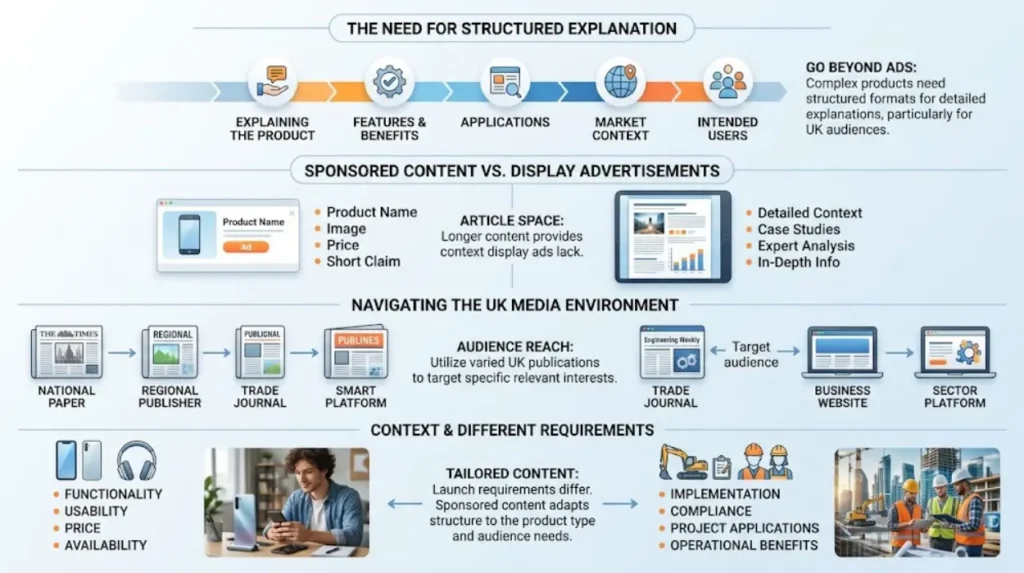
Sponsored content gives product launches a structured communication format for explaining products to UK audiences, particularly when a launch requires more information than a short advertisement provides and depends on clear descriptions of features, applications, market context, and intended users.
Product launches often involve information that requires explanation. A display advertisement can communicate a product name, image, price, or short claim. A longer sponsored article provides space for additional context.
The UK media environment includes national publications, regional publishers, specialist trade publications, business websites, and sector-specific platforms. Each publication serves different audience interests.
Sponsored content can therefore support product communication within a relevant publishing environment.
For example, a new construction technology product has different information requirements from a new consumer electronics product. Construction audiences often require information about implementation, compliance, project applications, and operational benefits. Consumer audiences often focus on functionality, usability, availability, and price.
This contextual difference affects how product launch content is structured.
How does sponsored content support product launch awareness?
Sponsored content supports product launch awareness by placing detailed product information within a media environment where relevant audiences already consume industry, business, technology, consumer, or specialist information related to the product category and its applications.
Awareness means that an audience becomes informed about a product and its existence.
Sponsored content contributes to awareness through repeated exposure to structured information. The article introduces the product, explains its purpose, and establishes its position within a defined market.
Awareness content normally answers basic questions:
- What is the product?
- Who is it designed for?
- What problem does it address?
- What are its main features?
- When is it available?
- Where can customers find more information?
- What distinguishes the product category?
A product launch article that answers these questions gives audiences a clear information base.
How does publication context affect awareness?
Publication context determines the environment in which the product information appears. A business publication reaches a different audience from a technology publication or regional news website.
For example, a cybersecurity product launch placed within a technology-focused publication reaches an audience already interested in software, digital security, infrastructure, and technology developments.
What information does product launch sponsored content usually contain?
Product launch sponsored content usually contains the product introduction, launch details, target audience, key features, applications, market context, supporting evidence, and relevant next-step information presented within the disclosure and editorial requirements of the publishing platform.
The content structure depends on the product and audience. A complete article normally provides enough information for readers to understand the product without relying on a short promotional statement.
Common components include:
Product definition
The opening section identifies the product and its category. It establishes what the product is and what it does.
Launch information
The article provides relevant launch details. These include launch dates, availability, market entry information, and geographic scope.
Product features
Features describe the product’s functions. Examples include software integrations, physical specifications, technical capabilities, materials, processing functions, or service components.
Target audience
The target audience identifies the users or organisations for whom the product is designed.
Applications
Applications explain how the product is used. For example, a business software product can support accounting, procurement, customer management, or project administration.
Supporting evidence
Evidence can include research findings, product data, customer results, technical specifications, certifications, or documented performance information.
These components create a more complete product explanation than a short advertisement.
How does sponsored content differ from traditional product advertising?
Sponsored content differs from traditional advertising because it uses a longer informational format to explain a product, while traditional advertisements generally prioritise concise promotional messages, visual attention, brand recognition, pricing, offers, or direct response actions.
Traditional advertising often uses banners, display advertisements, paid search advertisements, video advertisements, social advertisements, or promotional placements.
Sponsored content uses formats associated with publishing. These include articles, features, interviews, explainers, and case studies.
The distinction relates to content format and communication depth.
An advertisement for a new electric vehicle can show the vehicle, price, financing information, and a short message. A sponsored article can explain battery technology, charging capabilities, intended driving patterns, vehicle specifications, and launch availability.
Both formats are paid media. Their information structures differ.
Sponsored content also requires clear disclosure. Audiences need to understand that the content represents paid communication.
How does sponsored content help explain complex products?
Sponsored content helps explain complex products by providing sufficient space for definitions, technical details, applications, evidence, and market context, allowing audiences to understand products that require more information than a headline, advertisement, or short social media post provides.
Complex products often contain multiple technical or operational components.
Examples include financial technology platforms, medical devices, industrial equipment, enterprise software, renewable energy systems, and construction technologies.
A sponsored article can organise this information into logical sections.
For example, an enterprise software launch can explain its integration capabilities, user roles, implementation requirements, security features, reporting functions, and intended business applications.
This structure supports comprehension because each product component receives a defined explanation.
Why does context matter for technical products?
Technical information becomes more useful when readers understand its application.
A software feature such as automated reporting has limited meaning without information about the reporting process, intended users, data sources, or operational purpose.
Sponsored content provides space for these connections.
How does sponsored content support different UK product launch audiences?
Sponsored content supports different UK launch audiences by adapting product information to publication categories, audience interests, industry terminology, geographic relevance, and information requirements across consumer, business, professional, technical, and specialist market segments.
The UK contains diverse media audiences. A product launch does not address every audience in the same way.
Consumer products require accessible product information. Business products require operational and commercial context. Specialist products require technical detail and sector-specific terminology.
Regional audiences also have different information interests.
For example, a product introduced specifically to businesses in Manchester can be discussed through its relevance to regional business activity. A national product launch requires broader market context.
What role do trade publications play?
Trade publications serve defined professional sectors. Examples include construction, manufacturing, healthcare, finance, technology, retail, logistics, and energy.
Sponsored content in a trade publication can focus on information relevant to professionals within that sector.
This creates stronger topical alignment between the product and the publication’s established subject area.
How can sponsored content contribute to product education?
Sponsored content contributes to product education by explaining product functions, terminology, applications, operating principles, and relevant evidence in a structured format that gives audiences information needed to understand a new product before considering its practical or commercial relevance.
Product education is particularly important when a product introduces a new category, technical process, or unfamiliar solution.
Educational content explains how the product works and where it fits within existing practices.
For example, a company introducing an artificial intelligence platform for supply chain forecasting can explain data inputs, forecasting processes, system outputs, and business applications.
The article does not need to function as a technical manual. Its purpose is to establish sufficient understanding for the intended audience.
This educational function also supports later stages of the buyer journey. Readers who understand the product category can progress toward more detailed research.
For those exploring the next stage of product-launch communication,
Sponsored content amplification provides a relevant continuation.
What role does credibility play in sponsored product launch content?
Credibility in sponsored product launch content depends on transparent sponsorship disclosure, accurate product information, evidence-based claims, clear sourcing, consistent terminology, and alignment between the content topic and the publication’s established audience and subject matter.
Credibility is based on information quality and transparency.
Sponsored content does not represent independent editorial endorsement. The paid relationship needs clear disclosure. Product claims also need factual support.
Useful supporting information includes technical documentation, research, performance data, certifications, customer evidence, regulatory information, and verified specifications.
For example, a manufacturer claiming that a product meets a particular technical standard can provide the relevant certification or standard reference.
Accurate terminology also matters. A product should be described consistently throughout the article.
These practices reduce ambiguity and help audiences distinguish factual product information from unsupported claims.
When is sponsored content useful during a UK product launch?
Sponsored content is useful when a product launch requires detailed audience education, category explanation, technical information, market context, or publication-based exposure that extends beyond the limited information typically communicated through short advertisements and promotional announcements.
Sponsored content can serve several points during a launch campaign.
Before launch
Pre-launch content can introduce a product category, explain an emerging issue, or establish background information.
At launch
Launch content can introduce the product, explain its features, provide availability information, and establish its intended applications.
After launch
Post-launch content can explain use cases, customer experiences, technical developments, product updates, or broader market applications.
The appropriate content depends on the information requirement at each stage.
A product with a simple proposition can use concise content. A technical or unfamiliar product requires more detailed explanation.
How should businesses evaluate sponsored content for product launches?

Businesses can evaluate sponsored product launch content using measurable indicators such as publication reach, exposure to relevant audiences, engagement, referral activity, content consumption, branded search activity, and alignment between the publication’s audience and the product’s target market.
Evaluation begins with clear objectives.
If the objective is awareness, relevant measures include audience exposure and content views. If the objective is education, engagement and content consumption provide additional information.
Referral activity identifies visits generated from the sponsored content. Branded search activity indicates whether audiences are subsequently searching for the product or organisation.
Publication relevance also matters. A smaller specialist audience can provide stronger topical alignment than a larger general audience when the product serves a defined professional market.
Evaluation therefore requires both quantitative and contextual measures.
Explore More Expert Insights:
Why Energy Brands Publish Sponsored Content in 2026
What Sponsored Case Studies Do for UK B2B Brands
What is the overall role of sponsored content in UK product launches?
Sponsored content supports UK product launches by combining paid media distribution with detailed product information, enabling businesses to explain new products, communicate applications, educate relevant audiences, and establish launch information within appropriate publishing environments.
The primary function is communication.
Sponsored content gives product launches a structured format for presenting information that exceeds the limitations of short advertisements. It can explain products, features, applications, evidence, and market relevance.
Its effectiveness depends on accurate information, transparent sponsorship, appropriate publication selection, audience relevance, and clear content structure.
For UK product launches, these factors matter because audiences differ across consumer, business, regional, technical, and trade media environments.
Sponsored content therefore forms one part of a broader product launch communication strategy. Its value comes from the combination of detailed information, defined audiences, publication context, and measurable distribution.



