Launching a product in the UK requires more than announcing its availability. Brands need credible content, relevant audiences, clear product positioning, and measurable media exposure. Product launch sponsored content provides a structured way to present a new product through professionally produced media content.
For businesses evaluating sponsored content as part of a launch strategy, the focus is practical: where the content appears, who sees it, how the campaign supports product visibility, and what measurable outcomes the distribution creates.
This is where Time Intelligence Media Group provides a product launch sponsored content solution designed for businesses targeting UK audiences. The service combines sponsored editorial-style content with media distribution to support product launches across relevant digital channels.
What is product launch sponsored content?
Product launch sponsored content is paid media content created to introduce a new product to a defined audience through a publisher or media platform. It combines product information, audience targeting, editorial structure, and measurable distribution.
Sponsored content differs from a standard product advertisement. It uses an informative content format to explain the product, its features, applications, launch details, and market relevance.
A typical product launch sponsored article contains:
- Product introduction
- Key product features
- Customer or market problem
- Product benefits
- Brand information
- Launch date or availability
- Relevant supporting information
- A controlled call to action
For example, a UK technology company launching an enterprise software platform can use sponsored content to explain its functionality, target business decision-makers, and direct qualified visitors towards the product page.
How does Time Intelligence Media Group support a UK product launch?
Time Intelligence Media Group supports UK product launches by developing sponsored content around the product proposition and distributing that content through relevant media opportunities. The approach connects launch messaging, audience relevance, publication exposure, and measurable digital visibility.
The process begins with the product and its intended market. The content strategy identifies the product category, target audience, launch objective, differentiating features, and relevant search terms.
Time Intelligence Media Group then structures the sponsored content around these factors. The final article presents the product clearly while maintaining a media-focused format.
The distribution stage places the content in appropriate media environments. This gives the launch message an established publishing context rather than relying only on the company’s own website.
Businesses can also connect their launch campaign with broader educational content. The:
Sponsored content amplification approach explains how sponsored content extends product launch visibility across relevant audiences and media channels.
What does a product launch sponsored content campaign include?
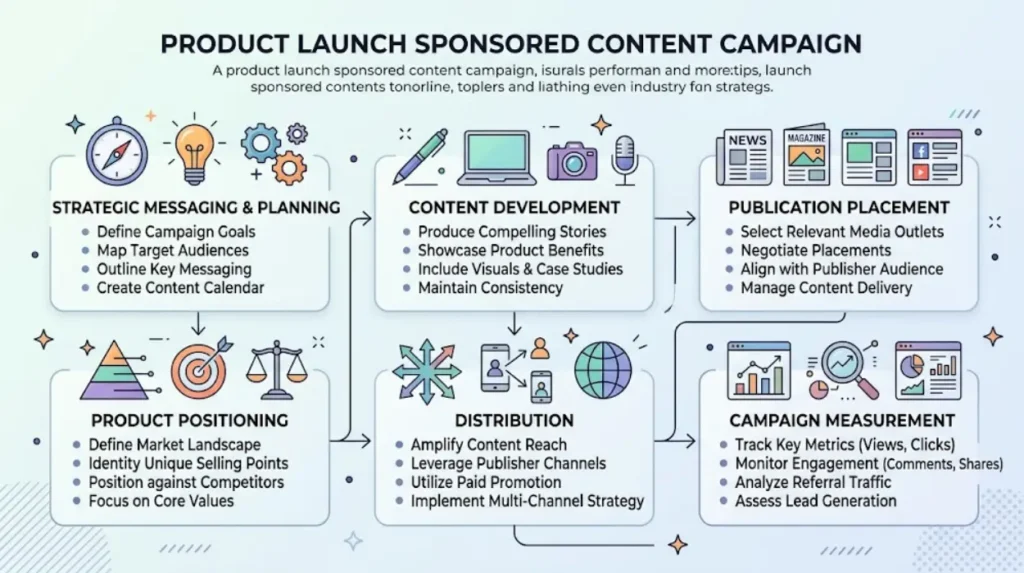
A product launch sponsored content campaign includes strategic messaging, content development, publication placement, product positioning, audience relevance, distribution, and campaign measurement. Each component supports a defined stage of the launch and creates a consistent message across media exposure.
Product positioning
Product positioning defines how the product is presented to its intended market. It identifies the product category, core functionality, primary audience, and commercial value.
For example, a new financial technology platform can focus its sponsored content on payment automation, business efficiency, security, or compliance depending on its target audience.
Sponsored content creation
The content translates product information into a structured article. It avoids presenting the entire piece as a conventional sales page.
The article can explain:
- What the product does
- Who uses it
- Which problem it addresses
- What differentiates it
- Where it is available
- Why the launch is relevant
Media placement
Media placement determines where the sponsored content appears. Relevant publications provide access to audiences aligned with the product category.
A construction technology launch, for example, benefits from content environments focused on construction, property, infrastructure, engineering, or business technology.
Distribution
Distribution extends the campaign beyond the company’s owned channels. It creates additional locations where users can discover information about the new product.
Measurement
Measurement connects media activity with defined campaign objectives. Useful metrics include published placements, referral traffic, engagement, content views, clicks, and conversions where tracking is available.
How does sponsored content improve product launch visibility?
Sponsored content improves product launch visibility by placing structured product information in media environments where relevant audiences already consume business and industry content. This creates additional discovery points beyond websites, social channels, search results, and existing customer databases.
A new product requires discoverability during its launch period. A company website provides an important information source, but it represents only one digital destination.
Sponsored content creates additional content assets around the launch. Each published article provides another opportunity for audiences to encounter the product.
This is particularly relevant for competitive UK markets. Multiple businesses often launch products within the same category. Structured media content gives brands another channel for explaining their product proposition.
Sponsored content also supports branded search visibility. Users searching for the company, product, category, or launch announcement can encounter additional references to the product across the wider digital environment.
Why use sponsored content instead of relying only on product advertising?
Sponsored content provides space for explanation, while conventional advertising focuses primarily on immediate promotion. Product launch campaigns benefit from content that explains functionality, market relevance, use cases, and product value before directing audiences towards commercial action.
Advertising formats often have strict space and attention limitations. Sponsored content provides more room for contextual information.
A product advertisement can communicate a launch date, offer, headline feature, or call to action. Sponsored content can explain how the product works and why it matters to its intended audience.
This distinction is important for complex products.
For example, an industrial technology product requires technical context. A B2B software platform requires information about functionality and business applications. A professional service product requires explanation of its use case and commercial relevance.
Sponsored content provides the format needed for these explanations.
How can brands measure product launch sponsored content?
Brands can measure product launch sponsored content through publication records, referral traffic, engagement data, clicks, conversions, and campaign reporting. Measurement establishes which media activity contributes to product discovery, website visits, audience engagement, and commercial outcomes.
Measurement starts with campaign objectives.
A brand focused on awareness can monitor content exposure and engagement. A brand focused on website traffic can measure referral sessions and clicks. A conversion-focused campaign can connect sponsored content traffic with tracked enquiries, registrations, downloads, or purchases.
Useful measurement categories include:
- Publication metrics: Number and type of media placements.
- Traffic metrics: Visits generated from published content.
- Engagement metrics: User interaction with the content.
- Click metrics: Visits generated through tracked links.
- Conversion metrics: Leads, registrations, purchases, or enquiries.
- Search visibility: Additional branded and product-related content appearing in search results.
UTM parameters provide a practical method for separating sponsored content traffic from other acquisition channels.
Which UK businesses benefit from product launch sponsored content?
UK businesses benefit from product launch sponsored content when they need structured media exposure for a new product, service, technology, or commercial offering. It applies across B2B, B2C, technology, finance, property, healthcare, education, energy, and professional markets.
Technology companies
Technology brands can use sponsored content to explain software functionality, product features, integrations, and business applications.
Fintech businesses
Fintech companies can explain financial products, payment systems, digital platforms, security features, and customer applications through structured content.
Property and construction firms
Property and construction businesses can introduce development technologies, building products, construction platforms, sustainability solutions, and professional services.
Healthcare businesses
Healthcare companies can communicate product information, service developments, digital health solutions, and market applications while maintaining clear informational messaging.
Energy companies
Energy businesses can use sponsored content to explain new technologies, energy solutions, efficiency products, renewable technologies, and commercial applications.
These examples demonstrate how sponsored content adapts to different product categories while maintaining a consistent launch structure.
When should a business use sponsored content for a product launch?
Businesses use sponsored content before, during, and after a product launch when they need additional media exposure around a defined product announcement. Timing depends on launch objectives, content readiness, publication schedules, and the campaign measurement framework.
Pre-launch content can build awareness before commercial availability. Launch-period content can support the main announcement. Post-launch content can extend visibility after the initial launch date.
A structured campaign can therefore include multiple content angles.
For example:
- Pre-launch: Product introduction and market problem
- Launch: Product features and availability
- Post-launch: Customer applications and business use cases
This approach gives the product campaign a longer content lifecycle than a single announcement.
How does Time Intelligence Media Group make sponsored content useful for product launches?
Time Intelligence Media Group makes sponsored content useful for product launches by combining product-focused content with media distribution, helping UK businesses create additional discovery points, explain product value, reach relevant audiences, and support measurable digital campaign objectives.
The service is designed for businesses that need more than content production. The commercial requirement is distribution within a media environment relevant to the launch.
Time Intelligence Media Group focuses on connecting the product story with suitable sponsored content opportunities. This supports brand visibility while giving businesses a structured asset that can be incorporated into wider digital marketing activity.
The campaign can also work alongside search optimisation, public relations, social media, email marketing, and product-page activity.
For businesses comparing approaches, the:
Product launch sponsored content solution provides a direct route from campaign planning to published media content.
What should businesses check before purchasing product launch sponsored content?

Businesses should evaluate publication relevance, audience alignment, content quality, distribution scope, reporting, tracking options, campaign timing, and commercial objectives before purchasing product launch sponsored content for a UK product announcement.
Publication relevance
Check whether the publication audience matches the product’s target market.
Content quality
Confirm that the content communicates product information accurately and clearly.
Distribution scope
Understand how many media placements the campaign includes and which types of publications are targeted.
Reporting
Confirm which campaign metrics are reported after publication.
Tracking
Check whether links and campaign parameters support traffic and conversion measurement.
Timing
Align publication schedules with the product launch calendar.
Business objective
Define whether the campaign focuses on awareness, traffic, engagement, lead generation, or product discovery.
These criteria help businesses compare sponsored content services based on measurable campaign requirements rather than placement volume alone.
Is product launch sponsored content suitable for a UK launch strategy?
Product launch sponsored content is suitable for UK businesses that need additional media visibility, detailed product explanation, relevant audience access, and measurable digital exposure alongside owned marketing and public relations activity during a structured product launch campaign.
A product launch requires coordinated communication across multiple channels. Sponsored content adds a media-based content layer to that strategy.
It gives businesses a controlled environment for explaining the product while creating additional opportunities for audience discovery. It also provides a reusable content asset for marketing teams, sales teams, social campaigns, email activity, and internal communications.
The strongest use cases involve products that require explanation, differentiation, or industry-specific context.
For businesses ready to evaluate a managed solution, Time Intelligence Media Group provides Product Launch Sponsored Content for brands seeking structured UK media exposure around new product announcements.
Explore More Expert Insights:
Energy Sponsored Content by Time Intelligence Media Group
Sponsored Case Studies by Time Intelligence Media Group
The decision process is straightforward: define the product, identify the target audience, establish launch objectives, select suitable media opportunities, produce focused sponsored content, distribute it, and measure the resulting activity.
This makes sponsored content a practical component of a UK product launch strategy where media visibility and clear product communication are commercial priorities.