Sponsored editorial content is paid media content that presents a manufacturing company, product, process, or expertise through an editorial-style format. It provides structured information while clearly identifying the content as sponsored rather than independent journalism.
Sponsored editorial content sits between traditional advertising and editorial publishing. It uses formats associated with professional media, including articles, interviews, expert features, industry explainers and case studies.
For manufacturing firms, the content focuses on technical subjects that require context. Examples include automation systems, industrial machinery, advanced materials, supply chain technology and production efficiency.
The sponsored label distinguishes this format from independent editorial coverage. Transparency remains an important part of responsible publishing.
Manufacturing firms use sponsored editorial content to explain technical subjects in a format that gives readers more information than a conventional display advertisement.
Why do manufacturing firms use sponsored editorial content?
Manufacturing firms use sponsored editorial content to explain complex products, communicate technical expertise, introduce business developments and reach defined professional audiences through structured media content relevant to industrial decision-making.
Manufacturing products often involve detailed specifications, production requirements and operational outcomes. A standard advertisement has limited space for explaining these factors.
Sponsored editorial content creates room for detailed information. A manufacturer can explain how a production system works, which problem it addresses and where it fits within an industrial operation.
What information does manufacturing content communicate?
Common subjects include:
- Product launches and technical specifications
- Factory automation and robotics
- Manufacturing software and digital transformation
- Engineering innovations
- Sustainability initiatives
- Supply chain developments
- Production efficiency
- Industry research
- Executive expertise
- Manufacturing case studies
For example, an industrial equipment manufacturer can publish an article explaining the operating principles, applications and maintenance requirements of a new production system.
This approach gives technical information a defined publishing context.
How does sponsored editorial content work for manufacturing firms?
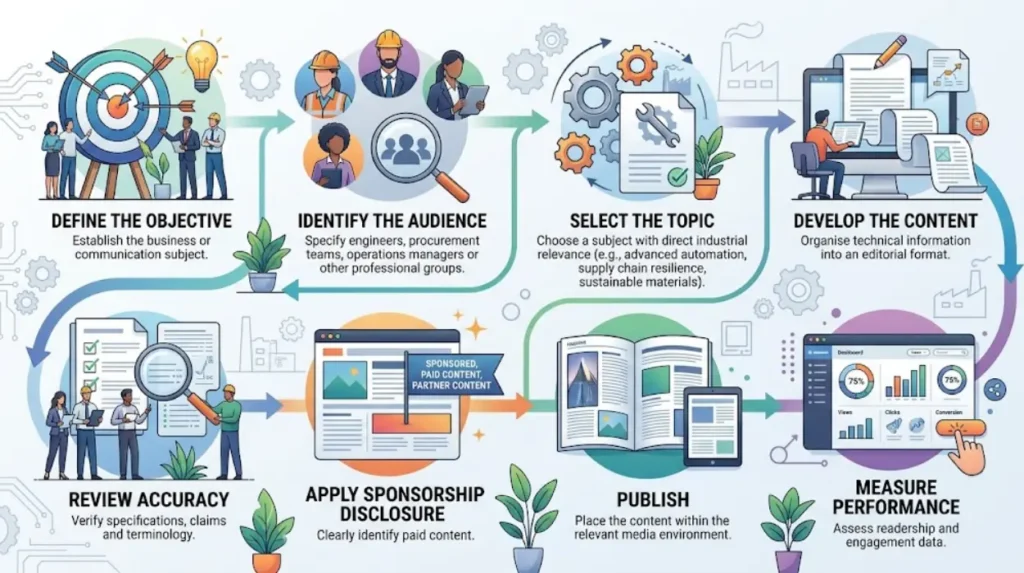
Manufacturing sponsored editorial content follows a structured process covering topic selection, audience definition, content development, compliance labelling, publication and performance assessment across relevant media environments and professional channels.
The process begins with a communication objective. The manufacturer identifies the information it needs to communicate and the audience that needs that information.
The next stage defines the editorial subject. A topic needs direct relevance to manufacturing operations, engineering, procurement, technology or business management.
Content development then converts technical information into an organised article or feature. Technical claims require accuracy and clear terminology.
Publication follows the requirements of the selected media environment. Sponsored material remains identifiable as paid content.
Performance assessment focuses on measurable outcomes such as readership, engagement, referral activity and content visibility.
What are the main stages?
- Define the objective – Establish the business or communication subject.
- Identify the audience – Specify engineers, procurement teams, operations managers or other professional groups.
- Select the topic – Choose a subject with direct industrial relevance.
- Develop the content – Organise technical information into an editorial format.
- Review accuracy – Verify specifications, claims and terminology.
- Apply sponsorship disclosure – Clearly identify paid content.
- Publish – Place the content within the relevant media environment.
- Measure performance – Assess readership and engagement data.
Each stage determines how effectively the content communicates its intended subject.
What types of sponsored editorial content do manufacturing firms use?
Manufacturing firms use several sponsored editorial formats, including expert articles, product features, interviews, case studies, technical explainers and industry perspectives designed around specific manufacturing subjects and professional audiences.
Different formats serve different communication objectives. A technical explainer prioritises education. A case study focuses on an application. An executive interview focuses on expertise and industry perspective.
Which formats are most common?
Expert articles present specialist knowledge around a defined manufacturing topic. An engineering company can discuss predictive maintenance, industrial automation or process optimisation.
Product features provide structured information about a specific product, system or technology. They commonly address functionality, applications and technical characteristics.
Case studies describe an implementation, operational problem and measured result. For example, a manufacturer can document how automation changed production throughput at a specific facility.
Executive interviews present perspectives from manufacturing leaders. Topics include investment, production strategy, workforce development and technological change.
Technical explainers simplify complex industrial concepts without removing essential technical meaning. Examples include industrial IoT, additive manufacturing and digital twins.
The format needs to match the information being communicated.
How do manufacturing firms choose topics for sponsored editorial content?
Manufacturing firms choose sponsored editorial topics by connecting technical expertise with identifiable industry questions, operational challenges, product developments and market subjects that matter to engineers, buyers, managers and other professional audiences.
Topic selection determines the informational value of the content. A subject needs a clear relationship with the audience’s work.
A manufacturer producing industrial sensors can focus on machine monitoring, measurement accuracy or predictive maintenance. A packaging manufacturer can focus on automation, material efficiency or production-line optimisation.
What makes a manufacturing topic relevant?
Relevant topics normally contain at least one defined business or technical context:
- A production challenge
- A technological development
- A regulatory change
- A process improvement
- A product development
- An engineering issue
- A supply chain development
- An industry trend
Specific subjects create stronger informational relevance than broad promotional statements.
For example, “How Predictive Maintenance Reduces Unplanned Production Downtime” provides a defined technical subject. “Why Our Company Leads Manufacturing” provides less informational detail.
How does sponsored editorial content reach professional manufacturing audiences?
Sponsored editorial content reaches professional manufacturing audiences through publications and media environments that attract engineers, procurement professionals, operations managers, executives and specialists across defined industrial sectors and manufacturing disciplines.
Audience relevance depends on publication context. Manufacturing is divided into sectors with different technical requirements and purchasing processes.
Relevant audiences include automotive manufacturers, aerospace companies, pharmaceutical producers, food manufacturers, electronics businesses and industrial engineering organisations.
Which manufacturing audiences engage with this content?
Professional audiences include:
- Engineering managers
- Procurement managers
- Operations directors
- Plant managers
- Production engineers
- Supply chain professionals
- Technical directors
- Manufacturing executives
- Research and development teams
For example, an article about industrial robotics has stronger relevance for automation engineers and production managers than for a general consumer audience.
Audience segmentation therefore influences topic selection, terminology and content format.
Readers interested in evaluating how this content reaches specialist audiences can explore:
Manufacturing sponsored content.
What role does technical accuracy play in manufacturing sponsored content?
Technical accuracy establishes the informational reliability of manufacturing sponsored content by ensuring that product specifications, engineering terminology, performance claims, operational details and industry references remain precise and clearly presented.
Manufacturing content often contains measurable information. Examples include production capacity, operating temperature, material specifications, machine speed and energy consumption.
Incorrect technical information changes the meaning of the content. It can also reduce credibility among specialist readers.
Which technical details require attention?
Technical review commonly covers:
- Product specifications
- Measurements and units
- Engineering terminology
- Performance data
- Production processes
- Safety information
- Compliance references
- Product applications
- Company claims
Manufacturing firms therefore need subject-matter review before publication.
An article about CNC machining, for example, requires accurate terminology for machining processes, tolerances, materials and equipment.
What are the benefits of sponsored editorial content for manufacturing firms?
Sponsored editorial content gives manufacturing firms additional space to communicate technical information, demonstrate subject expertise, explain applications, support product awareness and maintain a structured presence within relevant professional media environments.
The primary benefit is informational depth. Manufacturing companies can provide context that standard advertising formats often do not accommodate.
Sponsored editorial content also supports structured communication around specific business subjects.
How does it support manufacturing communication?
Technical education: Content explains processes, technologies and applications.
Product awareness: Articles introduce products within a broader industrial context.
Expert positioning: Specialist contributors demonstrate knowledge of defined manufacturing subjects.
Corporate communication: Firms explain investments, facilities, innovations and strategic developments.
Audience relevance: Content can focus on the information required by professional readers.
For example, a factory automation provider can publish a technical feature covering robotic integration, production-line data and operational monitoring within one structured article.
When do manufacturing firms use sponsored editorial content?
Manufacturing firms use sponsored editorial content for product launches, technology introductions, corporate developments, industry education, research announcements, facility investments and other communication events requiring detailed professional information.
Timing depends on the communication objective. A product feature can support awareness around a launch. A technical article can remain relevant beyond a specific launch date.
Which manufacturing events create suitable content opportunities?
Common examples include:
- Launching new machinery
- Introducing manufacturing software
- Opening production facilities
- Expanding manufacturing capacity
- Entering new industrial markets
- Introducing automation systems
- Publishing technical research
- Announcing sustainability programmes
- Demonstrating production improvements
- Sharing engineering expertise
The subject remains strongest when the content provides useful information beyond a simple company announcement.
How is sponsored editorial content different from traditional manufacturing advertising?
Sponsored editorial content provides more informational space and an article-based structure, while traditional advertising typically uses concise promotional messages, visual branding, product claims and direct response elements within defined advertising placements.
Traditional advertising prioritises immediate brand or product visibility. Sponsored editorial content prioritises structured information within an editorial-style format.
A machinery advertisement can present a product name, image, specification and contact information. A sponsored article can explain the machinery’s operating process, applications, maintenance requirements and industrial context.
Both formats are paid communication. Their structures and information density differ.
Clear sponsorship disclosure remains essential for sponsored editorial publishing.
How does sponsored editorial content support manufacturing education?
Sponsored editorial content supports manufacturing education by explaining technical concepts, production processes, technologies and operational issues in a structured format that gives professional readers sufficient context to understand specialised industrial subjects.
Manufacturing industries contain complex technologies that require explanation before readers understand their practical relevance.
Content about digital twins, industrial robotics or additive manufacturing can define the technology, explain its operation and describe relevant applications.
This educational function also supports informed professional research. Readers receive organised information before evaluating products, technologies or suppliers.
For example, a technical explainer on predictive maintenance can define the concept, describe sensor-based monitoring and explain how maintenance teams use equipment data.
What should manufacturing firms consider before using sponsored editorial content?
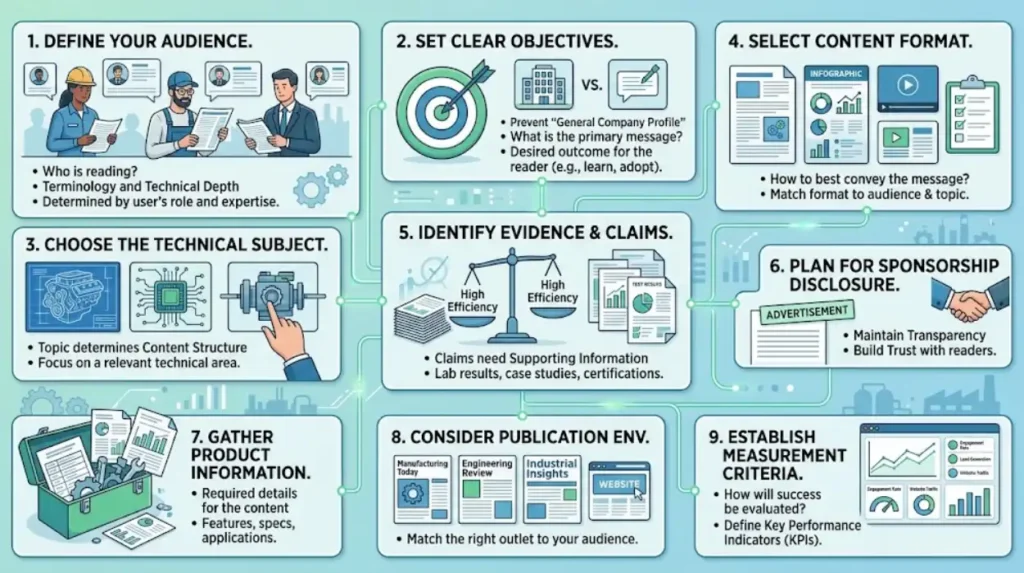
Manufacturing firms need to define their audience, communication objective, technical subject, content format, evidence requirements, sponsorship disclosure and measurement criteria before developing sponsored editorial content for professional media audiences.
A clear objective prevents the article from becoming a general company profile.
The audience determines terminology and technical depth. The topic determines the content structure. Evidence determines which claims require supporting information.
What factors need to be defined?
Manufacturing firms need to establish:
- Target professional audience
- Primary communication objective
- Technical subject
- Content format
- Required product information
- Supporting evidence
- Sponsorship disclosure
- Publication environment
- Measurement criteria
These elements create a clear framework for producing informative sponsored editorial content.
Explore More Expert Insights:
Why Automotive Brands Use Sponsored Content in the UK
How Sponsored Content Compares to PR and Native Ads
What is the overall role of sponsored editorial content in manufacturing?
Sponsored editorial content gives manufacturing firms a structured communication format for explaining technical subjects, presenting expertise, introducing industrial developments and providing professional audiences with detailed information within clearly identified paid media content.
Its value comes from the combination of editorial structure and manufacturing-specific information.
The format supports subjects ranging from automation and engineering to supply chains, materials, production technology and industrial software.
Effective manufacturing sponsored content remains specific, technically accurate and audience-focused. It separates factual explanation from unsupported promotion and identifies its sponsored status clearly.
As manufacturing becomes increasingly connected to automation, digital systems, engineering innovation and complex supply chains, structured technical communication remains an important part of how firms explain their activities and technologies to professional audiences.