

Automotive brands operate in a competitive UK market shaped by changing buyer behaviour, digital research, new vehicle technologies and strong competition across manufacturers, dealers and mobility providers. Buyers research vehicles, compare specifications, assess ownership costs and review brand information before contacting a retailer or requesting a test drive.
Sponsored content provides a structured way for automotive businesses to publish paid editorial-style material through relevant media environments. It combines brand-controlled messaging with the format, audience and distribution characteristics of online publishing.
Understanding why automotive brands use sponsored content requires a clear distinction between sponsored content, traditional advertising, editorial coverage and search marketing. Each format has a different purpose, production process and audience relationship.
What is sponsored content in the automotive industry?
Sponsored content is paid media content that communicates an automotive brand’s message through an article, feature, interview, guide or other publisher-defined format, with commercial sponsorship clearly identified to audiences.
Automotive sponsored content can cover vehicles, technology, ownership, sustainability, industry developments, mobility and consumer education. The content appears within a media environment rather than functioning solely as a conventional display advertisement.
Common formats include:
Automotive feature articles
A feature article examines a defined automotive topic in greater depth. A manufacturer, dealership group or automotive technology company funds the content, while the article follows the agreed publishing format.
Vehicle and technology guides
Guides explain specific subjects such as electric vehicle charging, vehicle safety technology, connected-car systems or new powertrain technologies. These formats suit audiences researching automotive products and concepts.
Expert interviews
Sponsored interviews present information through questions and answers with executives, engineers, designers or industry specialists. The format provides structured space for technical information and organisational perspectives.
Data-led articles
Data-led content uses statistics, surveys, research findings or market information to explain an automotive subject. Examples include electric vehicle adoption, charging behaviour and changing vehicle ownership patterns.
The defining characteristic is commercial sponsorship. Sponsored content is not independent editorial coverage. Its paid status requires appropriate disclosure under UK advertising and media standards.
Why do automotive brands use sponsored content?
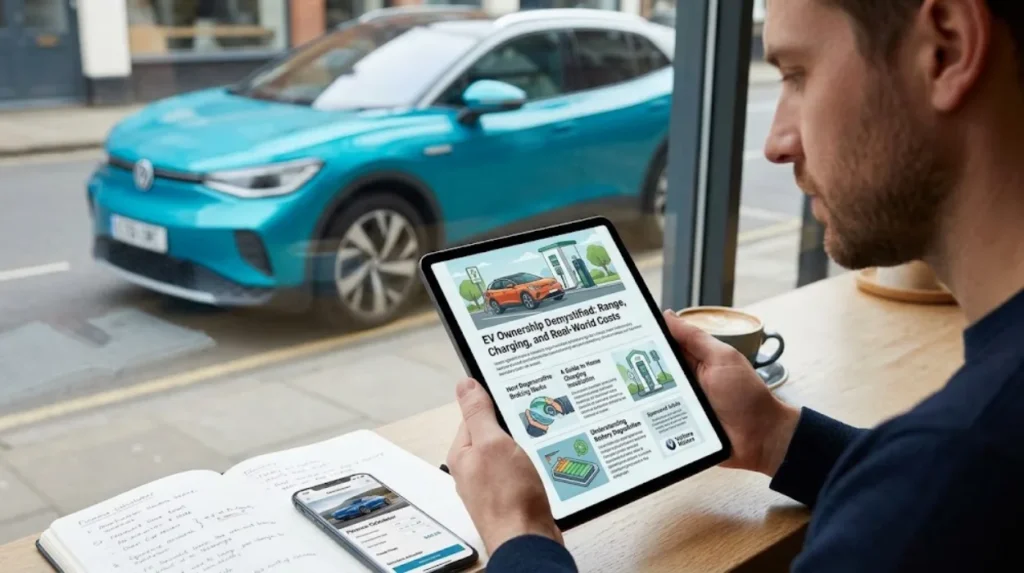
Automotive brands use sponsored content to explain complex products, control key messages, reach defined audiences, support consideration-stage research and place detailed information within relevant media environments across the UK automotive market.
Automotive purchasing involves more information than a short advertisement can communicate. Buyers compare vehicle dimensions, battery range, charging requirements, fuel economy, safety systems, financing structures and ownership considerations.
Sponsored content provides additional space for this information.
It also supports communication around subjects that require explanation. An electric vehicle article, for example, can explain charging infrastructure, battery technology and ownership considerations within one structured piece.
Supporting informed vehicle research
Vehicle research frequently involves multiple information sources. Consumers search for specifications, reviews, technology explanations, running costs and ownership information before making contact with a seller.
Sponsored articles add another information format to this research process.
Communicating technical information
Automotive technology contains specialist terminology. Examples include regenerative braking, advanced driver assistance systems, battery management systems and connected vehicle platforms.
A sponsored article can define these terms and explain their practical relevance without relying on short advertising copy.
Building topic-specific visibility
Automotive brands operate across numerous subject areas. These include electric mobility, commercial vehicles, vehicle safety, automotive finance, fleet management and sustainable transport.
Sponsored content allows each subject to receive dedicated coverage within an appropriate publishing context.
How does automotive sponsored content differ from traditional advertising?
Traditional advertising focuses on promotional messages, while sponsored content provides longer-form information in a publisher-style format, with paid sponsorship disclosed and the commercial relationship clearly identified to the audience.
Display advertising commonly uses banners, video placements, native advertising units or other predefined advertising formats. Its primary function is immediate visibility and message exposure.
Sponsored content uses a longer editorial-style structure. The content can include headings, explanations, statistics, quotations and supporting information.
The distinction is important because the two formats serve different communication requirements.
Advertising focuses on concise messaging
A vehicle advertisement can communicate a model name, price, finance offer, specification or promotional proposition within a limited space.
This format prioritises rapid recognition.
Sponsored content focuses on information
A sponsored article can address a complete subject. It can explain how a vehicle technology works, identify relevant ownership factors and provide supporting context.
This structure suits complex automotive topics.
Disclosure remains essential
Paid content requires clear identification. UK advertising rules distinguish commercial communications from independent editorial material.
Sponsored content therefore needs transparent labelling. Terms such as “Sponsored”, “Paid Content” or another clearly understood disclosure format identify the commercial nature of the material.
What types of automotive topics work well for sponsored content?
Automotive sponsored content works across vehicle technology, electric mobility, safety, ownership, fleet management, sustainability, innovation and consumer education because these subjects require detailed explanations beyond conventional advertising formats.
The strongest topics usually have a defined audience need and sufficient information to support a complete article.
Electric vehicles
Electric vehicle content can address charging, battery range, home charging, public charging networks and ownership requirements.
A detailed article can explain terminology and practical considerations for consumers entering the electric vehicle market.
Automotive safety
Safety technology provides another content category. Articles can explain autonomous emergency braking, lane-departure warning systems, blind-spot monitoring and driver assistance technologies.
These topics require explanation because individual systems have different functions.
Connected vehicles
Connected vehicle technology links vehicles with digital services, mobile applications, navigation systems and cloud-based platforms.
Sponsored content can explain how connectivity changes vehicle functionality and the information available to drivers.
Fleet and business mobility
Commercial audiences require different information. Fleet managers examine total cost of ownership, vehicle utilisation, fuel or charging costs, maintenance requirements and operational efficiency.
Sponsored content can address these subjects in a business-focused format.
Sustainable automotive development
Sustainability content can examine vehicle emissions, manufacturing processes, battery production, recycling and alternative powertrains.
The format supports detailed explanation rather than a single promotional claim.
How does sponsored content support the UK automotive buyer journey?
Sponsored content supports the UK automotive buyer journey by providing detailed information during research, comparison and consideration stages, when buyers evaluate vehicle features, technologies, ownership factors, brands and available solutions before purchase.
The automotive buying journey contains multiple information stages.
At the awareness stage, a consumer identifies a problem or interest. Examples include replacing a petrol vehicle, reducing fleet operating costs or understanding electric vehicle charging.
At the research stage, the consumer seeks detailed information.
At the comparison stage, the consumer evaluates competing models, technologies and ownership options.
At the consideration stage, specific brands and products receive closer attention.
Sponsored content primarily supports the information-heavy stages.
This role is distinct from direct sales messaging. The content provides information that helps users understand a category, technology or product proposition.
Readers examining the next stage of this process can explore:
How automotive sponsored content reaches UK buyers.
What role does media relevance play in automotive sponsored content?
Media relevance determines whether sponsored automotive content reaches an audience connected to vehicles, mobility, business, technology or consumer interests, making publication context an important component of content planning and distribution.
Audience relevance starts with the publication environment.
An article about fleet electrification has a different audience requirement from an article about family SUV ownership. A technology publication, business publication and automotive publication also attract different reader interests.
Automotive media
Automotive publications provide a direct contextual environment for vehicle-related content. Their audiences already engage with automotive subjects.
Business media
Business publications suit topics involving fleets, mobility strategy, commercial vehicles, corporate transport and automotive investment.
Technology media
Technology publications provide relevance for connected cars, autonomous systems, vehicle software, charging technology and automotive innovation.
Consumer media
Consumer publications provide access to broader audiences researching vehicle ownership, maintenance, safety and mobility.
The subject determines the appropriate media context. Audience relevance therefore begins during content planning rather than after publication.
What are the main benefits of automotive sponsored content?
The main benefits include controlled messaging, detailed product education, audience relevance, topic visibility, support for buyer research and structured communication around automotive technologies, ownership issues and industry developments.
Sponsored content creates several distinct communication benefits.
Message control
The sponsoring organisation controls the core information presented in the content. This supports consistent descriptions of technologies, products, services and corporate initiatives.
Greater informational depth
Long-form content provides space for explanations that do not fit into short advertisements.
For example, an article about electric vehicle ownership can address charging, battery range, running costs and practical usage within one content asset.
Audience targeting
Content can be placed in publications aligned with a specific audience. Fleet content can target business readers, while vehicle technology content can target automotive or technology audiences.
Reusable content value
A published sponsored article creates a permanent digital asset within its publishing environment, subject to the publisher’s retention and content policies.
The content can also support wider communications activity when reused through appropriate owned channels.
How should automotive sponsored content be structured?
Effective automotive sponsored content uses a defined topic, clear audience, accurate information, transparent sponsorship disclosure, logical headings and evidence-based explanations that connect the subject with a specific automotive information need.
Structure determines how efficiently readers process the information.
A practical article usually begins with the subject and its relevance. It then explains key concepts before presenting supporting details.
Define the automotive problem
The introduction establishes the subject. For example, an article about electric fleet vehicles can identify fleet electrification as the central topic.
Explain the technology or issue
The next section defines relevant terminology and processes. Technical terms receive clear explanations.
Present supporting evidence
Statistics, research findings, technical specifications and verified data strengthen informational content.
Connect information with practical use
The article explains how the subject affects vehicle owners, drivers, fleet managers or other defined audiences.
Maintain transparent commercial identification
The sponsored nature of the content remains clear. Promotional claims receive appropriate context and substantiation.
Which automotive businesses use sponsored content?
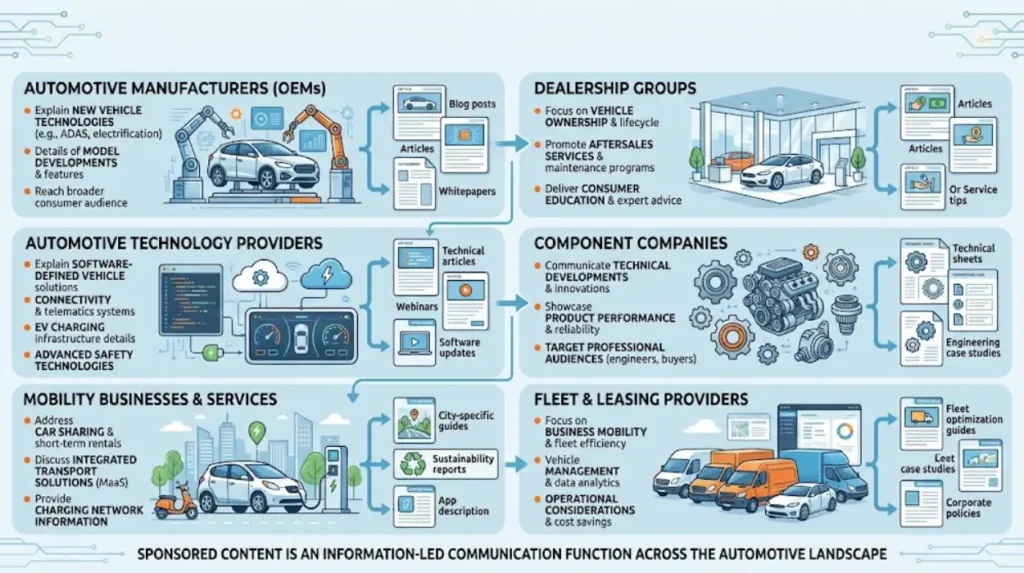
Automotive manufacturers, dealerships, technology providers, component companies, mobility businesses, fleet specialists and automotive service providers use sponsored content to communicate detailed information about products, technologies, services and industry developments.
The format applies across the automotive value chain.
Manufacturers use content to explain new vehicle technologies and model developments.
Dealership groups use it to address vehicle ownership, aftersales services and consumer education.
Automotive technology companies use sponsored articles to explain software, connectivity, charging systems and safety technologies.
Fleet providers focus on business mobility, vehicle management and operational considerations.
Component manufacturers communicate technical developments to professional audiences.
Mobility providers address subjects such as car sharing, charging infrastructure and integrated transport solutions.
The subject changes according to the business model and audience, but the underlying communication function remains information-led.
Explore More Expert Insights:
How Sponsored Content Compares to PR and Native Ads
Why Education Providers Publish UK Sponsored Content
When is sponsored content most useful for an automotive brand?
Sponsored content is most useful when an automotive topic requires detailed explanation, a defined audience needs reliable information, and the communication objective involves education, consideration or contextual visibility rather than short-form promotional exposure.
Several situations create a strong content requirement.
A new automotive technology requires explanation before audiences understand its practical value.
A complex vehicle feature requires supporting information beyond technical specifications.
A changing market condition creates new questions for consumers or businesses.
A fleet decision requires analysis of operational factors.
An emerging mobility solution requires category education.
Sponsored content addresses these situations through structured, publisher-hosted information.
It is one part of a wider automotive communications strategy. Search marketing, editorial coverage, social media, display advertising, video and owned content perform different functions.
The correct format depends on the audience, subject, communication objective and stage of the buyer journey.
Understanding these distinctions provides the foundation for evaluating:
Automotive sponsored content as part of UK automotive marketing and communications planning.



