

Ecommerce brands in the UK compete across search engines, social platforms, marketplaces, publishers, and news websites. Sponsored content connects commercial brands with audiences through paid editorial-style placements. Its effectiveness depends on audience relevance, content quality, publisher selection, distribution, and clear disclosure.
Understanding how ecommerce sponsored content reaches UK shoppers helps brands evaluate distribution options, campaign structures, and expected outcomes. The process involves several connected stages, from defining the target audience to publishing content on relevant media properties.
What Is Ecommerce Sponsored Content?
Ecommerce sponsored content is paid promotional material published through a media platform to reach a defined audience. It combines brand messaging with useful editorial-style information while clearly identifying the commercial relationship to consumers.
Sponsored content includes articles, buying guides, product explainers, sponsored listicles, interviews, and other publisher-hosted formats. The content promotes a product, service, category, or ecommerce brand.
For UK ecommerce businesses, sponsored content provides access to established media audiences. A retailer selling sustainable clothing, for example, can publish an article about responsible fashion trends through a relevant publication.
Sponsored content differs from organic editorial coverage. The advertiser funds the placement or production. The publisher controls the publication environment and applies its commercial content requirements.
Brands also need to understand the broader role of:
Sponsored content within an ecommerce marketing strategy. It sits between advertising, content marketing, public relations, and digital media distribution.
How Does Ecommerce Sponsored Content Reach UK Shoppers?
Ecommerce sponsored content reaches UK shoppers through publishers, news websites, specialist media, regional platforms, search visibility, and audience distribution channels that place commercial content in environments relevant to consumer interests and purchasing behaviour.
The distribution route starts with audience identification. A campaign defines factors such as location, interests, purchasing intent, product category, and demographic characteristics.
The publisher then provides access to an established audience. A fashion ecommerce brand targets fashion publications. A homeware retailer targets interiors and lifestyle media. A technology retailer targets consumer technology publications.
Content placement creates the initial exposure. Search indexing and social sharing create additional discovery opportunities when the publisher supports those channels.
A sponsored article published on a UK lifestyle website can therefore reach shoppers through direct website visits, search results, newsletter audiences, and social distribution.
What Role Do UK Publishers Play?
Publishers provide the environment where sponsored content appears. Their audience profile determines the relevance of the campaign.
A national news publisher provides broad consumer reach. A regional publication provides geographic relevance. A specialist ecommerce or lifestyle publication provides category relevance.
Publisher selection directly affects audience quality. A campaign targeting London fashion shoppers requires a different media mix from a campaign promoting gardening products to homeowners across Yorkshire.
What Happens Before Sponsored Content Is Published?
Before publication, ecommerce brands define campaign objectives, target audiences, content topics, publisher requirements, disclosure standards, distribution channels, and performance measures to create a controlled path from brand message to relevant UK consumer exposure.
The planning stage establishes the campaign framework.
First, the brand defines the commercial objective. Common objectives include product awareness, category education, website traffic, brand authority, and campaign visibility.
Second, the audience is defined. UK ecommerce campaigns often use geographic targeting such as London, Manchester, Birmingham, Leeds, Glasgow, or nationwide UK audiences.
Third, the content topic is selected. The topic needs a direct relationship with the promoted product or category.
For example, a home furniture retailer can create content about choosing furniture for small UK flats. A skincare ecommerce brand can publish educational content about daily skincare routines.
Fourth, suitable publishers are identified. Audience relevance, publication standards, domain authority, content format, geographic coverage, and distribution capabilities form part of the evaluation.
This planning process separates strategic sponsored content from simple paid placement.
Which Content Formats Reach Ecommerce Shoppers?
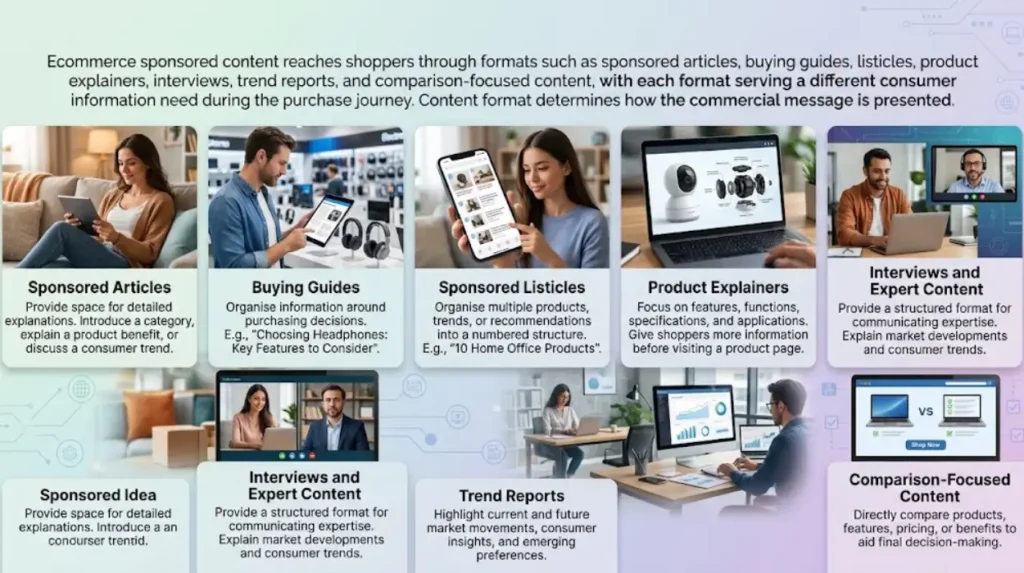
Ecommerce sponsored content reaches shoppers through formats such as sponsored articles, buying guides, listicles, product explainers, interviews, trend reports, and comparison-focused content, with each format serving a different consumer information need during the purchase journey.
Content format determines how the commercial message is presented.
Sponsored Articles
Sponsored articles provide space for detailed explanations. They work well for brands that need to introduce a category, explain a product benefit, or discuss a consumer trend.
Buying Guides
Buying guides organise information around purchasing decisions. A consumer electronics retailer can publish a guide explaining key features to consider when choosing headphones.
Sponsored Listicles
Listicles organise multiple products, trends, or recommendations into a numbered structure. For example, a home retailer can publish “10 Home Office Products for UK Remote Workers”.
Product Explainers
Product explainers focus on features, functions, specifications, and applications. They give shoppers more information before visiting a product page.
Interviews and Expert Content
Interviews provide a structured format for communicating expertise. An ecommerce founder, product specialist, or industry expert can explain market developments and consumer trends.
How Does Publisher Distribution Expand Reach?
Publisher distribution expands sponsored content reach by placing ecommerce campaigns within established media environments where consumers already access news, information, lifestyle content, business updates, and specialist topics relevant to their interests.
A single publisher placement creates one primary distribution point. A broader campaign uses multiple relevant media properties.
For example, an ecommerce brand targeting UK home improvement shoppers can combine national lifestyle media with regional publications and specialist home-interest websites.
This creates different exposure points for the same campaign message.
Distribution also affects audience context. A consumer reading a technology publication has a different information need from a consumer reading a regional news website.
The campaign therefore requires a publisher mix that matches the product category.
Multi-publication distribution also increases the number of indexed content assets associated with the campaign. Each published page creates a separate media reference to the brand.
How Does Search Visibility Help Sponsored Content Reach Shoppers?
Search visibility helps sponsored content reach shoppers after publication by allowing relevant pages to appear for consumer queries, branded searches, product categories, and informational topics when publishers permit indexing and search discovery.
Search engines provide an additional discovery route beyond the publisher’s existing audience.
A sponsored article targeting UK shoppers can address a specific search topic. For example, an article about choosing sustainable trainers can target informational interest around sustainable footwear.
The page then becomes part of the publisher’s searchable content environment.
Search visibility depends on factors such as relevance, page quality, indexing, search demand, internal linking, technical accessibility, and the publisher’s authority.
Sponsored content does not automatically guarantee search rankings. Publication and search visibility are separate outcomes.
Brands also need to distinguish between traffic from publisher audiences and traffic from search engines. Both channels provide measurable exposure, but they represent different acquisition paths.
What Makes Sponsored Content Relevant to UK Shoppers?
Sponsored content becomes relevant when its topic, language, product context, publisher audience, and geographic focus match the information needs of UK consumers at a specific stage of their purchasing journey.
UK relevance starts with the audience.
British English improves contextual alignment. Local references also strengthen relevance. Examples include UK pricing, British consumer terminology, local shopping habits, delivery expectations, seasonal events, and regional market conditions.
Product context also matters.
A UK fashion retailer discussing autumn clothing needs content aligned with British seasonal behaviour. A garden retailer needs content linked to UK gardening conditions and consumer interests.
The publisher audience remains equally important. Content about British property trends belongs in relevant property or lifestyle media rather than unrelated publications.
Relevance therefore depends on the relationship between the product, topic, audience, and publisher.
How Can Ecommerce Brands Measure Sponsored Content Performance?
Ecommerce brands measure sponsored content through publication reach, referral traffic, engagement, search visibility, branded searches, conversions, assisted conversions, and campaign-specific tracking that connects media exposure with measurable business activity.
Measurement starts with clear campaign objectives.
If the objective is awareness, brands track publication reach, impressions, page views, and engagement.
If the objective is traffic, referral sessions and landing-page behaviour provide stronger indicators.
If the objective is sales, ecommerce brands use tracked URLs, campaign parameters, conversion tracking, and attribution models.
Useful performance metrics include:
- Published placements
- Estimated audience reach
- Page views
- Referral traffic
- Engagement time
- Click-through rate
- Branded search activity
- Assisted conversions
- Direct conversions
- Cost per acquisition
Measurement needs consistent tracking across every placement.
A campaign distributed across 15 publications requires a reporting structure that identifies individual URLs, publishers, referral sources, and conversion activity.
When Is Ecommerce Sponsored Content Most Useful?
Ecommerce sponsored content is most useful when brands need targeted consumer awareness, category education, product visibility, publisher exposure, or additional distribution beyond owned channels such as ecommerce websites, email databases, and social media profiles.
Sponsored content fits several stages of the ecommerce customer journey.
Product Launches
New products require awareness and explanation. Sponsored content introduces the product to audiences outside the brand’s existing customer base.
Seasonal Campaigns
Retail events such as Christmas shopping, Black Friday, summer sales, and back-to-school campaigns create defined consumer interest periods.
New Market Entry
Brands entering a new UK region or category use relevant publishers to introduce their proposition to a new audience.
Category Education
Complex products require explanation before purchase. Sponsored content gives brands space to explain specifications, applications, and buying considerations.
Brand Positioning
Consistent publication across relevant media environments increases the number of places where consumers encounter the brand.
How Can Brands Evaluate Sponsored Content Options?
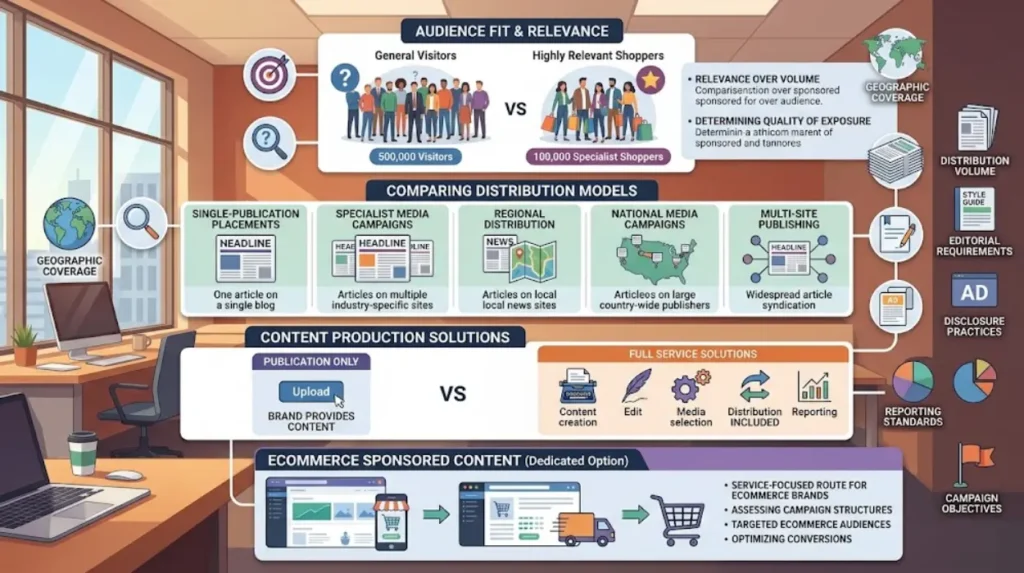
Brands can evaluate sponsored content options by comparing publisher relevance, audience quality, content formats, geographic coverage, distribution volume, editorial requirements, disclosure practices, reporting standards, and campaign objectives before selecting a media approach.
The evaluation process starts with audience fit.
A publisher with 500,000 general visitors is not automatically more valuable than a specialist publication with 100,000 highly relevant shoppers. Relevance determines the quality of exposure.
Brands then compare distribution models. Options include single-publication placements, specialist media campaigns, regional distribution, national media campaigns, and multi-site publishing.
Content production also needs evaluation. Some solutions provide publication only. Others include content creation, editing, media selection, distribution, and reporting.
For ecommerce brands evaluating a dedicated option,
Ecommerce Sponsored Content provides a service-focused route for assessing how sponsored campaigns can be structured and distributed.
What Is the Complete Path From Brand to UK Shopper?
The complete path runs from audience research and campaign planning through content creation, publisher selection, commercial disclosure, publication, distribution, audience exposure, search discovery, website visits, and performance measurement across relevant UK media channels.
The process follows a defined sequence:
- Identify the target UK shopper.
- Define the campaign objective.
- Select a relevant content topic.
- Choose the appropriate sponsored format.
- Identify suitable publishers.
- Produce content that meets publisher requirements.
- Apply clear commercial disclosure.
- Publish the content.
- Distribute the published content through available media channels.
- Track traffic, engagement, search visibility, and conversions.
- Compare results against campaign objectives.
- Use performance data to refine future campaigns.
This sequence connects media placement with measurable ecommerce activity.
Explore More Expert Insights:
How Thought Leadership Content Gets Published on 15 Sites
How Sponsored Listicles Get Distributed on UK News
Sponsored content therefore functions as a structured distribution method rather than a standalone article. Its performance depends on the connection between audience, content, publisher, distribution, and measurement.
For UK ecommerce brands, understanding this process provides a clearer basis for comparing sponsored content options and selecting media strategies that match specific commercial objectives.



