Sponsored listicles combine editorial-style list formats with paid brand placement. They present products, services, companies, or solutions within structured numbered or themed content. For UK businesses, this format supports brand visibility, audience engagement, search discovery, and measurable campaign distribution.
A sponsored listicle differs from a standard editorial article because the content is commercially commissioned. It still requires a clear structure, useful information, accurate claims, and appropriate sponsorship labelling. The format works across sectors including technology, finance, property, healthcare, retail, education, and professional services.
For brands evaluating publication options, understanding:
sponsored listicle distribution helps establish how content moves from production to publication and how media placements contribute to wider campaign objectives.
What are Sponsored Listicles by Time Intelligence Media Group?
Sponsored Listicles by Time Intelligence Media Group are paid, structured articles that present a brand, product, service, or solution within a numbered content format and distribute that content through targeted UK media publishing opportunities.
A sponsored listicle normally uses a clear headline and a numbered structure. Examples include:
- 10 UK Fintech Solutions for Growing Businesses
- 7 Property Trends Shaping the UK Market
- 12 Technology Services for Modern SMEs
- 8 Business Strategies for Faster Digital Growth
The format gives each entry a defined position within the article. A brand receives contextual placement rather than appearing as an isolated advertisement.
Time Intelligence Media Group provides sponsored content solutions designed around publication, audience targeting, and distribution requirements. The service focuses on turning approved brand information into structured media content suitable for selected publishing environments.
The commercial nature of the content remains clear. Sponsorship disclosure supports transparency between the advertiser, publisher, and audience.
What makes the format commercially useful?
A listicle gives brands several defined content positions. Each position can explain a product feature, service benefit, business proposition, or use case.
The structure also supports fast scanning. Readers can move between numbered sections without reading the entire article sequentially.
For B2B campaigns, this format creates space for concise explanations. A software company, for example, can occupy one section explaining its platform, target users, functionality, and commercial value.
How does the sponsored listicle publishing process work?
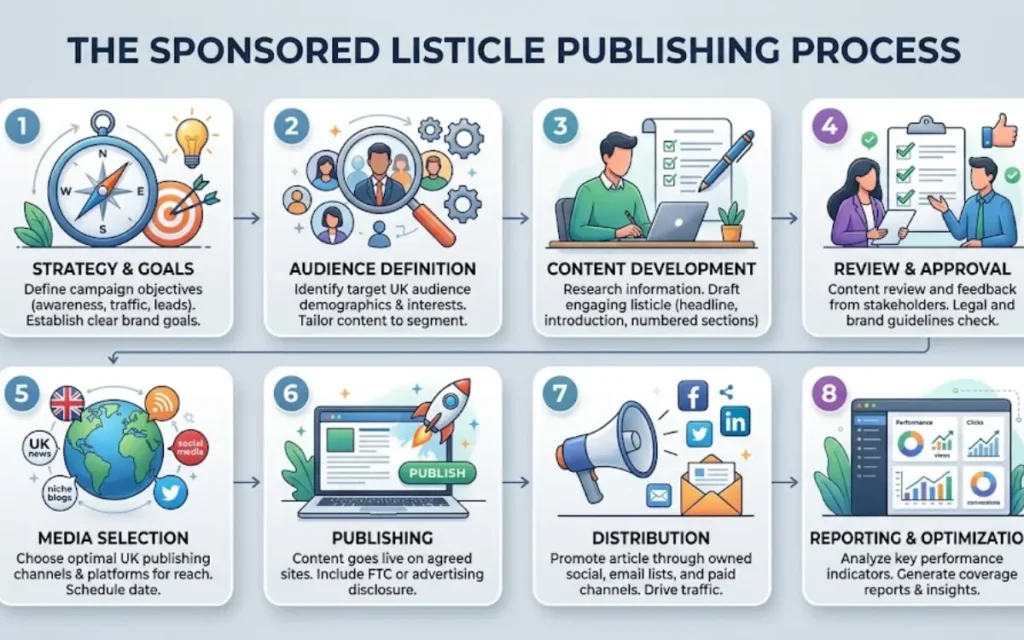
The process starts with campaign objectives, audience definition, and content requirements, followed by listicle development, approval, media selection, publication, distribution, and coverage reporting across agreed UK publishing channels.
The first stage establishes the campaign purpose. Common objectives include brand awareness, product visibility, website traffic, lead generation, search exposure, and authority building.
The next stage defines the target audience. A UK fintech campaign requires different media targeting from a property, healthcare, retail, or education campaign.
Content development then converts supplied information into a listicle structure. The article requires a headline, introduction, numbered sections, supporting information, and a clear conclusion.
After content approval, publication opportunities are selected according to the campaign requirements.
What happens before publication?
Pre-publication preparation normally includes:
- Campaign objective confirmation.
- Audience and sector identification.
- Topic and headline development.
- Brand information collection.
- Listicle drafting.
- Client review and approval.
- Media and publication planning.
- Final content checks.
Accuracy remains important at every stage. Product descriptions, statistics, company claims, service information, and contact details require verification before publication.
How does distribution fit into the process?
Distribution determines where the sponsored listicle appears. UK campaigns can target national, regional, business, trade, or sector-specific publishing environments.
The selection depends on relevance rather than publication volume alone. A campaign targeting UK construction professionals requires relevant construction and business audiences. A consumer technology campaign requires publications with appropriate technology or lifestyle readership.
The distribution stage therefore connects the content asset with defined media audiences.
Brands researching the wider process can also review:
Sponsored Listicles Perform Well to understand how publication and media placement operate together.
What components make a sponsored listicle effective?
An effective sponsored listicle contains a relevant topic, strong headline, logical numbered structure, useful information, accurate brand details, transparent sponsorship disclosure, contextual links, and a clear connection between reader intent and the promoted offering.
The headline establishes the subject and determines the reader’s initial understanding of the article. It needs to describe the list clearly.
The introduction establishes context. It explains the market issue, consumer requirement, business challenge, or trend addressed by the listicle.
Each numbered section then provides a defined information unit. The content needs consistent formatting across all entries.
What should each numbered section contain?
A strong section normally contains:
- The company, product, service, or solution name.
- A concise description.
- Relevant features or capabilities.
- A defined audience or use case.
- A specific commercial benefit.
- Supporting facts where appropriate.
For example, a UK accounting software company can be presented through its target business size, core functions, integration capabilities, and intended business use.
This structure keeps the promotional message connected to useful information.
Why does topic relevance matter?
Topic relevance determines whether the listicle matches the audience’s search and reading intent.
A generic list featuring unrelated businesses creates weak contextual alignment. A focused article such as “10 UK Cybersecurity Services for SMEs” establishes a clear subject area.
The topic also creates semantic relationships between the main entity, related services, industry terminology, and user requirements. This improves content clarity for readers and search systems.
What benefits do Sponsored Listicles provide UK businesses?
Sponsored Listicles provide UK businesses with structured brand exposure, contextual product presentation, targeted media distribution, additional content assets, stronger audience discovery, and measurable publication outcomes within a defined sponsored content campaign.
The primary benefit is structured visibility. Instead of presenting a brand through a standalone promotional message, the listicle places it within a broader topic.
This structure supports comparison-based reader behaviour. Readers searching for solutions often evaluate several providers, features, or approaches before making a decision.
A sponsored listicle can therefore position a business within a defined commercial category.
How can sponsored listicles support brand visibility?
Brand visibility increases when the same business appears within relevant content distributed through appropriate publishing channels.
For example, a UK software provider featured in a technology-focused listicle reaches an audience already interested in technology solutions.
The content also creates a reusable digital asset. Once published, the article provides a reference point for campaigns, sales activity, social promotion, and digital communications.
How can listicles support search visibility?
Search visibility depends on several factors, including topic relevance, publication quality, content structure, indexing, links, and search demand.
A properly structured listicle creates clear relationships between the brand and relevant industry terms.
For example, a property company featured within a listicle about UK property services gains contextual association with terms related to its service category.
This does not mean every sponsored placement produces a specific ranking result. Search performance depends on the wider website, content, authority, technical factors, and search environment.
How does the format support audience engagement?
Listicles are designed for scanning. Numbered headings create visual breaks and allow readers to identify relevant sections quickly.
Each section can answer a specific question about a product or service. This reduces unnecessary repetition and keeps the commercial information organised.
For decision-stage audiences, concise product explanations provide a practical way to understand the offering before visiting the company’s website.
When should UK businesses choose Sponsored Listicles by Time Intelligence Media Group?
UK businesses choose Sponsored Listicles by Time Intelligence Media Group when they need structured sponsored content, targeted media exposure, contextual brand positioning, and a publication format that presents commercial information through an organised UK-focused list.
The service fits campaigns where content placement is part of a broader marketing strategy.
It is particularly relevant when a business has a defined product, service, launch, campaign, market position, or customer segment that requires media visibility.
Which industries can use sponsored listicles?
Sponsored listicles work across multiple UK sectors, including:
- Fintech and financial services.
- Technology and SaaS.
- Property and construction.
- Healthcare and professional services.
- Retail and ecommerce.
- Education and training.
- Business consulting.
- Recruitment and employment services.
- Travel and hospitality.
- Consumer brands.
A fintech business, for example, can feature within a list of financial technology solutions. A training provider can appear within a list of professional development services.
The subject determines the context. The brand then occupies a defined position within that context.
What campaign objectives fit this service?
The service supports several defined objectives:
Brand awareness: Increase exposure through sponsored media content.
Product positioning: Present a product within a relevant market category.
Service discovery: Introduce a service to an audience researching solutions.
Content marketing: Develop a structured article for wider digital promotion.
Lead generation: Direct interested readers towards a relevant commercial destination.
Search visibility: Create additional published content connected with relevant entities and topics.
The campaign objective determines the article angle, publication strategy, content structure, and measurement criteria.
What should businesses evaluate before purchasing?
Businesses need to evaluate five core areas:
- Audience relevance: Does the publication reach the intended UK audience?
- Content quality: Does the article communicate the commercial proposition accurately?
- Distribution: Does the campaign include appropriate publishing channels?
- Transparency: Is the sponsored nature of the content clearly identified?
- Reporting: Does the campaign provide evidence of publication and coverage?
These factors provide a practical purchasing framework.
A publication count alone does not establish campaign quality. Relevance, content accuracy, audience alignment, and reporting also determine the value of sponsored media activity.
How can businesses get started with Sponsored Listicles by Time Intelligence Media Group?
Businesses can start by defining their campaign objective, target UK audience, preferred topic, featured offering, publication requirements, and desired outcomes, then provide the necessary brand information for sponsored listicle development and distribution.
The first decision is the campaign purpose. A business needs to identify whether the priority is awareness, product positioning, audience discovery, traffic, leads, or a combination of defined objectives.

The second decision is the audience. UK national, regional, business, trade, and specialist audiences have different relevance levels.
The third decision is the listicle concept. The topic needs a direct relationship with the product, service, or market category.
What information does a business need to provide?
Useful campaign information includes:
- Company name and description.
- Product or service details.
- Target audience.
- Key differentiators.
- Approved statistics.
- Website destination.
- Campaign objective.
- Preferred topic or industry.
- Required publication timeframe.
- Brand messaging requirements.
Providing accurate information reduces revisions and supports faster content approval.
What outcomes should businesses measure?
Measurement needs to connect publication activity with campaign objectives.
Relevant metrics include publication count, publication URLs, estimated audience information where available, referral traffic, engagement, enquiries, leads, branded search activity, and assisted conversions.
For lead-generation campaigns, website analytics and CRM records provide stronger evidence than page views alone.
For awareness campaigns, publication reach and brand visibility provide important indicators.
Explore More Expert Insights:
Sponsored Video Content by Time Intelligence Media Group
Get Lead-Driven Sponsored Content From Time Intelligence Media Group
For search-focused campaigns, businesses can monitor indexed coverage, referring domains, branded queries, and organic visibility over time. Sponsored listicles work best when publication is treated as one component of an integrated marketing campaign.
For businesses ready to evaluate a UK sponsored content campaign, Sponsored Listicles by Time Intelligence Media Group provides a defined route from content development to media publication and distribution. The approach combines structured listicle content with targeted UK media exposure, giving brands a practical format for presenting products and services to relevant audiences.