Sponsored content across 15 sites means distributing one planned branded article through 15 relevant publications, giving a SaaS company broader visibility, consistent messaging, and multiple opportunities to reach UK business audiences.
Sponsored content is paid editorial-style content created to communicate a brand, product, insight, announcement, or industry perspective. For SaaS companies, the content often focuses on software capabilities, business challenges, digital transformation, automation, cybersecurity, productivity, or customer outcomes.
Publishing across 15 sites changes the distribution model. Instead of relying on one publication, the campaign uses a defined group of websites. Each placement provides another publication environment where the SaaS brand appears.
The 15-site model also requires coordination. The content needs one consistent core message, accurate company information, suitable publication targeting, and controlled distribution.
For example, a UK workflow software company launching an automation platform can publish a sponsored article explaining how businesses reduce manual processes through workflow technology. The same campaign then reaches multiple business, technology, startup, and sector-relevant publications.
Companies exploring the fundamentals first can review:
Sponsored content for UK SaaS companies before planning a multi-site campaign.
Why do SaaS brands use 15-site sponsored content campaigns?
SaaS brands use 15-site campaigns to expand publication reach, reinforce brand messaging, create multiple media touchpoints, and place software-focused content in publications relevant to technology, business, startups, and professional audiences.
SaaS purchasing involves repeated research. Decision-makers review vendors, compare solutions, read industry information, and evaluate business outcomes before selecting software.
A single article creates one media touchpoint. Fifteen placements create a broader publication footprint.
How does multi-site distribution improve visibility?
Each publication introduces the campaign to its own audience and search environment. The result is wider exposure for the same strategic message.
A SaaS brand selling customer relationship management software, for example, can use sponsored content to discuss sales productivity, customer data, automation, and pipeline management. These subjects connect the product with several business needs.
What does consistency add to a campaign?
Consistency keeps the brand message recognisable across placements. Core facts remain stable while headlines, introductions, and publication contexts differ where appropriate.
A consistent campaign includes the same company name, product description, key statistics, positioning, and approved claims.
This structure reduces messaging errors and keeps every placement aligned with the campaign objective.
How do SaaS brands prepare sponsored content for 15 publications?

SaaS brands prepare multi-site sponsored content by defining one campaign objective, identifying the target audience, creating an evidence-based article, approving brand information, and adapting distribution details for each publication.
Preparation begins before publication. The campaign needs a defined purpose.
Common objectives include brand awareness, product education, thought leadership, market positioning, launch communication, and demand generation.
What information belongs in the campaign brief?
A campaign brief normally defines:
- Brand name and company description
- SaaS product or service category
- Primary audience
- Geographic focus
- Campaign objective
- Core topic
- Supporting evidence
- Approved claims
- Preferred publication categories
- Target number of placements
- Linking requirements
- Publication timeline
For a UK cybersecurity SaaS provider, the brief can focus on cyber resilience for SMEs. The article then supports that topic through practical information rather than excessive product promotion.
How is the article structured?
A strong sponsored article normally follows a clear information sequence:
- Identify the business problem.
- Explain why the issue matters.
- Present relevant industry information.
- Discuss practical solutions.
- Introduce the SaaS category.
- Connect the company with the topic.
- Provide factual supporting information.
This structure keeps the article useful while retaining its commercial purpose.
How are 15 publication sites selected for SaaS sponsored content?
Fifteen publication sites are selected according to audience relevance, topical alignment, geographic relevance, publication quality, editorial context, and campaign objectives rather than simply selecting websites based on site count.
The number 15 defines distribution scale. It does not automatically define publication value.
A relevant publication gives the SaaS company stronger contextual alignment than an unrelated website.
What publication categories are relevant to SaaS?
Relevant categories include:
- UK business publications
- Technology publications
- Startup publications
- Entrepreneurial media
- Finance and fintech media
- Professional services publications
- Industry-specific trade publications
For example, a SaaS accounting platform fits naturally within business, finance, SME, and technology publications.
A property management SaaS platform fits property, construction, business, technology, and real estate publications.
Why does audience relevance matter?
Audience relevance connects the article topic with readers who have a legitimate interest in the subject.
A developer-focused SaaS product requires a different publication environment from an HR software platform. Publication selection therefore starts with the target buyer and business problem.
What is the publication process across 15 sites?
The 15-site publication process involves campaign planning, content preparation, publication selection, submission, approval, scheduling, publication, and coverage verification across the selected media network.
The process requires coordination between content production and distribution.
What happens before submission?
The campaign team checks the article for factual accuracy, spelling, grammar, brand terminology, links, statistics, claims, and formatting.
The final article then enters the distribution stage.
What happens during publication?
Each publication receives the approved content according to its publishing requirements. Publication details can differ across websites.
The campaign tracks each placement by publication name, article title, publication date, URL, and status.
What happens after publication?
Published placements are checked individually. The verification process confirms that the article appears correctly and that the agreed content elements are present.
A 15-site campaign therefore requires a coverage record rather than a single publication confirmation.
What content components make a 15-site SaaS campaign effective?
Effective 15-site SaaS sponsored content combines a relevant topic, strong headline, factual information, clear company positioning, useful explanations, consistent branding, appropriate links, and publication-specific formatting requirements.
The article needs to work for both readers and the distribution strategy.
Which topics work for SaaS sponsored content?
SaaS topics often include:
- Business automation
- Artificial intelligence
- Cybersecurity
- Cloud software
- Data management
- Customer experience
- Workforce productivity
- Financial technology
- Digital transformation
- Software integration
For example, a project management SaaS company can publish an article about improving project visibility across distributed teams.
How important are statistics and evidence?
Specific evidence strengthens informational quality. Numbers provide measurable context.
A SaaS company can use customer adoption figures, industry statistics, operational metrics, survey findings, or verified company data where appropriate.
Every statistic needs an identifiable source or clear ownership.
How should brand mentions be handled?
Brand mentions need relevance. The company enters the article where its expertise or solution connects directly with the topic.
Excessive promotional language reduces informational value. A focused article explains the issue first and positions the SaaS company within that subject.
How do SaaS brands measure results from 15 sponsored placements?
SaaS brands measure 15-site campaigns through placement completion, publication quality, audience relevance, referral activity, branded visibility, engagement, search performance, and campaign-specific business metrics tracked after publication.
Measurement starts with the original campaign objective.
A brand awareness campaign uses different indicators from a lead-generation campaign.
Which metrics are useful?
Relevant metrics include:
- Number of confirmed publications
- Publication relevance
- Article URLs
- Referral traffic
- Engagement
- Branded search activity
- Content visibility
- Lead activity
- Assisted conversions
- Coverage quality
The campaign record also confirms whether all 15 intended placements were published.
How does tracking improve future campaigns?
Tracking identifies which publication categories produce the strongest engagement or commercial relevance.
For example, a B2B SaaS company can compare traffic and engagement from technology publications against business publications. The results provide evidence for future media selection.
What is the difference between one-site and 15-site sponsored content?
One-site sponsored content creates a single publication placement, while a 15-site campaign creates a broader media footprint across multiple publications with coordinated messaging, wider audience exposure, and a larger coverage record.
The main difference is distribution scale.
A single placement offers focused exposure. A 15-site campaign provides multiple publication environments.
When does one placement fit a campaign?
One placement fits campaigns with a narrow audience, limited geographic requirements, or a highly specific publication objective.
For example, a specialist SaaS company targeting a small professional community can prioritise one highly relevant trade publication.
When does 15-site distribution fit?
Fifteen-site distribution fits brands seeking broader UK visibility across several relevant publication categories.
It also fits product launches, market positioning campaigns, thought leadership initiatives, and wider brand awareness programmes.
The correct model depends on audience, objective, budget, content, and publication requirements.
How can SaaS brands use 15-site sponsored content for different campaigns?
SaaS brands use 15-site sponsored content for product launches, thought leadership, market education, business announcements, industry commentary, software category awareness, and campaigns designed to establish stronger visibility across UK digital publications.
How does it support product launches?
A product launch campaign explains the market problem, introduces the product category, presents key capabilities, and communicates the launch message across selected publications.
A SaaS analytics platform launching a new reporting feature can focus its campaign on data visibility and faster business decision-making.
How does it support thought leadership?
Thought leadership campaigns focus on expertise rather than product features.
A SaaS executive can discuss AI adoption, cybersecurity standards, workplace technology, data governance, or software procurement. The company becomes associated with a defined subject area.
How does it support market education?
Market education explains a business challenge before presenting the relevant software category.
For example, a CRM provider can publish content explaining the operational impact of fragmented customer data. The article then introduces CRM technology as a structured solution category.
What should SaaS brands evaluate before choosing a 15-site sponsored content solution?
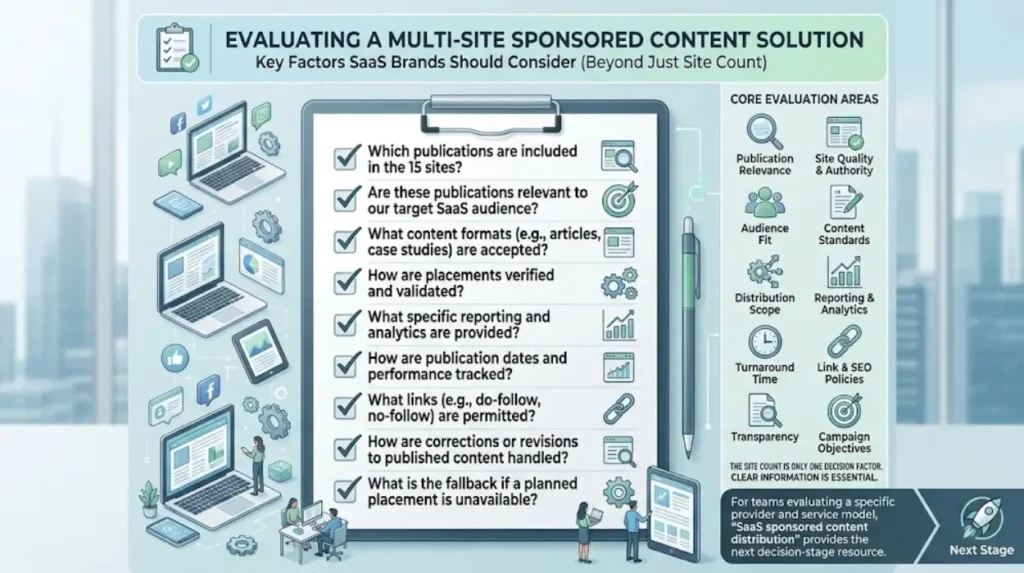
SaaS brands should evaluate publication relevance, site quality, audience fit, content standards, distribution scope, reporting, turnaround time, link policies, transparency, and campaign objectives before selecting a multi-site sponsored content solution.
The site count is only one decision factor.
A provider offering 15 placements needs to define what those placements include. Buyers need clear information about publication names, content requirements, delivery process, reporting, and campaign scope.
What questions belong in the evaluation?
SaaS marketing teams can ask:
- Which publications are included?
- Are the publications relevant to the target audience?
- What content formats are accepted?
- How are placements verified?
- What reporting is provided?
- How are publication dates tracked?
- What links are permitted?
- How are corrections handled?
- What happens if a planned placement is unavailable?
These questions establish the operational details before a campaign begins.
For teams evaluating a specific provider and service model,
SaaS sponsored content distribution provides the next decision-stage resource.
What does a successful 15-site SaaS sponsored content campaign achieve?
A successful 15-site SaaS sponsored content campaign delivers verified publication coverage, consistent brand messaging, relevant audience exposure, useful content, measurable campaign data, and a structured media footprint aligned with the company’s UK marketing objective.
The campaign begins with a defined audience and ends with measurable coverage.
The 15 placements function as a coordinated distribution programme. Each article contributes to the wider campaign while maintaining factual and brand consistency.
Explore More Expert Insights:
How Healthcare Sponsored Articles Get Published on UK News
How Fintech Sponsored Content Reaches UK Business Readers
For SaaS companies operating in competitive UK markets, the strongest campaigns connect content topic, audience, publication relevance, and measurable objectives.
A structured approach also makes future campaigns easier to plan. Marketing teams can compare publication performance, content themes, engagement data, and coverage outcomes.
The result is a repeatable sponsored content process rather than a collection of unrelated media placements.