

Fintech sponsored content gives financial technology brands a controlled way to communicate with UK business audiences through relevant digital publications. It combines paid editorial placement, audience targeting, financial-sector expertise, and structured messaging to place a company’s expertise in front of readers.
For fintech companies, the distribution environment matters as much as the content itself. Business readers include finance directors, founders, investors, technology leaders, compliance professionals, procurement teams, and financial services decision-makers. Each audience group searches for different information.
Understanding how sponsored content reaches these readers helps fintech marketers evaluate publication selection, audience relevance, content quality, placement formats, and measurable outcomes. This is the consideration stage between understanding sponsored content and selecting a suitable distribution approach.
What is fintech sponsored content?
Fintech sponsored content is paid editorial-style content created for a defined business audience and published through a relevant media outlet, giving financial technology companies controlled visibility within credible UK digital publishing environments.

Sponsored content differs from earned media because the brand pays for placement. It also differs from a standard advertisement because the format focuses on useful editorial information rather than a short promotional message.
A fintech sponsored article can explain a financial technology trend, introduce a product category, examine regulatory developments, or present research findings. Examples include an article explaining open banking adoption, a guide to fraud prevention technology, or an analysis of digital payment infrastructure.
The publication provides the audience and publishing environment. The fintech company provides the subject expertise, data, positioning, and commercial message. The resulting article serves both informational and marketing objectives.
What makes sponsored content relevant to fintech?
Fintech operates across several specialised markets. These include payments, banking technology, wealth technology, lending platforms, insurtech, regtech, blockchain infrastructure, cybersecurity, and financial data services.
Each category has distinct terminology and reader expectations. A payments platform needs different editorial context from a regtech provider. Relevant publication placement helps align the subject with an audience already interested in the financial technology sector.
Brands exploring the educational foundations of this approach can review fintech sponsored content to understand why financial technology companies use this format across UK news environments.
How does fintech sponsored content reach UK business readers?
Fintech sponsored content reaches UK business readers through targeted publication selection, audience alignment, relevant subject matter, search visibility, publication distribution, and consistent financial-sector messaging across trusted digital media environments.
The process starts with audience definition. A campaign identifies the people the content needs to reach. A fintech serving banks targets banking professionals. A business payments provider targets finance teams and corporate decision-makers.
The next stage involves publication selection. Publications are assessed according to audience profile, topical relevance, geographical reach, editorial format, and business readership.
Content development follows publication selection. The article uses a clear business problem, relevant evidence, defined terminology, and practical information. This structure supports readers who actively research financial technology solutions.
Publication then creates the initial exposure. Search engines provide an additional discovery route when the article is indexed. Readers also encounter content through publication navigation, related articles, newsletters, or other distribution channels.
What happens after publication?
Publication creates an accessible digital asset. The article remains available through the media outlet and can continue receiving visits from search queries and direct readers.
Performance measurement then tracks relevant indicators. These include page views, referral traffic, engagement, branded search activity, backlinks where available, and conversions attributed to the campaign.
The exact reporting model depends on the publisher and distribution arrangement. A strong measurement framework connects media exposure with defined business objectives.
Which publications reach UK fintech decision-makers?
UK fintech decision-makers are reached through business news websites, financial publications, technology media, trade publications, specialist fintech outlets, and broader corporate news platforms with established professional audiences.
Publication relevance is more important than a simple site-count metric. Ten unrelated websites do not provide the same audience value as a smaller group of publications that consistently attracts financial and business readers.
A fintech campaign can target publications covering banking, financial services, technology, investment, business strategy, entrepreneurship, and regulation. Examples include content environments focused on digital banking, payments, cybersecurity, enterprise technology, or financial markets.
What type of fintech content attracts UK business readers?
UK business readers respond to fintech content that addresses identifiable financial, operational, regulatory, technological, or commercial issues with specific information, relevant evidence, practical explanations, and terminology appropriate to professional decision-makers.
Business readers generally need information that supports research and decision-making. Content therefore performs a stronger role when it answers a defined question rather than presenting a company description.
Useful topics include payment efficiency, fraud prevention, open banking, financial automation, regulatory technology, embedded finance, digital identity, artificial intelligence in finance, and financial data management.
A fintech article also benefits from original evidence. Examples include survey findings, transaction data, customer research, market statistics, implementation results, or expert commentary.
How does content quality affect reader engagement?
Content quality determines whether the placement provides useful value beyond brand exposure. A clear headline establishes the subject. The introduction defines the business issue. Subsequent sections explain causes, processes, implications, and practical considerations.
Strong sponsored content separates facts from promotional claims. Product information appears within relevant context. Technical terms receive clear definitions. Statistics include specific figures and dates.
For example, an article about payment automation can explain reconciliation processes, transaction volumes, settlement workflows, and reporting requirements before introducing a relevant technology solution.
How does search visibility support sponsored content?
Search visibility extends sponsored content beyond its initial publication audience by allowing indexed articles to appear for relevant queries, strengthen topical associations, generate referral opportunities, and support long-term discovery around defined fintech subjects.
Search optimisation starts with subject selection. The article needs a clear primary topic supported by related entities and terminology.
For a digital banking article, relevant terms can include open banking, account-to-account payments, financial APIs, payment infrastructure, customer authentication, and banking technology.
The content structure also supports search understanding. Descriptive headings, concise answers, specific terminology, and logically connected sections help search systems identify the article’s subject.
Does every sponsored article generate SEO value?
Sponsored content does not guarantee rankings, backlinks, or search traffic. Results depend on publication authority, indexing, content relevance, competition, linking policies, technical accessibility, and search demand.
The primary value remains controlled exposure to a relevant audience. Search visibility adds another discovery channel when publication and content conditions support indexing.
This distinction matters when evaluating a campaign. Media placement, audience reach, search discovery, referral traffic, and commercial conversion represent separate performance dimensions.
What are the main benefits of fintech sponsored content?
Fintech sponsored content provides controlled brand exposure, sector-specific audience access, educational positioning, search discovery, referral opportunities, and measurable media assets while allowing companies to control their core message and publication timing.
The first benefit is message control. The company defines the central topic, evidence, terminology, and commercial context within the agreed editorial format.
The second benefit is audience relevance. Financial technology content appears where business readers already consume information about finance, technology, regulation, and corporate markets.
The third benefit is educational positioning. A company can demonstrate knowledge through detailed explanations rather than relying on short promotional claims.
The fourth benefit is measurable distribution. Digital publication provides trackable URLs, referral sources, engagement data, and campaign reporting.
How does sponsored content support the fintech buying journey?
Fintech purchasing involves research before commercial contact. Buyers examine problems, compare approaches, assess suppliers, and evaluate implementation requirements.
Sponsored content supports the research stage by answering questions before direct sales engagement. For example, a regtech company can publish an article explaining automated compliance monitoring before readers encounter its specific solution.
This approach creates a connection between educational search behaviour and commercial consideration. The content remains useful while introducing the category and relevant solution criteria.
When is fintech sponsored content useful for UK brands?
Fintech sponsored content is useful when a UK financial technology brand needs controlled access to business audiences, stronger sector visibility, educational messaging, market positioning, or measurable publication exposure around a specific campaign objective.
Common use cases include product launches, market expansion, research announcements, thought leadership, funding announcements, regulatory education, technology explainers, and category awareness campaigns.
A fintech entering the UK market can use sponsored content to introduce its expertise to British business readers. An established company can use the format to explain a new product category or address an emerging industry issue.
Which campaigns benefit from targeted publication distribution?
Targeted distribution works particularly well when the audience is clearly defined. Examples include:
- A payments platform targeting CFOs and finance directors.
- A regtech provider targeting compliance leaders.
- A cybersecurity fintech targeting banking technology teams.
- A wealthtech platform targeting investment professionals.
- An embedded finance provider targeting digital commerce businesses.
Each campaign requires different publication criteria and editorial subjects.
How can brands evaluate fintech sponsored content options?
Brands can evaluate fintech sponsored content options by comparing publication relevance, audience quality, editorial format, distribution scope, search accessibility, reporting standards, content requirements, turnaround times, and total campaign cost against defined marketing objectives.
A structured evaluation prevents publication volume from becoming the only selection criterion.
The first comparison concerns audience. Does the publication reach the intended UK business readers? The second concerns relevance. Does its editorial environment match the fintech category?
The third concerns distribution. Does the campaign provide one publication, multiple publications, specialist trade outlets, or broader business media exposure?
For companies evaluating a managed distribution option:
Fintech Sponsored Content by Time Intelligence Media Group provides a decision-stage reference for assessing a dedicated UK fintech media service.
What should a fintech campaign brief include?
A campaign brief defines the primary audience, business objective, subject, target publications, key facts, supporting evidence, preferred terminology, publication timeframe, and measurement requirements.
For companies evaluating a managed distribution option, Fintech Sponsored Content provides a decision-stage reference for assessing a dedicated UK fintech media service.
A clear brief also improves editorial consistency. Every publication receives the same factual foundation while the final presentation follows the agreed publishing format.
How does sponsored content fit into a UK fintech media strategy?
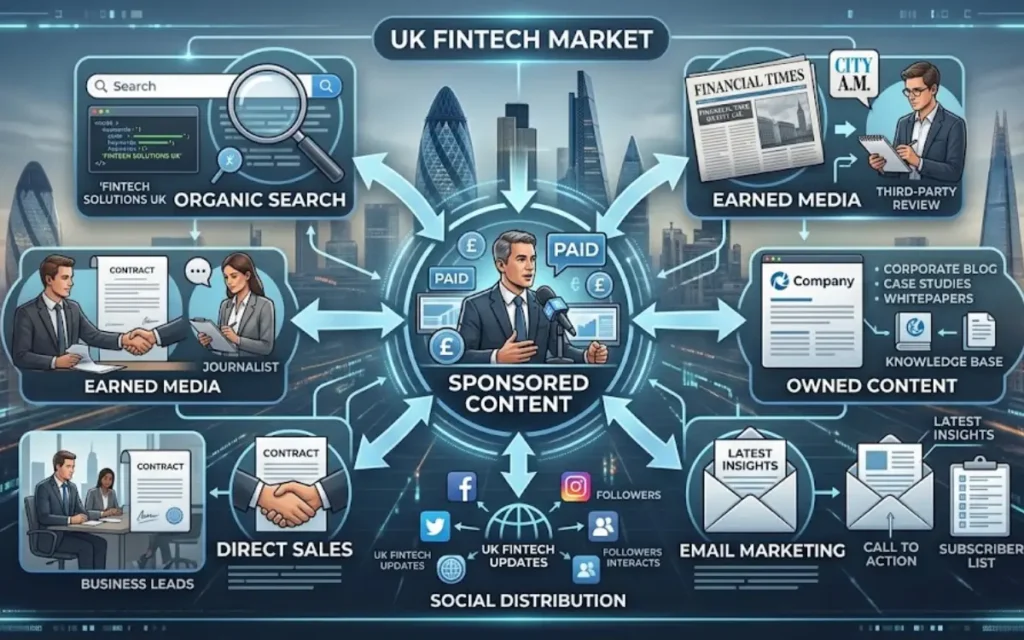
Sponsored content fits into a UK fintech media strategy as a controlled distribution channel that connects educational content with targeted business audiences, complementing organic search, earned media, owned content, social distribution, email marketing, and direct sales activity.
Sponsored content works best as part of a defined media system. Owned content provides the company’s primary knowledge base. Search optimisation supports organic discovery. Earned media provides independent editorial coverage. Sponsored media provides controlled publication access.
The channels serve different functions. Sponsored content provides control over the core message and placement. Earned coverage provides independent editorial validation. Owned content provides a permanent destination for deeper information.
A coordinated strategy therefore uses each channel according to its role rather than treating every publication activity as identical.
What is the practical next step for fintech marketers?
The practical next step is to define the target UK business audience, select relevant publication categories, establish the campaign subject, prepare evidence-led content, and compare distribution options against measurable objectives.
Explore More Expert Insights:
Sponsored Content and GEO: How to Write Articles That Win AI Overview Citations
How to Repurpose a Sponsored Article Into 6 UK Distribution Assets
A structured evaluation gives fintech marketers a clear basis for deciding whether sponsored content fits their media strategy. It also establishes the criteria required to compare publishers, packages, distribution networks, and reporting standards.
The result is a more controlled approach to reaching UK business readers with financial technology content that remains relevant, specific, measurable, and aligned with the intended stage of the buying journey.



