

Winning an award creates a defined news event for a business, founder, professional, charity, or organisation. UK media coverage turns that event into published stories across relevant news websites. A structured distribution process connects the award announcement with journalists, publishers, audiences, search engines, and industry readers.
Understanding:
How award winners get covered across 15 UK news sites requires more than identifying publications. The process involves story preparation, editorial relevance, distribution, timing, publication, and coverage measurement. Each stage affects how consistently an award announcement appears across the UK media landscape.
What does award winner coverage across 15 UK news sites mean?
Award winner coverage across 15 UK news sites means distributing one verified award story to multiple relevant UK publications, creating separate published articles that extend the announcement’s reach, visibility, credibility, search presence, and audience access across national, regional, business, and specialist media channels.
The core entity is the award winner. This refers to an individual, company, organisation, product, project, or team that has received formal recognition from an established awards programme.
The second entity is the UK news site. This refers to a digital publication serving a UK audience. Examples include business publications, regional newspapers, industry publications, and general-interest news websites.
Coverage across 15 sites does not mean publishing identical content without editorial context. Each publication has its own audience, editorial focus, formatting requirements, and publishing process.
The educational stage explains why award stories attract media attention. The next stage focuses on how structured distribution turns one award announcement into multiple UK media placements.
For broader context, readers can first review:
Award coverage to understand how award announcements become media stories before examining the distribution process.
How does an award announcement become a UK news story?
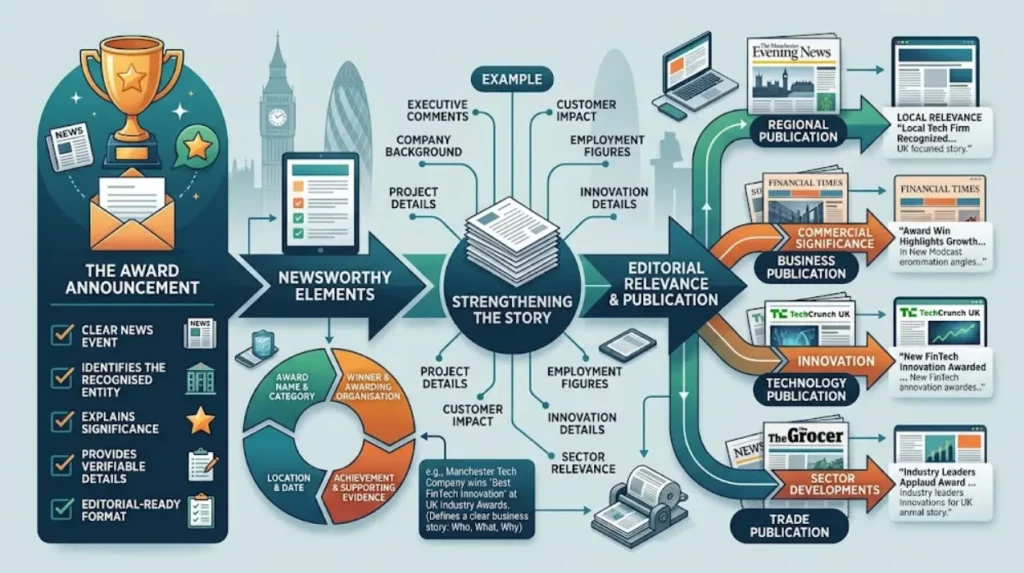
An award announcement becomes a UK news story when it contains a clear news event, identifies the recognised entity, explains the significance of the award, provides verifiable details, and presents information in a format that supports editorial publication across relevant UK media outlets.
What makes an award announcement newsworthy?
A strong award story contains specific information. The award name, category, winner, awarding organisation, location, date, achievement, and supporting evidence establish the basic news structure.
For example, a Manchester technology company winning “Best FinTech Innovation” at a recognised UK industry awards programme creates a defined business story. The announcement identifies who won, what they won, and why the recognition matters.
The strongest stories also provide supporting information. This includes executive comments, company background, project details, customer impact, employment figures, innovation details, or sector relevance.
Why does editorial relevance matter?
Editorial relevance determines whether a publication has a clear reason to publish the announcement.
A regional publication focuses on local relevance. A business publication focuses on commercial significance. A technology publication focuses on innovation. A professional trade publication focuses on sector developments.
The same award can therefore support several media angles without changing the underlying facts.
How is an award story prepared for distribution across 15 UK news sites?
Preparing an award story for 15 UK news sites involves verifying award details, defining the central news angle, writing factual copy, adding supporting information, preparing media assets, checking publication requirements, and creating a distribution package suited to different UK editorial audiences.
The preparation stage establishes the information architecture of the announcement.
What information belongs in the release?
A complete award announcement normally contains:
- Awarding organisation
- Award name
- Winning category
- Winner name
- Award date
- Award location
- Reason for recognition
- Supporting achievement
- Winner quotation
- Organisation background
- Contact information
- Relevant website details
Accuracy is essential because award names, categories, dates, and winner descriptions form the factual foundation of the published story.
How do media assets support the story?
Images provide additional publishing material. A professional winner photograph, awards ceremony image, product image, or project photograph gives publishers usable visual content.
For example, a property company winning a regional development award can provide a ceremony photograph alongside details of the completed development.
Media assets also improve the completeness of the distribution package. They give publications additional material without requiring extensive follow-up.
How does distribution reach 15 UK news sites?
Distribution connects the completed award announcement with a selected network of UK publications through media databases, editorial relationships, syndication systems, targeted outreach, or specialist distribution services that match stories with appropriate publication channels.
Distribution is the operational stage between content preparation and publication.
A distribution strategy first identifies suitable publication categories. These categories include national news, regional news, business media, trade media, technology publications, property publications, healthcare media, and specialist sector websites.
The 15-site target then becomes a defined coverage objective.
How are UK publications selected?
Publication selection depends on relevance, geography, industry, audience, and editorial scope.
For example, a London-based fintech award winner has a different media profile from a Scottish construction company. The first story aligns with financial and technology publications. The second aligns with construction, regional, property, and infrastructure publications.
Relevance creates a stronger connection between the award and the publication’s readership.
What role does geographic targeting play?
Geography provides an additional news angle.
An award winner based in Birmingham has a local business story for West Midlands publications. A winner operating nationally has a broader UK business story. A Scottish organisation has additional relevance for Scottish media.
Geographic targeting therefore expands the distribution strategy beyond a single national audience.
What components determine successful coverage across 15 UK news sites?
Successful coverage depends on five connected components: newsworthiness, publication relevance, accurate content, distribution timing, and editorial suitability. These components determine whether an award announcement reaches appropriate publications and develops measurable visibility across the UK digital media environment.
How does newsworthiness affect coverage?
Newsworthiness gives the story its editorial purpose. Winning an award is the event. The supporting facts explain its significance.
A company receiving its tenth industry award has a different story from a startup receiving its first national recognition. Both contain news value, but the supporting context changes.
How does publication relevance affect results?
Relevance connects the story with the right audience.
A healthcare award winner belongs in healthcare media. A construction award winner belongs in construction and built-environment publications. A technology award winner belongs in technology and business media.
This segmentation creates a more precise distribution structure.
Why does factual accuracy matter?
Award coverage contains identifiable facts. Incorrect award categories, dates, organisation names, or winner descriptions reduce editorial confidence.
A fact-checking process therefore forms part of professional award distribution.
Why does timing matter?
Timing affects news relevance. Award announcements receive their strongest attention close to the recognition event.
For example, publishing an announcement immediately after a ceremony keeps the award connected to the event. A delayed announcement separates the story from the original news moment.
How does coverage across 15 UK news sites support brand visibility?
Coverage across 15 UK news sites expands the number of digital locations where an award winner appears, creating broader brand visibility, additional audience touchpoints, stronger third-party recognition, greater search exposure, and a larger collection of published references surrounding the award achievement.
The visibility benefit comes from distribution across multiple independent publication environments.
A company featured on a business publication, a regional news website, and a specialist trade site reaches different audiences through each channel.
Does multiple publication coverage improve search visibility?
Published coverage creates additional indexed pages containing the organisation name, award name, category, executives, products, services, and related industry terms.
Search engines can therefore encounter the same entity across multiple authoritative contexts.
Coverage also supports branded search. A person searching for a company after seeing its award announcement finds more external references describing the achievement.
How does third-party coverage affect credibility?
Third-party publication provides external confirmation of the award achievement.
A company website states that the organisation won an award. Independent news coverage provides additional evidence that the achievement entered the wider public information environment.
The effect is strongest when the coverage remains factually consistent across publications.
How can businesses compare different award coverage options?
Businesses can compare award coverage options by examining publication relevance, number of targeted sites, geographic reach, industry coverage, editorial quality, publication verification, reporting detail, turnaround time, and the distinction between guaranteed distribution and independently earned editorial coverage.
Different distribution models provide different levels of control.
What is broad distribution?
Broad distribution focuses on reaching a large publication network. It prioritises scale and exposure.
This model suits announcements where the primary objective is increasing the number of publication opportunities.
What is targeted UK distribution?
Targeted distribution focuses on specific publication categories.
A UK fintech company, for example, can prioritise financial, technology, startup, London, and business publications rather than using a general media list.
Targeting creates stronger topical relevance.
What is a managed media coverage service?
A managed service combines story preparation, publication targeting, distribution, monitoring, and reporting.
The buyer evaluates the complete workflow rather than assessing distribution as a standalone activity.
For organisations comparing practical options, UK news coverage provides the next decision-stage context.
How do businesses measure coverage across 15 UK news sites?
Businesses measure award coverage by recording published URLs, publication names, publication dates, audience relevance, geographic distribution, article quality, brand mentions, search visibility, referral activity, and other measurable outcomes associated with the 15-site UK coverage objective.
A coverage report turns published articles into measurable data.
What belongs in a coverage report?
A useful report records:
- Publication name
- Article headline
- Published URL
- Publication date
- Publication category
- Geographic focus
- Award reference
- Brand mention
- Executive mention
- Available audience data
- Search or referral indicators
This information allows businesses to compare coverage quality rather than counting articles alone.
Why does publication quality matter?
Fifteen publications do not provide identical value.
A specialist financial publication reaches a different audience from a small regional website. A national business publication provides a different context from an industry directory.
Coverage measurement therefore requires both quantity and relevance.
Which businesses benefit from coverage across 15 UK news sites?

Businesses, founders, professionals, charities, universities, property firms, technology companies, healthcare organisations, and professional service providers benefit from structured award coverage when recognition provides a genuine news event relevant to UK audiences and identifiable industry or geographic communities.
Which sectors use award announcements?
Award announcements frequently apply to sectors with established recognition programmes.
Examples include:
- Financial technology
- Construction
- Property
- Healthcare
- Technology
- Education
- Professional services
- Hospitality
- Retail
- Manufacturing
Each sector has its own publication ecosystem. A targeted approach connects the award with publications that already cover the relevant field.
Why are regional winners particularly suitable?
Regional awards create two connected stories: the achievement itself and the organisation’s local relevance.
A Leeds-based engineering company winning an infrastructure award has an industry story and a Yorkshire business story. Those two contexts create different publication opportunities.
What is the next step after understanding UK award coverage?
The next step is evaluating the distribution model against the award’s audience, target publications, timing, geographic focus, coverage objective, reporting requirements, and available resources before selecting an approach for securing visibility across 15 UK news sites.
The decision process begins with the award itself.
Identify the winner, category, awarding organisation, ceremony date, supporting achievement, target audience, and geographic relevance. Then define the desired publication mix.
A clear objective prevents publication volume from becoming the only measurement.
Explore More Expert Insights:
How Embargoes Time Event Coverage Across 15 News Sites
How International Event Coverage Reaches UK News Readers
The next consideration is the distribution route. Businesses can compare direct journalist outreach, targeted media relations, syndication, distribution platforms, and managed coverage services.
The final consideration is measurement. A 15-site campaign requires a defined reporting framework that records where the story appeared, when it appeared, which audiences it reached, and how consistently the award details were presented.
Understanding these factors creates a practical foundation for evaluating award coverage across the UK media landscape.



