Glasgow events generate news value through their location, participants, subject matter, timing, and public relevance. UK-wide news coverage extends that local event value across national, regional, business, trade, and specialist media audiences.
Understanding how this process works helps event organisers identify the factors that influence media interest. It also explains why some Glasgow events receive coverage beyond Scotland while others remain concentrated in local publications.
What does UK-wide news coverage mean for a Glasgow event?
UK-wide news coverage means an event receives editorial attention from publications serving audiences across Britain, including national, regional, business, trade, technology, cultural, and specialist news sectors.
A Glasgow event starts with a geographic identity. Glasgow is Scotland’s largest city and an established centre for business, culture, education, sport, technology, and major public events.
UK-wide coverage expands the geographic reach of the event story. The resulting coverage connects the Glasgow event with audiences in London, Manchester, Birmingham, Leeds, Bristol, Edinburgh, Cardiff, Belfast, and other UK locations.
News coverage differs from simple event promotion. Editorial coverage focuses on information that has relevance to a publication’s audience. This includes announcements, developments, notable participants, economic impact, new initiatives, public interest, and sector-specific developments.
For example, a Glasgow fintech conference has local relevance because it takes place in Glasgow. Its wider relevance comes from fintech investment, financial technology developments, business leaders, regulatory discussions, or industry announcements.
Why do Glasgow events attract attention beyond Scotland?
Glasgow events attract wider UK attention when their subject, participants, outcomes, or economic relevance connect with audiences outside the city and Scotland. Geographic location alone does not determine national news value.
An event becomes more relevant to UK publications when its story contains a clear national or sector-wide element.
Several factors influence this relevance.
Nationally relevant subjects
Events involving UK business, technology, healthcare, education, finance, infrastructure, property, energy, or public policy have established national subject relevance.
A Glasgow healthcare conference discussing NHS workforce challenges, for example, addresses an issue affecting organisations throughout the United Kingdom.
Recognisable participants
Speakers, companies, researchers, investors, athletes, public figures, and industry leaders can increase the editorial relevance of an event.
A conference featuring a prominent technology executive has a stronger national news angle when the executive announces a significant investment, partnership, product, or expansion.
Economic significance
Economic activity provides another route to UK-wide coverage.
A new Glasgow development involving substantial investment, employment creation, construction activity, or business expansion has relevance beyond the immediate event location.
Timely developments
Timing also affects news value. An event connected to a major industry development, government announcement, market change, or significant business milestone has a stronger news context.
How does an event story move from Glasgow into UK media?
A Glasgow event reaches wider UK media through a structured news process involving story development, editorial targeting, media distribution, publication decisions, and subsequent coverage across relevant geographic and industry audiences.
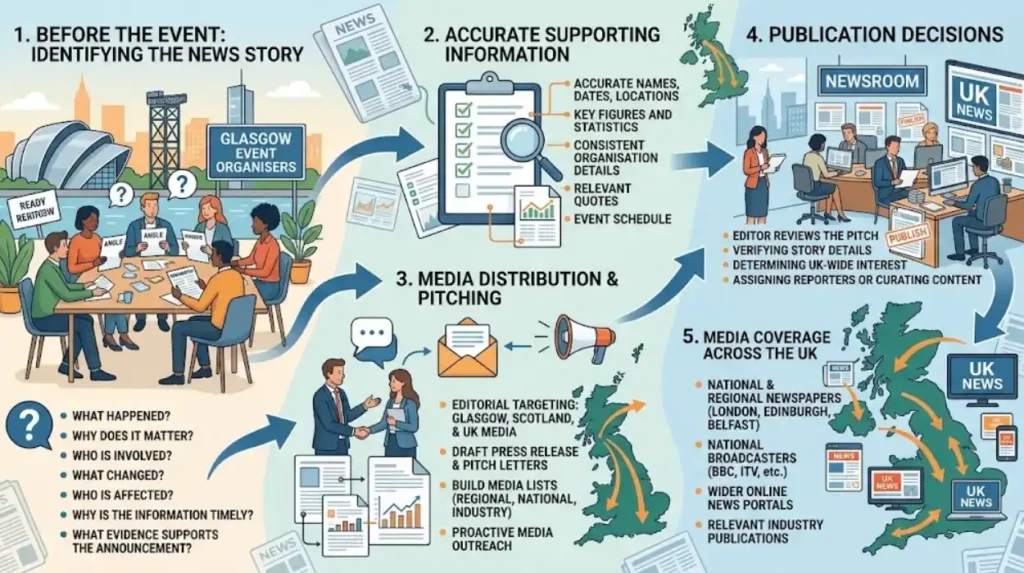
The process begins before the event itself.
Organisers first identify the central news story. This is different from simply describing the event schedule.
A useful news story answers key questions:
- What happened?
- Why does it matter?
- Who is involved?
- What changed?
- Who is affected?
- Why is the information timely?
- What evidence supports the announcement?
The story then requires accurate supporting information. Names, dates, locations, figures, quotes, organisations, and event details need consistency.
Developing the news angle
A Glasgow event can contain several potential angles.
A business conference could focus on investment. A technology exhibition could focus on product launches. A cultural festival could focus on attendance, artistic programmes, or economic contribution. A sporting event could focus on participation, competition, or community impact.
The strongest angle depends on the publication and its audience.
Targeting relevant publications
UK media consists of different editorial categories.
These include national newspapers, regional newspapers, business publications, trade publications, technology media, healthcare publications, finance media, entertainment outlets, and specialist websites.
An event story does not need identical relevance across every category.
For example, a Glasgow property conference has different editorial value for a construction publication than for a technology publication. The story angle changes according to audience interest.
This targeting process is central to:
Glasgow event coverage, because UK-wide reach depends on matching the event story with appropriate media audiences.
What information makes a Glasgow event newsworthy?
Newsworthy event information includes measurable developments, significant participants, new announcements, timely subjects, economic effects, public relevance, and specific outcomes that give journalists a clear reason to report the story.
Event information becomes stronger when it contains verifiable facts.
Specific figures provide measurable context. Examples include attendance numbers, investment amounts, employment figures, participating organisations, exhibition numbers, funding totals, project values, or geographic expansion.
Announcements
Announcements often provide the central news element.
Examples include:
- A company announcing a new Glasgow headquarters
- A conference revealing a major industry partnership
- An event announcing a new investment programme
- A festival reporting significant economic activity
- A technology event introducing a new product
Data
Data gives journalists evidence to support a story.
An organiser stating that an event attracted 5,000 visitors provides more useful information than describing the event as “highly attended.”
Expert commentary
Expert comments provide context around complex subjects.
A specialist speaking about artificial intelligence, renewable energy, financial technology, healthcare, or construction can connect a Glasgow event with broader UK developments.
Outcomes
Events become more newsworthy when they produce a measurable outcome.
Examples include a signed partnership, funding commitment, research announcement, new initiative, recruitment programme, or industry agreement.
Which UK media sectors cover Glasgow events?
UK media coverage includes national, regional, business, trade, specialist, technology, finance, healthcare, cultural, and sector-specific publications, with each category selecting stories according to its audience and editorial priorities.
Different media sectors evaluate event stories differently.
National media
National publications focus on stories with broad UK relevance. A Glasgow event gains national relevance through major announcements, prominent participants, economic developments, public issues, or significant business activity.
Regional media
Scottish and UK regional publications examine local developments more closely.
Glasgow-based publications focus on the city’s businesses, communities, institutions, events, and economic activity. Other regional publications focus on their own geographic audiences.
Business media
Business publications prioritise company activity, investment, leadership, entrepreneurship, employment, markets, and economic developments.
A Glasgow business summit announcing a £10 million investment provides a clear business news angle.
Trade publications
Trade media focuses on defined industries.
Examples include construction, healthcare, finance, technology, property, education, energy, transport, and hospitality publications.
Specialist media
Specialist publications serve narrower audiences. Their editorial decisions often depend on technical relevance rather than geographic proximity.
This allows a Glasgow event to gain coverage from a specialist publication whose audience extends across the UK.
How does event timing affect UK-wide coverage?
Event timing affects coverage because journalists prioritise information connected to current developments, scheduled announcements, market activity, public events, seasonal topics, and wider news cycles occurring when the story becomes available.
Timing influences both relevance and competition.
An event announcement released months before the event can establish early awareness. A major announcement made during the event creates immediate news value. Post-event reporting can focus on outcomes, attendance, agreements, or measurable results.
Before the event
Pre-event coverage focuses on what is going to happen.
Examples include speaker announcements, programme launches, major partnerships, investment commitments, or new initiatives.
During the event
Live developments create immediate reporting opportunities.
A new product announcement, major agreement, leadership statement, or significant development can become the central story.
After the event
Post-event coverage focuses on what happened.
Attendance figures, investment outcomes, partnerships, awards, research findings, and economic impact provide factual material for follow-up stories.
Timing also needs to account for competing news events, parliamentary activity, major sporting fixtures, public holidays, and industry calendars.
What role does the event location play in wider coverage?
Glasgow provides a strong geographic identifier, but location alone does not create UK-wide coverage. The event story requires wider relevance through its subject, participants, data, announcements, economic impact, or connection to national developments.
Location establishes context.
A Glasgow event tells audiences where the activity takes place. Wider editorial relevance tells audiences why the activity matters elsewhere.
For example, a Glasgow construction conference discussing national housing supply has two geographic dimensions. Glasgow provides the event location. UK housing supply provides the broader subject.
This distinction helps explain why two events held in the same city receive different levels of media attention.
A small private networking event has limited external relevance. A Glasgow conference announcing a national industry initiative has broader editorial significance.
What benefits does UK-wide coverage provide for Glasgow events?
UK-wide coverage increases the geographic visibility of an event story, introduces the organisation and its activities to broader audiences, creates editorial references, and establishes a wider record of the event across relevant media sectors.
The primary benefit is expanded information reach.
A local audience learns about the event through Glasgow-focused publications. A UK audience encounters the same development through national, business, trade, or specialist media.
Coverage also creates a searchable record.
Published articles can remain accessible after the event. They provide factual references to the event, its participants, announcements, and outcomes.
Audience expansion
UK-wide coverage exposes an event story to audiences outside Glasgow and Scotland.
Sector visibility
Trade and specialist coverage connects an event with professionals interested in its specific subject.
Search visibility
Published news stories can appear in search results when users look for the event, organisation, speakers, announcements, or related subjects.
Reputation evidence
Independent editorial coverage creates documented evidence that an event generated news interest.
These benefits differ from paid advertising because editorial coverage follows publication-specific news criteria and reporting practices.
Which Glasgow events can achieve UK-wide news relevance?
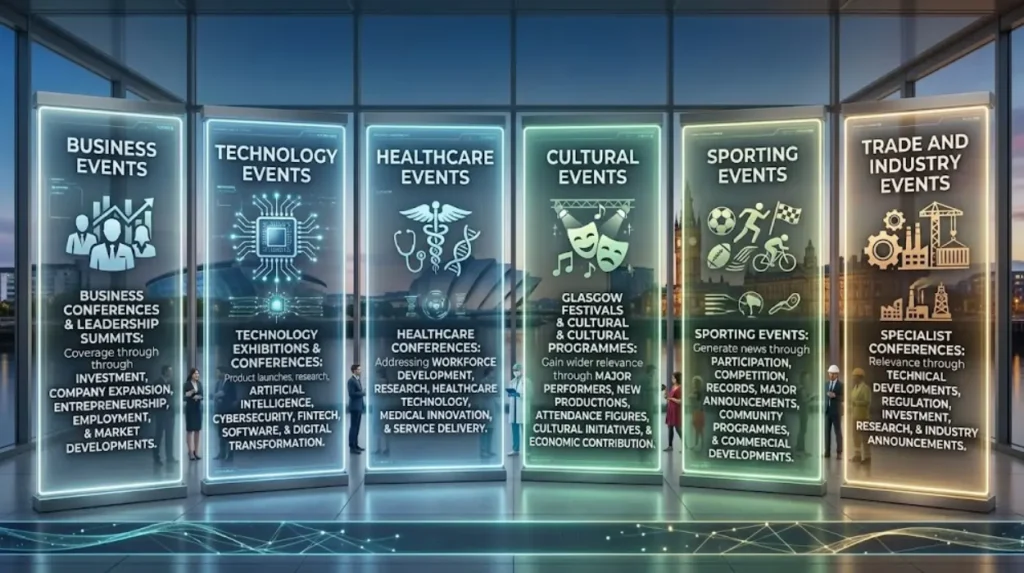
Glasgow conferences, exhibitions, business events, technology events, healthcare conferences, cultural festivals, sporting events, and industry gatherings can achieve UK-wide relevance when their stories contain clear national, sectoral, economic, or public-interest information.
The event category provides the initial context. The story determines the wider relevance.
Business events
Business conferences and leadership summits generate coverage through investment, company expansion, entrepreneurship, employment, and market developments.
Technology events
Technology exhibitions and conferences focus on product launches, research, artificial intelligence, cybersecurity, fintech, software, and digital transformation.
Healthcare events
Healthcare conferences can address workforce development, research, healthcare technology, medical innovation, and service delivery.
Cultural events
Glasgow festivals and cultural programmes gain wider relevance through major performers, new productions, attendance figures, cultural initiatives, and economic contribution.
Sporting events
Sporting events generate news through participation, competition, records, major announcements, community programmes, and commercial developments.
Trade and industry events
Specialist conferences create relevance through technical developments, regulation, investment, research, and industry announcements.
Explore More Expert Insights:
Why Bristol Events Need Multi-Site News Coverage in 2026
How Leeds Events Reach 15 UK News Websites
How can organisers understand the path from local event to UK-wide coverage?
Organisers can understand the path by separating event promotion from news development, identifying measurable story elements, defining the relevant audience, selecting suitable media sectors, and connecting Glasgow activity with wider UK interests.
The process follows a clear sequence:
- Define the event and its purpose.
- Identify the strongest news development.
- Collect specific supporting facts.
- Confirm accurate names, dates, figures, and quotations.
- Identify national, regional, business, and specialist relevance.
- Match the story with appropriate editorial audiences.
- Consider timing and competing news.
- Track published coverage and resulting visibility.
This framework explains how a Glasgow event moves from a local occurrence to a UK-wide news story.
The key distinction is location versus relevance. Glasgow establishes where the event happens. News value establishes why audiences across the United Kingdom need to know about it.
Understanding this distinction provides the foundation for exploring:
Glasgow event coverage and the specific media distribution patterns that determine how one event reaches multiple UK news websites.