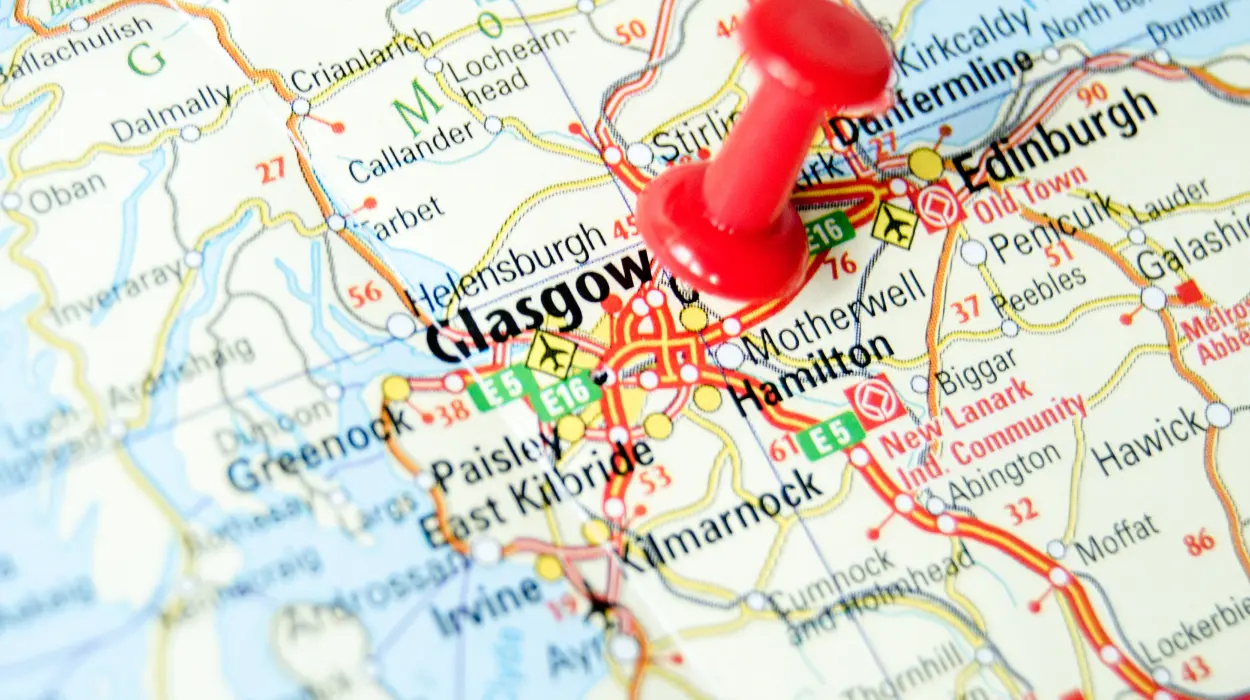
Glasgow event coverage is the process of turning a local event into a newsworthy story for publications beyond Scotland. It combines event relevance, editorial messaging, targeted distribution, media timing, and geographic angles to secure broader UK visibility.
Glasgow event coverage focuses on more than announcing that an event is taking place. Effective coverage presents information that fits the editorial interests of UK publications. The story requires a clear reason for national or regional relevance.
A Glasgow business conference, technology exhibition, charity fundraiser, property event, or cultural festival can contain several news angles. These include economic impact, business growth, industry trends, community participation, expert speakers, attendance figures, and new developments.
The objective is to create a structured news story that works across different publication categories. Regional newspapers focus on local relevance. National business publications focus on economic or industry significance. Trade publications focus on specialist information.
For organisations evaluating media distribution options, understanding:
Glasgow event coverage helps clarify how local event stories move into wider UK media channels.
How does a Glasgow event become suitable for UK-wide coverage?
A Glasgow event is suitable for UK-wide coverage when its announcement includes a clear news angle, measurable information, relevant stakeholders, timely context, and a subject that connects with audiences beyond Glasgow and Scotland.
Identify the strongest news angle
The news angle determines how journalists understand the event. A simple event announcement provides limited editorial information. A specific development gives the story stronger relevance.
For example, a Glasgow technology conference featuring 500 attendees from 20 UK companies provides several measurable facts. The story can focus on technology investment, business participation, employment, innovation, or industry collaboration.
Other strong event angles include:
- A new industry initiative launched at the event
- A major partnership announced during a conference
- A significant investment connected to an event
- A charity campaign involving measurable fundraising
- A business event attracting national industry leaders
- Research findings presented at a specialist conference
- A cultural event generating substantial visitor activity
Each angle changes the publication audience. The story structure needs to match that audience.
Build a UK relevance layer
National relevance requires information that extends beyond the event location. UK-wide statistics, industry data, national trends, expert commentary, and participation from organisations across Britain provide useful context.
A Glasgow fintech event, for example, gains broader relevance when its announcement addresses UK financial technology investment, regulation, employment, or business adoption.
What process helps Glasgow events secure placements across UK publications?
A structured media placement process connects event information with appropriate publication categories, editorial angles, distribution channels, timing, and supporting assets to increase the number of relevant UK publication opportunities.
1. Define the event entity
The first step establishes the event clearly. Important information includes the event name, organiser, location, date, purpose, speakers, audience, partners, and key announcement.
This creates a consistent factual foundation for the media story.
2. Select the news angle
The next step identifies the strongest editorial reason for coverage. One event can contain multiple angles, but the primary release needs a focused central story.
A Glasgow construction conference can focus on infrastructure investment. A healthcare event can focus on new research or healthcare innovation. A business summit can focus on investment, employment, or economic development.
3. Create the media narrative
The media narrative converts event information into a structured news release. It normally includes a headline, summary, key announcement, supporting facts, quotes, background information, and organisational details.
The opening section needs to communicate the main news quickly. Supporting paragraphs then establish relevance and evidence.
4. Segment publication targets
UK media consists of different publication types. Each category serves a distinct audience.
Relevant categories include:
- Scottish regional publications
- UK national publications
- Business publications
- Industry trade media
- Technology publications
- Finance media
- Property publications
- Lifestyle and culture publications
- Local authority and community-focused outlets
A targeted distribution strategy connects the event with publication categories that match its subject.
5. Distribute at the correct time
Timing affects the usefulness of event coverage. Pre-event announcements build awareness. During-event updates provide immediate developments. Post-event stories capture results, attendance, announcements, and outcomes.
A conference taking place on Friday requires a different media timetable from an event announcing a major partnership several weeks in advance.
6. Measure publication results
Coverage measurement identifies where the story appeared and how broadly it travelled. Useful metrics include publication count, publication type, geographic reach, referral traffic, backlinks, indexed coverage, and audience relevance.
This process creates a measurable connection between event communications and media visibility.
Which components influence UK-wide event coverage?
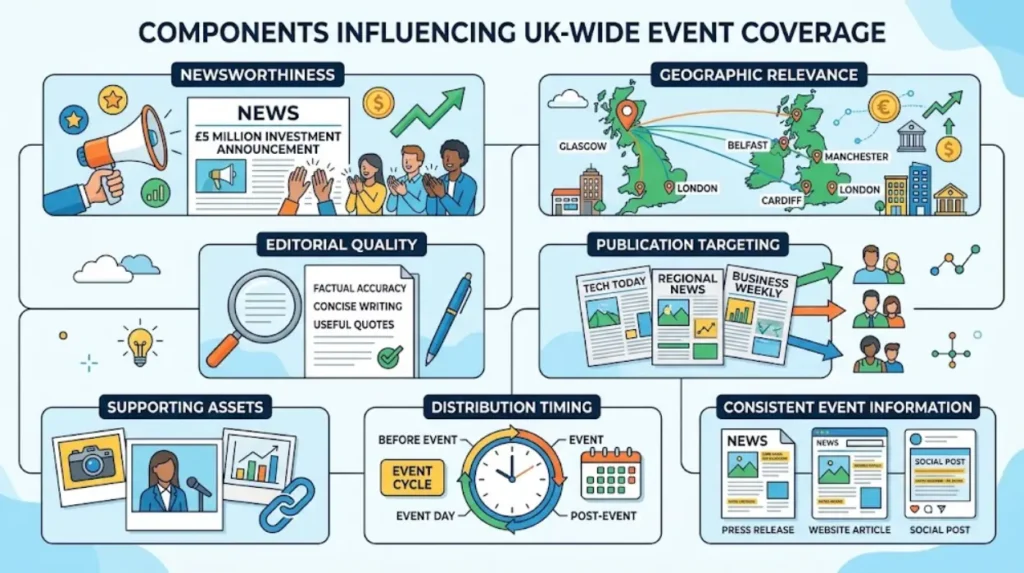
UK-wide event coverage depends on newsworthiness, geographic relevance, editorial quality, publication targeting, supporting evidence, distribution timing, and consistent event information across every version of the media story.
Newsworthiness
Newsworthiness provides the foundation. Publications require a clear reason to publish information.
An event headline such as “Glasgow Business Conference Announced” provides basic information. A headline centred on a £5 million investment announcement, 500 attendees, or a major industry partnership contains stronger news value.
Geographic relevance
Geographic relevance connects Glasgow with wider UK audiences. A local event gains national context through participants, organisations, investment, economic impact, or industry significance extending beyond Scotland.
Editorial quality
Editorial quality includes factual accuracy, concise writing, useful quotes, clear attribution, and relevant supporting information. These elements help publications assess the story efficiently.
Distribution targeting
Distribution targeting determines which media audiences receive the announcement. A technology event requires different publication targets from a charity fundraiser or property conference.
Supporting assets
Images, speaker details, event statistics, research findings, and links to authoritative information strengthen the information package. Visual assets also support digital publication formats.
Timing
Timing determines whether the announcement aligns with the event cycle and current editorial interest. Early announcements, event-day developments, and post-event outcomes serve different communication objectives.
Why does multi-site coverage matter for Glasgow events?
Multi-site coverage gives a Glasgow event exposure across different UK audiences rather than concentrating visibility in one publication category. It also creates multiple digital references to the event, its organisers, announcements, speakers, and associated organisations.
A multi-site strategy distributes coverage across relevant publication environments. The same event can receive attention from regional, national, business, and specialist audiences when the story contains appropriate editorial relevance.
For example, a Glasgow property conference can attract interest from Scottish business media, UK property publications, construction outlets, and broader business news websites.
The benefit is not simply the number of publications. Publication relevance also matters.
Ten closely related websites do not provide the same audience diversity as coverage spanning regional business media, national news platforms, and specialist trade publications.
This distinction is important when comparing media distribution approaches. The number of placements needs to be evaluated alongside publication relevance, geographic spread, topic alignment, and coverage quality.
How can event organisers evaluate different media distribution options?
Event organisers can evaluate media distribution options by comparing publication reach, target categories, geographic coverage, editorial standards, reporting detail, timing, placement volume, and the relevance of each publication to the event audience.
Compare publication reach
Reach describes the audiences accessible through the selected publication network. UK-wide distribution requires coverage beyond Glasgow-based outlets.
Compare publication categories
A strong distribution plan identifies whether placements include national, regional, business, and trade publications. Category diversity demonstrates broader media targeting.
Compare editorial relevance
Placement relevance measures how closely each publication relates to the event topic. A fintech conference requires finance and technology relevance. A construction event requires property, construction, infrastructure, and business relevance.
Compare reporting
A media distribution service needs clear reporting. Useful reports identify publication names, live coverage, URLs, dates, and other measurable placement information.
Compare distribution scale
Distribution scale refers to the number and type of publications targeted. A specific placement target provides a clearer benchmark than an undefined claim of broad reach.
For readers evaluating larger distribution packages,
15 UK news websites provides a practical benchmark for assessing multi-publication event coverage.
Which Glasgow events benefit from UK-wide media placement?
Glasgow conferences, exhibitions, business launches, cultural festivals, charity events, technology events, healthcare conferences, property forums, and corporate gatherings can use UK-wide placement when their stories contain information relevant to audiences beyond Glasgow.
Business and corporate events
Business events generate news angles around investment, partnerships, expansion, employment, leadership, and industry development.
For example, a Glasgow business summit announcing a new UK-wide partnership has relevance across multiple business audiences.
Technology and fintech events
Technology events often contain information about innovation, investment, artificial intelligence, cybersecurity, financial technology, and digital transformation.
These topics connect naturally with specialist UK media.
Healthcare and life sciences events
Healthcare conferences can generate coverage through research announcements, clinical innovation, professional collaboration, health technology, and institutional partnerships.
The story needs factual evidence and clear attribution.
Property and construction events
Property events can focus on developments, investment, infrastructure, regeneration, construction activity, or planning announcements.
A Glasgow development conference involving a £20 million project has a stronger UK business angle than a basic attendance announcement.
Cultural and charity events
Cultural festivals and charity events can use attendance figures, fundraising totals, notable participants, community impact, and national partnerships as news angles.
These details provide measurable reasons for wider coverage.
How does Glasgow event coverage support broader digital visibility?
Glasgow event coverage supports digital visibility by creating multiple indexed references to the event across relevant publications, increasing discoverability for event names, organisers, announcements, speakers, and associated topics in search environments.
Published coverage creates searchable records across multiple websites. These records can contain the event name, organiser, location, announcement, speaker information, and supporting keywords.
The structure of each article also affects discoverability. Clear headlines, factual descriptions, named entities, relevant terminology, and consistent information help search systems interpret the subject.
Backlinks provide another measurable component when publications include links to relevant event or organisation pages. The value depends on the quality and relevance of the referring publication.
Coverage also supports branded search visibility. Repeated references to an event and its organisers create additional digital documents associated with the same entities.
What is the best way to measure the success of Glasgow event coverage?
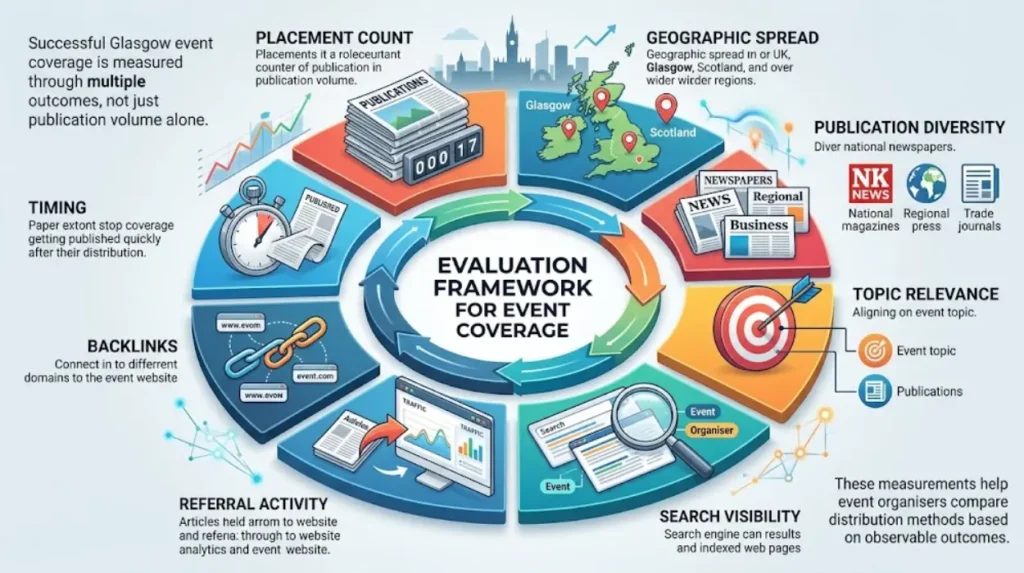
Successful Glasgow event coverage is measured through publication placements, geographic distribution, audience relevance, indexed coverage, referral activity, backlinks, engagement, and the consistency of reporting across the UK media network.
A publication count provides the first measurement. It does not provide the complete picture.
A useful evaluation framework includes:
- Placement count: Number of live publications carrying the story.
- Geographic spread: Coverage across Glasgow, Scotland, and wider UK markets.
- Publication diversity: Presence across national, regional, business, and trade media.
- Topic relevance: Alignment between publications and the event subject.
- Search visibility: Indexed pages associated with the event and organiser.
- Referral activity: Traffic generated from published coverage.
- Backlinks: Relevant links pointing to the event or organisation.
- Timing: Speed between distribution and publication.
These measurements help event organisers compare media distribution methods based on observable outcomes rather than publication volume alone.
How should Glasgow organisers approach UK-wide event coverage?
Glasgow organisers need a defined news angle, accurate event information, targeted UK publication categories, suitable timing, strong supporting evidence, and measurable reporting to turn local event announcements into structured UK-wide media coverage.
The process starts with the event story. The strongest news angle determines the target media categories. Those categories determine distribution priorities. Timing then aligns the announcement with the event cycle.
The result is a media strategy built around relevance rather than geographic location alone.
Explore More Expert Insights:
How Bristol Event Coverage Reaches 15 News Sites Affordably
How Leeds Event Coverage Combines Regional and National News
A Glasgow event remains locally rooted while its story reaches audiences across the United Kingdom. The strongest coverage connects the event’s local identity with a wider business, industry, cultural, economic, or community context.
This approach gives organisers a practical framework for assessing Glasgow event coverage, comparing distribution options, and understanding how a local event secures placements across the wider UK media landscape.