Bristol event news coverage on 15 sites from Times Intelligence provides a structured distribution route for businesses, organisers, venues, and event professionals seeking measurable UK media exposure. The service focuses on placing one event story across multiple news publishing environments with consistent information.
For decision-makers, the value is not simply the number of publications. The relevant factors include editorial presentation, distribution breadth, event relevance, publication consistency, turnaround, reporting, and the ability to use published coverage as an ongoing marketing asset.
The earlier:
Bristol event coverage reaches 15 news sites affordably explains how multi-site distribution works from a cost perspective. This article focuses on the decision stage: what Bristol event news coverage includes, how the process operates, what businesses receive, and when the service fits an event marketing strategy.
What is Bristol event news coverage on 15 sites?
Bristol event news coverage on 15 sites is a managed media distribution service that publishes one approved event story across 15 news websites, creating multiple online coverage points for a Bristol-based event, organisation, or campaign.
The service turns an approved event announcement into a distributed media asset. The story can cover a conference, corporate event, exhibition, launch, networking event, festival, charity event, business gathering, or professional forum.
Times Intelligence manages the distribution process rather than requiring the organiser to approach 15 websites individually.
The central output is a set of published online news placements. Each placement provides a separate URL and publication reference where available.
What does the service cover?
Typical event information includes:
- Event name and purpose
- Bristol location
- Event date and schedule
- Organiser information
- Speakers and participating organisations
- Key announcements
- Registration information
- Relevant quotes
- Images where supported
- Website or event landing page
- Contact information where appropriate
The content remains focused on the event rather than functioning as a conventional advertisement.
How does Times Intelligence distribute Bristol event news across 15 sites?
Times Intelligence uses a structured workflow covering content preparation, editorial review, distribution, publication monitoring, and coverage reporting to move an approved Bristol event story across 15 participating news websites.
The process begins with event information and the required announcement. The content is then prepared for publication using a news-oriented structure.
The next stage involves quality control. Names, dates, locations, links, quotations, and factual claims require accuracy before distribution.
Once approved, the release enters the distribution stage. The objective is consistent presentation across the selected news network.
Publication monitoring follows distribution. Published URLs are collected so the organiser can verify the resulting coverage.
What happens before publication?
The pre-publication stage establishes the factual foundation of the release.
Important checks include:
- Event name verification.
- Date and venue verification.
- Organiser identification.
- Speaker and partner verification.
- Link accuracy.
- Headline and opening paragraph review.
- Spelling and British English checks.
- Compliance with publication requirements.
This process reduces factual inconsistencies across published versions.
What happens after distribution?
Post-distribution work focuses on identifying live coverage. The resulting publication links provide evidence of where the event story appeared.
This creates a usable media record for internal reporting, stakeholder communication, social media activity, event websites, and future marketing campaigns.
What is included in 15-site Bristol event coverage?
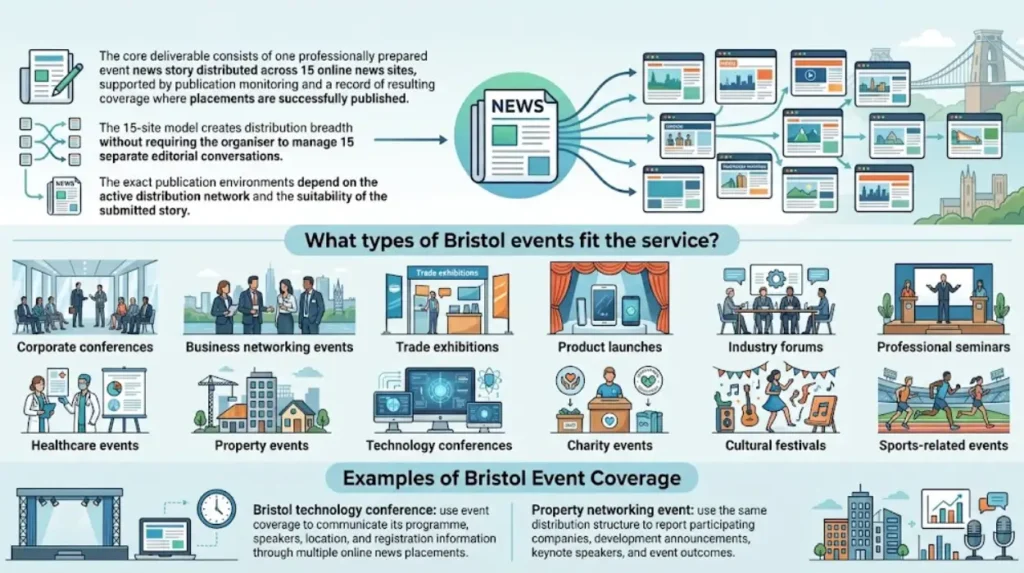
The core deliverable consists of one professionally prepared event news story distributed across 15 online news sites, supported by publication monitoring and a record of resulting coverage where placements are successfully published.
The 15-site model creates distribution breadth without requiring the organiser to manage 15 separate editorial conversations.
The exact publication environments depend on the active distribution network and the suitability of the submitted story.
What types of Bristol events fit the service?
The service applies to multiple event categories, including:
- Corporate conferences
- Business networking events
- Trade exhibitions
- Product launches
- Industry forums
- Professional seminars
- Healthcare events
- Property events
- Technology conferences
- Charity events
- Cultural festivals
- Sports-related events
For example, a Bristol technology conference can use event coverage to communicate its programme, speakers, location, and registration information through multiple online news placements.
A property networking event can use the same distribution structure to report participating companies, development announcements, keynote speakers, and event outcomes.
How does 15-site coverage support event visibility?
Fifteen separate publication placements create multiple discoverable references to the same event, giving organisers broader online visibility than a single event webpage or isolated announcement provides.
Event visibility depends on how easily audiences can encounter relevant information.
An organiser’s website provides the primary source. Social platforms create additional discovery channels. News publication adds another layer by placing the event story within online media environments.
The 15-site model therefore supports a broader digital footprint.
How does published coverage support SEO?
Published event stories can create indexed URLs containing relevant entities such as the event name, organiser, venue, Bristol, industry category, and event date.
Where a publication includes a valid hyperlink, the link provides an additional pathway to the organiser’s website.
SEO value depends on the publication, link attributes, indexing status, relevance, content quality, and search-engine treatment. Publication quantity alone does not guarantee rankings.
The stronger objective is a coherent entity footprint around the event.
Why choose 15-site distribution instead of contacting publications individually?
Fifteen-site distribution consolidates event media outreach into one managed process, reducing the operational work involved in preparing, pitching, tracking, and documenting individual online publication opportunities.
Direct outreach requires research, contact identification, pitching, follow-up, editorial communication, and tracking.
A managed distribution service creates a defined workflow instead.
This distinction matters for event organisers working against fixed launch dates.
What operational work does the service reduce?
An organiser normally needs to manage several activities when conducting direct media outreach:
- Publication research
- Contact database development
- Pitch preparation
- Release formatting
- Follow-up communication
- Publication tracking
- URL collection
- Coverage reporting
A distribution service consolidates these activities around one approved news release.
The organiser retains control over the event facts and messaging while the distribution process handles publication outreach.
How does Bristol event coverage fit into an event marketing strategy?
Bristol event news coverage works as one component of an event marketing strategy, supporting awareness before the event and providing documented coverage that remains available after the event has taken place.
Timing determines how the coverage functions.
Before an event, the story can communicate the event’s purpose, speakers, agenda, venue, and registration details.
During an event, coverage can focus on announcements, participation, milestones, or significant developments.
After an event, the story can document attendance, outcomes, partnerships, awards, fundraising results, or business announcements.
What does pre-event coverage achieve?
Pre-event coverage establishes an online news presence before attendees arrive.
For example, a Bristol business conference can announce its keynote speaker, participating organisations, venue, and registration details through a structured news story.
This creates multiple publication references that support the event’s wider digital campaign.
What does post-event coverage achieve?
Post-event coverage converts completed activity into a documented media asset.
A story can report key outcomes, new partnerships, attendance milestones, awards, fundraising achievements, or strategic announcements.
This extends the communication lifecycle beyond the event date.
Who benefits most from Times Intelligence Bristol event coverage?
The service fits Bristol organisations that require defined multi-site media distribution, measurable publication outputs, and a repeatable process for communicating events through online news channels.
The strongest use cases involve organisations with a clear event announcement and a specific reason for seeking wider digital media exposure.
Which organisations use this type of coverage?
Relevant users include:
- Event organisers
- Bristol businesses
- Conference producers
- Corporate marketing teams
- Venue operators
- Professional associations
- Trade organisations
- Startups
- Property companies
- Technology businesses
- Healthcare organisations
- Charities
A corporate organiser launching a new annual conference has a different message from a charity promoting a fundraising event. Both fit the distribution model when the content has a clear news purpose.
What should you check before ordering 15-site Bristol event coverage?
Before purchasing distribution, confirm the number of target sites, content requirements, publication process, expected reporting, turnaround, link policy, editorial conditions, and the exact deliverables included in the selected package.
The number of sites is only one purchasing factor.
A decision-maker needs to understand what happens before, during, and after distribution.
Which service specifications matter?
Review these points before approval:
- Distribution count: Confirm that the package specifies 15 publication placements.
- Content requirements: Check word count, formatting, images, links, and quotations.
- Editorial process: Establish how content is reviewed before distribution.
- Turnaround: Confirm the expected publication timeframe.
- Reporting: Verify how published URLs and coverage are supplied.
- Link policy: Check whether links are included and how they are treated.
- Revision process: Confirm how factual corrections are handled.
- Coverage conditions: Understand what happens when an individual publication does not publish the story.
These specifications make the service easier to compare with alternative PR distribution options.
How should businesses measure the results of Bristol event news coverage?
Businesses can measure Bristol event coverage through publication count, live URLs, referral traffic, branded search activity, engagement, registrations, backlinks where applicable, and the contribution of coverage to the wider event marketing campaign.
Publication count provides the simplest measurement.
However, a stronger evaluation combines media outputs with website and campaign data.
Which metrics matter after publication?
Track:
- Number of live publications
- Number of indexed URLs
- Referral sessions
- Event registration traffic
- Link clicks
- Branded search activity
- Social engagement
- Coverage lifespan
- Audience interactions
- Leads attributed to media activity
For example, a Bristol conference organiser can compare registration traffic before and after coverage publication and review referral sources inside its analytics platform.
Media coverage does not operate independently from other marketing channels. Measurement works best when the event website, analytics platform, CRM, and media report use consistent campaign tracking.
When is Times Intelligence Bristol event coverage the right choice?
Times Intelligence Bristol event coverage fits organisations that need a defined 15-site distribution package, structured publication management, and documented online media coverage for a Bristol event with a clear newsworthy announcement.
The service is particularly relevant when an organiser needs predictable distribution rather than an open-ended media outreach campaign.
It also fits organisations running recurring events that require a repeatable communication process.
A quarterly business forum, annual conference, product launch series, or recurring industry event can use the same workflow for each announcement.
The decision ultimately depends on distribution requirements, event timing, content readiness, budget, reporting needs, and the value placed on multi-site publication.
For organisations comparing affordability and distribution scale,
Bristol event coverage provides the relevant middle-funnel context.
For organisations ready to evaluate the service itself, Times Intelligence offers a defined route from event content preparation to multi-site publication and coverage documentation.
What are the main outcomes of 15-site Bristol event news coverage?
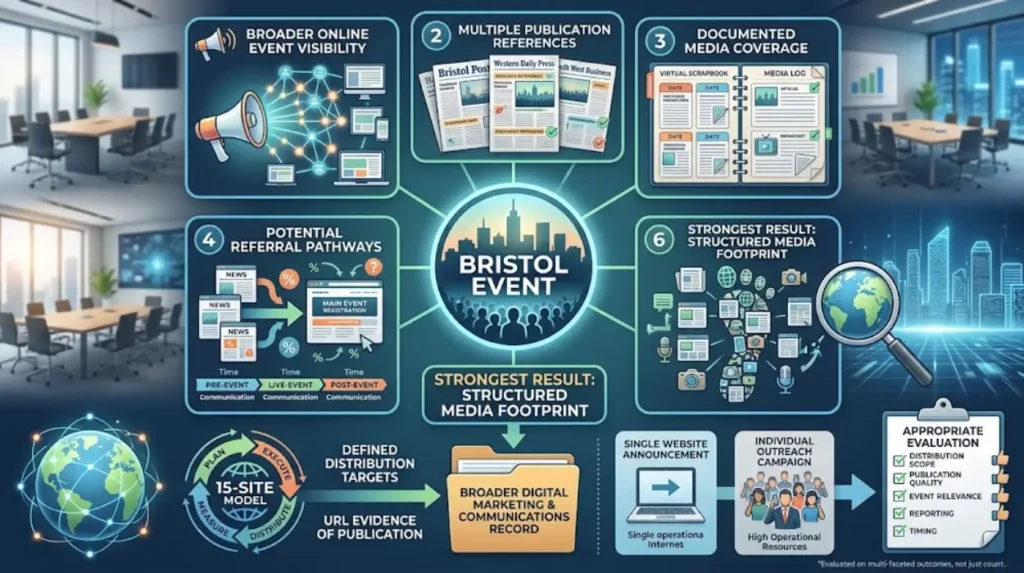
The main outcomes are broader online event visibility, multiple publication references, documented media coverage, potential referral pathways, and a repeatable distribution process that supports pre-event, live-event, and post-event communications.
The strongest result is a structured media footprint around the event.
The 15-site model provides a defined distribution target. The resulting URLs provide evidence of publication. The coverage can then become part of the organisation’s broader digital marketing and communications record.
For Bristol businesses and event organisers, this creates a practical decision-stage option when a single website announcement does not provide sufficient media distribution and a fully managed individual publication outreach campaign requires more operational resources.
Explore More Expert Insights:
Book Leeds Event Coverage Across 15 News Websites
Award Ceremony Coverage on 15 UK News Sites
The appropriate evaluation is therefore based on distribution scope, publication quality, event relevance, reporting, timing, and measurable business outcomes, rather than publication count alone.