Startup launch coverage on 15 UK news sites today gives a new company structured visibility across national, regional, business, technology, and specialist media. The objective is measurable publication reach, relevant audience exposure, search visibility, and credible third-party references.
For founders preparing a launch, distribution is not simply about sending one press release. It involves preparing a newsworthy announcement, matching the story with suitable UK publications, distributing the release, tracking published coverage, and evaluating the resulting media footprint.
The difference between basic distribution and a managed startup launch coverage service is execution. A decision-maker needs to know which publications receive the announcement, how many placements are secured, what audiences each publication serves, and how the coverage is reported.
Understanding:
Startup launch coverage helps founders evaluate the right distribution model before committing budget. It also connects with the wider process explained in:
Startup Launch Events, where audience relevance and publication selection determine how startup announcements reach technology audiences.
What does startup launch coverage on 15 UK news sites include?
Startup launch coverage on 15 UK news sites includes preparing one launch announcement, distributing it through a targeted media network, securing publication across 15 relevant sites, and providing evidence of published coverage for review.
A startup launch coverage package normally contains several connected activities:
- Press release preparation or optimisation
- UK-focused media distribution
- Publication targeting
- Editorial formatting
- Coverage monitoring
- Published URL collection
- Media report delivery
- Search visibility assessment
The 15-site target provides a defined distribution outcome. It gives the startup a measurable media objective instead of an undefined promise of exposure.
For example, a fintech startup launching a payment platform can distribute a launch announcement across business, technology, finance, and regional publications. A property technology startup requires a different publication mix because its relevant audience includes property professionals, developers, investors, and technology buyers.
What does a 15-site media target mean?
A 15-site target means the campaign is structured around publication across 15 UK news websites. The sites do not all need to belong to the same editorial category.
A balanced campaign can include technology publications, business news sites, regional outlets, startup publications, and relevant trade media.
The exact publication mix depends on the announcement, industry, audience, and editorial relevance. A higher publication count does not automatically create stronger results. Relevance and credible publication matter.
How does startup launch coverage reach UK publications today?
Startup launch coverage reaches UK publications through a defined workflow covering announcement preparation, distribution, publication targeting, editorial processing, live coverage monitoring, and final reporting across the selected UK media network.
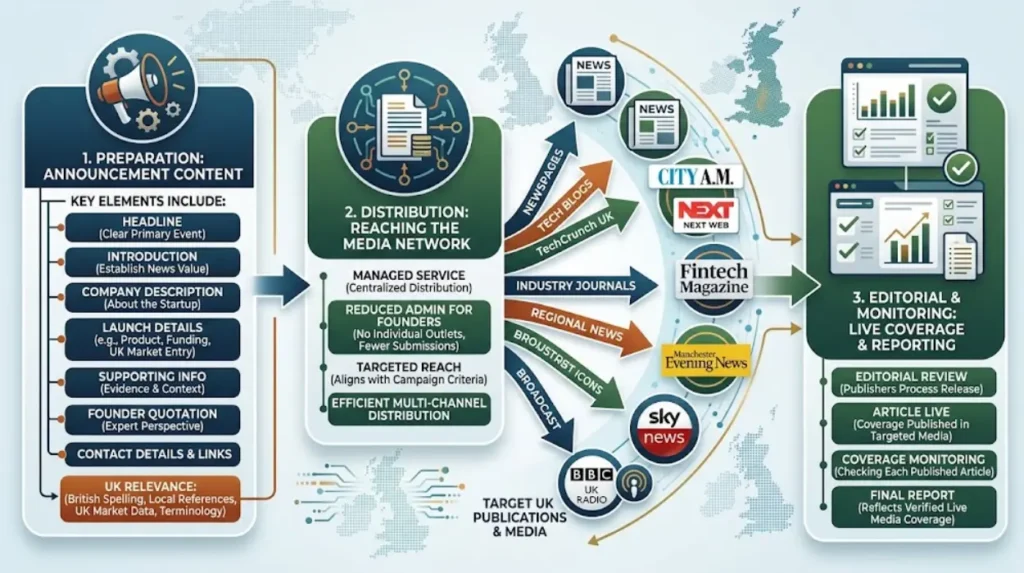
The process begins before distribution. The launch announcement needs a clear news angle. Editors require information that identifies what happened, who is involved, why it matters, and what makes the announcement relevant to their audience.
How is the startup announcement prepared?
The announcement normally contains a headline, introduction, company description, launch details, supporting information, founder quotation, contact details, and relevant links.
The headline identifies the primary event. The opening paragraph establishes the news value. Supporting sections provide evidence and context.
For example, a launch announcement can focus on a new product, investment round, technology platform, UK market entry, strategic partnership, or major commercial milestone.
The content also needs UK relevance when the campaign targets UK media. British spelling, local references, UK market information, and appropriate terminology improve contextual alignment.
How is the release distributed?
Once prepared, the announcement enters the selected distribution network. The distribution process sends the release to publications and media channels aligned with the campaign criteria.
A managed service handles the operational stages centrally. This reduces the need for founders to identify individual publications, format multiple submissions, monitor publication status, and maintain a separate coverage spreadsheet.
The distribution stage is followed by monitoring. Each published article is checked and recorded so the final report reflects actual live coverage.
How are the 15 UK news sites selected for a startup launch?
The 15 UK news sites are selected according to industry relevance, audience alignment, geographic relevance, publication type, editorial context, and the startup announcement itself rather than using the same media list for every launch campaign.
Publication selection is one of the most important decision points in a launch coverage campaign.
A technology startup requires technology-focused visibility. A healthcare startup requires healthcare and business relevance. A regional startup with strong local significance requires appropriate regional coverage.
What types of UK publications can be included?
Relevant categories include:
- UK technology publications
- Business news websites
- Startup publications
- Regional news sites
- Financial publications
- Industry trade media
- Specialist business publications
For example, a Manchester-based software startup can prioritise technology and business publications alongside relevant North West media. A London fintech startup can focus on fintech, finance, business, and technology audiences.
The media list needs to reflect the announcement rather than simply maximising the number of websites.
Why does publication relevance matter?
Publication relevance determines whether the audience has a logical connection with the startup.
A launch announcement for an artificial intelligence platform gains stronger contextual value from technology and business publications than from unrelated entertainment media.
Relevance also supports search context. When multiple credible publications discuss the same company, product, market, or launch event, the startup develops a broader set of third-party references around its entity.
What should a startup press release contain for UK launch coverage?
A startup press release for UK launch coverage needs a clear news angle, factual headline, concise introduction, company context, supporting evidence, relevant quotations, accurate contact information, and terminology that matches the intended UK audience.
The content needs to communicate the launch quickly.
What information belongs in the announcement?
A practical startup launch release includes:
- The launch event or announcement
- The startup name and location
- The product or service
- The target market
- The launch date
- Relevant founders or executives
- Supporting facts
- A company background section
- A media contact
- Relevant website information
The release also needs factual consistency. Company names, funding figures, dates, executive titles, product descriptions, and locations require verification before distribution.
How does SEO fit into the press release?
SEO elements support discoverability without turning the release into keyword-stuffed content.
The startup name, product name, industry category, location, and principal announcement need natural contextual placement.
For example, a London-based cybersecurity startup launching a threat-monitoring platform can naturally reference “London cybersecurity startup,” “threat monitoring platform,” and the relevant market segment where those terms accurately describe the announcement.
The purpose is contextual clarity. The release remains a news document rather than an artificial search-engine text.
What results can a startup expect from 15 UK news placements?
Fifteen UK news placements create a measurable media footprint containing multiple published references to the startup, its launch, product, founders, or market activity across relevant online news environments.
The outcome is easier to evaluate when each placement is recorded individually.
A useful campaign report identifies the publication, article headline, publication date, live URL, coverage type, and relevant campaign details.
Does 15-site coverage improve brand visibility?
Yes, the campaign creates multiple public references to the startup.
One announcement published across 15 websites gives the company more than one point of media exposure. Readers encounter the startup through different publication audiences and search environments.
The result is particularly relevant during a launch because the company is establishing its public identity.
A startup with limited existing media coverage benefits from creating a documented launch footprint that journalists, customers, investors, partners, and search users can access.
Does media coverage support SEO?
Published media coverage can contribute to a startup’s broader online visibility through indexed articles, branded references, contextual mentions, and links where publications include them.
Coverage also creates third-party content associated with the startup entity.
However, publication does not guarantee a specific search ranking. Search performance depends on the wider website, technical SEO, content quality, authority, competition, indexing, and user demand.
How should a startup measure the value of 15 UK news placements?
A startup should measure 15-site coverage through confirmed publication count, publication relevance, live URLs, audience alignment, branded visibility, referral activity, search visibility, and campaign reporting rather than relying on publication volume alone.
The first measurement is simple: how many targeted publications actually published the announcement?
The second measurement concerns quality. A relevant technology publication has different strategic value from an unrelated website.
Which campaign metrics matter?
Important measurements include:
- Number of confirmed publications
- Number of live articles
- Publication names
- Article URLs
- Publication dates
- Industry relevance
- Geographic relevance
- Referral traffic
- Branded search activity
- Backlinks where applicable
- Coverage longevity
The campaign report provides the evidence needed to assess performance.
For a startup preparing repeated announcements, historical reports also provide useful benchmarks. A founder can compare launch coverage with funding announcements, product releases, partnership news, and expansion campaigns.
When is 15-site UK startup coverage suitable?
Fifteen-site UK startup coverage is suitable for founders launching products, entering markets, announcing funding, introducing partnerships, reporting major milestones, or creating a structured media footprint around a significant company announcement.
The strongest use cases involve announcements with clear news value.
Which startup announcements fit the model?
Common examples include:
Product launches: A startup introduces a new software platform, application, hardware product, or business service.
Funding announcements: A company announces a confirmed investment round and provides relevant funding information.
Market expansion: A startup enters the UK market or expands from one UK region into another.
Strategic partnerships: A startup announces a commercially significant partnership with another organisation.
Major milestones: A company reaches a measurable customer, revenue, product, hiring, or operational milestone.
Founder-led launches: Founders introduce a new venture with a clearly defined product and market proposition.
The announcement needs substantive information. A minor company update does not have the same news value as a significant commercial or product milestone.
How can a startup choose a 15-site UK news coverage service?
A startup should evaluate a coverage service by checking its publication network, confirmed placement process, reporting standards, UK media relevance, turnaround expectations, content requirements, pricing structure, and evidence provided after publication.
The decision needs specification rather than general claims.
A founder can request the expected publication categories, number of target sites, reporting format, content requirements, revision process, and delivery timeline before purchase.
What questions should founders ask?
A practical evaluation includes:
- Which UK publications are included?
- Is the 15-site target clearly defined?
- Are publication URLs supplied after coverage?
- How is coverage verified?
- Is content preparation included?
- Which industries are supported?
- How are unsuitable publications handled?
- What reporting is delivered?
- What is the campaign turnaround?
- What happens if the target is not achieved?
These questions establish the service scope before payment.
For a startup launch, the important distinction is between a media distribution service and a general publicity promise. A defined 15-site package provides a measurable output that can be reviewed after the campaign.
What is the final decision for startup launch coverage on 15 UK news sites today?
Startup launch coverage on 15 UK news sites provides a defined UK media distribution outcome, combining targeted publication, launch announcement visibility, live coverage tracking, and measurable reporting for founders evaluating a structured media campaign.
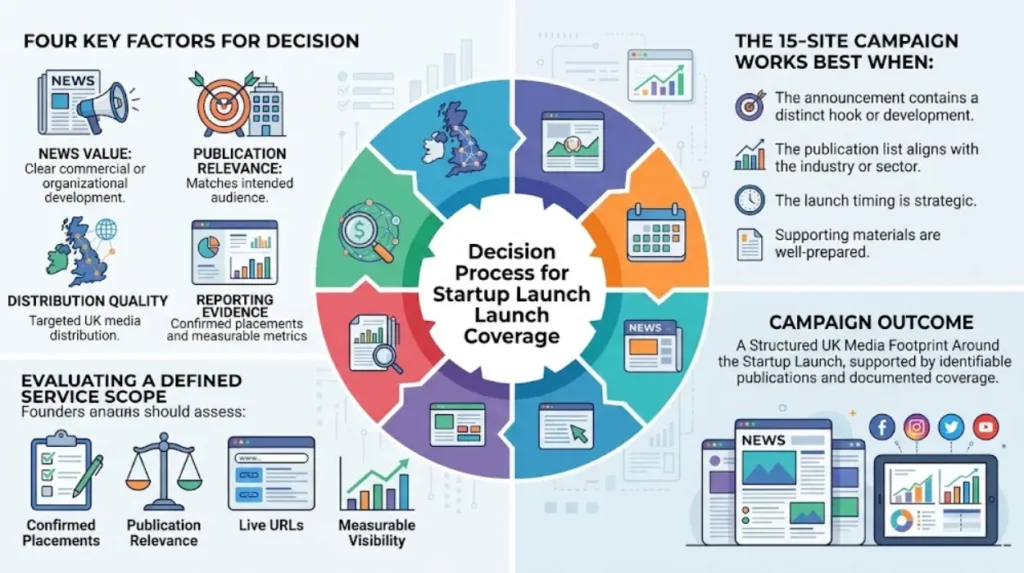
The decision rests on four factors: news value, publication relevance, distribution quality, and reporting evidence.
A 15-site campaign works best when the announcement contains a clear commercial or organisational development and the publication list matches its intended audience.
Explore More Expert Insights:
How Charity Gala Coverage Reaches 15 UK News Sites
Earned vs Paid Event Coverage: What Delivers Better ROI
For founders ready to execute a launch campaign, a defined service scope makes evaluation easier. The campaign can be assessed through confirmed placements, publication relevance, live URLs, and measurable visibility rather than vague exposure claims.
The result is a structured UK media footprint around the startup launch, supported by identifiable publications and documented coverage.