

Charity gala coverage across 15 UK news sites requires a structured distribution process that connects one newsworthy event with relevant national, regional, business, lifestyle, charity, and community publications. The process combines story development, media targeting, press release distribution, editorial relevance, and coverage monitoring.
For charities, gala coverage is more than a record of an evening. It creates a set of media assets that document fundraising activity, recognise supporters, highlight beneficiaries, and communicate organisational impact. A coordinated approach also helps charities understand how one event announcement develops into coverage across multiple UK news audiences.
What is charity gala coverage across 15 UK news sites?
Charity gala coverage across 15 UK news sites is a coordinated media distribution process that places one gala story across multiple relevant publications, increasing visibility while creating consistent, structured coverage around the charity, event, fundraising purpose, and participants.
A charity gala is a formal fundraising or awareness event organised to support a charitable cause. It often includes a dinner, speeches, awards, auctions, performances, sponsor recognition, or beneficiary stories.
News coverage turns these event elements into editorial content. A publication can focus on the fundraising result. Another can focus on a prominent speaker. A regional publication can focus on local attendees or beneficiaries.
The 15-site model uses multiple publication types rather than treating the UK media landscape as one audience.
Which UK publications are relevant?
Relevant publication categories include:
- National news publications
- Regional newspapers
- Local news websites
- Charity and nonprofit publications
- Business media
- Lifestyle publications
- Entertainment publications
- Event-focused publications
- Community news platforms
For example, a London charity gala can contain national interest through its fundraising result, business relevance through corporate sponsorship, and local relevance through London-based organisers or beneficiaries.
How does one charity gala story reach 15 UK news sites?
A gala story reaches 15 UK news sites through a sequence covering story preparation, editorial targeting, release distribution, publication selection, follow-up, and coverage monitoring, with each stage connecting the event information to identifiable media audiences and publication requirements.
The process starts before the gala takes place. The charity identifies the central news angle and gathers the information required for publication.
The core story normally contains the event name, date, venue, charity, fundraising purpose, amount raised, key speakers, sponsors, notable attendees, beneficiary information, and relevant quotations.
The release then presents these details in a news format. The headline communicates the primary event development. The opening paragraph establishes what happened and why it matters.
How is the media distribution structured?
A structured distribution process normally follows six stages:
- Story development — identify the strongest news angle.
- Media segmentation — classify relevant UK publications.
- Press release preparation — create an accurate and publishable story.
- Distribution — deliver the release to selected media channels.
- Editorial publication — publications assess and publish relevant content.
- Coverage monitoring — record published articles and their URLs.
This structure separates distribution from publication. Sending a release does not automatically guarantee editorial publication. Each publication applies its own editorial standards, audience requirements, and content processes.
What information makes a charity gala story newsworthy?
A charity gala story becomes stronger when it contains specific fundraising results, measurable charitable impact, recognised participants, distinctive event developments, credible quotations, and local relevance that give UK publications clear factual reasons to cover the announcement.
News value depends on identifiable information. Generic statements about a successful evening provide limited editorial substance.
A stronger release identifies what happened, who participated, what was achieved, and why the result matters.
For example, “Charity gala raises £250,000 for children’s hospice services” provides a measurable outcome. The figure gives journalists a concrete fact for a headline or opening paragraph.
Which event details strengthen the story?
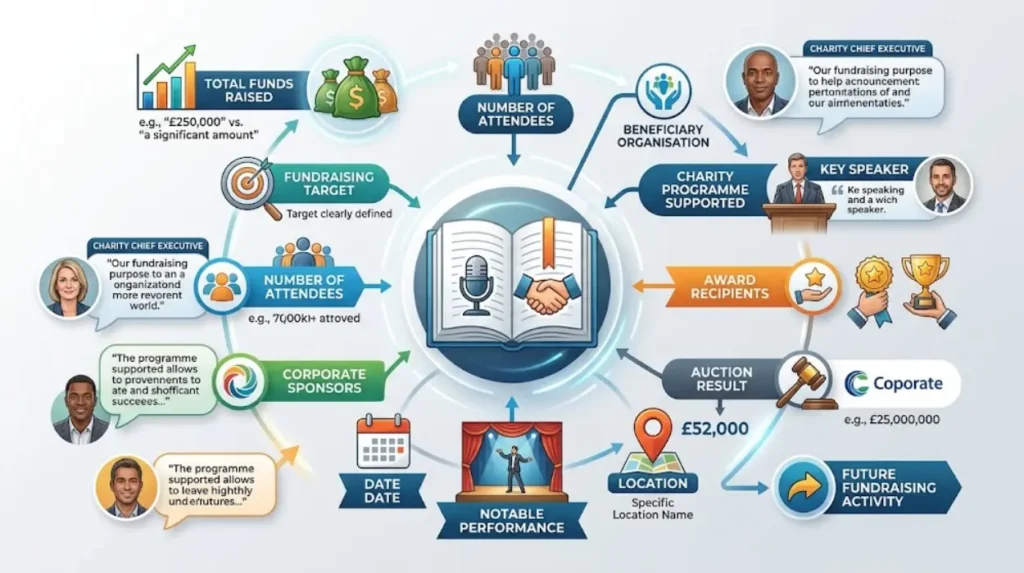
Important details include:
- Total funds raised
- Fundraising target
- Number of attendees
- Beneficiary organisation
- Charity programme supported
- Key speaker
- Award recipients
- Corporate sponsors
- Auction result
- Notable performance
- Location
- Date
- Future fundraising activity
Specificity improves editorial usability. A £250,000 fundraising result has stronger informational value than “a significant amount was raised.”
Quotes also add context. A charity chief executive can explain the purpose of the fundraising. A beneficiary representative can describe the programme supported by the event.
How should charities segment the 15 UK news sites?
Media segmentation divides the 15 target sites according to geography, audience, industry, and editorial interest, allowing the same gala announcement to reach publications whose readers have a measurable connection to the charity, event location, fundraising subject, or participating organisations.
Segmentation prevents irrelevant distribution. A charity gala in Manchester has stronger regional relevance for Greater Manchester publications than for unrelated local outlets.
The same event can still contain multiple editorial angles. A corporate sponsor creates a business angle. A celebrity guest creates an entertainment angle. A fundraising achievement creates a charity angle.
What does a segmented media mix look like?
A 15-site distribution can contain different publication categories, such as:
| Publication focus | Example editorial angle |
|---|---|
| National news | Major fundraising achievement |
| Regional news | Local charity or venue connection |
| Business media | Corporate sponsorship |
| Charity media | Beneficiary impact |
| Lifestyle media | Gala event and social attendance |
| Community media | Local participation |
| Entertainment media | Performer or notable guest |
The exact publication mix depends on the gala’s facts. Relevance remains more important than simply increasing the number of outlets.
Charities evaluating distribution options can also examine:
Charity gala coverage to understand how event coverage fits within a broader UK media strategy.
What happens after the press release is distributed?
After distribution, each publication evaluates the story against its editorial relevance, audience, available publishing capacity, and content standards; published articles then become individual coverage assets that require monitoring, verification, and organised reporting.
Distribution creates the opportunity for coverage. Editorial teams determine whether and how a story appears.
Some publications publish the release with limited changes. Others rewrite the headline, adjust the introduction, shorten the copy, or select different details. A publication can also use only one part of the announcement.
This creates variation across the 15 sites. The underlying facts remain consistent while headlines, article length, images, and editorial framing differ.
How is published coverage monitored?
Coverage monitoring records:
- Publication name
- Article headline
- Publication date
- Article URL
- Geographic relevance
- Editorial category
- Key message included
- Image usage
- Fundraising figure reported
A central coverage report provides a reliable record of where the gala appeared. It also separates confirmed published coverage from distribution activity.
What benefits does coverage across 15 UK news sites provide?
Coverage across 15 UK news sites gives charities broader media visibility, multiple published references to the gala, stronger documentation of fundraising activity, greater audience reach across regions, and a structured evidence base for evaluating communications performance.
The first benefit is broader visibility. One article reaches one publication audience. Fifteen relevant publications create multiple opportunities for audiences to encounter the same charitable achievement.
The second benefit is message consistency. Repeated reporting of the charity name, fundraising amount, beneficiary programme, and event purpose strengthens recognition.
The third benefit is documentation. Published articles create a public record of the gala and its fundraising outcome.
How does multi-site coverage support charity communications?
Charities can use confirmed coverage in several communication activities:
- Post-event reporting
- Sponsor communications
- Annual reports
- Donor updates
- Social media content
- Fundraising presentations
- Stakeholder communications
- Future event promotion
For example, a charity raising £300,000 through an annual gala can use published coverage to document the event’s public visibility alongside its internal fundraising records.
Coverage also creates reusable evidence for future communications. The articles remain separate from the original press release and demonstrate how external publications presented the event.
Which charity gala use cases benefit from 15-site coverage?
Multi-site gala coverage fits fundraising dinners, annual charity balls, corporate charity events, award ceremonies, beneficiary-focused galas, milestone celebrations, and major donor events where measurable outcomes provide clear editorial material for multiple UK publication audiences.
Different gala formats produce different news angles.
An annual charity ball can focus on year-on-year fundraising. A corporate charity gala can emphasise the relationship between business sponsors and charitable programmes. An awards evening can focus on recognised individuals and organisational achievements.
What examples demonstrate different coverage angles?
A healthcare charity gala can focus on funding for medical research or patient services.
A children’s charity gala can focus on funds supporting education, accommodation, or family services.
A community fundraising gala can focus on local participation and regional impact.
A corporate-sponsored gala can focus on the sponsor’s contribution alongside the charity’s fundraising result.
These angles help media targeting because each publication receives a clear reason for relevance.
How can charities evaluate a 15-site gala coverage strategy?
Charities can evaluate a 15-site coverage strategy by measuring confirmed publications, audience relevance, geographic distribution, message accuracy, article quality, referral activity, backlinks where available, and the relationship between media coverage and wider post-event communications.
A simple measurement framework separates volume from quality.
Fifteen published articles provide a coverage count. Geographic diversity shows whether the distribution reached different UK audiences. Message inclusion confirms whether important facts appeared accurately.
Referral traffic provides a separate performance measure when publication analytics or tracking systems provide the required data.
Which metrics matter most?
Useful metrics include:
- Published coverage: Number of confirmed articles.
- Publication relevance: Alignment between each site and the charity’s audience.
- Geographic spread: Representation across relevant UK regions.
- Message accuracy: Correct charity name, fundraising figure, and event details.
- Backlinks: Links pointing to the charity website where publishers include them.
- Referral traffic: Visits generated from published articles.
- Content reuse: Number of communications assets created from the coverage.
These measurements create a clearer evaluation than counting press release distributions alone.
What is the difference between distribution and confirmed gala coverage?
Distribution measures where a charity sends its announcement, while confirmed gala coverage measures where a publication actually publishes an article; the distinction matters because media delivery, editorial selection, and public visibility represent separate stages of the coverage process.
A distribution report can show delivery to 15 publications. A coverage report confirms which publications published content.
This distinction is important for performance reporting. A media strategy needs both operational evidence and published results.
The strongest reporting system records the original release, distribution targets, published URLs, publication dates, and article details in one organised document.
For charities comparing implementation options:
15 UK news sites provides a decision-stage view of multi-site gala coverage and its practical structure.
How should charities plan gala coverage before the event?
Charities can plan gala coverage by defining the news angle early, collecting verified event information, preparing approved quotations, identifying relevant UK media categories, organising distribution targets, and establishing a coverage monitoring process before the gala takes place.
Preparation improves operational consistency. The charity already knows which facts require verification and which stakeholders require approval.
The media plan also becomes easier to execute when publication categories are defined before the event.
A practical timeline starts several weeks before the gala. Story development and media research happen first. Final fundraising figures and event outcomes are added after the event.
What should the post-event workflow contain?
The post-event workflow includes:
- Confirm the final fundraising figure.
- Verify attendee and speaker information.
- Approve quotations.
- Finalise images and captions.
- Update the press release.
- Distribute the completed announcement.
- Monitor publications.
- Verify every published article.
- Record URLs and publication dates.
- Report coverage results.
This process connects event management with media operations.
Explore More Expert Insights:
Earned vs Paid Event Coverage: What Delivers Better ROI
How Event Coverage Builds 15 Quality Backlinks for Brands
What does successful 15-site charity gala coverage achieve?
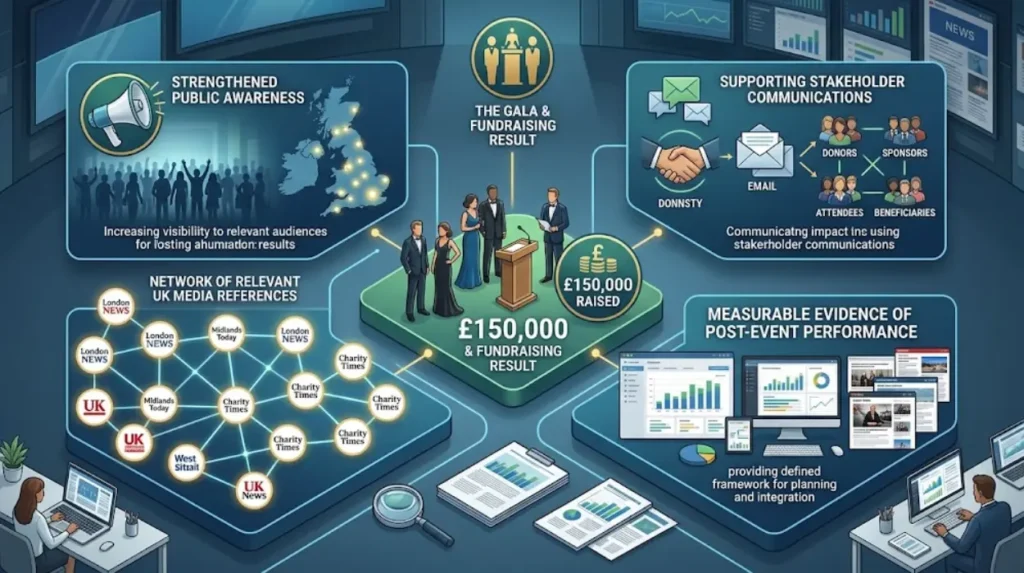
Successful 15-site charity gala coverage creates a documented network of relevant UK media references that communicates the event’s fundraising result, strengthens public awareness, supports stakeholder communications, and provides measurable evidence of post-event media performance.
The central objective is not simply to distribute one announcement. It is to build structured visibility around a specific charitable event and its measurable outcome.
A well-organised strategy connects the charity, gala, fundraising result, beneficiaries, sponsors, attendees, and relevant UK audiences. It also establishes a measurable process from story creation to confirmed publication.
For organisations assessing media distribution options, the 15-site model provides a defined framework for comparing targeting, distribution, publication outcomes, and reporting quality. This makes charity gala coverage easier to plan, measure, and integrate into wider UK communications activity.



