
Hybrid event coverage is a coordinated process that turns one physical-and-digital event into news content distributed across multiple relevant UK news sites, using structured messaging, media targeting, editorial standards, and consistent event information.
A hybrid event combines in-person attendance with online participation. Examples include conferences with livestreams, product launches with virtual audiences, corporate summits with remote speakers, and exhibitions with digital access.
News coverage gives these events visibility beyond registered attendees. Multi-site coverage extends that visibility across different publication audiences. A single event announcement can therefore become a set of published stories rather than one isolated article.
The process starts with the event’s core news value. Editors need a clear reason to cover the event. This includes a notable speaker, business development, industry announcement, research finding, partnership, investment, or measurable public relevance.
For UK audiences, publication selection also matters. National business publications serve a different audience from regional newspapers or specialist trade publications.
The educational stage explains what hybrid event coverage looks like in practice. The next stage focuses on how distribution across 15 sites is organised.
Readers reviewing the broader fundamentals can explore:
Hybrid UK event coverage for context before evaluating distribution approaches.
How is hybrid event coverage prepared for 15 news sites?
Preparation begins by converting event information into a news-ready story, identifying its strongest news angle, creating publication-specific assets, checking factual accuracy, and mapping the announcement against 15 relevant UK news sites and their audience requirements.
What information does the coverage package contain?
A standard coverage package contains the event name, date, venue, online participation details, organisers, speakers, topic, purpose, key announcement, supporting statistics, quotes, imagery, and contact information.
The headline identifies the central development. The introduction establishes why the event matters. The body provides evidence and context.
The content also needs consistent factual information. Event dates, speaker names, organisation names and quoted statements require verification before distribution.
Why does publication relevance matter?
Fifteen sites do not represent one identical audience. Each publication has its own editorial focus and readership.
For example, a London business publication can focus on commercial developments, while a regional publication can prioritise local economic impact. A technology publication can focus on digital innovation, while an industry trade site can focus on sector-specific developments.
This creates a publication mapping process rather than simple duplication.
How does a hybrid event story move from one announcement to 15 publications?
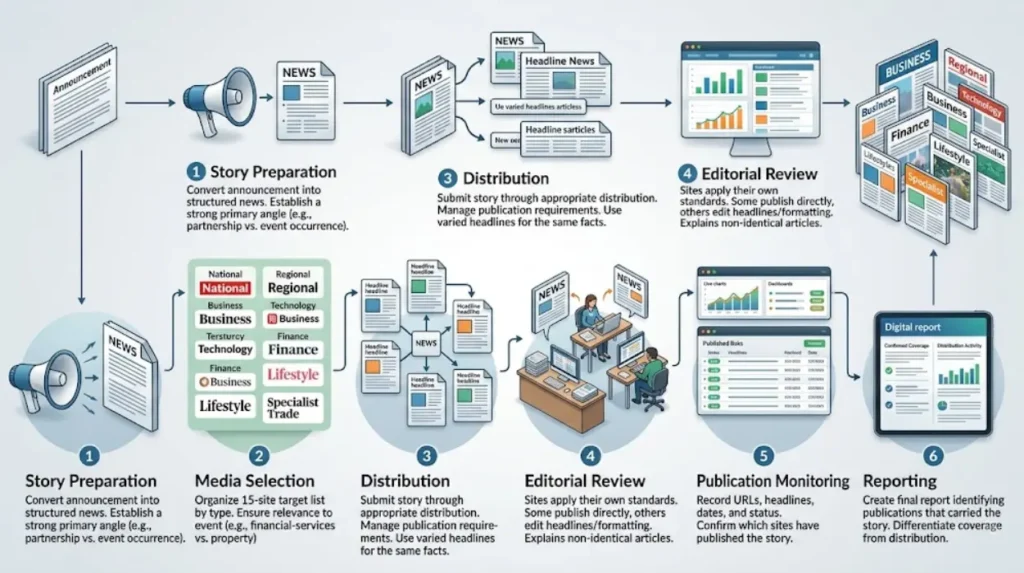
Distribution moves through defined stages: story preparation, media selection, submission, editorial review, publication, monitoring, and reporting. Each stage determines whether the event information reaches suitable publications and remains accurate across the coverage set.
Stage 1: Story preparation
The event announcement is converted into a structured news story. The primary angle is established before distribution.
For example, a UK technology conference announcing a £5 million innovation partnership has a stronger news angle than a generic statement saying the conference will take place.
Stage 2: Media selection
The 15-site target list is organised by publication type. Categories include national, regional, business, technology, finance, lifestyle and specialist trade media.
The selection depends on relevance. A financial-services event requires different media targets from a property conference.
Stage 3: Distribution
The completed story is submitted through an appropriate media distribution process. Publication requirements remain important at this stage.
The same factual story can use different headline treatments while retaining the same underlying information.
Stage 4: Editorial review
News sites apply their own editorial standards. Some publish supplied material with limited changes. Others edit headlines, introductions or formatting.
This distinction explains why multi-site coverage does not always produce 15 identical articles.
Stage 5: Publication monitoring
Published URLs, headlines, publication dates and article status are recorded. Monitoring confirms which sites have published the story.
Stage 6: Reporting
The final report identifies the publications that carried the story and separates confirmed coverage from distribution activity.
What are the 15 news site categories used for hybrid event coverage?
A 15-site coverage strategy normally combines national, regional, business, specialist, technology, finance and industry publications to create audience diversity while keeping every target publication relevant to the event’s subject and news value.
1. National news sites
National publications provide broad UK visibility. They are relevant when an event has national economic, political, cultural or business significance.
2. Regional news sites
Regional publications connect events with specific cities, counties and communities. A Manchester event with local employment impact has a clear regional angle.
3. Business publications
Business sites focus on companies, investment, entrepreneurship, leadership and economic developments.
4. Technology publications
Technology sites suit events involving artificial intelligence, software, cybersecurity, digital infrastructure and emerging technologies.
5. Finance publications
Finance-focused sites suit banking, investment, fintech, insurance, payments and capital-market events.
6. Industry trade publications
Trade publications target professional audiences within defined sectors. Examples include construction, healthcare, manufacturing and logistics media.
7. Professional-interest publications
These sites serve specific professional communities. An HR leadership summit, for example, has relevance for human resources publications.
8. Local business publications
Local business sites provide additional visibility for events connected to regional companies, investment and employment.
The remaining publication targets are selected according to the event’s subject rather than through a fixed universal list. A 15-site strategy therefore represents a media mix, not 15 predetermined websites.
How do publishers treat the same hybrid event differently?
Publishers interpret the same event through different editorial priorities. One publication can emphasise the business announcement, another the regional impact, and another the specialist industry development while retaining the same verified event facts.
Business angle
A business publication can focus on investment, partnerships, revenue, expansion or leadership.
Regional angle
A regional publication can focus on the event’s location, local businesses, employment or community relevance.
Technology angle
A technology publication can focus on new platforms, artificial intelligence, digital infrastructure or technical innovation demonstrated at the event.
Sector angle
A trade publication can focus on how the event affects a defined professional sector.
This differentiation improves contextual relevance. It also prevents the coverage strategy from depending on one generic audience.
What content elements improve multi-site event coverage?
Strong multi-site coverage depends on a clear headline, factual opening, relevant statistics, authoritative quotes, useful event details, credible supporting evidence, original imagery and consistent terminology across every version distributed to targeted publications.
Headlines
The headline identifies the news development rather than simply promoting attendance.
Weak: “Leading Industry Experts Gather for Major UK Event.”
Stronger: “UK Fintech Summit Announces New £5 Million Digital Payments Partnership.”
The second headline contains a specific development that editors and readers can identify immediately.
Opening paragraph
The opening paragraph answers the basic news questions: who, what, where, when and why.
Quotes
Quotes add attributable information from organisers, speakers, executives or relevant experts. Each quote needs a clear speaker identity and organisational affiliation.
Statistics
Numbers strengthen factual context. Examples include attendee numbers, investment value, research findings, participating organisations and event duration.
Images
Relevant photographs support visual publication formats. Event images include speakers, venues, demonstrations and audience activity.
What are the benefits of distributing hybrid event coverage across 15 news sites?
Multi-site coverage expands audience reach, creates multiple discovery points, supports brand visibility, strengthens event search presence, provides publication diversity, and creates a documented record of the event across relevant UK media environments.
Wider audience discovery
A hybrid event already reaches physical and virtual attendees. News coverage adds people who did not register for the event.
Multiple search entry points
Published articles create additional indexed pages associated with the event, organiser, speakers and announcement.
Greater publication diversity
Fifteen relevant publications expose the story to different reader groups. This supports broader awareness than a single publication placement.
Extended event visibility
Event content can remain discoverable after the live programme ends. Published coverage creates an additional post-event information layer.
Measurable media reporting
Coverage can be tracked through publication names, URLs, dates and article formats. These records create a structured media report.
How can organisations compare different hybrid event coverage options?
Organisations can compare coverage options by examining publication relevance, site count, editorial quality, geographic distribution, sector alignment, reporting standards, publication timing, content requirements and the distinction between guaranteed distribution and confirmed editorial publication.
What does publication count actually measure?
A 15-site target indicates the intended distribution scope. It does not automatically mean that every site will publish identical content.
The quality of the publication mix matters. Fifteen highly relevant publications provide more contextual value than a larger list of unrelated sites.
What does editorial publication mean?
Editorial publication means the story appears within a publication’s editorial environment. This differs from simply sending a press release to media contacts.
The distinction matters when comparing distribution solutions.
What does reporting quality involve?
A useful report records publication names, article URLs, publication dates, headlines and relevant coverage details.
This allows teams to verify outcomes rather than relying only on distribution volume.
When is 15-site hybrid event coverage most useful?
Fifteen-site coverage is most useful when an event has a defined news angle, multiple relevant audience groups, measurable announcements, strong supporting information, and a need to extend visibility beyond attendees across UK business, regional and specialist media.
Corporate conferences
Corporate conferences can use multi-site coverage for major announcements, executive appointments, partnerships and market developments.
Product launches
Hybrid product launches combine physical demonstrations with online audiences. News coverage extends the launch story beyond event participants.
Industry summits
Industry summits benefit from specialist coverage because trade publications reach professionals who already understand the sector.
Investment and business events
Investment announcements, funding developments and business partnerships provide strong financial and commercial angles.
Technology events
Technology conferences generate specialised angles around artificial intelligence, cybersecurity, cloud infrastructure and digital transformation.
Explore More Expert Insights:
How Virtual Event Coverage Gets Published on UK News Sites
How Festival Coverage Runs Across 15 UK News Websites
How should businesses move from awareness to evaluating hybrid event coverage?
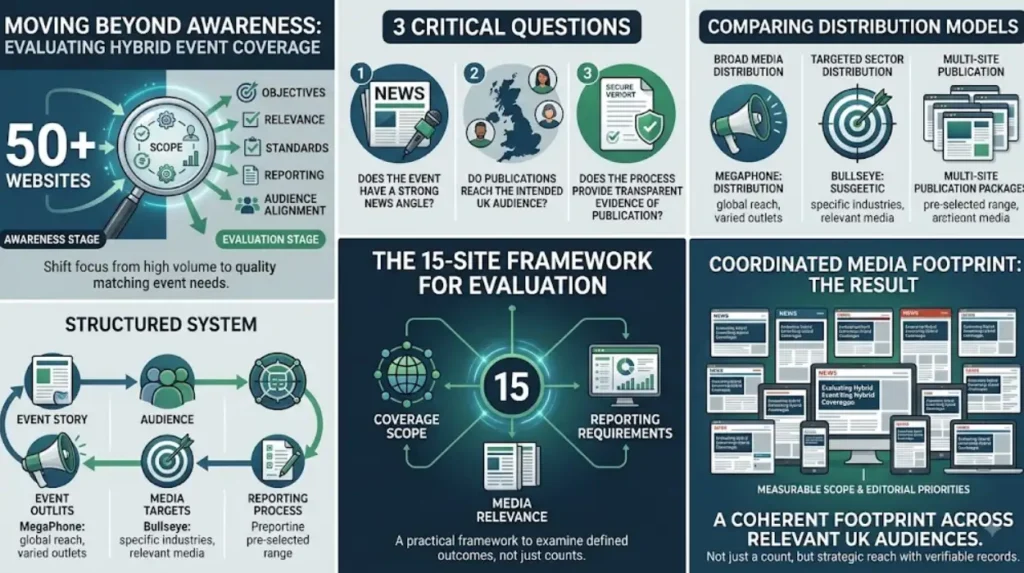
The evaluation stage focuses on matching event objectives with publication relevance, distribution scope, editorial standards, reporting requirements and audience alignment rather than selecting coverage based only on the number of websites included.
The first question is whether the event has a strong news angle. The second is whether the selected publications reach the intended UK audience. The third is whether the coverage process provides transparent evidence of publication.
Organisations can then compare different distribution models. These include broad media distribution, targeted sector distribution and multi-site publication packages.
For teams ready to examine a defined publication outcome,
15 news sites provides a more specific framework for evaluating coverage scope, media relevance and reporting requirements.
Hybrid event coverage works best when the event story, audience, media targets and reporting process operate as one structured system. A 15-site strategy provides measurable distribution scope while allowing different publications to interpret the same verified event through their own editorial priorities.
The result is not simply a larger publication count. It is a coordinated media footprint across relevant UK audiences, supported by clear content, targeted publication selection and verifiable coverage records.



