

Healthcare events generate information for clinicians, researchers, policymakers, investors, healthcare organisations, and the public. Their coverage requires more than publishing an event announcement. UK editorial standards require accuracy, relevance, responsible sourcing, clear attribution, and appropriate handling of medical information.
Healthcare event coverage refers to journalistic or editorial reporting about conferences, exhibitions, forums, summits, seminars, launches, and professional gatherings within the healthcare sector. Effective coverage presents verified event information while identifying the wider healthcare issue, development, research finding, professional discussion, or policy context.
For organisations planning media coverage, understanding UK editorial standards helps shape stronger event stories before distribution. This approach also connects with the principles discussed in:
Healthcare event coverage, where newsworthiness and audience relevance determine whether an event provides a credible editorial story.
What are UK editorial standards for healthcare event coverage?
UK editorial standards require healthcare event coverage to present accurate facts, identify sources, distinguish claims from evidence, protect personal information, and provide relevant context without misleading readers about medical, scientific, or professional matters.
Editorial standards define the requirements used by publishers and journalists when evaluating information for publication. Healthcare reporting applies these standards with particular attention to medical accuracy and public interest.
A healthcare event story normally identifies:
- Event name and location
- Event date and purpose
- Organising body
- Speakers and participating organisations
- Relevant healthcare topic
- Verified statements
- Supporting evidence
- Audience relevance
- Appropriate professional context
The story also needs a clear distinction between factual reporting and promotional claims. Statements such as “the event will transform healthcare” require evidence and attribution. A factual statement such as “the conference brings together NHS leaders, researchers, and healthcare technology companies” requires identifiable supporting information.
UK publishers also apply editorial policies concerning accuracy, fairness, privacy, conflicts of interest, and potentially harmful information. Healthcare communications therefore require careful preparation before submission.
Why does accuracy matter in healthcare reporting?
Healthcare information directly affects professional understanding and public interpretation. Incorrect descriptions of treatments, research findings, medical conditions, or clinical developments create misleading information.
Event coverage therefore needs precise terminology. For example, a presentation about an early-stage clinical study must not be described as a proven treatment. A discussion about artificial intelligence in diagnostics must not be presented as evidence that an AI system has achieved clinical approval unless that approval exists.
How do journalists assess whether a healthcare event is newsworthy?
Journalists assess healthcare events through news value, audience relevance, factual substance, timing, expert participation, sector impact, and the presence of a specific development that gives the event significance beyond attendance or promotion.
An event becomes more editorially relevant when it contains information that matters to a defined audience. A healthcare technology conference featuring a new diagnostic platform has stronger news value when the announcement includes verified information about its development, testing, regulatory position, or intended application.
Newsworthiness commonly includes several factors.
Timeliness
A recent development receives greater editorial attention than an old announcement. Coverage scheduled around the event date also provides clearer relevance.
Public or professional impact
An event discussing NHS procurement, healthcare workforce shortages, digital health regulation, or patient safety addresses issues with established sector relevance.
Expert participation
Named experts strengthen the factual structure of an event story. Examples include NHS executives, university researchers, clinical specialists, healthcare economists, and recognised industry professionals.
New information
A new report, research finding, partnership, product announcement, policy discussion, or investment decision provides a stronger editorial reason for coverage.
Audience relevance
A specialist healthcare publication requires information relevant to its readership. A medical technology announcement suits a technology-focused healthcare audience when the story explains the practical development and its sector relevance.
What information should a healthcare event press release contain?
A healthcare event press release needs a factual headline, concise summary, event details, named sources, verified quotations, relevant healthcare context, supporting evidence, and clear contact information for journalists seeking additional information or clarification.
The first section needs to communicate the central news point. It answers what happened, who is involved, where it happened, when it happened, and why the development matters.
A strong release normally includes:
- Headline: States the principal event development.
- Subheading: Adds specific context.
- Opening paragraph: Summarises the news.
- Event details: Provides date, venue, purpose, and participating organisations.
- Quotes: Attributes statements to named individuals.
- Supporting information: Adds relevant evidence or sector context.
- Background: Explains the organisation or event.
- Media contact: Provides a route for verification.
The release needs factual consistency throughout. Names, job titles, dates, figures, organisation names, and event details require verification before distribution.
For example, if a healthcare summit announces a partnership between a university and a medical technology company, the release needs to identify both organisations, explain the partnership, name an authorised spokesperson, and state what the partnership involves.
How should medical claims be handled in healthcare event coverage?
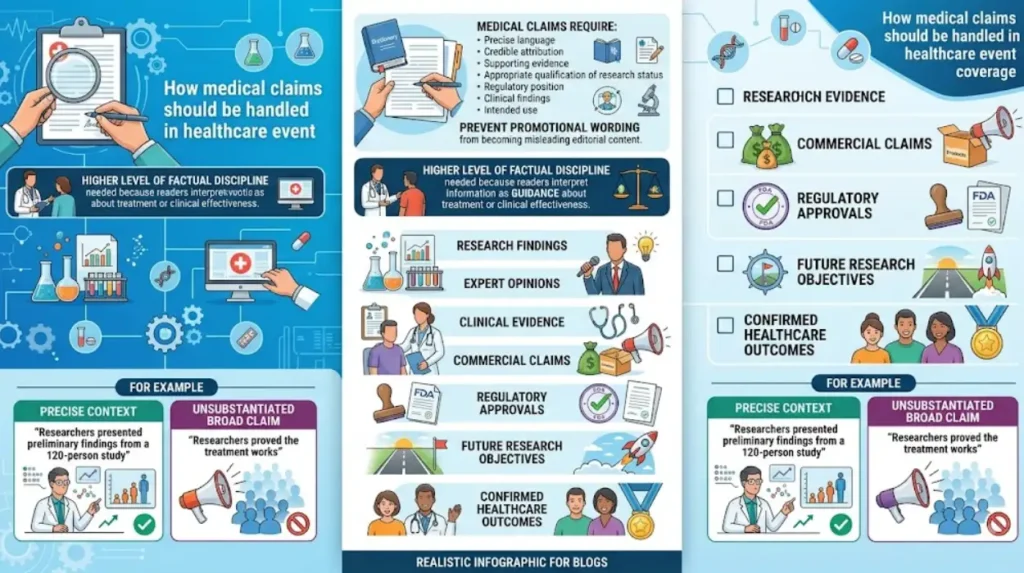
Medical claims require precise language, credible attribution, supporting evidence, and appropriate qualification of research status, regulatory position, clinical findings, and intended use to prevent promotional wording from becoming misleading editorial content.
Medical claims require a higher level of factual discipline because readers can interpret healthcare information as guidance about treatment or clinical effectiveness.
A healthcare event story needs to distinguish between:
- Research findings
- Expert opinions
- Clinical evidence
- Commercial claims
- Regulatory approvals
- Future research objectives
- Confirmed healthcare outcomes
For example, “researchers presented preliminary findings from a 120-person study” provides specific context. “Researchers proved the treatment works” makes a substantially broader claim and requires evidence supporting that conclusion.
How does attribution improve credibility?
Attribution identifies who made a statement or generated evidence. A quote from a named professor represents a specific source. A statement such as “experts agree” provides no identifiable source.
Good attribution uses clear descriptions. Examples include:
- “Dr Sarah Williams, consultant cardiologist, said…”
- “Researchers at the University of Manchester reported…”
- “The conference report identified…”
- “The company announced…”
Attribution allows editors and readers to understand the origin of information.
How does editorial verification affect healthcare event coverage?
Editorial verification checks names, dates, statistics, quotations, organisational relationships, research references, regulatory statements, and event details before publication, reducing factual errors and improving the reliability of healthcare event reporting.
Verification begins with the source material. Event organisers need accurate documentation for every significant claim.
Important verification points include:
Event details
The event name, venue, date, registration information, and organiser need to match official records.
Speaker information
Speaker names, professional titles, institutional affiliations, and roles require confirmation.
Statistics
Healthcare statistics need identifiable sources. A figure such as “40% of hospitals use artificial intelligence” requires a source, publication date, and relevant geographical or population context.
Research
Research references need accurate study names, institutions, publication status, participant numbers, and findings.
Partnerships
Claims involving NHS organisations, universities, charities, technology companies, or pharmaceutical companies require accurate descriptions of the relationship.
Verification also improves the quality of syndication. When identical or substantially similar information reaches multiple publications, factual consistency becomes essential.
What makes healthcare event coverage suitable for UK audiences?
UK-focused healthcare coverage needs British terminology, relevant national context, accurate references to UK healthcare institutions, and information that explains why the event matters to British healthcare professionals, organisations, policymakers, or the public.
Regional relevance influences editorial value. UK healthcare coverage benefits from precise references to the NHS, Department of Health and Social Care, UK universities, professional bodies, healthcare regulators, and national health policy where relevant.
The terminology also needs consistency. For example, “NHS trust”, “integrated care board”, “general practitioner”, and “consultant” carry specific meanings within the UK healthcare system.
A healthcare event in London discussing digital health regulation has greater relevance when its coverage explains the UK regulatory environment rather than presenting only the event agenda.
The same principle applies to regional events. A healthcare conference in Manchester can include regional NHS developments, university research, workforce issues, or local healthcare investment when those details form part of the event’s news value.
How can organisations prepare healthcare events for editorial coverage?
Organisations can prepare healthcare events for editorial coverage by identifying the strongest news angle, verifying information, preparing authoritative spokespeople, creating evidence-based materials, and matching the story with publications serving relevant UK healthcare audiences.
Preparation starts before the event. The communications team identifies the central news point and removes information that does not contribute to it.
A practical preparation process includes:
- Identify the primary news development.
- Confirm all event facts.
- Select qualified spokespersons.
- Prepare accurate quotations.
- Gather supporting statistics.
- Confirm research and regulatory information.
- Prepare approved visual assets.
- Identify relevant UK publications.
- Align the release with the event schedule.
- Review the final material for accuracy.
This process creates a clearer editorial proposition. It also helps organisations understand the difference between media distribution and editorial acceptance.
Distribution sends information to selected media channels. Editorial acceptance depends on each publication’s relevance, standards, audience, available space, newsroom priorities, and assessment of news value.
What media coverage options are available for healthcare events?
Healthcare organisations can use targeted media outreach, specialist healthcare publications, regional news outlets, business media, national publications, and broader distribution networks depending on audience, news value, geography, and campaign objectives.
Different media routes serve different communication requirements.
Specialist healthcare publications
These publications reach clinicians, healthcare executives, researchers, medical technology professionals, and sector specialists. They suit technical event developments and professional discussions.
Regional publications
Regional media provide geographic relevance. A healthcare event connected to Birmingham, Leeds, Glasgow, Cardiff, or Belfast can target publications serving those areas when the story has local significance.
Business publications
Business media suit healthcare investment, mergers, partnerships, technology developments, leadership announcements, and commercial expansion.
National publications
National outlets address broader developments with significant public interest or national healthcare relevance.
Distribution networks
Media distribution networks provide structured delivery across selected publications and channels. They offer a practical solution when an organisation needs broad reach while maintaining a defined media strategy.
The appropriate route depends on the event’s actual news value. A specialist research presentation and a national healthcare policy announcement require different publication strategies.
How can healthcare event coverage support a wider media strategy?
Healthcare event coverage supports a wider media strategy by creating documented news assets, extending event visibility, reaching defined professional audiences, strengthening organisational information consistency, and generating material that supports later communications activity.
Event coverage forms one part of an ongoing communications programme. It can support pre-event awareness, live-event reporting, post-event announcements, research communication, partnership news, and sector commentary.
A quarterly healthcare communications strategy, for example, can connect four event-related news moments:
- January: Healthcare technology conference announcement
- April: Research partnership presentation
- July: Regional healthcare innovation summit
- October: Annual sector report launch
Each event creates a distinct editorial opportunity when the underlying information contains a clear news angle.
Coverage also creates a searchable record of organisational activity. Accurate publication references can support corporate communications, stakeholder engagement, recruitment, investor communication, and professional visibility.
The value comes from relevance and consistency rather than publication volume alone.
When should organisations consider professional healthcare media distribution?
Organisations should consider professional media distribution when they require structured UK publication targeting, consistent release delivery, specialist media access, or support preparing healthcare announcements for editorially relevant audiences.
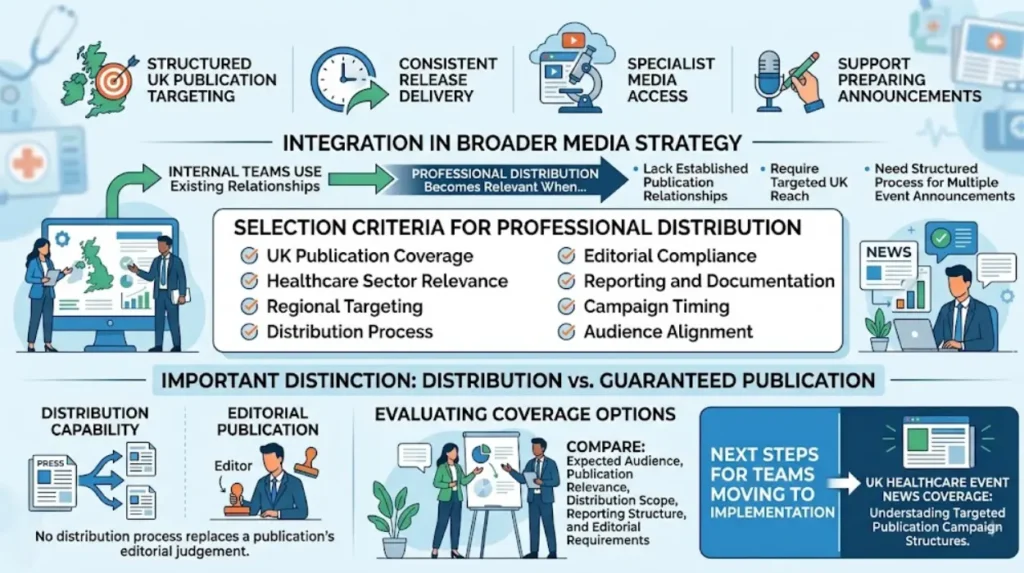
Professional distribution is one solution within a broader media strategy. It becomes relevant when internal teams lack established publication relationships, require targeted UK reach, or need a structured process for distributing multiple event announcements.
Selection criteria include:
- UK publication coverage
- Healthcare sector relevance
- Regional targeting
- Distribution process
- Editorial compliance
- Reporting and documentation
- Campaign timing
- Audience alignment
The key distinction remains between distribution capability and guaranteed editorial publication. No distribution process replaces a publication’s editorial judgement.
Organisations evaluating coverage options can compare the expected audience, publication relevance, distribution scope, reporting structure, and editorial requirements before selecting an approach.
For teams moving from education into implementation,
UK healthcare event news coverage provides a relevant next step for understanding how targeted publication campaigns are structured.
What are the key benefits of meeting UK editorial standards?
Meeting UK editorial standards improves factual accuracy, strengthens source credibility, supports responsible healthcare communication, increases editorial usability, reduces avoidable corrections, and creates consistent information for professional and public audiences across relevant publications.
Editorial compliance provides practical benefits beyond publication.
Accurate content reduces correction requirements. Clear attribution improves source transparency. Specific statistics strengthen evidence. Relevant context helps journalists assess the story quickly.
For healthcare organisations, these standards also support responsible communication. Medical information requires particular care because inaccurate wording can affect public understanding.
A well-prepared event story also gives journalists usable material. Clear facts, named experts, verified quotations, and relevant context reduce unnecessary clarification.
The result is a stronger foundation for media outreach and targeted distribution.
Explore More Expert Insights:
How Fintech Event Coverage Reaches UK Business Readers
How Conference Coverage Reaches 15 Publications in One Campaign
Healthcare event coverage works best when the event itself contains a clear news development and the supporting communication meets the standards expected by UK editorial audiences. Organisations that understand these requirements can select appropriate media routes, prepare stronger releases, and build more consistent healthcare communications campaigns.



