Conference coverage is a coordinated process that turns one event into multiple publication opportunities across relevant UK media outlets. A single campaign uses one core announcement, tailored messaging, targeted distribution, editorial relevance, and structured follow-up to achieve broader coverage.
How does one conference campaign reach 15 publications?
A conference campaign reaches 15 publications by combining one newsworthy event story with targeted media selection, publication-specific angles, timely distribution, editorial follow-up, and consistent campaign assets. The process creates multiple opportunities from one coordinated announcement without producing unrelated stories.
A conference generates several news elements. These include keynote announcements, speaker participation, attendance figures, research findings, partnership announcements, awards, product launches, and industry discussions.
The campaign starts by identifying the strongest news angle. The angle becomes the central narrative for the press release and supporting media materials.
The 15-publication target then requires media segmentation. National business publications, regional newspapers, industry journals, technology outlets, finance media, and event-focused publications serve different audiences.
For example, a London technology conference announcing a new artificial intelligence partnership can target technology publications, business media, London-focused outlets, and relevant professional journals.
This approach differs from sending identical information to an unstructured media list. Each publication receives a story with a clear connection to its readership.
Those researching the educational foundation of this process can also explore:
Conference news coverage for additional context on how conference stories enter UK media.
What happens before a conference coverage campaign begins?
Before distribution begins, the campaign defines the conference story, target publications, audience, timing, supporting assets, and measurable objectives. These elements establish the campaign structure and ensure every media opportunity connects with the same verified event information and core message.
Defining the news angle
The news angle identifies why the conference deserves media attention. A conference itself is an event. Coverage requires a specific development within that event.
Useful angles include:
- A major speaker joining the programme
- New industry research presented at the conference
- A significant business partnership announced during the event
- A regional economic impact
- A new technology demonstration
- Attendance from recognised industry organisations
- A major award or recognition
A strong angle gives journalists a clear reason to consider the story.
Building the media target
The campaign then creates a publication list. A 15-publication campaign needs relevance rather than simple numerical volume.
For example, a healthcare conference can target healthcare trade media, business publications, regional outlets, professional journals, and specialist technology publications when the programme includes health technology.
Preparing campaign assets
The core press release needs supporting information. Typical assets include speaker biographies, event photographs, company information, research statistics, quotations, website details, and approved logos.
These materials help maintain consistency across different coverage opportunities.
How is the conference story adapted for different publications?
Conference stories are adapted through audience-specific angles, headlines, quotations, statistics, and contextual information while preserving verified facts. National business media receive commercial relevance, regional outlets receive local significance, and specialist publications receive industry-specific information from the same campaign.
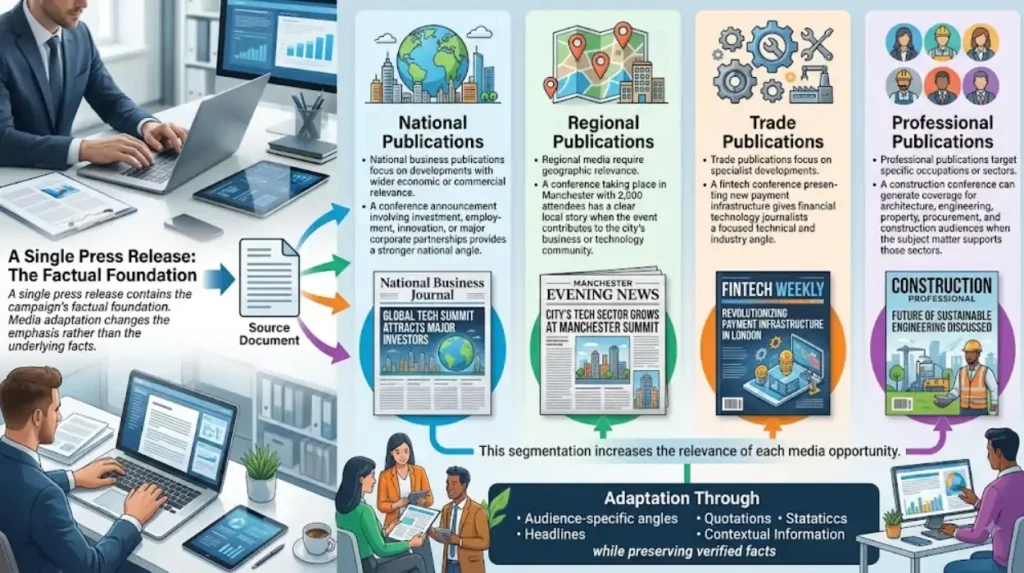
A single press release contains the campaign’s factual foundation. Media adaptation changes the emphasis rather than the underlying facts.
National publications
National business publications focus on developments with wider economic or commercial relevance. A conference announcement involving investment, employment, innovation, or major corporate partnerships provides a stronger national angle.
Regional publications
Regional media require geographic relevance. A conference taking place in Manchester with 2,000 attendees has a clear local story when the event contributes to the city’s business or technology community.
Trade publications
Trade publications focus on specialist developments. A fintech conference presenting new payment infrastructure gives financial technology journalists a focused technical and industry angle.
Professional publications
Professional publications target specific occupations or sectors. A construction conference can generate coverage for architecture, engineering, property, procurement, and construction audiences when the subject matter supports those sectors.
This segmentation increases the relevance of each media opportunity.
Which campaign components help secure coverage across 15 publications?
The main campaign components are a newsworthy press release, targeted media database, publication-specific angles, verified quotations, supporting assets, distribution timing, journalist follow-up, tracking, and reporting. Each component supports a defined stage of the campaign and contributes to measurable publication reach.
Press release
The press release provides the central factual record. It normally contains a headline, introduction, supporting details, quotations, event information, and relevant organisation details.
Media targeting
Media targeting determines which publications receive the story. A campaign targeting 15 publications can divide them into groups based on sector, geography, audience, and editorial focus.
Quotations
Quotes add direct statements from relevant conference representatives. A keynote speaker, event organiser, business leader, or research author can provide an attributable perspective.
Supporting media
Conference photographs, speaker images, research graphics, and event statistics strengthen the available media package.
Timing
Timing connects distribution with the event calendar. Pre-event announcements build awareness. During-event releases capture immediate developments. Post-event stories focus on outcomes, findings, attendance, and announcements.
Tracking
Tracking records publication activity, links, headlines, publication dates, and campaign reach. This information creates a measurable record of the 15-publication objective.
How does timing affect conference media coverage?
Timing determines which conference developments receive attention before, during, and after an event. Early announcements support awareness, event-day developments create immediate news, and post-event results provide evidence, statistics, announcements, and outcomes for continuing editorial coverage.
Before the conference
Pre-event coverage focuses on speakers, programme announcements, research previews, partnerships, and attendance.
A release announcing a former government minister as keynote speaker provides a clear pre-event news angle.
During the conference
Event-day coverage focuses on announcements made during sessions, new partnerships, research findings, awards, demonstrations, and major statements.
These stories require rapid access to verified information.
After the conference
Post-event coverage focuses on measurable outcomes. Examples include attendance numbers, research findings, investment announcements, partnership agreements, awards, and key conclusions.
A conference with 1,500 attendees can therefore produce separate pre-event, event-day, and post-event news opportunities.
What role does media segmentation play in reaching 15 publications?
Media segmentation divides the campaign audience according to publication type, industry, geography, and readership. This method prevents irrelevant distribution and gives each publication a clear editorial connection to the conference, increasing the usefulness of every targeted media opportunity.
A segmented campaign can include five broad publication groups.
- National business media — organisations seeking UK-wide commercial developments.
- Regional publications — outlets covering cities, counties, and local economies.
- Trade publications — specialist media serving defined industries.
- Technology publications — outlets covering software, artificial intelligence, cybersecurity, fintech, or related fields.
- Professional publications — media serving sectors such as healthcare, construction, education, finance, or engineering.
For example, a Birmingham manufacturing conference can use regional business media for local relevance, manufacturing publications for sector relevance, and national business outlets for investment or economic developments.
The 15-publication target therefore represents a structured media mix rather than 15 identical distribution destinations.
How can one conference generate multiple editorial angles?
One conference can generate multiple editorial angles when its programme contains distinct news elements. Speakers, research, partnerships, technology, attendance, awards, regional impact, and business announcements create separate factual angles while remaining connected to the same conference campaign.
Speaker announcement
A recognised speaker can create a pre-event story based on expertise, role, or sector relevance.
Research announcement
New research provides statistics and findings that support evidence-led coverage.
Partnership announcement
A new partnership creates a business-focused angle when organisations announce a defined agreement.
Regional impact
Local attendance, employment, investment, or economic activity creates regional relevance.
Technology development
Product demonstrations or technology announcements provide specialist opportunities for technology publications.
Conference results
Post-event statistics and outcomes create a separate news opportunity after the conference concludes.
This approach extends the campaign without changing the central event identity.
What should be measured in a 15-publication conference campaign?
A 15-publication campaign should measure confirmed placements, publication names, publication dates, story headlines, links, geographic distribution, industry relevance, estimated audience, and campaign completion. These metrics distinguish actual media coverage from distribution activity or potential editorial opportunities.
A media distribution report needs clear definitions.
Confirmed placement means the story appears on a publication.
Publication reach refers to the audience associated with the outlet or available media measurement.
Geographic coverage identifies national, regional, or local publication activity.
Industry coverage identifies specialist sectors represented in the campaign.
Referral traffic measures visits generated through published links when tracking data is available.
Coverage quality considers relevance, prominence, context, and the connection between the article and conference news.
The campaign objective is therefore not simply to send a release to 15 outlets. It is to build measurable and relevant publication coverage across a defined media set.
When is a multi-publication conference campaign most useful?
A multi-publication conference campaign is most useful when an event contains several newsworthy developments and requires visibility across national, regional, trade, or specialist audiences. It provides structured media exposure for launches, research, partnerships, speakers, and measurable event outcomes.
The approach suits conferences with a defined business or industry purpose.
For example, a fintech summit can combine a speaker announcement, new research, technology demonstrations, and partnership news. These elements support different media audiences.
A property conference can generate regional coverage through local development news while targeting property, construction, finance, and business publications.
An education conference can focus on research, policy discussions, institutional partnerships, and sector developments.
A technology conference can use product announcements, artificial intelligence research, cybersecurity developments, and executive participation as distinct editorial angles.
The campaign structure remains consistent across these examples. The media targets and story angles change according to the event.
Explore More Expert Insights:
How UK Corporate Events Get Covered Across 15 News Sites
Edinburgh Event Coverage: How 15 News Sites Amplify Reach
How does a structured campaign connect conference coverage with the next step?
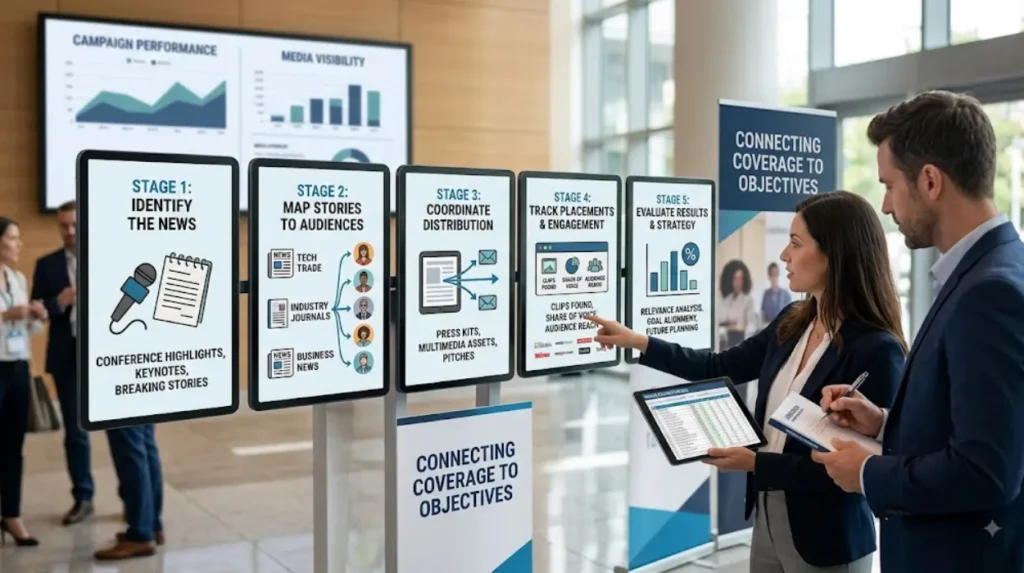
A structured campaign connects conference coverage with broader media objectives by identifying suitable publications, matching stories to audiences, coordinating distribution, tracking placements, and evaluating results. This process helps organisations understand which coverage approaches support their wider communication and visibility goals.
Conference coverage works best when it forms part of a defined communications process.
The first stage identifies the news. The second stage maps the story to relevant publications. The third stage prepares and distributes the media materials. The fourth stage tracks confirmed coverage. The final stage evaluates publication relevance and campaign performance.
Organisations comparing practical distribution approaches can move from:
Conference coverage campaign when they are ready to evaluate implementation options.
A 15-publication campaign therefore depends on coordination rather than publication count alone. Strong results come from a clear news angle, precise media segmentation, timely distribution, publication relevance, supporting assets, and measurable reporting.
When these components work together, one conference becomes a structured media campaign capable of reaching multiple UK publication audiences through distinct, relevant editorial opportunities.