Fintech event news coverage services distribute event announcements, interviews, speaker insights, and business developments across targeted UK publications, creating measurable media visibility across national, regional, financial, technology, and specialist business news channels.
Fintech event news coverage is a media distribution service designed to place event-related stories in relevant publications. It connects fintech conferences, summits, networking events, product demonstrations, panel discussions, and industry announcements with established UK media audiences.
A professional service focuses on more than publishing one press release. It manages story preparation, publication targeting, distribution, and coverage reporting.
For a fintech event, suitable coverage can include:
- Event announcements
- Speaker and keynote news
- New product announcements
- Funding or investment announcements made at an event
- Partnership announcements
- Industry research presented at an event
- Executive interviews
- Panel discussion insights
- Post-event business developments
The objective is measurable exposure across relevant publications rather than a single publication placement.
Businesses evaluating a distribution provider can also review [fintech event coverage] to understand how event stories reach UK business audiences before selecting a campaign.
How does coverage across 15 UK sites work?
A 15-site campaign starts with a newsworthy fintech event story, matches the announcement with relevant UK publications, distributes approved content, monitors resulting coverage, and provides publication evidence for evaluating reach, visibility, and campaign performance.
The process begins with the event details. The service provider identifies the strongest news angle and prepares the announcement for media distribution.
The story then moves through publication targeting. A fintech event needs appropriate media categories because financial technology stories attract different audiences across business, finance, technology, startup, and regional publications.
1. Story preparation
The press release establishes the event, organisation, date, location, speakers, subject matter, and business relevance.
A strong release answers the essential journalistic questions:
- What happened?
- Who is involved?
- When is it happening?
- Where is it happening?
- Why does it matter?
- What evidence supports the announcement?
2. Publication targeting
The campaign identifies 15 suitable UK publication opportunities.
These can include business publications, fintech media, financial news platforms, technology publications, startup media, and regional business outlets.
For example, an event about open banking can prioritise financial technology and payments audiences, while an event focused on AI-driven lending can target fintech, technology, banking, and business publications.
3. Distribution
The approved release enters the distribution network. Publication decisions remain dependent on each outlet’s editorial processes and content requirements.
The campaign records resulting placements so the business can distinguish confirmed coverage from distribution activity.
4. Coverage monitoring
Published stories are monitored after distribution. The resulting coverage is collected into a campaign report.
This creates a clear record of which publications carried the story and where the event announcement appeared.
What does a 15-site fintech media campaign include?
A complete 15-site fintech media campaign typically includes press release preparation, publication targeting, UK distribution, coverage monitoring, published-link collection, and reporting, giving event organisers a defined process for converting one announcement into measurable multi-publication media exposure.
The exact package depends on the provider, but decision-makers need to examine each component before purchasing.
Press release optimisation
The release needs a clear headline, concise introduction, relevant quotations, supporting facts, event information, and appropriate links.
SEO elements also require attention. The primary topic should appear naturally without keyword stuffing.
For example, a release for a London fintech summit can centre on the event name, sector focus, speakers, and key announcement rather than repeating the phrase “fintech event” throughout the article.
UK publication distribution
UK distribution focuses on publications that serve relevant audiences.
A 15-site package creates a defined publication target. The value depends on the relevance, authority, audience, and actual publication status of those sites.
Media monitoring
Monitoring confirms which stories have been published.
The report can include publication names, article URLs, publication dates, headlines, and campaign details.
Coverage reporting
A useful report separates distribution from confirmed coverage.
This distinction matters because sending a press release does not automatically mean that 15 independent editorial publications have published the story.
Why does publication relevance matter for fintech event coverage?
Publication relevance determines whether fintech event coverage reaches people interested in financial technology, banking, payments, investment, technology, entrepreneurship, and business development rather than generating exposure in unrelated media environments.
A fintech company needs an audience that understands financial technology.
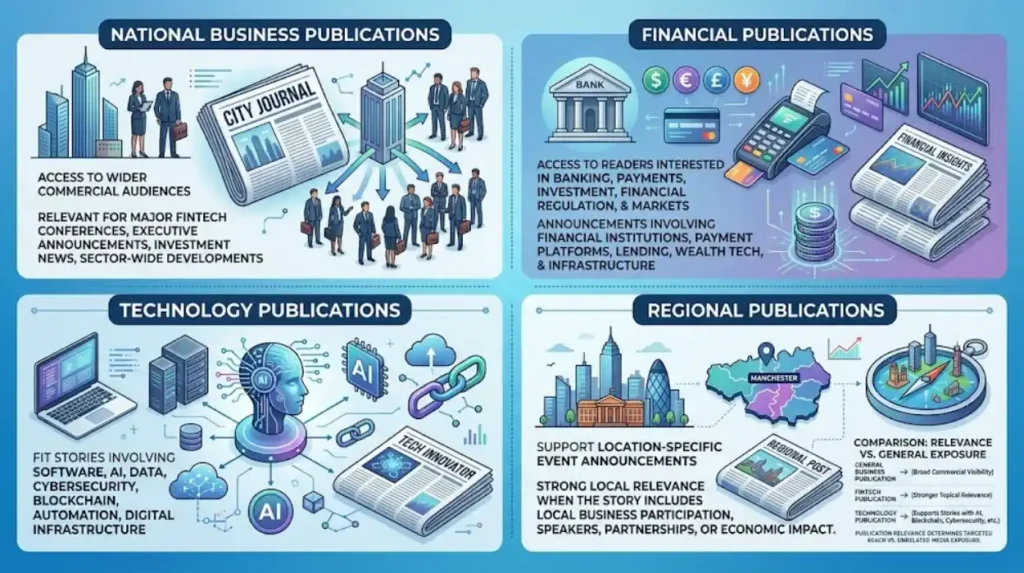
A general business publication can provide broad commercial visibility. A fintech publication provides stronger topical relevance. A technology publication can support stories involving artificial intelligence, blockchain infrastructure, cloud platforms, cybersecurity, or payment technology.
National business publications
National business outlets provide access to wider UK commercial audiences.
They are relevant for major fintech conferences, executive announcements, investment news, and sector-wide developments.
Financial publications
Financial publications provide access to readers interested in banking, payments, investment, financial regulation, and financial markets.
These outlets fit announcements involving financial institutions, payment platforms, lending companies, wealth technology, and financial infrastructure.
Technology publications
Technology media fit stories involving software, artificial intelligence, data, cybersecurity, blockchain, automation, and digital infrastructure.
Regional publications
Regional business publications support location-specific event announcements.
For example, an event held in Manchester can have a stronger local relevance when the story includes local business participation, speakers, partnerships, or economic impact.
What business outcomes can fintech event news coverage support?
Fintech event coverage can support event awareness, brand visibility, executive positioning, search visibility, stakeholder communication, and post-event credibility by placing verified business information across multiple relevant UK media environments.
Coverage does not replace event marketing, direct outreach, paid advertising, or audience engagement. It provides an additional media visibility channel.
Event awareness
Pre-event coverage introduces the event to potential attendees before registration deadlines.
A story can highlight speakers, topics, partnerships, venue information, and registration details.
Executive visibility
Speaker announcements create opportunities to associate senior executives with specific fintech subjects.
For example, a chief executive speaking about payment innovation can receive coverage that identifies both the executive and the organisation.
Search visibility
Published media coverage creates indexed pages containing the organisation’s name, event information, executives, and relevant sector terminology.
These pages can contribute to a broader digital footprint.
Post-event credibility
Post-event stories provide a second opportunity to communicate results.
An organisation can report attendance figures, partnership announcements, research findings, awards, or key conclusions from the event.
When should a fintech company use a 15-site coverage service?
A 15-site coverage service fits fintech organisations that have a defined news announcement, a UK audience, a specific event objective, and a need for measurable multi-publication distribution rather than relying entirely on owned channels or social media.
Timing depends on the type of event story.
Before the event
Pre-event coverage focuses on awareness.
Useful announcements include:
- Event launch
- Speaker confirmation
- Agenda publication
- Registration opening
- Strategic partnerships
- Sponsorship announcements
- New research revealed at the event
During the event
Live event coverage focuses on developments with immediate news value.
Examples include a product launch, investment announcement, strategic partnership, regulatory development, or major research finding.
After the event
Post-event coverage focuses on outcomes.
Examples include attendance records, new partnerships, keynote findings, awards, research results, and significant business announcements.
Using multiple stages creates a wider event communications timeline.
How should businesses compare fintech event coverage providers?
Businesses should compare publication quality, confirmed site targets, UK relevance, distribution process, reporting standards, turnaround times, content requirements, pricing, and coverage verification before selecting a fintech event news coverage provider.
The number of sites alone does not determine campaign value.
A provider promising 15 sites needs to explain what “15 sites” means.
Businesses can ask:
- Which publications are included?
- Are the 15 sites guaranteed targets or possible placements?
- Are publications UK-based or simply accessible in the UK?
- Does the service include press release writing?
- Who approves the final release?
- How quickly is distribution completed?
- How is published coverage verified?
- Are article URLs included in reporting?
- Does the campaign include national, regional, finance, and technology publications?
- What happens if a targeted publication does not publish the story?
These questions establish the difference between distribution and confirmed editorial coverage.
Publication quality
Assess the relevance of each publication to fintech audiences.
Reporting quality
Look for reports containing identifiable publication evidence.
Content support
Determine whether the provider edits or writes the press release.
Campaign transparency
Understand exactly what the package includes before payment.
What makes a fintech event story suitable for UK media coverage?
A fintech event story needs a clear news angle, identifiable organisations or executives, timely information, sector relevance, supporting facts, and a reason for UK audiences to care about the announcement beyond basic event promotion.
A simple event invitation often has limited news value.
A stronger story connects the event to a wider development.
For example, “Fintech company announces London conference” provides basic information. “UK fintech company announces payments conference featuring new research into fraud prevention” provides a clearer editorial angle.
Strong event stories contain specific facts.
These can include:
- Confirmed speaker names
- Attendance figures
- Research statistics
- Partnership details
- Investment values
- Product developments
- Industry findings
- Geographic relevance
- Business milestones
The stronger the factual foundation, the easier it becomes to communicate why the event matters.
How can a 15-site coverage campaign support the full event marketing strategy?
A 15-site media campaign works alongside owned, earned, and direct marketing channels by extending event information into external publications while providing reusable coverage assets for websites, investor communications, social channels, sales materials, and post-event reporting.
Event organisers can reuse verified coverage across several business communication activities.
A published article can support:
- Website press pages
- Corporate newsrooms
- LinkedIn updates
- Investor communications
- Speaker promotion
- Event recap pages
- Sales presentations
- Partnership announcements
- Internal communications
The campaign therefore creates media assets beyond the initial distribution period.
For a fintech business, this also creates a documented history of external coverage around major events and announcements.
What should a fintech business expect from a professional coverage service?
A professional fintech event coverage service provides a defined distribution process, relevant UK publication targeting, transparent campaign reporting, and documented coverage results, allowing businesses to evaluate media activity against specific event, visibility, and communication objectives.
The most important expectation is clarity.
A business needs to know what it is purchasing, where the release is distributed, which publications are targeted, and how results are reported.
A 15-site campaign provides a specific distribution scope. The provider needs to explain the publication mix and reporting methodology.
The business also needs realistic expectations about editorial publication. Distribution guarantees and editorial guarantees are different concepts.
A transparent service clearly separates:
- Distribution
- Target publications
- Confirmed publication
- Editorial coverage
- Monitoring
- Reporting
This distinction makes campaign performance easier to evaluate.
For businesses already researching how event stories reach UK commercial audiences,
Fintech event coverage provides the next stage of consideration before selecting a distribution service.
Is fintech event news coverage across 15 UK sites worth considering?
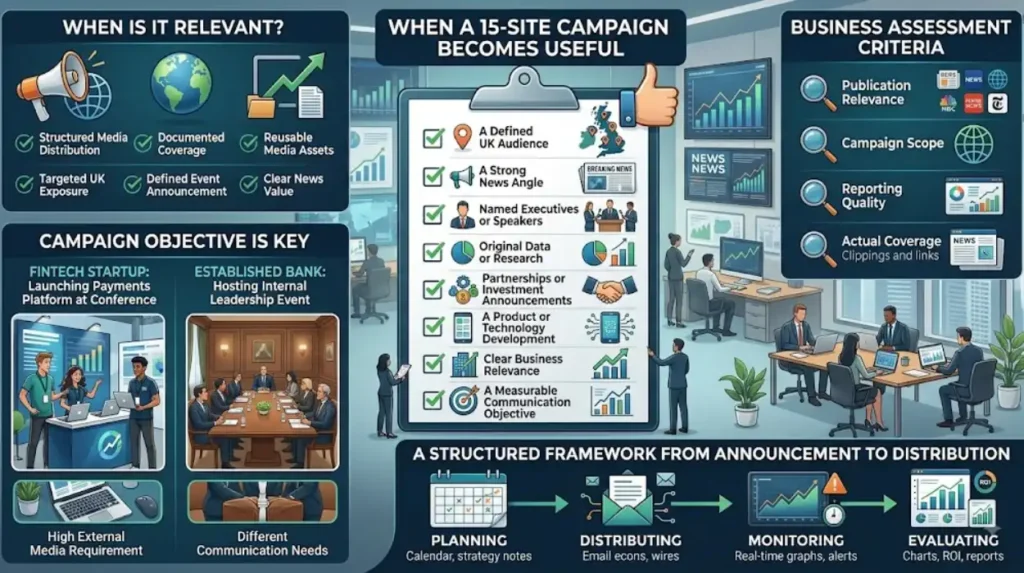
Fintech event news coverage across 15 UK sites is relevant when an organisation needs structured media distribution, targeted UK exposure, documented coverage, and reusable media assets for a defined event announcement with clear commercial or industry news value.
The decision depends on the campaign objective.
A fintech startup launching a payments platform at an industry conference has a different media requirement from an established bank hosting an internal leadership event.
A 15-site campaign becomes more useful when the event has:
- A defined UK audience
- A strong news angle
- Named executives or speakers
- Original data or research
- Partnerships or investment announcements
- A product or technology development
- Clear business relevance
- A measurable communication objective
Explore More Expert Insights:
Book Conference News Coverage on 15 UK Publications
Get UK Corporate Event Coverage Across 15 News Sites
Businesses can then assess the service according to publication relevance, campaign scope, reporting quality, and actual coverage.
For organisations seeking a structured route from fintech event announcement to UK media distribution, a 15-site campaign provides a defined framework for planning, distributing, monitoring, and evaluating event-related news coverage.