
Conference news coverage places an event, speaker, announcement, or business development in front of relevant UK media audiences. Booking coverage across 15 UK publications creates a structured distribution campaign that expands visibility across national, regional, business, and trade media.
What does booking conference news coverage on 15 UK publications include?
Booking conference news coverage on 15 UK publications involves preparing a newsworthy conference story, selecting relevant publications, distributing the release, monitoring placements, and reporting confirmed coverage across the selected UK media outlets.
Conference coverage starts with a defined news angle. The story can focus on an event announcement, keynote speaker, industry finding, partnership, award, product launch, or significant business development.
A 15-publication campaign requires publication selection based on audience relevance. A technology conference, for example, needs technology and business publications rather than unrelated lifestyle outlets.
The campaign also requires publication verification. Confirmed coverage distinguishes published articles from distribution attempts, syndicated copies, or media pitches that receive no placement.
This makes the:
15 UK publications target a measurable media distribution objective rather than a general publicity claim.
How does a 15-publication conference coverage campaign work?
A conference coverage campaign normally moves through five stages: story development, publication targeting, distribution, placement monitoring, and reporting. Each stage establishes measurable information about where the conference story appears and which audiences receive it.
1. Develop the conference story
The first step is to identify the strongest news element. Common examples include:
- A major industry conference announcement
- A new keynote speaker
- Publication of conference research
- A strategic partnership announced at the event
- A significant attendance milestone
- A new product launched during the conference
- An award presented at the event
The release needs a clear headline, factual supporting information, relevant quotes, event details, and company information.
2. Select 15 UK publications
Publication selection depends on the conference subject, audience, location, and commercial objective.
For example, a financial technology conference can target fintech, finance, banking, technology, and business publications. A construction conference can target construction, property, infrastructure, engineering, and regional business media.
3. Distribute the announcement
The completed release is distributed through the selected media network. Distribution creates the opportunity for the conference story to reach multiple publications through one coordinated campaign.
4. Monitor coverage
Coverage monitoring identifies which publications have published the announcement. Monitoring also records article URLs, publication names, publication dates, headlines, and relevant coverage details.
5. Report confirmed placements
A final report provides evidence of the campaign outcome. It can include the 15 publication names, live article links, publication dates, coverage type, and relevant audience information.
The process connects the original conference announcement with measurable media results.
What makes a conference announcement suitable for UK media coverage?
A conference announcement becomes suitable for UK media coverage when it contains a clear news event, identifiable organisations or people, relevant industry information, timely developments, and evidence that gives journalists a specific reason to publish the story.
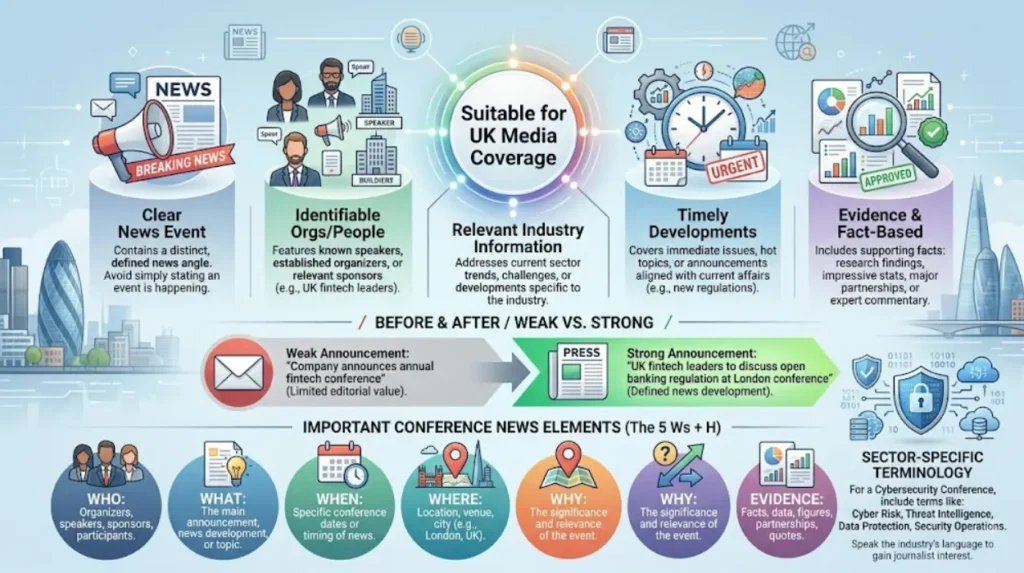
News value remains central to conference PR. Simply stating that a company is hosting an event provides limited editorial information.
A stronger announcement contains a defined development.
For example, “UK fintech leaders to discuss open banking regulation at London conference” provides a clearer news angle than “Company announces annual fintech conference.”
Important conference news elements
A strong conference release normally includes:
- Who: The organisers, speakers, sponsors, or participating organisations
- What: The announcement or development
- When: The conference date or announcement date
- Where: The venue or event location
- Why: The relevance of the conference or announcement
- Evidence: Research, attendance figures, partnerships, awards, or expert commentary
These elements give publications factual material for an article.
Conference coverage also benefits from sector-specific terminology. A cybersecurity conference, for example, needs accurate references to cyber risk, threat intelligence, data protection, security operations, or related subjects when those topics form part of the event.
How do you choose the right 15 UK publications?
The right 15 UK publications match the conference subject, target audience, geographic relevance, and business objective. Publication quality depends on editorial relevance, audience alignment, authority, and the likelihood that readers will value the conference announcement.
Publication selection is a strategic part of the campaign.
A list containing 15 unrelated websites does not provide the same value as a targeted media list.
National publications
National business and news publications provide broad UK visibility. They are relevant when the conference has national significance, prominent speakers, major research, or substantial industry implications.
Regional publications
Regional publications are relevant when the conference has a strong geographic connection.
For example, a Manchester technology conference can target Greater Manchester business media alongside national technology publications.
Trade publications
Trade media provide specialist audiences. Examples include finance publications for fintech conferences, construction publications for infrastructure events, and technology publications for software conferences.
Business publications
Business media are useful for conferences involving investment, entrepreneurship, leadership, corporate strategy, employment, innovation, or economic developments.
The final 15-publication list can combine these categories according to the conference’s audience.
What does a conference coverage campaign cost?
The cost of conference news coverage depends on the number of publications, publication quality, distribution method, editorial requirements, campaign scope, reporting, and additional media services included in the package. A 15-publication campaign requires a defined deliverable before pricing comparisons.
A reliable comparison starts with the exact service scope.
Two providers can quote different prices while offering different publication networks, editorial processes, reporting standards, or placement guarantees.
Compare the deliverables
Before booking, confirm:
- Number of targeted publications
- Publication categories
- UK geographic coverage
- Distribution method
- Release writing or editing
- Editorial review
- Publication monitoring
- Live links or coverage report
- Expected campaign timeline
- Revision or approval process
A clear scope prevents confusion between distribution to 15 publications and confirmed publication across 15 outlets.
These are different deliverables.
How does Time Intelligence Media Group support 15-publication conference coverage?
Time Intelligence Media Group supports conference PR distribution by coordinating the release, targeting relevant UK publications, managing distribution, tracking published coverage, and providing campaign reporting for businesses seeking measurable conference media visibility.
For a BOFU campaign, the key consideration is the complete service workflow.
The process begins with the conference announcement and its news angle. The release is prepared for media distribution and reviewed for clarity, accuracy, and relevance.
The publication targeting stage then aligns the announcement with appropriate UK media categories.
The campaign also includes coverage tracking. Published articles are recorded so the business can identify where the conference announcement appeared.
The service is relevant for conference organisers, event companies, corporate communications teams, trade associations, professional bodies, and businesses using conferences as part of their communications strategy.
Businesses assessing the broader campaign model can review:
What should you check before booking conference news coverage?
Before booking conference coverage, confirm the publication list, campaign deliverables, reporting method, timeline, editorial process, pricing structure, and definition of successful placement. These details establish whether the service matches the conference’s visibility and audience objectives.
Confirm the publication list
Ask for the exact 15 publications or a clearly defined publication selection process.
A credible campaign needs identifiable media targets.
Confirm what counts as coverage
Coverage can mean a published editorial article, syndicated release, business listing, or other media appearance. Confirm which formats count toward the campaign total.
Confirm reporting
The report needs sufficient information to verify results. Useful fields include:
- Publication name
- Article headline
- Publication date
- Live URL
- Coverage category
- Campaign reference
Confirm timing
Conference announcements are time-sensitive. A release for an event taking place on 20 September requires a different distribution schedule from a post-event announcement published on 25 September.
Confirm revisions
The provider needs a defined process for correcting factual errors, updating event information, and approving the final release before distribution.
What results can 15 UK conference placements deliver?
Fifteen confirmed UK media placements create multiple opportunities for audience exposure, search visibility, brand discovery, stakeholder communication, and post-campaign evidence. The value depends on publication relevance, article quality, audience alignment, and the conference story itself.
The first outcome is broader media visibility.
A conference announcement appearing across business, trade, regional, and specialist publications reaches audiences through different editorial environments.
The second outcome is searchable coverage.
Published articles create indexed references to the conference, organisation, speakers, and associated topics when the publications make the content available to search engines.
The third outcome is reusable media evidence.
A company can use confirmed article links in internal reports, stakeholder updates, event marketing materials, investor communications, or post-event reporting, subject to its communications policies.
The fourth outcome is audience segmentation.
A conference story placed in a fintech publication reaches a different audience from the same story appearing in a regional business publication.
This makes publication relevance an important performance factor.
Which conferences can use a 15-publication UK media campaign?
A 15-publication campaign applies to conferences across sectors when the event contains a clear news angle and identifiable UK audience. Common applications include technology, finance, healthcare, construction, education, energy, professional services, and business conferences.
Technology conferences
Technology events can promote new research, product announcements, cybersecurity developments, AI discussions, software innovations, and expert speakers.
Finance and fintech conferences
Financial events can focus on regulation, investment, banking innovation, payments, financial technology, and economic developments.
Healthcare conferences
Healthcare conferences can feature research findings, professional discussions, healthcare innovation, policy developments, and expert participation.
Construction and property conferences
Construction events can cover infrastructure investment, development projects, sustainability, engineering innovation, planning, and regional economic activity.
Professional services conferences
Legal, consulting, accounting, recruitment, and business advisory conferences can generate coverage around industry trends, research, leadership, and professional developments.
The campaign structure remains consistent while the publication mix changes according to sector relevance.
How do you book conference news coverage on 15 UK publications?
To book conference news coverage on 15 UK publications, define the conference announcement, identify the target audience, confirm the publication package, approve the release, provide event information, and establish the campaign timeline before distribution begins.
A practical booking process starts with the campaign requirements.
Provide the conference name, date, location, organiser, website, speakers, announcement details, target audience, and preferred publication categories.
Next, confirm the 15-publication distribution scope.
Then review the release before approval. The final version needs accurate names, dates, statistics, quotations, links, and company information.
After approval, distribution begins according to the agreed schedule.
Once coverage is published, request the campaign report containing confirmed placements and live article links.
Is booking 15 UK publications right for your conference?
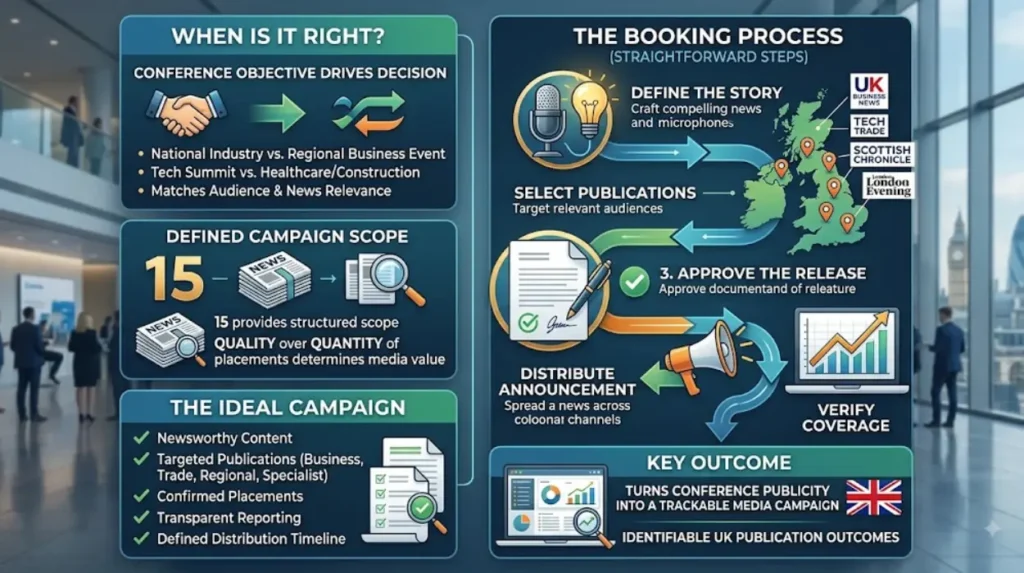
Booking 15 UK publications fits conferences that need measurable UK media exposure across relevant business, trade, regional, or specialist audiences. The right campaign combines newsworthy content, targeted publications, confirmed placements, transparent reporting, and a defined distribution timeline.
The decision depends on the conference objective.
A national industry conference requires a different publication mix from a regional business event. A technology summit requires different media targets from a healthcare or construction conference.
The number 15 provides a defined campaign scope. The quality of those 15 placements determines the practical media value.
A structured campaign therefore starts with audience and news relevance rather than publication volume alone.
Explore More Expert Insights:
Get UK Corporate Event Coverage Across 15 News Sites
Edinburgh Event News Coverage Services Across 15 Websites
For a conference organiser or business communications team seeking measurable UK coverage, the booking process is straightforward: define the story, select the publications, approve the release, distribute the announcement, and verify the resulting coverage.
That approach turns conference publicity into a trackable media campaign with identifiable UK publication outcomes.



