

Conference news coverage is the publication of verified conference-related information by news outlets, trade publications, regional media, or specialist websites. It converts event developments, speaker announcements, research findings, and business outcomes into news content distributed across relevant UK audiences.
Conference news coverage connects a live or planned conference with media audiences beyond the people attending the event. It focuses on information that has editorial value, such as major announcements, industry findings, notable speakers, policy discussions, awards, partnerships, or measurable business developments.
A conference is an organised event where professionals, businesses, academics, policymakers, or industry representatives meet around a defined subject. A news publication is a media outlet that produces and distributes editorial content to an audience.
Coverage therefore involves more than publishing an event name and date. The conference becomes the source of information for a news story, event report, interview, announcement, or industry update.
What information creates a conference news story?
Conference coverage commonly uses several types of information:
- Speaker announcements, such as the appointment of a recognised industry executive.
- Research findings, such as new data presented during a business conference.
- Policy discussions, such as changes discussed by public-sector specialists.
- Product announcements, such as a technology company unveiling new software.
- Partnership announcements, such as two organisations confirming a strategic agreement.
- Awards and recognitions, such as an industry award presented during the event.
- Attendance milestones, such as a conference attracting 2,000 delegates.
- Post-event outcomes, such as commitments announced following a conference session.
The strongest news information has a clear subject, identifiable organisations or people, specific facts, and a defined relevance to the publication’s audience.
How does conference information become news content?
Conference information becomes news content when organisers identify a factual development, prepare accurate source material, assess its editorial relevance, and provide it to appropriate publications. Journalists then review the information, select relevant details, and publish stories according to their editorial requirements.
The process begins with identifying the conference event and its newsworthy elements. Organisers then prepare information that gives journalists enough context to understand the development.
A basic conference news package contains the event name, location, date, subject, participating organisations, relevant speakers, key developments, quotations, supporting facts, and contact information.
How is a conference story prepared?
A conference story normally follows a clear information structure.
The opening section identifies the most important development. The following paragraphs explain who is involved, what happened, where it happened, and why the information matters.
For example, a UK technology conference announcing a £10 million investment programme has a stronger news angle than a simple statement confirming that the conference took place.
Supporting information then establishes context. This includes previous research, company information, sector statistics, speaker credentials, or details about the programme.
Accuracy is essential. Names, job titles, dates, financial figures, locations, quotations, and organisational descriptions require verification before distribution.
What role does the news angle play?
The news angle identifies the specific development that makes conference information relevant to a publication.
A conference with 500 attendees is an event. A conference where 500 attendees hear the announcement of a new £20 million industry investment contains a distinct news development.
Different angles also suit different publications. A technology publication focuses on technology developments. A regional publication focuses on local economic activity. A financial publication focuses on investment, funding, markets, and corporate developments.
This distinction helps determine which publications receive the information.
How does one conference reach 15 UK publications?
One conference reaches 15 UK publications through coordinated media distribution that supplies the same verified news development to multiple relevant outlets. Each publication independently assesses the information, selects suitable details, and determines whether and how it fits its editorial coverage.
Reaching 15 publications involves identifying suitable media outlets and providing them with usable information. The 15 publications do not necessarily publish identical articles.
One outlet can publish a short news report. Another can focus on a speaker. A trade publication can emphasise the conference’s industry findings. A regional publication can focus on local participation.
The underlying information remains connected to the same conference, while editorial treatment differs between publications.
Which types of UK publications cover conferences?
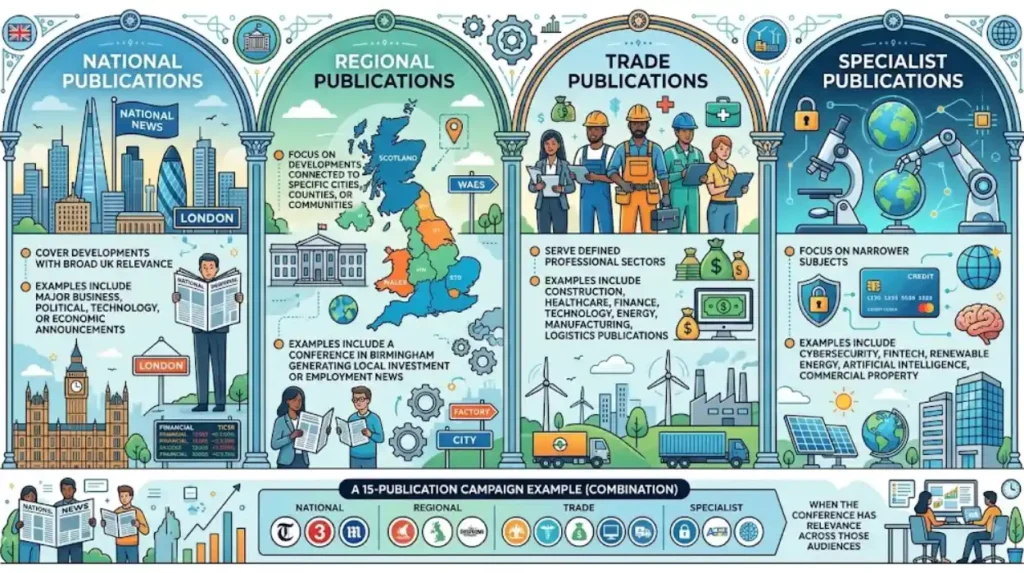
Conference news can reach several publication categories.
National publications cover developments with broad UK relevance. Examples include major business, political, technology, or economic announcements.
Regional publications focus on developments connected to specific cities, counties, or communities. Examples include a conference held in Birmingham that generates local investment or employment news.
Trade publications serve defined professional sectors. Examples include construction, healthcare, finance, technology, energy, manufacturing, and logistics publications.
Specialist publications focus on narrower subjects. Examples include cybersecurity, fintech, renewable energy, artificial intelligence, or commercial property.
A 15-publication campaign can therefore contain a combination of national, regional, trade, and specialist outlets when the conference has relevance across those audiences.
How are publications selected?
Publication selection depends on relevance, audience, geography, industry, and editorial focus.
A healthcare conference requires healthcare publications and relevant business or regional outlets. A construction conference requires construction media and publications covering property, infrastructure, engineering, or regional development.
Geographic relevance also matters. A conference in Manchester with a significant local economic announcement has a clear connection to Greater Manchester publications.
The objective is not simply to count 15 websites. The publications need a logical relationship with the conference subject and its news development.
What happens after conference news is distributed?
After conference news is distributed, publications receive the information, evaluate its relevance, verify details where necessary, and decide whether to publish. Published coverage can appear as event news, industry reporting, announcement coverage, interviews, or summaries of significant conference developments.
Distribution does not mean that every publication produces an identical story. Editorial teams control publication decisions, headlines, article length, images, quotations, and publication timing.
Some outlets publish shortly after receiving the information. Others use the information as part of a broader article or sector report.
How do journalists evaluate conference information?
Journalists assess several factors when reviewing conference news.
News value determines whether the information contains a meaningful development.
Relevance determines whether the subject matches the publication’s audience.
Accuracy determines whether claims can be supported by reliable information.
Timeliness determines whether the development is current enough for publication.
Clarity determines whether the journalist can quickly understand the story.
For example, a conference announcing a new UK manufacturing investment contains clear financial and economic information. A publication covering British manufacturing can identify the relevance immediately.
Why do publication formats differ?
Every publication has its own editorial structure and audience.
One article can focus on a corporate announcement. Another can report on a conference speaker’s comments. A third can highlight a research statistic. A fourth can connect the event to regional economic activity.
This produces different forms of conference media coverage from the same underlying event.
The difference is important because conference coverage is not simply a repeated copy of one event description. Editorial context determines how information appears to each audience.
What information helps a conference receive wider UK coverage?
Wider UK conference coverage depends on clear news value, accurate facts, strong supporting evidence, relevant spokespeople, timely information, and appropriate publication targeting. These elements help journalists understand the development quickly and determine its relevance to their specific audiences.
Conference organisers can improve the usefulness of their media information by preparing specific, verifiable details.
Which facts are most useful?
Useful conference facts include:
- Exact conference dates and location.
- Number of attendees or participating organisations.
- Names and positions of important speakers.
- Specific research findings.
- Investment values and financial figures.
- Names of organisations involved.
- Confirmed partnerships or agreements.
- Relevant quotations from identified individuals.
- Sector statistics supporting the announcement.
- Clear information about what happens next.
Specific figures provide stronger editorial information than general descriptions.
For example, “the conference attracted more than 1,500 delegates from 22 countries” provides measurable information. “The conference attracted a large international audience” provides less usable detail.
Why are quotations important?
Quotations provide attributed commentary from identifiable individuals. A quotation normally includes the speaker’s full name, position, organisation, and relevant statement.
A strong quotation adds interpretation or context rather than repeating facts already stated in the article.
For example, a chief executive discussing the commercial significance of a new partnership provides commentary around the announcement. The factual details establish what happened, while the quotation explains its significance from the organisation’s perspective.
How does conference coverage benefit organisations and audiences?
Conference coverage extends information beyond event attendees, creates discoverable records of important developments, and connects conference activity with wider industry audiences. It also gives journalists, professionals, researchers, and businesses access to factual information after the event ends.
The primary informational benefit is reach. A conference attended by 800 people can generate information accessed by audiences far larger than the physical audience.
Coverage also creates a public record of important announcements and discussions. Published articles can document partnerships, research findings, investment decisions, leadership statements, and industry developments.
How does coverage extend conference visibility?
A conference has a defined physical or digital audience. Media coverage introduces selected conference developments to publication audiences.
For example, a London finance conference can produce coverage for financial professionals who did not attend the event. A regional technology conference can reach businesses outside the venue’s immediate audience.
This distinction separates event attendance from media exposure. Attendance requires participation in the conference. Media coverage allows people to discover specific developments through publications.
What role does coverage play after an event?
Post-event coverage provides continuing access to information.
An article published after a conference can document what was announced, who participated, and what outcomes followed. Researchers and professionals can use these reports to understand sector developments.
Conference coverage therefore remains useful beyond the event date. It records information that continues to have relevance when readers search for a company, speaker, announcement, research finding, or industry development.
Why can the same conference appear across multiple publications?
The same conference can appear across multiple publications because each outlet serves a distinct audience and evaluates the event through its own editorial focus. A single development can therefore generate national, regional, trade, financial, technology, or specialist coverage.
Multiple publication appearances do not require multiple unrelated events. One conference can contain several news angles that suit different editorial audiences.
For example, a conference announcing a renewable energy investment can interest national business media, regional publications near the project location, energy trade media, and specialist sustainability publications.
Each outlet addresses a different information need.
What determines the number of relevant publications?
The number of suitable publications depends on the conference subject, news value, geographic relevance, industry relevance, and available editorial markets.
A niche technical conference has a narrower publication universe than a major national economic summit.
A conference with strong regional, commercial, and sector relevance has more potential publication categories. For example, a UK construction conference can relate to construction media, property publications, engineering outlets, regional newspapers, business publications, and infrastructure media.
The publication count therefore reflects the breadth of the conference’s news relevance rather than the event name alone.
What is the difference between conference coverage and event promotion?
Conference coverage reports newsworthy conference developments, while event promotion communicates information designed to encourage attendance or participation. Coverage focuses on editorial relevance; promotion focuses on marketing objectives such as registrations, sponsorships, ticket sales, speakers, or event awareness.
An event promotion page can list ticket prices, registration deadlines, agenda details, venue information, and speaker biographies.
A news article focuses on developments that have editorial value.
For example, announcing that registration has opened is promotional information. Reporting that a conference revealed new research showing a measurable change in the UK market is news information.
Both forms of communication serve different purposes.
Understanding this distinction helps conference organisers separate marketing material from information that has genuine news relevance.
Explore More Expert Insights:
What News Media Coverage Means for UK Corporate Events
Why Edinburgh Events Need Coverage on 15 News Websites
What should readers understand about reaching 15 UK publications?
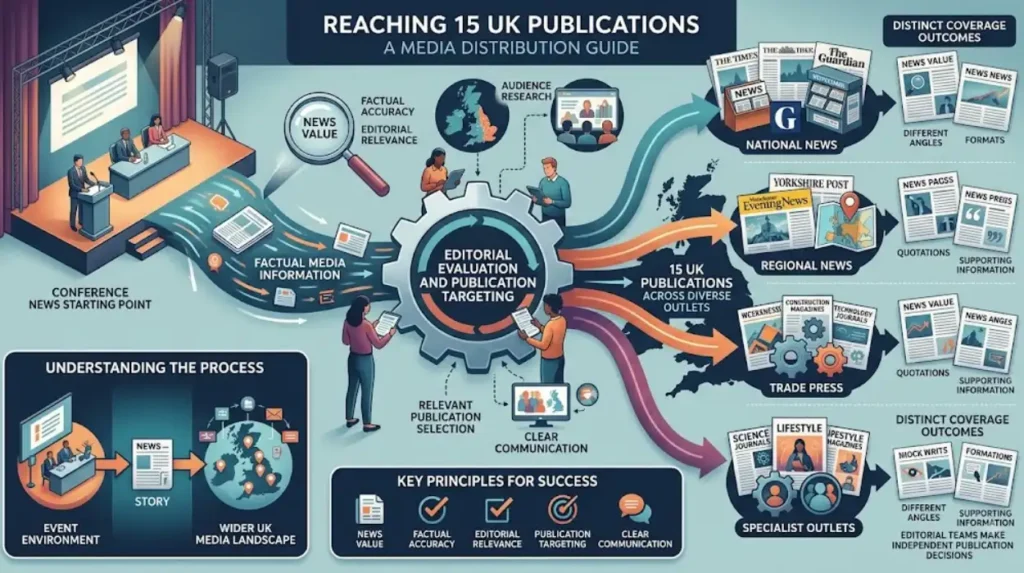
Reaching 15 UK publications is a media distribution outcome involving relevant publication selection, accurate conference information, editorial evaluation, and independent publication decisions. The process connects one conference with multiple audiences through distinct national, regional, trade, and specialist outlets.
Conference news coverage begins with a specific development. That development is converted into clear, factual media information and matched with publications whose audiences have a relevant interest.
The resulting coverage can differ by publication because editorial teams select different angles, formats, quotations, and supporting information.
Understanding the process provides a clearer view of how conference stories move from an event environment into the wider UK media landscape.
For readers examining the next stage,
Conference coverage explains how one campaign can connect the same event with multiple publications. For readers researching the practical booking stage,
Conference news coverage focuses on how publication distribution is arranged around a specific conference.
The central principle remains consistent: effective conference news coverage depends on news value, factual accuracy, editorial relevance, publication targeting, and clear communication.



