

Corporate events generate information about organisations, executives, industries, products, partnerships, awards, investments, and business milestones. News media coverage turns selected event information into published editorial content that reaches audiences beyond the people physically attending the event.
In the United Kingdom, corporate event coverage includes reporting, interviews, photographs, event announcements, industry stories, and post-event articles. Understanding how this coverage works helps event organisers distinguish between event attendance, media interest, editorial reporting, and measurable public visibility.
What does news media coverage mean for a UK corporate event?
News media coverage is editorial reporting about a corporate event published by recognised news outlets, trade publications, business websites, or regional media. It communicates verified event information to audiences beyond attendees, speakers, sponsors, and organisers.
Media coverage differs from owned event content. An organisation controls its website, blog, newsletter, and social media channels. A news publication independently selects information for editorial publication.
Corporate event coverage can focus on the event itself or on the business developments announced during it. Examples include a technology conference announcing a new product, a financial forum featuring an economic policy discussion, or an industry summit presenting new investment figures.
The published article becomes part of the event’s wider media footprint. It creates a public record of what happened and identifies the people, organisations, topics, and developments associated with the event.
What counts as corporate event coverage?
Common forms include:
- Pre-event news announcements
- Event previews
- Speaker interviews
- Executive interviews
- On-site reporting
- Product or partnership announcements
- Industry commentary
- Event photography
- Post-event reports
- Regional business coverage
- Trade publication articles
Each format serves a different editorial purpose. A preview explains why an upcoming event matters. An interview provides expert commentary. A post-event report records developments that occurred during the event.
Why does media coverage matter for UK corporate events?
Media coverage extends the reach of corporate events beyond physical attendance by distributing event information through independent publications. It increases discoverability, documents business developments, supports organisational visibility, and connects event activity with relevant industry and regional audiences.
A corporate event has a defined physical or digital audience. Media coverage creates an additional audience through publication readership, search engines, news platforms, and professional networks.
Coverage also separates event information from direct organisational messaging. A published report provides editorial context around the event, including quotations, business developments, industry trends, and relevant background.
For example, a London-based business conference attended by 300 professionals has an immediate audience of 300 attendees. A published article about the conference reaches the publication’s existing audience and remains accessible through online search after the event ends.
How does coverage affect event visibility?
Media visibility depends on the publication, topic, timing, relevance, headline, article format, and audience. National business media and specialist trade publications serve different audiences.
A corporate finance conference has greater topical relevance for financial publications than for unrelated lifestyle media. A regional manufacturing event has stronger local relevance for regional business publications and manufacturing trade media.
This relationship between subject matter and publication audience forms an important part of newsworthiness.
How do journalists decide whether a corporate event is newsworthy?
Journalists assess corporate events through newsworthiness factors such as public relevance, business impact, credible speakers, new information, timing, geographic significance, industry importance, and access to verifiable facts, quotations, data, announcements, or other reportable developments.
An event name alone does not automatically create a news story. Journalists need a clear reason for covering the event.
Newsworthiness commonly comes from several components.
What makes an event newsworthy?
New information gives journalists a specific development to report. Examples include a company investment, acquisition, product launch, research finding, funding announcement, or strategic partnership.
Prominent participants can increase editorial relevance. Examples include senior executives, government representatives, recognised researchers, industry leaders, and subject-matter experts.
Public impact connects an event with a wider audience. Topics involving employment, investment, technology, regulation, infrastructure, sustainability, healthcare, or economic activity often have identifiable public relevance.
Timing also affects coverage. An announcement linked to a current policy change, market development, industry report, or major economic event has a defined news context.
Location creates regional relevance. An event in Manchester involving local investment has a different editorial angle from a similar event in Edinburgh or Birmingham.
What happens before a corporate event receives news coverage?
Pre-event coverage begins when organisers provide journalists with relevant information about the event, its purpose, participants, announcements, location, timing, and editorial significance. Journalists then assess whether the information fits their publication, audience, timing, and reporting priorities.
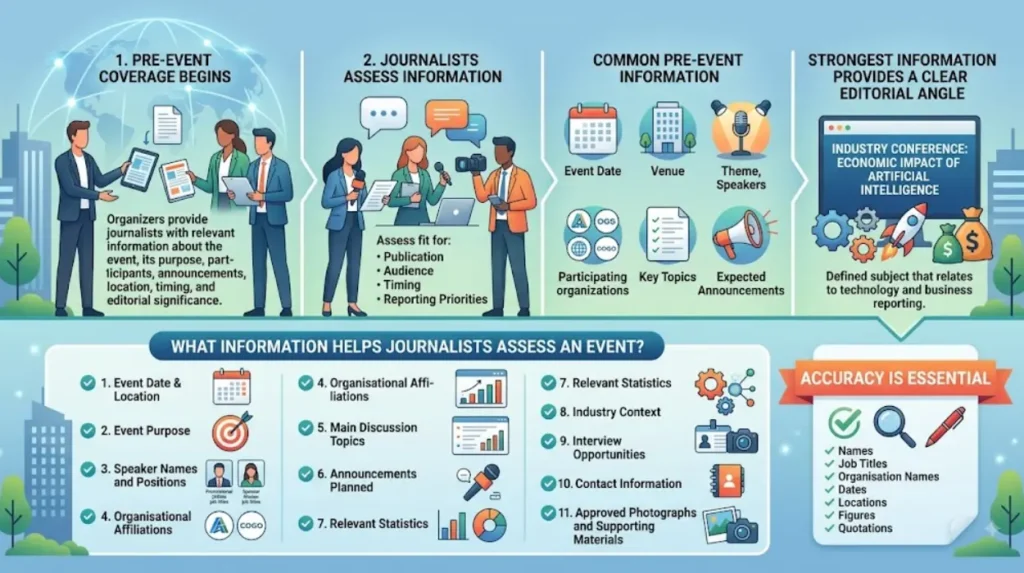
Pre-event information commonly includes the event date, venue, theme, speakers, participating organisations, key topics, and expected announcements.
The strongest information provides a clear editorial angle. For example, an industry conference focused on the economic impact of artificial intelligence has a defined subject that relates to technology and business reporting.
What information helps journalists assess an event?
Useful information includes:
- Event date and location
- Event purpose
- Speaker names and positions
- Organisational affiliations
- Main discussion topics
- Announcements planned for the event
- Relevant statistics
- Industry context
- Interview opportunities
- Contact information
- Approved photographs and supporting materials
Accuracy is essential. Names, job titles, organisation names, dates, locations, figures, and quotations require verification.
How is corporate event coverage produced during the event?
During an event, journalists gather information through observation, interviews, speeches, press materials, photographs, presentations, and verified statements. They select relevant developments and construct an article around facts that meet the publication’s editorial requirements and audience interests.
On-site coverage can produce different article formats. A journalist can report on a keynote speech, interview an executive, document a product announcement, or report on a significant industry statement.
The reporting process involves selecting information rather than reproducing the entire event programme.
What do journalists look for during an event?
Journalists typically focus on:
- New announcements
- Significant statements
- Executive comments
- Market data
- Research findings
- Policy developments
- Investment information
- Business partnerships
- Product launches
- Industry trends
For example, if a UK technology conference includes 20 presentations but one company announces a £10 million investment programme, that announcement provides a distinct business news angle.
What happens after a corporate event is reported?
Post-event coverage records significant developments after the event and places them within a wider business, industry, regional, or public context. Published reports can include event outcomes, announcements, executive quotations, attendance information, statistics, and relevant background information.
Post-event reporting often focuses on what changed or what was announced rather than simply confirming that an event took place.
A conference report can therefore explain a new partnership announced during the event. A business summit can generate coverage about investment figures. An awards event can generate stories about winning organisations and their achievements.
Why are post-event reports different from event announcements?
An announcement describes an upcoming activity. A post-event article reports what actually occurred.
This distinction affects the information available to journalists. After an event, journalists have access to confirmed outcomes, completed speeches, final attendance figures, published announcements, and direct quotations from participants.
Which types of UK media cover corporate events?
UK corporate events can attract national news outlets, regional publications, business media, trade publications, technology websites, financial media, professional journals, and specialist publications when the event’s subject matches their editorial audience and reporting priorities.
Different media categories provide different forms of visibility.
What are the main media categories?
National media covers developments with broad UK relevance. Examples include major economic, political, corporate, and public-interest stories.
Regional media focuses on geographic relevance. Examples include business developments involving organisations in Birmingham, Leeds, Glasgow, Cardiff, Manchester, or Bristol.
Trade media serves specific industries. Examples include construction, healthcare, financial services, manufacturing, technology, hospitality, and energy publications.
Business media focuses on companies, markets, leadership, investment, entrepreneurship, and economic developments.
Specialist media targets defined professional audiences. Examples include technology, cybersecurity, property, logistics, and professional services publications.
The same corporate event can therefore produce different editorial angles across media categories.
How does corporate event coverage appear in search results?
Published news coverage creates indexable content containing event names, organisation names, speaker names, topics, locations, announcements, and quotations. Search engines can use these entities and relationships to understand the event and connect relevant queries with published coverage.
Search visibility depends on factors including publication indexing, article relevance, terminology, headline structure, entity references, links, publication authority, and search demand.
A corporate event article can remain discoverable after the event date. Someone searching for an event name, speaker, company announcement, or industry topic can encounter the published article.
What information makes event coverage easier to understand?
Clear entity references improve factual interpretation. An article is more precise when it identifies the organisation, person, location, event, industry, and announcement separately.
For example, “A technology company announced a new investment” provides less specific information than an article identifying the company, investment amount, location, event, and executive responsible for the announcement.
What are the main benefits of news coverage for corporate events?
News coverage provides corporate events with editorial visibility, searchable documentation, broader audience reach, industry recognition, regional relevance, and additional context around business developments. These outcomes extend the event’s communication footprint beyond attendees and owned organisational channels.
The benefits depend on the quality and relevance of the coverage.
How does coverage support long-term event visibility?
A published article creates a permanent digital reference point while the publication maintains the content. The article can appear in search results, be referenced by other websites, and provide background for future reporting.
Coverage also connects the event with identifiable entities. These include companies, executives, industries, locations, products, partnerships, and announcements.
This creates a broader information environment around the event.
Which corporate events commonly receive news coverage?
Corporate events with clear business, industry, regional, economic, technological, or public-interest relevance commonly generate media attention. Examples include conferences, trade shows, investment forums, product launches, awards, executive summits, annual meetings, and industry exhibitions.
The strongest examples contain a reportable development or relevant subject.
What are common examples?
A fintech conference can generate coverage around financial technology regulation or investment.
A construction summit can generate reporting about infrastructure investment or housing development.
A healthcare conference can produce coverage around research, policy, technology, or healthcare delivery.
A corporate awards event can generate regional business coverage about winning companies and professional achievements.
A product launch can attract technology or trade media when it introduces a relevant product, feature, market development, or commercial announcement.
Explore More Expert Insights:
Why Edinburgh Events Need Coverage on 15 News Websites
How Birmingham Events Reach Wider Audiences Through News Coverage
How should UK corporate events be understood in relation to media coverage?
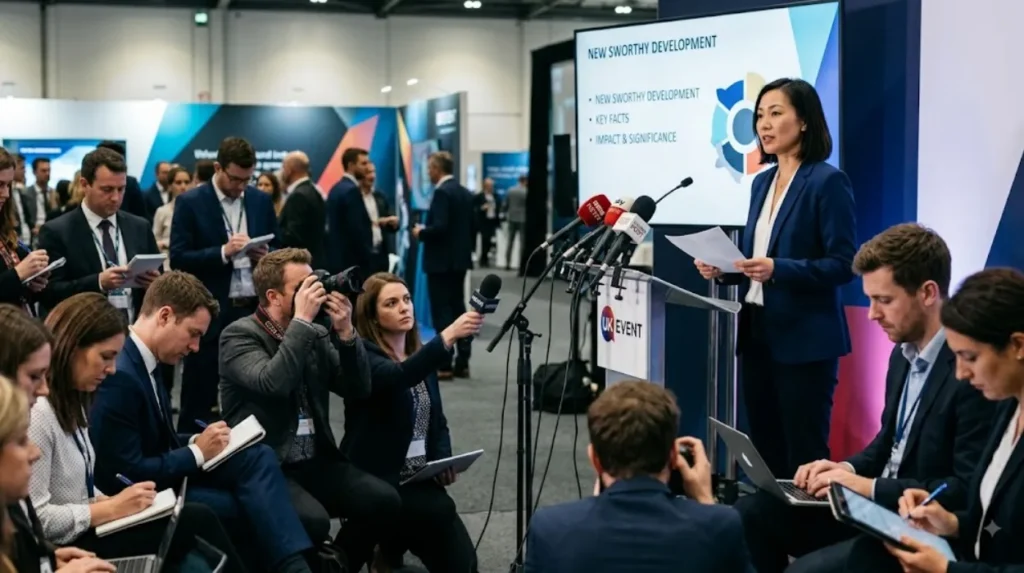
UK corporate event media coverage is an editorial process that connects event information with relevant audiences through news publications. Its value depends on newsworthiness, factual accuracy, publication relevance, timing, credible sources, and the significance of the reported development.
Understanding this process helps distinguish between hosting an event and generating news coverage about it. An event provides the setting, participants, discussions, and developments. Journalism selects and reports the information that has editorial relevance.
The process begins with identifying a newsworthy subject. It continues through information preparation, journalist assessment, reporting, publication, and search discovery.
For organisations planning corporate events, this distinction establishes the foundation for understanding how media visibility develops.
As the topic moves from basic awareness toward practical evaluation, readers can explore:
UK corporate event coverage to understand how coverage is distributed across multiple news sites. For a more action-focused perspective,
Corporate event media coverage explains the practical route from an event announcement to published media visibility.



