Birmingham is one of the United Kingdom’s largest cities and a major centre for business, culture, education, sport, technology and entertainment. Events held in Birmingham attract audiences beyond those physically attending. News coverage extends the event’s visibility by turning key developments, announcements and outcomes into information that wider audiences can discover.
News coverage refers to the publication of event-related information through newspapers, digital news publications, broadcasters, trade media and regional publications. For Birmingham events, this process connects local activity with audiences across the West Midlands and the wider United Kingdom.
Understanding how this works helps event organisers, businesses, charities, public bodies and community groups recognise the factors that determine whether an event receives broader attention.
What does news coverage mean for a Birmingham event?
News coverage means publishing verified information about a Birmingham event through relevant media outlets, allowing people beyond the physical audience to discover its purpose, participants, announcements, results and wider significance through published news content.
An event becomes a news subject when it contains information that matters to an identifiable audience. The event itself provides the setting, while the news story identifies the specific development that deserves attention.
For example, a Birmingham technology conference can generate coverage through the announcement of a new investment programme. A cultural festival can attract coverage through a major performance, community initiative or attendance milestone.
What makes an event newsworthy?
Newsworthiness describes the characteristics that make information relevant to journalists and audiences. Common factors include:
- Local relevance: The event directly affects Birmingham residents, organisations or communities.
- Public interest: The subject concerns a significant issue, development or activity.
- Timeliness: The information relates to a current or recently completed event.
- Scale: The event involves substantial attendance, investment or participation.
- Notable participants: Recognised business leaders, performers, athletes, researchers or public figures increase informational value.
- New information: Announcements, results, research findings or launches provide a specific news angle.
A Birmingham business summit, for example, becomes more news-focused when it announces a new employment initiative involving local companies and training providers.
How does Birmingham event news reach audiences outside the city?
Birmingham event news reaches wider audiences when a relevant story is prepared with clear facts, distributed to appropriate media channels, published by news organisations and discovered through search engines, social platforms, websites and digital news services.
The process starts with identifying the strongest news angle. Event organisers then prepare information that journalists can understand and verify.
A basic event announcement contains the event name, location, date, purpose, organisers and participating organisations. A stronger news story also explains what happened, why it matters and what changes or developments resulted.
After publication, digital distribution increases the number of locations where audiences encounter the information.
How does the news distribution process work?
The process generally follows five stages:
- Event development: The organisation creates or hosts an event in Birmingham.
- News identification: A specific announcement, development or outcome is selected as the story.
- Content preparation: Facts, quotes, statistics and supporting information are organised into a news format.
- Media publication: Relevant publications receive and publish the story.
- Audience discovery: Readers find the coverage through websites, search engines, social networks and news platforms.
This sequence transforms an event from a physical occurrence into searchable public information.
Which types of Birmingham events receive wider news attention?
Birmingham events across business, technology, culture, education, sport, healthcare, property and community sectors can attract wider news attention when they contain timely information with clear relevance, identifiable participants, measurable outcomes or developments that interest audiences beyond attendees.
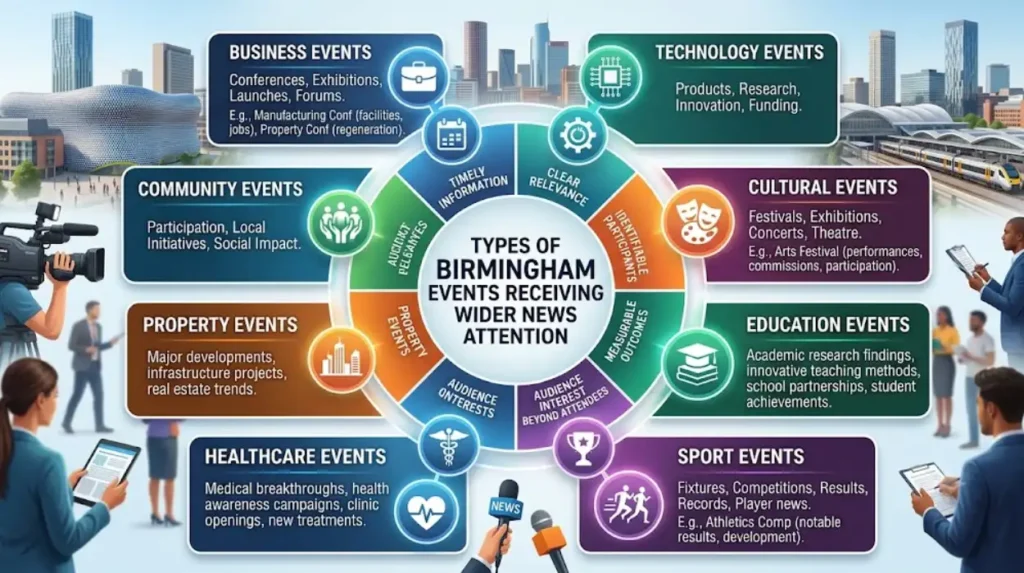
Different sectors produce different news angles. A business event often focuses on investment, expansion, partnerships or economic activity. A technology event focuses on products, research, innovation or funding.
Cultural and community events often generate stories around participation, performances, local initiatives and social impact.
Which business events generate news stories?
Business events include conferences, exhibitions, launches, networking events, investment forums and industry meetings.
For example, a Birmingham manufacturing conference can produce a news story when companies announce new facilities or employment plans. A property conference can generate coverage when developers reveal a major regeneration project.
Which cultural events attract media interest?
Cultural events include festivals, exhibitions, concerts, theatre productions and public celebrations.
A Birmingham arts festival provides multiple potential news angles. These include headline performances, new commissions, participation figures, cultural partnerships and community programmes.
Which sporting events create wider coverage?
Sporting events generate news through fixtures, competitions, results, records, player announcements and community programmes.
A Birmingham athletics competition, for example, can attract coverage when athletes achieve notable results or when organisers announce a new development programme.
Why does local relevance matter in Birmingham event coverage?
Local relevance gives Birmingham event stories a clear connection to people, organisations and communities in the city, while strong local significance provides a foundation for wider coverage when the event also contains information relevant to audiences across the United Kingdom.
Birmingham has a large and diverse economic and cultural environment. Events often involve organisations from several sectors and locations.
A local story becomes more transferable when its subject has broader implications. A new technology partnership involving Birmingham businesses, for example, has relevance for local readers and technology audiences elsewhere in the UK.
How does Birmingham connect with wider UK audiences?
Birmingham is part of a wider regional and national media environment. Stories can move from local publications to specialist publications and national news platforms when the underlying information has broader relevance.
The strongest stories do not depend only on the event location. They contain information that answers a wider question.
For example, a Birmingham employment conference can become relevant nationally when participants announce a programme addressing skills shortages affecting multiple UK industries.
What information makes Birmingham event coverage useful to journalists?
Useful event information gives journalists verified facts, specific details, relevant quotations, supporting statistics and clear context, enabling them to understand the event quickly and produce accurate coverage without searching for basic information from multiple sources.
Journalists need information that establishes what happened and why it matters. Vague promotional statements provide less usable material than specific facts.
A strong event news package identifies the central development near the beginning and supports it with evidence.
What details belong in an event news story?
Important details include:
- Event name
- Birmingham location
- Event date
- Organising body
- Main announcement or development
- Relevant participants
- Attendance figures where verified
- Financial or operational figures where relevant
- Direct quotations
- Supporting data
- Background information
- Next steps
For example, stating that 1,200 people attended a business conference provides more useful information than describing the event as “very successful”.
Why are quotations important?
Quotations provide attributed statements from identifiable people. They add context and establish responsibility for claims.
A quotation from an event organiser can explain the purpose of an initiative. A quotation from a participating business leader can explain its commercial significance.
Quotes work best when they provide information rather than repeating promotional language.
How does digital search increase the reach of Birmingham event coverage?
Digital search increases Birmingham event visibility by making published stories discoverable through relevant queries, names, locations, topics and organisations, allowing people who did not attend the event to find information after publication.
Search engines connect users with published information based on the words and concepts contained within pages.
A story about a Birmingham technology conference can become discoverable through searches involving the event name, Birmingham technology events, participating organisations or the specific announcement made at the conference.
What makes event coverage searchable?
Search visibility depends on clear and consistent information.
Relevant entities should be identified accurately. These include:
- Birmingham
- The event name
- Participating organisations
- Speakers
- Venues
- Industry sectors
- Announced projects
- Relevant locations
- Specific products or initiatives
Clear terminology helps search systems understand the subject of the article and connect it with relevant queries.
This also supports AI-driven search systems that identify entities, relationships and factual statements when generating answers.
How do regional and national publications differ in Birmingham event coverage?
Regional publications focus primarily on Birmingham and West Midlands relevance, while national publications prioritise developments with broader public, economic, cultural or sector-specific significance that connects a Birmingham event with audiences across the United Kingdom.
Regional media provide strong geographic relevance. Their audiences have a direct connection with Birmingham and surrounding areas.
National publications require a wider angle. The event must contain information that extends beyond its location.
Trade publications operate between these models. Their audience is defined by an industry rather than geography.
What role does trade media play?
Trade media covers specialist sectors such as construction, technology, healthcare, finance, manufacturing and education.
A Birmingham construction conference can therefore receive coverage in property or construction publications even when the event has limited general public relevance.
This creates another route to wider audiences. The geographic location remains Birmingham, while the audience becomes national or sector-specific.
How do event outcomes extend audience reach?
Event outcomes extend audience reach because measurable results, announcements, partnerships, awards, investments and new initiatives provide lasting news value that remains relevant after attendees leave the Birmingham venue and the event itself has ended.
The conclusion of an event does not end its news value. Announcements made during the event can generate separate stories.
For example, a conference that announces a £10 million investment programme creates information that remains relevant after the conference closes.
Which outcomes create continuing coverage?
Useful post-event developments include:
- New partnerships
- Investment announcements
- Project launches
- Employment commitments
- Research findings
- Awards
- Competition results
- Attendance records
- Community initiatives
- Future event announcements
These developments give audiences a reason to read about the event after it has taken place.
How can Birmingham event coverage reach different audience groups?
Birmingham event coverage reaches different audience groups by presenting the same verified event information through relevant geographic, sectoral and interest-based media channels, allowing local residents, businesses, professionals and national audiences to discover distinct aspects.
A single event can have several legitimate audience segments.
A business conference can interest Birmingham companies, national industry professionals, investors and policymakers. A cultural event can attract local residents, tourists, arts professionals and regional audiences.
How does audience segmentation affect coverage?
Audience segmentation identifies who needs the information.
For example:
- Local audiences: Birmingham residents and nearby communities.
- Regional audiences: West Midlands businesses and organisations.
- National audiences: UK-wide consumers and professionals.
- Trade audiences: Specialists within a particular industry.
- Interest audiences: People following a specific topic, event or participant.
Understanding these audiences helps explain why the same Birmingham event can generate different types of coverage.
What is the wider value of news coverage for Birmingham events?
The wider value of Birmingham event news coverage comes from extending information beyond attendees, creating searchable records, connecting local developments with national audiences and giving organisations, communities and industries access to verified information about significant events.
News coverage creates a public record of an event and its key developments. It also provides information for people who were unable to attend.
A Birmingham event therefore becomes more than a single physical gathering. Its announcements, participants, outcomes and relevance can remain accessible through published news content.
For readers moving from general education to the publication process,
Birmingham Event Coverage provides a natural next step. For readers examining broader distribution outcomes,
Get Birmingham Event Coverage the topic from an awareness perspective.
What should readers understand about Birmingham event news coverage?
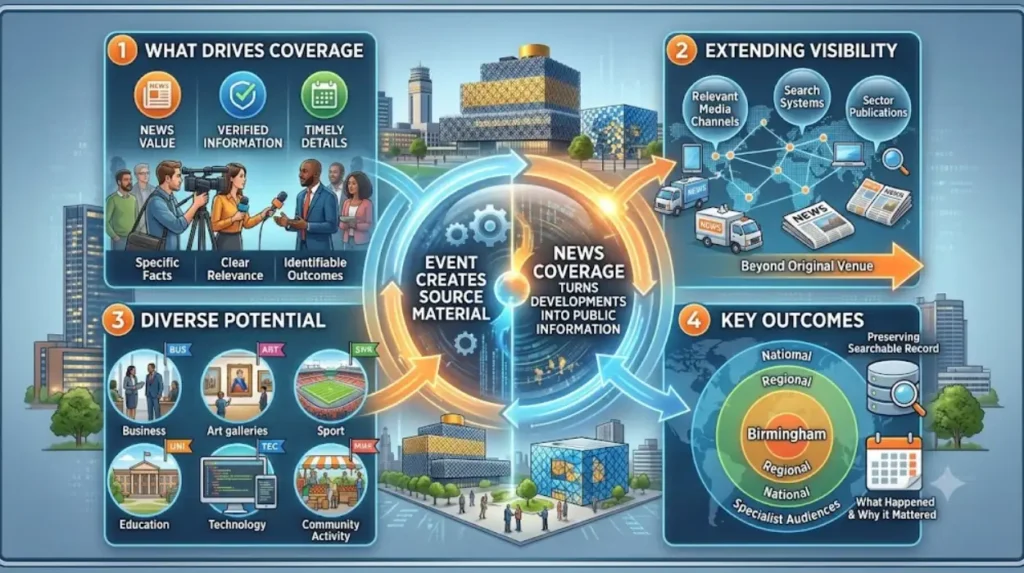
Birmingham event coverage reaches wider audiences when an event contains clear news value, presents verified information, connects with identifiable audiences and appears through relevant media channels, search systems and sector publications that extend visibility beyond the original venue.
The central principle is simple: an event creates the source material, while news coverage turns important developments from that event into accessible public information.
What should readers understand about Birmingham event news coverage?
Birmingham event coverage reaches wider audiences when an event contains clear news value, presents verified information, connects with identifiable audiences and appears through relevant media channels, search systems and sector publications that extend visibility beyond the original venue.
The central principle is simple: an event creates the source material, while news coverage turns important developments from that event into accessible public information.
Explore More Expert Insights:
Why Manchester Events Deserve National News Coverage in 2026
How London Events Get Covered Across 15 UK News Sites
Birmingham’s business, cultural, sporting, educational, technological and community activity creates many potential news subjects. The strongest coverage depends on specific facts, clear relevance, timely information and identifiable outcomes.
This process connects local events with regional, national and specialist audiences while preserving a searchable record of what happened and why it mattered.