London event coverage reaches multiple news sites through coordinated press release distribution, editorial targeting, publication scheduling, and digital syndication. A single approved announcement enters a distribution network that sends the same core information to selected UK media outlets.
London has a dense and diverse media environment. Event organisers can target national publications, London-focused news sites, regional outlets, business media, lifestyle publications, and specialist trade websites.
Simultaneous coverage does not mean that 15 journalists independently discover and write about the same event at exactly the same time. It refers to coordinated distribution across a network of media destinations.
The process begins with a newsworthy event announcement. The announcement is formatted as a press release, reviewed for accuracy, and distributed through a media network. Each destination receives the core story within the same distribution cycle.
For example, a London technology conference announcing its keynote speakers can be distributed to technology publications, London business websites, event-focused publications, and broader UK news platforms.
This approach differs from traditional one-to-one media pitching. Instead of contacting each publication separately, distribution provides structured access to multiple outlets through one coordinated release.
For readers moving from general education into solution evaluation, understanding:
London event coverage helps clarify how media distribution networks operate and where different publication types fit.
What happens when a London event press release enters a distribution network?
A London event press release passes through preparation, verification, targeting, distribution, publication, and monitoring stages. Each stage controls how the announcement reaches media websites and how resulting coverage is identified, recorded, and assessed.
The distribution process contains several connected steps.
1. Event information is prepared
The organiser provides the essential event details. These include the event name, date, location, purpose, speakers, organisers, registration information, and relevant announcement.
The release needs a clear news angle. A generic statement about an upcoming event provides limited editorial value. A specific announcement provides stronger context.
Examples include:
- A London conference announces a new keynote speaker.
- A business summit publishes its 2026 agenda.
- A charity event announces a major fundraising target.
- A technology event reveals a new industry partnership.
- A cultural festival confirms its programme.
2. The release is structured for media distribution
The press release normally contains a headline, summary, main body, quotations, company or organiser information, and contact details.
Digital distribution also requires accurate links and media assets where relevant.
The structure helps publications process the announcement quickly. It also creates a consistent source document for syndicated coverage.
3. Relevant media destinations are selected
The distribution network identifies publications according to geography, industry, audience, and content relevance.
For London events, geographic relevance is important. A London business event has a different media profile from a London music festival or healthcare conference.
The same event can therefore enter several publication categories without changing its fundamental announcement.
4. The release is distributed
The completed release enters the media distribution network. Participating outlets receive the content according to the network’s distribution process.
This is the stage that creates simultaneous or near-simultaneous availability across multiple news sites.
5. Coverage is monitored
After distribution, published pages are identified and recorded.
Monitoring separates confirmed online coverage from distribution activity. A release being sent to 15 destinations does not automatically mean 15 independent editorial articles exist.
This distinction is important when evaluating media performance.
Which types of London news sites can publish event coverage?
London event announcements can reach national, regional, business, lifestyle, trade, technology, entertainment, and specialist news sites. Publication selection depends on the event topic, audience, geographic relevance, editorial requirements, and distribution network.
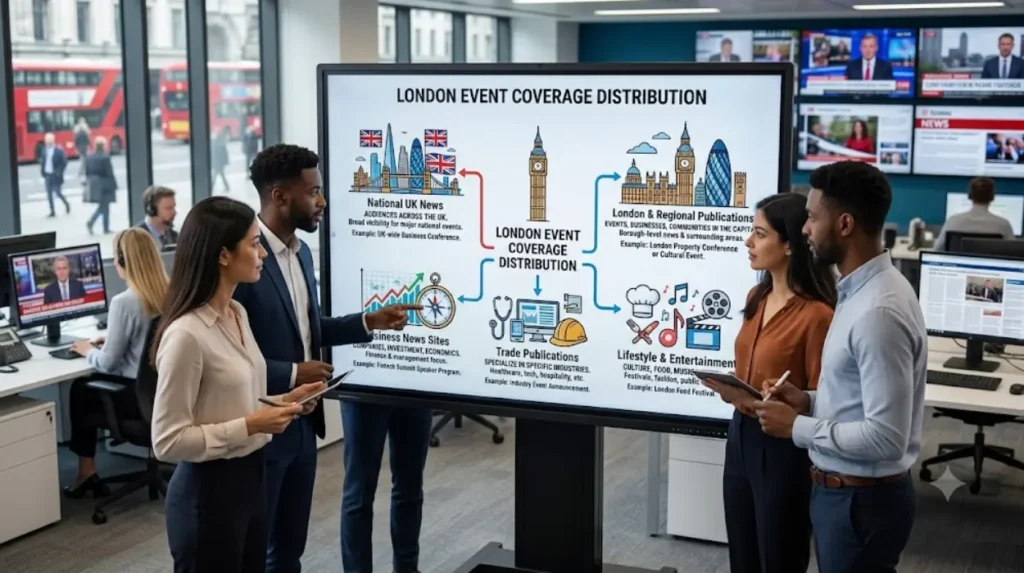
Each publication category serves a different audience.
National UK news sites
National publications address audiences across the United Kingdom. They provide broad visibility when an event has significant national relevance.
For example, a UK-wide business conference has stronger national relevance than a small local networking event.
London and regional publications
London-focused websites concentrate on events, businesses, communities, and developments within the capital.
A London property conference, borough-level cultural event, or local business initiative fits this category.
Regional distribution also helps connect event announcements with audiences in specific parts of London and surrounding areas.
Business news sites
Business publications focus on companies, investment, entrepreneurship, finance, management, and economic developments.
A London fintech summit announcing its speaker programme has a clear business-media context.
Trade publications
Trade publications specialise in specific industries.
Examples include healthcare, technology, construction, finance, education, hospitality, and professional services.
An event announcement gains stronger relevance when the publication’s audience matches the event’s subject.
Lifestyle and entertainment publications
Lifestyle and entertainment sites cover subjects such as culture, food, music, fashion, leisure, and public events.
A London food festival has a different media profile from a financial services conference.
Why does one event release appear across multiple news sites?
One event release appears across multiple news sites because distribution networks syndicate or circulate approved content to participating publications. Each site receives the same core announcement, while presentation, placement, and editorial treatment vary by publication.
Syndication is the redistribution of published or supplied content across multiple media platforms.
This model provides scale without requiring an organiser to create 15 separate press releases.
The core information remains consistent. The event name, date, location, organiser, announcement, and quotation maintain the same factual basis.
Publication treatment differs according to the website.
One site can publish the full release. Another can display a shortened version. A third can place the announcement within a business news section.
This creates an important distinction between distribution reach and independent editorial coverage.
Distribution reach describes the number and type of media destinations receiving the announcement.
Editorial coverage describes content produced or independently selected by a publication.
For media reporting, these metrics need separate labels.
What determines whether an event is suitable for 15-site distribution?
Event suitability depends on news value, audience relevance, geographic connection, factual clarity, timing, and publication requirements. A distribution strategy works best when the event announcement contains a specific development that matters to defined London or UK audiences.
Several factors determine distribution suitability.
News value
The announcement needs a clear reason for publication.
New speakers, partnerships, programmes, awards, funding, venues, attendance milestones, or major event developments provide identifiable news angles.
Geographic relevance
London provides a strong geographic identifier.
An event at ExCeL London, Olympia London, The O2, or a central London conference venue has a clear location signal. The location needs to connect to the announcement rather than appear only as a keyword.
Audience relevance
The intended audience determines publication selection.
A technology event belongs in technology-focused channels. A healthcare conference belongs in healthcare media. A London property event fits property and construction publications.
Timing
Event announcements require accurate publication timing.
A speaker announcement released six months before an event serves a different purpose from a final programme announcement released two weeks before the event.
Timing also affects the usefulness of resulting coverage.
Content quality
The release needs factual information that journalists and readers can understand quickly.
Unsupported claims, unclear dates, excessive promotional language, and missing event details reduce usefulness.
How does London event distribution differ from individual media pitching?
Distribution and individual pitching use different media access models. Distribution sends one structured announcement through a defined network, while pitching involves direct communication with individual journalists about a specific story and its editorial relevance.
Individual pitching is relationship-driven. A public relations professional identifies a journalist, reviews their recent coverage, and presents a tailored story.
Distribution is network-driven. The same approved announcement moves through a media network according to selected targeting criteria.
Both approaches serve different purposes.
A London event with a broad business audience can use distribution for scalable visibility. A major announcement requiring exclusive treatment can use direct pitching to selected journalists.
A combined strategy also exists. Distribution establishes broad availability while targeted outreach addresses priority publications individually.
The correct approach depends on the event, announcement, media objective, and required level of editorial engagement.
How should businesses measure coverage across 15 London news sites?
Businesses should measure distribution reach, confirmed publication count, publication relevance, referral traffic, backlinks, audience quality, search visibility, and resulting engagement separately. These metrics show whether media distribution produced useful exposure rather than relying only on publication volume.
A practical measurement framework includes several indicators.
Distribution reach
Record how many media destinations received the release.
This measures network distribution rather than confirmed publication.
Confirmed coverage
Record the number of live URLs carrying the announcement.
This provides a more precise measure of online publication.
Publication relevance
Classify each website by category.
For example:
- London news
- UK business
- Technology
- Finance
- Trade media
- Lifestyle
- Regional news
Referral traffic
Track visits arriving from published media pages.
Referral traffic demonstrates whether coverage generated measurable website activity.
Search visibility
Monitor indexed pages, branded searches, event-related searches, and ranking changes.
A well-structured event announcement can create additional searchable references to the event and organiser.
Conversion activity
Where tracking is available, measure registrations, enquiries, downloads, or ticket purchases attributed to media referrals.
This connects media visibility with a measurable business outcome.
When is multi-site London event coverage most useful?
Multi-site London event coverage is most useful when an organiser needs broad awareness across defined audiences and wants one announcement distributed consistently across multiple media destinations. It fits conferences, exhibitions, festivals, business events, launches, and industry gatherings.
Conferences
Business and professional conferences often require visibility among specialised audiences.
Distribution can place speaker announcements, agendas, partnerships, and programme updates across relevant business and trade publications.
Exhibitions and trade shows
Exhibitions benefit from industry-specific coverage because attendees often search for events through specialist media.
A construction exhibition, for example, has a stronger connection to construction trade media than general entertainment websites.
Cultural events
Festivals, exhibitions, performances, and public programmes can target London lifestyle and cultural publications.
The announcement needs specific information about the programme, venue, dates, and public relevance.
Corporate events
Companies organising launches, summits, awards, and business forums can use distribution to create a consistent public record of key announcements.
The strongest results come from matching the announcement with appropriate publication categories.
What should organisers check before choosing a London media distribution approach?
Organisers should check publication relevance, network size, distribution geography, sector coverage, reporting standards, monitoring capability, publication verification, and measurement options before selecting a media distribution approach for a London event.
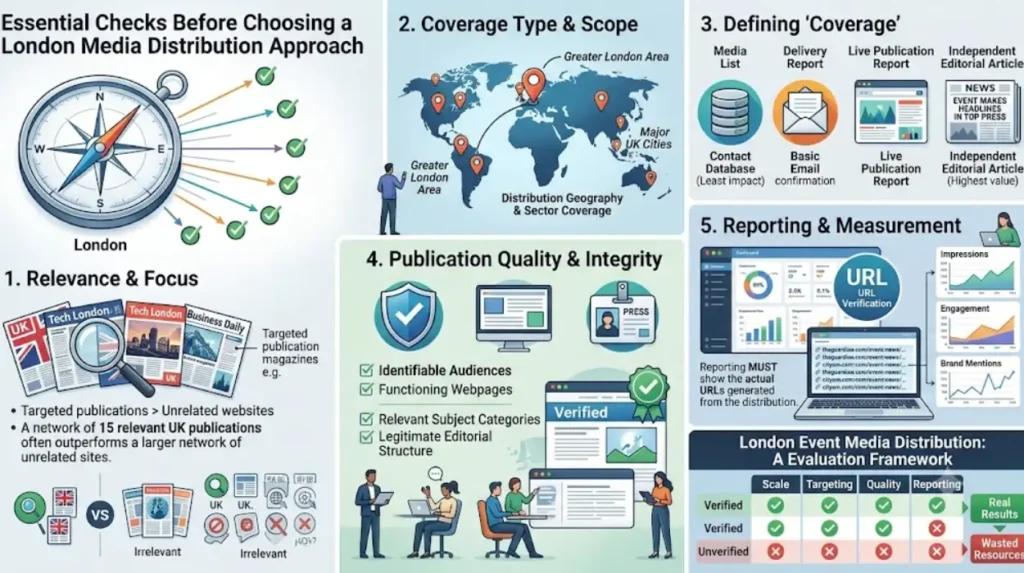
The number of destinations is only one selection factor.
A network containing 15 relevant UK publications can provide more useful coverage than a larger network containing unrelated websites.
Organisers also need to understand what the provider defines as coverage. A media list, delivery report, live publication report, and independent editorial article represent different outcomes.
Publication quality also matters. The media sites need identifiable audiences, functioning pages, relevant subject categories, and legitimate editorial structures.
Reporting needs to show the URLs generated from the distribution. This allows organisers to verify the actual outcome.
For organisations evaluating different approaches,
London event media distribution provides a practical framework for comparing scale, targeting, publication quality, and reporting.
How does 15-site coverage fit into a wider London PR strategy?
Fifteen-site coverage works as one component of a wider London PR strategy that can combine press release distribution, journalist outreach, owned content, social promotion, event partnerships, and post-event reporting to extend the announcement across multiple channels.
A media distribution campaign establishes broad availability.
Direct journalist outreach adds targeted editorial engagement.
The organiser’s website provides the authoritative event information.
Social channels extend the announcement to existing audiences.
Partner organisations provide additional distribution through their own networks.
Post-event coverage creates a second media opportunity. Organisers can announce attendance figures, awards, outcomes, partnerships, speakers, or key findings after the event.
This creates a sequence rather than a single announcement.
The educational foundation is covered in London event coverage, while the next stage focuses on comparing distribution options, publication types, and campaign structures. Organisers evaluating implementation can also review London event media distribution services when assessing available approaches.
Explore More Expert Insights:
Crisis-Proofing Your UK Event: How to Handle Negative Coverage Before It Happens
Measuring Event Media Coverage: 7 Metrics Beyond Impressions for UK Organisers
The central principle is measurement. Reaching 15 news sites simultaneously describes a distribution outcome. Evaluating those 15 sites requires additional analysis of relevance, publication status, audience, search visibility, referral traffic, and business results.
A structured approach therefore moves beyond counting websites. It connects the event announcement, selected media network, publication outcomes, and measurable audience response into one coherent media process.