London event coverage across 15 UK news sites means one event story appears across multiple British news publications through coordinated editorial distribution, creating wider visibility for the same event, announcement, speaker, venue, or organisation.
London hosts thousands of conferences, exhibitions, award ceremonies, business events, cultural programmes, launches, charity events, and public gatherings each year. These events generate information that can become relevant to different news audiences.
Coverage across multiple UK news sites does not mean that every publication independently discovers the event. A structured distribution process can provide the same core announcement to several publications while each site presents the information according to its editorial format.
The resulting coverage can include event announcements, attendance reports, speaker information, programme details, business developments, or post-event outcomes.
Why do London events attract coverage from multiple UK news sites?
London events generate newsworthy information because they involve organisations, people, locations, industries, and developments that connect with national, regional, business, cultural, and community audiences across the United Kingdom.
London is a major centre for finance, technology, government, professional services, media, entertainment, education, culture, and international business. Events connected to these sectors have multiple potential news angles.
Business and professional events
Business conferences and industry exhibitions often contain information about market developments, corporate announcements, new partnerships, expert speakers, and sector trends.
For example, a London technology conference featuring a new artificial intelligence product creates a technology-focused news angle. A financial services conference discussing regulatory changes creates a financial and business angle.
Cultural and public events
Art exhibitions, theatre programmes, festivals, charity events, and community initiatives have different editorial relevance. Local publications focus on geographic relevance, while broader publications focus on cultural significance or public interest.
Events involving recognised organisations
An event involving a major company, public institution, industry association, university, or prominent speaker has identifiable entities that make the story easier to classify and contextualise.
How does one London event reach 15 UK news sites?
A multi-site event coverage process starts with a structured event announcement, identifies relevant editorial audiences, distributes the information through a news network, and enables participating publications to publish or adapt the story for their readers.
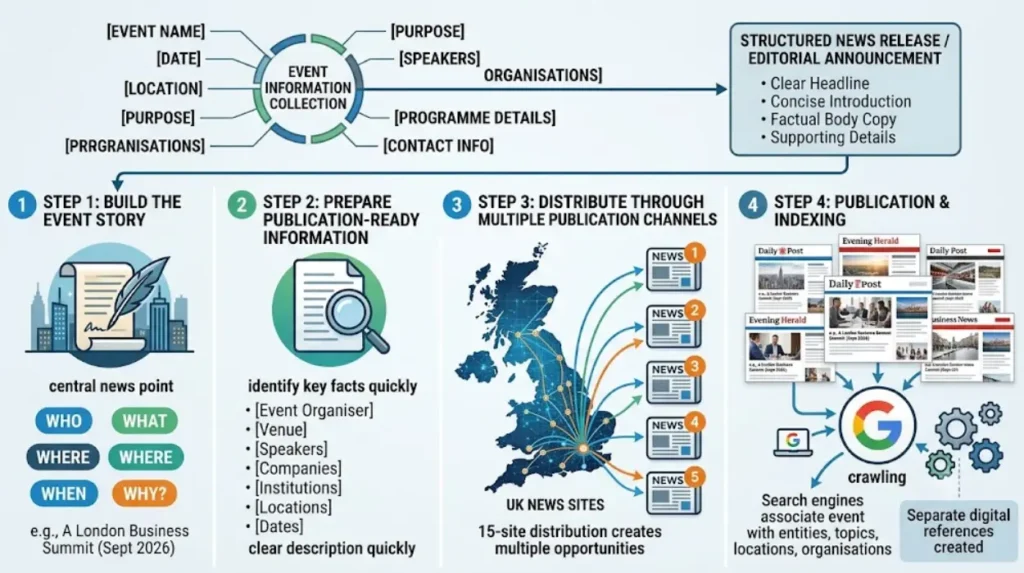
The process begins with information collection. Event organisers provide the event name, date, location, purpose, speakers, participating organisations, programme details, and relevant contact information.
The information is then structured into a news release or editorial announcement. The document needs a clear headline, concise introduction, factual body copy, and supporting details.
Step 1: Build the event story
The event story establishes the central news point. It answers essential questions such as who is involved, what is happening, where it takes place, when it occurs, and why the event matters.
For example, a London business summit scheduled for September 2026 can be presented through its participating companies, subject matter, speakers, and expected industry relevance.
Step 2: Prepare publication-ready information
The announcement is formatted so that news websites can identify the key facts quickly. Important entities receive clear descriptions.
These entities include the event organiser, venue, speakers, companies, institutions, industries, locations, and event dates.
Step 3: Distribute through multiple publication channels
The prepared story enters a distribution network containing relevant UK news websites. The network determines where the information becomes available.
A 15-site distribution creates multiple publication opportunities rather than relying on a single website.
Step 4: Publication and indexing
Once published, each article becomes an individual web document. Search engines can crawl these pages and associate the event with relevant entities, topics, locations, and organisations.
The published pages also create separate digital references to the event.
What information does a London event story need for news coverage?
A London event story needs accurate event facts, a clear news angle, identifiable participants, location details, timing, supporting evidence, and relevant context so editors and readers can understand the event without additional explanation.
The quality of event information affects how clearly a publication can present the story.
Essential event details
A complete event announcement generally includes:
- Event name
- Event date
- Event location
- Organising entity
- Event purpose
- Main speakers
- Participating organisations
- Programme or agenda
- Registration information
- Relevant industry context
- Supporting statistics
- Quotes from authorised representatives
- Contact information
Specific details make an announcement easier to process. “A major London conference” provides limited information. “A two-day fintech conference at ExCeL London on 15–16 September 2026” establishes a precise event entity.
The news angle
The event itself is not always the complete news story. The announcement needs a defined reason for publication.
Examples include a new industry conference, an important speaker joining an event, a major partnership announced at an event, the launch of a new programme, or a significant attendance milestone.
How do 15 UK news sites differ in their coverage?
Fifteen UK news sites can serve different audiences and editorial contexts, so the same London event can gain exposure through business, regional, industry, technology, cultural, or general news perspectives depending on each publication.
News websites do not all serve identical audiences. Their editorial focus influences the way an event is presented.
National news audiences
National publications address readers across the UK. They typically require a story with broad public, economic, political, cultural, or business relevance.
Regional audiences
Regional and London-focused publications emphasise geographic relevance. A Westminster conference, Canary Wharf business event, or South Bank cultural programme has a clear London connection.
Trade and specialist audiences
Industry publications focus on specific sectors. Examples include technology, finance, healthcare, construction, education, hospitality, and professional services.
An event can therefore have several legitimate editorial angles without changing its underlying facts.
What determines whether an event is newsworthy?
Event newsworthiness depends on relevance, timeliness, public interest, identifiable developments, credible participants, geographic significance, and a clear reason for publication rather than simply the existence of an event.
Newsworthiness is determined by the information contained within the event story.
Timeliness
An upcoming event has a defined publication window. Announcements released too early lack immediate relevance, while announcements released after the event lose their pre-event value.
Relevance
The event needs a connection to an identifiable audience. A London sustainability conference has stronger relevance for environmental and business readers when it includes measurable developments or recognised industry participants.
People and organisations
Speakers, sponsors, exhibitors, organisers, and participating institutions add identifiable entities to the story.
Location
London provides a specific geographic context. Venues such as ExCeL London, Olympia London, The O2, Wembley Stadium, and conference centres across central London establish clear location signals.
How does simultaneous coverage differ from ordinary event promotion?
Simultaneous coverage refers to coordinated publication across multiple news websites within a defined distribution period, while ordinary promotion relies on individual channels such as social media, email, websites, advertisements, or direct audience communication.
Social media posts reach followers. Email newsletters reach subscribers. Event websites provide official information.
News coverage creates separate editorial pages on external websites. Each page becomes an independent source containing information about the event.
This distinction matters for search visibility because a social media post and a news article have different content structures, publication environments, and indexing characteristics.
The concept of:
London event coverage reaches 15 news sites simultaneously can therefore be understood as a distribution model rather than a single promotional post.
What happens after an event is published across multiple news sites?
After publication, each news page becomes a separate online document that can be discovered, crawled, indexed, shared, referenced, or found through searches related to the event, organisation, location, speaker, or subject.
Search engines process each published page independently. They analyse content, entities, links, page structure, publication information, and relevance.
Search discovery
A reader searching for the event name can encounter coverage from more than one publication.
For example, searches involving a conference name and “London” can connect the event with published pages containing those terms and related entities.
Digital references
Multiple articles create several external references to the same event. These references establish broader online presence around the event entity.
Audience discovery
Readers who do not follow the organiser can encounter the event while reading news related to their industry, location, or interests.
Which types of London events can receive multi-site coverage?
Many event categories can generate multi-site news coverage when they contain a clear news angle, including conferences, exhibitions, awards, product launches, cultural events, charity programmes, business forums, networking events, and public-sector gatherings.
Conferences and summits
Business and professional conferences generate content through speakers, themes, sector developments, research, and announcements.
Exhibitions and trade shows
Exhibitions create stories around exhibitors, product launches, industry participation, technology demonstrations, and market developments.
Awards and recognition events
Awards events contain identifiable winners, categories, organisations, and achievements.
Cultural and entertainment events
Festivals, exhibitions, performances, and cultural programmes create local and specialist news angles.
Charity and community events
Charity campaigns and community programmes can attract coverage when they contain measurable activities, fundraising developments, participation figures, or public-interest objectives.
How does multi-site coverage support event visibility?
Coverage across multiple UK news sites expands the number of digital locations where an event appears, strengthens its searchable information footprint, and gives different audiences opportunities to discover the event through relevant news publications.
The main benefit is distribution breadth. A single event page reaches the audience of one website. Fifteen published pages create a wider publication footprint.
This does not guarantee identical audience engagement across every site. Publication readership, search demand, topic relevance, and article prominence differ between websites.
The value of multi-site coverage therefore depends on the relevance and quality of the participating publications as well as the strength of the underlying event story.
What should organisers understand before seeking UK event coverage?
Event organisers need to distinguish news distribution from advertising, prepare accurate information, define the central news angle, understand publication audiences, and evaluate coverage based on relevance, publication quality, timing, and searchable visibility.
A strong event coverage process begins before publication. Organisers need a factual event narrative and complete supporting information.
They also need to understand that distribution does not replace newsworthiness. Fifteen publication opportunities do not automatically make an event relevant to every audience.
The strongest stories connect a specific event with a specific development, person, organisation, sector, location, or public-interest issue.
For readers comparing distribution approaches,
London event coverage across 15 news sites provides the next stage of understanding around how coordinated publication works.
What is the key takeaway about London event coverage?

London events can reach 15 UK news sites through structured news distribution that transforms one factual event announcement into multiple publication opportunities, creating broader digital visibility across relevant national, regional, business, specialist, and local news audiences.
The process involves defining the event story, preparing accurate information, identifying suitable publication audiences, distributing the announcement, and monitoring resulting coverage.
Explore More Expert Insights:
Why Your Keynote Speaker Gets Zero Press Without a Dedicated Coverage Partner
From Room to Feed: How UK Event Content Travels Across 10 Platforms in 24 Hours
The number 15 represents publication breadth rather than guaranteed editorial treatment. Each news website has its own audience, format, editorial context, and publication process.
For event organisers, understanding these mechanics provides a clearer foundation for evaluating how London events become visible across the UK news ecosystem.