

Milestone press releases are structured announcements that document measurable nonprofit achievements, strengthen public credibility, and give philanthropists evidence of organisational progress, financial activity, community impact, and institutional momentum before they consider deeper engagement or significant charitable funding decisions.
A milestone press release communicates a specific organisational achievement to journalists, donors, philanthropic networks, sector publications, and other relevant audiences. It focuses on an event that demonstrates measurable progress.
Common nonprofit milestones include:
- Reaching a defined number of beneficiaries
- Completing a major community programme
- Securing a significant grant
- Launching a new regional initiative
- Achieving an independently verified impact target
- Establishing a strategic institutional partnership
- Completing a major fundraising campaign
- Publishing independently reviewed impact results
For high-net-worth individual philanthropists, the value of a milestone announcement lies in its evidence. Wealthy donors frequently assess organisational credibility before entering a funding relationship. A clear public record of achievements gives them an additional source of information beyond direct fundraising communications.
A milestone press release also creates an identifiable public entity around an organisation’s work. It connects the nonprofit with measurable outcomes, geographic communities, programme areas, leadership, partners, and beneficiaries.
This makes milestone communications relevant to the wider discovery process covered in:
Why do milestone announcements matter to high-net-worth philanthropists?
Milestone announcements matter because they convert nonprofit activity into publicly documented evidence. They demonstrate measurable outcomes, organisational continuity, leadership execution, programme reach, and institutional recognition, giving prospective philanthropists stronger information for evaluating credibility and funding relevance.
High-net-worth individual philanthropists often operate through structured giving strategies. Their decisions frequently involve research into an organisation’s mission, governance, impact, leadership, financial position, and previous achievements.
A milestone announcement supports this research by presenting a defined event with supporting facts.
Public evidence strengthens organisational credibility
A nonprofit that announces a measurable achievement creates a public information trail. The trail can include:
- Programme outcomes
- Beneficiary numbers
- Geographic reach
- Partnership details
- Funding achievements
- Independent recognition
- Leadership statements
- Future programme objectives
The announcement becomes one component of the organisation’s wider digital footprint.
For example, a UK nonprofit reporting that its education programme supported 25,000 young people in 2026 provides a specific impact metric. The number gives prospective funders a measurable point for further investigation.
Milestones demonstrate organisational execution
Philanthropists assess more than an organisation’s mission statement. They also examine whether the organisation delivers programmes consistently.
A completed initiative demonstrates execution. A documented partnership demonstrates institutional coordination. A verified impact result demonstrates measurement discipline.
These signals provide useful context when a potential donor compares several organisations working within the same philanthropic field.
How should a nonprofit structure a milestone press release for philanthropists?
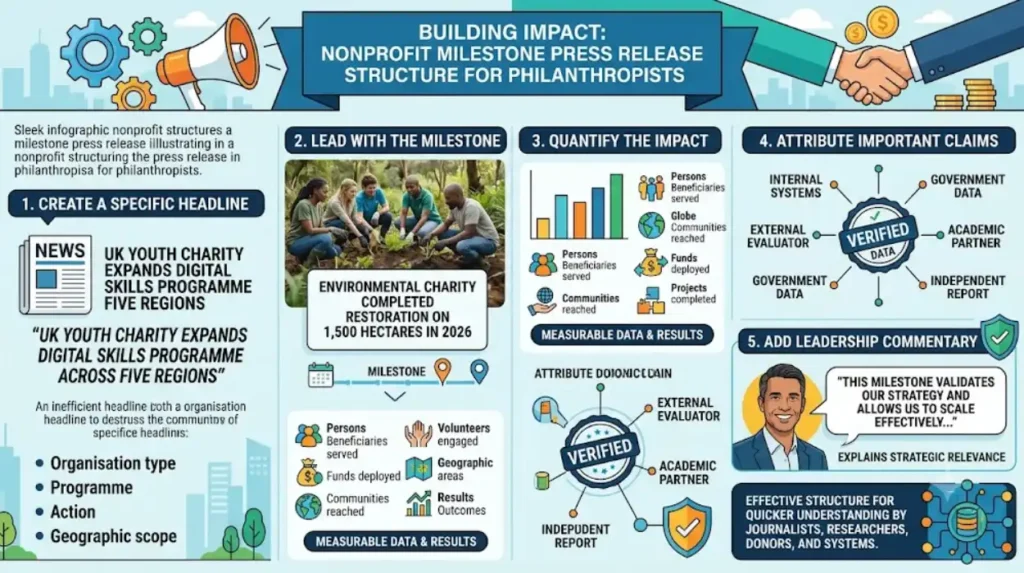
A nonprofit press release for philanthropic audiences needs a precise headline, verified milestone, measurable impact data, credible attribution, relevant organisational context, leadership commentary, supporting evidence, and a clear explanation of what the achievement means for future programme delivery.
The structure affects how quickly journalists, researchers, donors, and information systems understand the announcement.
1. Create a specific headline
The headline needs to identify the achievement.
A headline such as “UK Youth Charity Expands Digital Skills Programme Across Five Regions” communicates more information than “Charity Announces Exciting New Development.”
The stronger version identifies:
- Organisation type
- Programme
- Action
- Geographic scope
2. Lead with the milestone
The first paragraph needs to establish the core achievement.
For example:
A UK environmental charity completed restoration work across 1,500 hectares of degraded habitat during its 2026 programme.
This sentence provides a measurable event without requiring readers to interpret promotional language.
3. Quantify the impact
Numbers improve information clarity.
Useful metrics include:
- Beneficiaries served
- Communities reached
- Funds deployed
- Projects completed
- Volunteers engaged
- Geographic areas covered
- Programme completion rates
- Measured environmental or social outcomes
Each number needs relevant context.
4. Attribute important claims
Claims need identifiable sources. An impact figure can reference an internal measurement system, external evaluator, government dataset, academic partner, or independently verified report.
Attribution increases the usefulness of the announcement for due diligence.
5. Add leadership commentary
A leadership quote explains the strategic relevance of the milestone. It also identifies the person accountable for the programme.
The quote needs to provide information rather than repeat promotional statements.
Which milestones attract greater philanthropic attention?
Milestones with measurable social impact, credible independent validation, significant programme scale, sustained community outcomes, strategic partnerships, or transparent funding deployment provide stronger evidence for philanthropists evaluating whether a nonprofit delivers meaningful and accountable results.
Not every organisational event has equal informational value.
A new office opening, staff appointment, or routine internal update provides limited evidence about programme effectiveness. A verified increase in beneficiaries or measurable improvement in community outcomes provides stronger philanthropic relevance.
Impact milestones
Impact milestones document changes produced by a programme.
Examples include:
- 10,000 households receiving clean-water access
- 5,000 students completing vocational training
- 2,000 patients receiving community healthcare support
- 30% improvement in programme completion rates
The metric needs a defined measurement period.
Funding milestones
Funding announcements demonstrate financial momentum but require context.
A nonprofit announcing a £2 million programme grant provides information about external confidence and programme capacity. The announcement becomes stronger when it explains the funding purpose, delivery period, geographic scope, and expected outputs.
Partnership milestones
Strategic partnerships demonstrate institutional relationships.
Examples include a charity working with a UK university, local authority, healthcare institution, corporate foundation, or international development organisation.
The announcement needs to explain what each party contributes and what the partnership delivers.
Recognition milestones
Awards, accreditation, research recognition, and sector-level acknowledgements create additional credibility signals.
The issuing organisation needs to be clearly identified. The award category and year also need to be stated.
How can nonprofits make milestone press releases discoverable to philanthropists?
Nonprofits improve discoverability by combining specific terminology, measurable achievements, clear organisational descriptions, authoritative distribution, structured digital content, and consistent naming across public channels where philanthropists and their advisers conduct research.
Philanthropists do not rely on one information source. Their research can include nonprofit websites, annual reports, news coverage, foundation databases, professional networks, regulatory information, and sector publications.
A milestone press release needs to fit within this broader information environment.
Use entity-specific language
The organisation needs consistent naming.
A release should clearly identify the nonprofit, programme, geographic location, beneficiary group, funding partners, and relevant sector.
For example, a release about a UK homelessness programme needs clear references to homelessness services, local communities, programme funding, housing outcomes, and the geographic area involved.
Use measurable terminology
Specific terms improve information retrieval.
“Expanded support” provides limited information.
“Opened three additional community centres and increased annual service capacity from 4,000 to 6,500 beneficiaries” provides substantially more context.
Build a consistent publication record
Repeated announcements create a chronological record of organisational development.
A nonprofit can document:
- Programme launch
- Initial funding
- First measured outcome
- Regional expansion
- Partnership development
- Programme completion
- Independent evaluation
This sequence gives researchers a clearer view of organisational progress.
How does press release distribution support philanthropic discovery?
Press release distribution extends a milestone beyond the nonprofit’s owned website by placing the announcement across relevant media, information, and search environments, increasing the number of credible public touchpoints available during philanthropic research and organisational due diligence.
Distribution represents the next stage after creating the announcement.
A release published only on a nonprofit website has one primary discovery point. Distribution creates additional opportunities for the milestone to appear in relevant media and information environments.
National and regional visibility
UK nonprofits often operate within specific communities. Regional publications can provide valuable evidence of local programme activity.
For example, a charity expanding services across Greater Manchester gains relevant exposure through publications covering the region and its communities.
National coverage provides a different form of visibility. It places the milestone within a wider UK public-interest context.
Sector-specific visibility
Trade and specialist publications reach audiences with established interest in specific fields.
Examples include publications covering:
- Healthcare
- Education
- Environment
- Social care
- International development
- Community development
- Financial services
A philanthropist researching one of these areas gains more relevant information from specialist coverage than from generic exposure.
Information hubs and search visibility
Distributed press releases also contribute to the public information environment used by researchers and search systems.
The objective is not simply volume. Relevance, factual consistency, authoritative publication environments, and accurate organisational information matter more than publishing the same announcement indiscriminately.
This distinction becomes important when evaluating:
What measurable outcomes can milestone press releases produce?
Milestone press releases produce measurable communication outcomes through media mentions, referral traffic, branded searches, publication reach, backlink acquisition, stakeholder engagement, and increases in qualified enquiries linked to specific organisational announcements and campaigns.
Measurement turns a press release from a one-time announcement into an assessable communications activity.
Media coverage
Track the number of relevant publications that reference the milestone.
Separate national, regional, trade, specialist, and international coverage. This segmentation shows where the announcement achieved visibility.
Website activity
Monitor traffic generated after publication.
Useful metrics include:
- Referral sessions
- New users
- Landing-page visits
- Average engagement
- Programme-page visits
- Donation-page visits
Compare performance against the organisation’s normal traffic levels.
Branded search activity
Track searches containing the organisation’s name, programme name, or campaign name.
An increase following significant media coverage provides evidence of increased public discovery.
Qualified philanthropic enquiries
Track enquiries from:
- Private philanthropists
- Family offices
- Philanthropic advisers
- Private foundations
- Corporate foundations
- High-net-worth donor networks
The source of each enquiry needs to be recorded where attribution is available.
Conversion and relationship metrics
The ultimate value of a milestone announcement extends beyond immediate traffic.
A nonprofit can track whether public visibility leads to:
- Introductory meetings
- Due-diligence requests
- Funding discussions
- Partnership enquiries
- Repeat engagement
- Major gifts
These measures connect communications activity with fundraising development.
When should nonprofits use milestone press releases in a philanthropic strategy?
Nonprofits should use milestone press releases when they have a verified achievement that demonstrates programme progress, measurable impact, institutional credibility, funding deployment, geographic expansion, or strategic relevance to their target philanthropic community.
Timing matters because a milestone has greater informational value when the evidence is current.
A nonprofit launching a three-year programme can establish a communications sequence around defined stages rather than publishing one announcement at the end.
At programme launch
The launch establishes purpose, funding, partners, geography, and intended outcomes.
At major delivery milestones
An interim milestone demonstrates execution.
For example, a programme reaching 50% of its beneficiary target creates a clear point for public reporting.
After independent evaluation
Evaluation results provide stronger evidence than general promotional claims. The release can summarise the evaluation findings and identify the methodology.
After significant funding achievements
A major grant or philanthropic commitment creates an opportunity to explain how funding supports measurable programme activity.
At programme completion
Completion announcements consolidate the public record. They can include final outputs, measured outcomes, beneficiary data, and lessons identified through evaluation.
How can milestone press releases fit into a broader philanthropic communications strategy?

Milestone press releases work best as one part of a broader philanthropic communications system that combines impact reporting, donor research, digital visibility, direct relationship development, annual reporting, and credible third-party coverage into one consistent organisational narrative.
A press release does not replace direct donor engagement.
It supports the research environment around that engagement.
A nonprofit can connect each major milestone with its annual report, impact report, programme pages, leadership communications, case studies, and fundraising materials.
This creates consistency across public and private communications.
For organisations targeting high-net-worth individual philanthropists, consistency matters because prospective donors frequently conduct research before entering direct conversations.
The sequence is straightforward:
Milestone → Public announcement → Relevant distribution → Media discovery → Independent research → Direct engagement → Due diligence → Philanthropic relationship
Each stage provides different information.
The earlier educational stage explains how institutional funders and corporate sponsors discover less-visible advocacy projects through [grant maker discovery]. The next stage focuses on how milestone communications turn organisational achievements into discoverable evidence.
For organisations assessing distribution options, understanding [newswire services] provides the next practical step. The objective is to match the announcement, audience, geographic scope, sector relevance, and measurement framework with an appropriate distribution approach.
Explore More Expert Insights:
Crisis Communication Frameworks: Issuing Rapid Public Statements to Retain Community Trust Fast
Crafting an Authoritative Press Release Layout for Complex Policy Reform and Community Initiatives
Milestone press releases therefore function as evidence-led communications assets. Their strongest contribution to philanthropic discovery comes from measurable achievements, credible attribution, consistent organisational information, and distribution into relevant public information environments.
For UK nonprofits, this approach creates a structured connection between programme delivery, public visibility, philanthropic research, and measurable fundraising communications.



