
Donor fatigue describes declining attention, engagement, or financial support after repeated appeals for humanitarian assistance. Continuous press presence keeps an organisation visible, explains changing needs, demonstrates progress, and gives donors current reasons to remain informed and engaged.
Humanitarian organisations operate in environments where funding demands remain high while public attention shifts rapidly. Donor fatigue develops when audiences encounter repeated requests for financial support without sufficient awareness of changing circumstances, measurable outcomes, or new developments.
The issue affects individual donors, institutional funders, corporate supporters, and community fundraising networks. A donor who contributed during an emergency does not automatically remain engaged throughout the recovery period.
Press presence provides a structured communication channel for maintaining awareness. News coverage, press releases, interviews, expert commentary, and verified organisational updates keep humanitarian issues within public discussion.
Why does donor attention decline?
Donor attention declines for several identifiable reasons:
- Repeated exposure to similar fundraising appeals
- Competing humanitarian emergencies
- Economic pressure on households and businesses
- Limited information about how previous donations were used
- Reduced media coverage after the initial emergency
- Long recovery periods with fewer dramatic developments
These factors make communication continuity important. A humanitarian organisation needs to communicate beyond the initial fundraising announcement.
How does continuous press presence work for humanitarian organisations?
Continuous press presence creates a consistent flow of verified news about humanitarian activities, emerging needs, programme milestones, community outcomes, and funding requirements. It extends public awareness beyond individual campaigns and maintains an identifiable information trail.
Continuous press presence does not mean publishing identical fundraising messages every week. It means communicating legitimate developments as they occur.
A humanitarian organisation can structure its media communication around different stages of its work. An emergency response can generate an initial announcement. Subsequent updates can address beneficiary numbers, distribution progress, programme expansion, operational milestones, partnerships, and recovery activities.
This approach creates multiple news events from one broader humanitarian programme.
What does a continuous press cycle contain?
A structured press cycle can include:
- Initial response announcement — Defines the emergency, affected population, and immediate response.
- Operational update — Reports activities such as food distribution, shelter provision, medical support, or water access.
- Impact update — Provides verified figures showing programme progress.
- Community update — Explains developments affecting beneficiaries and local communities.
- Funding update — Defines remaining financial requirements and programme priorities.
- Milestone announcement — Reports completed targets or expansion into additional locations.
- Recovery update — Explains longer-term reconstruction and resilience work.
Each communication serves a distinct informational purpose.
Why does media visibility matter when humanitarian emergencies receive less attention?
Media visibility matters because public attention often decreases after an emergency leaves the immediate news cycle. Regular factual coverage keeps humanitarian needs, response activities, and unresolved challenges visible when fewer organisations compete for public attention.
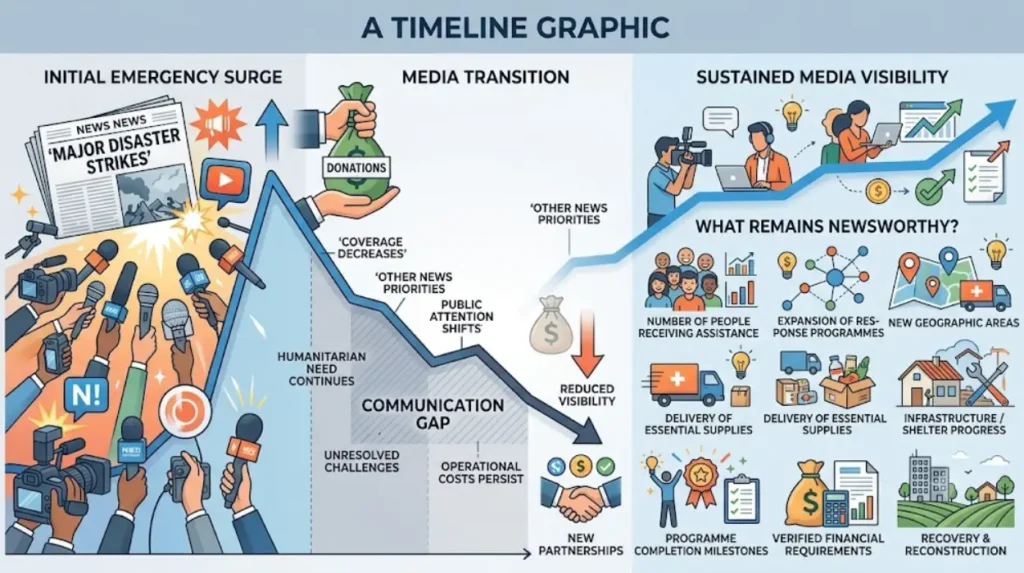
Humanitarian emergencies frequently experience an initial surge of media coverage. Major disasters, conflicts, disease outbreaks, and displacement crises attract substantial reporting when events first occur.
Coverage then changes as other events become news priorities.
This transition creates a communication gap. The humanitarian need continues, but public awareness decreases. Funding requirements therefore become less visible at the same time that operational costs continue.
Continuous press activity addresses this gap by communicating new developments rather than relying on the original emergency announcement.
What information remains newsworthy after the initial emergency?
Several developments retain public relevance:
- Number of people receiving assistance
- Changes in humanitarian needs
- Expansion of response programmes
- New geographic areas requiring support
- Delivery of essential supplies
- Infrastructure or shelter progress
- New partnerships
- Programme completion milestones
- Verified financial requirements
- Recovery and reconstruction activities
The information becomes stronger when it contains specific figures, dates, locations, and measurable outcomes.
How does continuous press presence support donor trust?
Continuous press presence supports donor trust by providing regular evidence of activity, progress, and accountability. Consistent factual reporting allows donors to understand what has changed, which programmes remain active, and how humanitarian priorities develop over time.
Trust depends on information quality and consistency. A single fundraising announcement provides limited visibility into the subsequent use of resources.
Ongoing communication creates additional opportunities to report measurable progress.
For example, an organisation responding to flooding can report that 8,500 households received emergency supplies during the first month. A later update can report the number of temporary shelters completed. A further announcement can document the transition towards permanent housing.
Each update contributes to an evidence-based public record.
Which facts strengthen humanitarian press communication?
Strong humanitarian updates generally include:
- Exact beneficiary numbers
- Specific locations
- Defined programme dates
- Quantities of supplies delivered
- Number of facilities supported
- Funding targets and remaining requirements
- Verified programme milestones
- Named institutional partnerships where appropriate
Precision reduces ambiguity. It also gives journalists, donors, researchers, and other stakeholders information that can be independently understood and referenced.
How does press continuity reduce dependence on emergency appeals?
Press continuity reduces dependence on emergency appeals by creating multiple communication opportunities throughout a humanitarian programme. Organisations can report progress, needs, outcomes, and recovery activities instead of relying on repeated messages that request immediate donations.
Emergency appeals remain important during acute crises. They are not sufficient as the only communication mechanism.
Repeated emergency appeals can create message fatigue when audiences encounter similar requests without new information. Continuous press communication introduces different factual subjects while maintaining awareness of the underlying humanitarian issue.
A programme therefore becomes a continuing news story rather than a sequence of identical fundraising requests.
What communication themes can replace repeated appeals?
Humanitarian organisations can communicate:
Response: What assistance has been delivered?
Impact: How many people have received support?
Need: Which humanitarian requirements remain unresolved?
Progress: Which programme targets have been achieved?
Accountability: What measurable outcomes demonstrate programme activity?
Recovery: What happens after immediate relief?
These themes provide distinct information while remaining connected to the same humanitarian mission.
How does continuous press presence help humanitarian organisations maintain relevance?
Continuous press presence maintains relevance by connecting humanitarian organisations with current developments, public concerns, and measurable programme outcomes. Regular news activity gives journalists and audiences new factual reasons to recognise the organisation’s work.
Relevance depends on current information. A press release published six months ago provides historical context but does not explain current programme conditions.
Regular communication creates an updated information footprint.
This footprint includes organisational announcements, media references, expert commentary, campaign milestones, and programme updates. Search engines and AI systems also encounter a larger body of structured information when assessing entities and topics.
Why does timing matter?
Timing determines whether information reaches audiences while an issue remains relevant.
A humanitarian organisation can align communications with:
- New humanitarian assessments
- Programme milestones
- Seasonal risks
- International awareness dates
- Major funding developments
- Changes in local conditions
- Completion of response phases
- Launches of recovery programmes
Timing does not require artificial news creation. It requires identifying legitimate developments that warrant public communication.
What role does press release syndication play in maintaining visibility?
Press release syndication distributes a structured announcement across multiple media and information channels. For humanitarian organisations, syndication extends the reach of verified updates and creates additional opportunities for journalists, supporters, volunteers, and researchers to discover current information.
Press release syndication involves distributing a press release through a network of media, news, and information platforms.
The value comes from distribution consistency and information accessibility. A properly structured release gives external audiences a clear description of what happened, where it happened, and why it matters.
Syndication also creates a searchable record of organisational developments.
Organisations examining longer-term communication strategies can explore:
Press release distribution through the next stage of campaign planning.
What makes a humanitarian press release useful?
A useful release contains:
- A specific headline
- A clear announcement
- Verified statistics
- Relevant dates and locations
- A concise explanation of humanitarian significance
- Statements from authorised representatives
- Supporting organisational information
- Accurate contact details
The release needs a genuine news event. Distribution does not replace newsworthiness.
How can continuous press presence support volunteer engagement?
Continuous press presence supports volunteer engagement by keeping humanitarian activities visible after initial campaigns end. Regular updates show where work continues, which programmes need participation, and how volunteers contribute to measurable humanitarian outcomes.
Volunteer recruitment and donor engagement share an important communication requirement: people need current information before taking action.
A volunteer who encounters an organisation only during an emergency receives limited information about ongoing opportunities.
Regular media activity can highlight community programmes, field operations, fundraising events, skills-based volunteering, awareness initiatives, and recovery projects.
This expands the organisation’s public narrative beyond financial contributions.
What information helps potential volunteers?
Relevant volunteer communication includes:
- Current programme locations
- Volunteer roles
- Required skills
- Time commitments
- Programme dates
- Number of volunteers required
- Community outcomes
- Training requirements
These details transform general awareness into practical understanding.
Organisations developing this stage of engagement can explore:
Volunteer sign-ups as part of post-campaign momentum planning.
How does continuous press presence support long-term humanitarian fundraising?
Continuous press presence supports long-term fundraising by maintaining awareness between major campaigns. Regular reporting demonstrates programme activity, communicates unresolved needs, and gives supporters current information before future fundraising decisions arise.
Long-term humanitarian funding requires sustained communication because programmes often extend beyond the lifespan of a single campaign.
A disaster response can move from emergency relief to temporary accommodation, healthcare support, livelihood assistance, and reconstruction. Each stage creates different funding requirements.
Continuous press activity communicates these changes.
The approach also supports financial transparency. Organisations can report progress against defined targets rather than presenting fundraising as an isolated event.
What does long-term fundraising communication need to demonstrate?
Effective communication addresses four core questions:
- What happened?
- What has been achieved?
- What remains necessary?
- What resources are required next?
Specific answers provide context for future donor decisions.
What are the main risks of inconsistent humanitarian press communication?
Inconsistent communication creates information gaps between campaigns, reduces public awareness of ongoing work, and leaves audiences dependent on older information. It also limits opportunities to report measurable outcomes and explain changing humanitarian priorities.
Silence does not necessarily mean that humanitarian activity has stopped. It means external audiences receive fewer current signals about that activity.
This creates several communication risks.
What happens when organisations communicate only during crises?
Crisis-only communication creates a narrow public information profile. Audiences primarily associate the organisation with urgent appeals.
Other aspects of humanitarian work receive less visibility.
These include prevention, recovery, community development, volunteer programmes, partnerships, operational achievements, and long-term resilience.
A continuous press strategy provides greater informational depth without requiring constant fundraising appeals.
How can humanitarian organisations maintain a sustainable press presence?
Humanitarian organisations can maintain sustainable press presence by creating an editorial calendar based on genuine programme milestones, verified data, seasonal developments, operational updates, and humanitarian priorities rather than publishing repetitive fundraising messages.
Sustainability requires planning. A press calendar can map communications across 12 months.
Each planned announcement needs a distinct factual basis.
What can a 12-month press calendar include?
A structured calendar can cover:
- Quarterly programme results
- Monthly operational milestones
- Seasonal humanitarian risks
- New programme launches
- Volunteer initiatives
- Partnership announcements
- Impact statistics
- Recovery milestones
- Annual reports
- Funding updates
This structure separates communication frequency from fundraising frequency.
An organisation can remain visible without asking for donations in every announcement.
Why is continuous press presence important for humanitarian organisations facing donor fatigue?
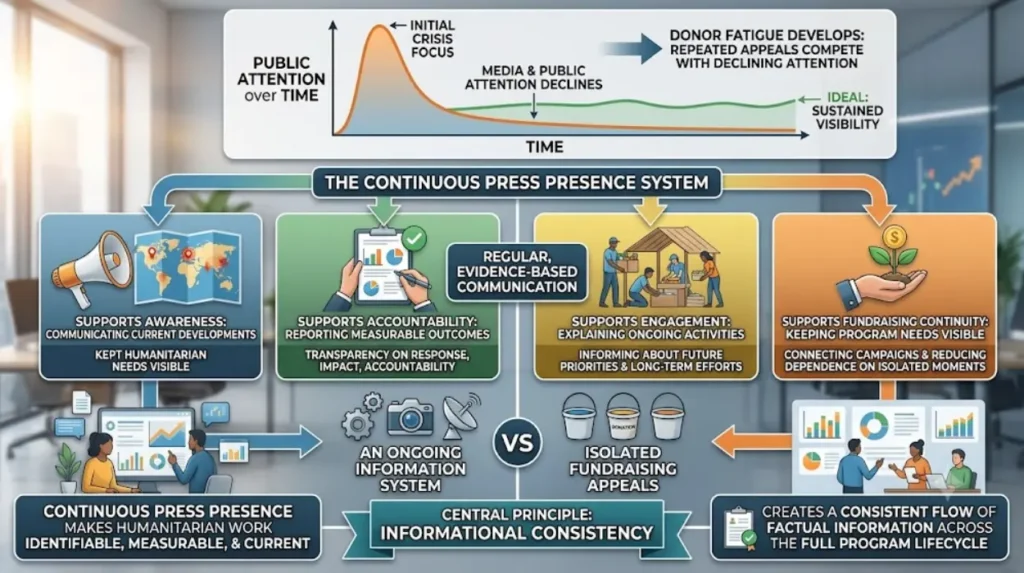
Continuous press presence is important because donor fatigue develops when repeated appeals compete with declining public attention. Regular, evidence-based communication keeps humanitarian needs and outcomes visible while providing current information about response, impact, accountability, and future priorities.
Humanitarian organisations face communication challenges that extend beyond individual fundraising campaigns. Emergencies attract intense attention, but humanitarian needs frequently continue after media interest declines.
Continuous press presence creates a consistent flow of factual information across the full programme lifecycle.
It supports awareness by communicating current developments. It supports accountability by reporting measurable outcomes. It supports engagement by explaining ongoing activities. It supports fundraising continuity by keeping programme needs visible between campaigns.
Explore More Expert Insights:
Why newly launched charities fail to secure foundational grants without a structured media footprint
The central principle is informational consistency. Humanitarian communication becomes stronger when audiences receive accurate, relevant, and current information at each stage of response and recovery.
Continuous press presence therefore functions as an ongoing information system rather than a sequence of isolated fundraising appeals. It keeps humanitarian work identifiable, measurable, and current while reducing dependence on a single moment of public attention.