Timing an announcement with global awareness days and rallies means planning press distribution around recognised public moments when audiences, journalists, organisations, and communities already focus on a specific issue. This approach aligns a message with existing attention patterns and improves relevance.
Press distribution timing is the process of selecting the most effective date and period to release information to media outlets. When organisations connect announcements with global awareness days, public campaigns, and organised rallies, they create a stronger relationship between the announcement topic and current public conversations.
Global awareness days are internationally recognised dates dedicated to specific causes, industries, or social issues. Examples include World Mental Health Day on 10 October, International Women’s Day on 8 March, World Environment Day on 5 June, and World Cancer Day on 4 February.
Rallies are organised public gatherings where communities, campaign groups, and organisations bring attention to specific issues. These events create concentrated periods of public discussion, media interest, and social engagement.
For charities, public sector organisations, and mission-driven businesses, announcement timing affects visibility. A funding announcement, research release, partnership update, or campaign launch gains stronger contextual relevance when it connects with an existing awareness moment.
Strategic timing does not replace news value. Journalists still evaluate originality, evidence, impact, and audience relevance. Awareness days create a relevant publishing environment, but the announcement requires clear information and a meaningful purpose.
How awareness moments influence media attention
Media organisations plan editorial coverage around predictable dates. Journalists often prepare features, interviews, statistics-based articles, and opinion pieces before major awareness events.
An organisation announcing a new mental health initiative during Mental Health Awareness Week provides journalists with a direct connection between the announcement and an active public discussion.
The same principle applies across sectors:
- Healthcare organisations align research updates with health awareness campaigns.
- Environmental organisations connect sustainability announcements with climate-related events.
- Charities align fundraising announcements with relevant social causes.
- Government bodies coordinate public information releases around national campaigns.
This connection helps journalists understand why an announcement matters at that specific time.
How do organisations identify the right awareness day for a press announcement?
Organisations identify the right awareness day by matching the announcement purpose, target audience, sector relevance, and media interest with a recognised event calendar. The selected date must strengthen the message rather than replace its core news value.
Selecting an awareness day requires structured research. Organisations first define the purpose of the announcement and identify the audiences that need to receive the information.
A press announcement about a new healthcare programme requires a different timing approach from a technology investment announcement. The awareness event must connect directly with the subject matter.
The process of matching announcements with awareness events
The first step involves reviewing relevant awareness calendars. Organisations analyse national and international dates connected with their sector.
Important factors include:
- Topic alignment: The awareness day must relate directly to the announcement.
- Audience relevance: The event must attract attention from the intended audience.
- Media interest: Journalists covering the topic must recognise the connection.
- Timing availability: The organisation must prepare materials before the awareness period begins.
For example, a charity launching a homelessness support programme evaluates dates such as World Homeless Day on 10 October. A financial organisation announcing financial literacy research reviews events connected with financial education and consumer awareness.
Why timing requires audience analysis
Awareness days attract different audiences. Some events receive attention from consumers, while others focus on policymakers, professionals, or specialist communities.
A public health announcement targeting NHS stakeholders requires different media planning from a consumer campaign targeting families.
Audience analysis helps organisations choose suitable distribution channels, including:
- National newspapers.
- Regional publications.
- Trade media.
- Specialist industry platforms.
- Broadcast outlets.
- Digital news platforms.
The timing decision depends on where the intended audience receives information.
How does press distribution work around global awareness days?
Press distribution around global awareness days involves preparing, scheduling, and delivering announcements during periods of increased topic awareness. Organisations coordinate media lists, content assets, journalist outreach, and publication timing.
Press distribution is the organised delivery of news materials to journalists, editors, publications, and media platforms. The process includes preparation before the awareness event and monitoring after distribution.
A successful distribution plan begins several weeks before the selected date. Organisations prepare press releases, supporting data, spokesperson availability, images, and background information.
What steps are involved in awareness-based press distribution?
The process includes five main stages:
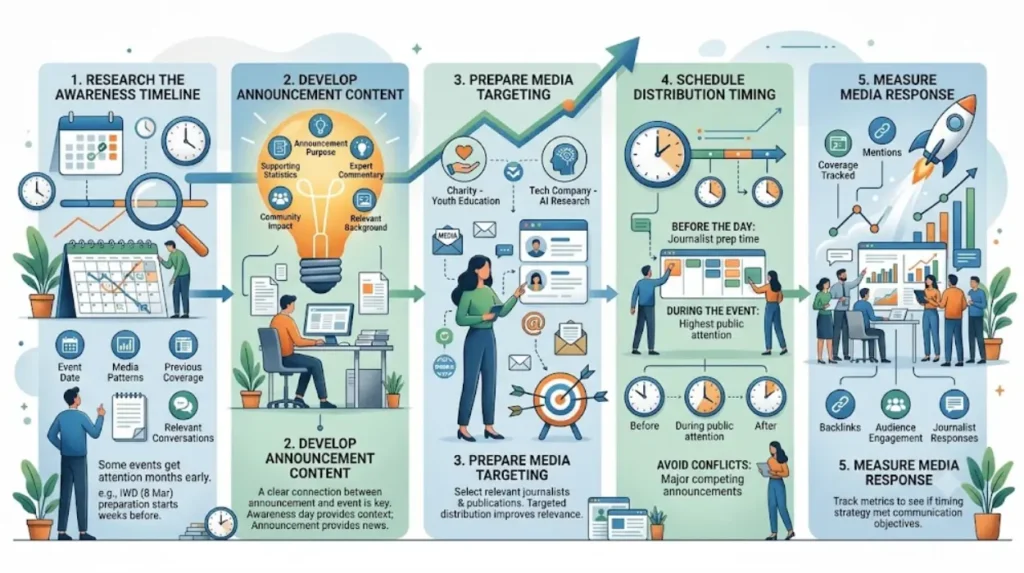
1. Research the awareness timeline
Organisations review the event date, media patterns, previous coverage, and relevant conversations. Some awareness events receive attention months before the official date.
For example, journalists often prepare International Women’s Day coverage several weeks before 8 March. Organisations publishing related announcements need early preparation.
2. Develop announcement content
The press release requires a clear connection between the announcement and the awareness event.
Effective content includes:
- The announcement purpose.
- Supporting statistics.
- Expert commentary.
- Community impact.
- Relevant background information.
The awareness day provides context. The announcement provides the news.
3. Prepare media targeting
Media targeting involves selecting journalists and publications that cover the announcement topic.
A charity announcement about youth education funding requires different media contacts from a technology company announcing artificial intelligence research.
Targeted distribution improves relevance because journalists receive information connected to their reporting areas.
4. Schedule distribution timing
Organisations select the release date based on media behaviour and audience attention.
Important timing considerations include:
- Publishing before the awareness day to allow journalists preparation time.
- Publishing during the event when public attention is highest.
- Avoiding conflicts with major competing announcements.
5. Measure media response
After distribution, organisations track coverage, mentions, backlinks, audience engagement, and journalist responses.
Measurement shows whether the timing strategy achieved its communication objectives.
What components are included in an awareness day press distribution strategy?
An awareness day press distribution strategy includes calendar research, audience identification, media targeting, content preparation, scheduling, monitoring, and performance evaluation. Each component supports stronger alignment between the announcement and public attention.
Organisations require multiple elements to coordinate an effective announcement timeline. Timing alone does not create media visibility. The complete strategy combines research, communication planning, and distribution management.
Awareness calendar research
Awareness calendar research identifies relevant dates and campaign periods. Organisations analyse established events, industry-specific dates, and public campaigns.
Examples include:
- Health awareness events.
- Environmental campaigns.
- Human rights observances.
- Education initiatives.
- Business and technology events.
The research process prevents organisations from selecting dates without a clear connection.
Media list development
A media list identifies journalists, editors, and publications relevant to the announcement.
A healthcare announcement requires healthcare journalists and medical publications. A public sector announcement requires government, policy, and regional journalists.
Media relevance improves the chance that journalists consider the announcement suitable for their audience.
Content adaptation
Different audiences require different content approaches. A press release distributed to national media focuses on broad public impact. A trade publication version includes technical details relevant to industry professionals.
Content adaptation improves understanding across different media channels.
Organisations developing a wider communication strategy often review structured approaches such as:
Why newly launched charities fail to secure foundational grants without a structured media footprint when planning announcement visibility and media engagement.
Why is timing important for charity and public sector announcements?
Timing is important for charity and public sector announcements because these organisations depend on public awareness, stakeholder trust, and media attention. Connecting announcements with relevant awareness moments creates stronger context for funding updates, campaigns, and community initiatives.
Charities and public sector organisations frequently communicate information connected with social issues. These organisations compete for attention among many announcements published every day.
Strategic timing helps create relevance by connecting the announcement with an existing public conversation.
Charity announcement examples
Charities often use awareness periods to highlight:
- New fundraising campaigns.
- Research findings.
- Community programmes.
- Volunteer initiatives.
- Impact reports.
A charity publishing a poverty research report during an economic hardship awareness campaign creates a stronger connection between data and public discussion.
However, the announcement requires original information. Awareness timing does not replace evidence or public value.
Public sector announcement examples
Public sector organisations announce:
- Government grants.
- Community investments.
- Policy updates.
- Public service improvements.
- Infrastructure projects.
Large public announcements require accurate communication, compliance checks, and suitable distribution channels. Organisations planning government-related announcements often evaluate structured approaches such as:
Public Sector Wire to understand public sector media requirements.
How can organisations avoid mistakes when timing announcements?
Organisations avoid announcement timing mistakes by maintaining news value, preparing materials early, researching competing events, and ensuring the awareness connection supports the message. Poor timing reduces relevance and creates unnecessary competition for media attention.
Awareness days attract many announcements from organisations with similar objectives. Strong preparation separates valuable information from general campaign noise.
Common timing mistakes
Organisations often experience problems when they:
- Select an awareness day without a clear connection.
- Release announcements after media planning deadlines.
- Ignore competing events.
- Use generic messaging.
- Focus only on the date instead of the audience.
For example, releasing a healthcare announcement on a major awareness day without expert commentary or supporting evidence reduces journalist interest.
Building a stronger timeline
A structured timeline improves preparation.
A typical timeline includes:
Eight to twelve weeks before release
- Select the awareness date.
- Research media opportunities.
- Prepare announcement messaging.
Four to six weeks before release
- Finalise press materials.
- Confirm spokespersons.
- Build media targeting lists.
One to two weeks before release
- Complete distribution scheduling.
- Review final content.
- Confirm supporting assets.
After release
- Monitor coverage.
- Analyse performance.
- Record lessons for future announcements.
What are the benefits of synchronising press distribution with awareness events?

Synchronising press distribution with awareness events improves message relevance, strengthens media context, supports audience engagement, and helps organisations participate in established public conversations with clearer communication objectives.
The main benefit is improved contextual relevance. Journalists and audiences understand why the announcement appears at a particular time.
Additional benefits include:
- Stronger media storytelling opportunities.
- Improved stakeholder awareness.
- Better alignment with campaign conversations.
- Increased opportunities for expert commentary.
- More effective communication planning.
Explore More Expert Insights:
How to Build an NGO Digital Press Kit that Attracts the Attention of Purpose-Driven Journalists
For charities, businesses, and public organisations, awareness-based timing provides a structured method for connecting announcements with existing attention cycles.
A successful strategy combines the right date, the right message, the right audience, and the right distribution approach. Organisations that understand these elements create announcements that contribute meaningfully to wider public conversations while maintaining clear communication goals.