

Newly launched charities struggle with foundational grants because funders evaluate credibility, public awareness, organisational transparency, and community recognition before allocating resources. A structured media footprint provides evidence that a charity exists, communicates its mission clearly, and reaches relevant audiences.
A media footprint is the collection of public-facing information channels that establish an organisation’s presence. For charities, this includes press coverage, online publications, news mentions, interviews, public announcements, and consistent digital communication.
Foundational grants are early-stage funding sources designed to help charities establish operations, deliver initial programmes, and build organisational capacity. Grant providers assess whether a charity demonstrates legitimacy, measurable purpose, and the ability to create public value.
New charities often focus heavily on registration, fundraising plans, and programme development. However, limited public visibility creates challenges during grant evaluation. Funders operate in environments where accountability, reputation, and evidence of community impact influence funding decisions.
A structured media footprint creates documented proof of activity. It connects a charity’s mission with public recognition and provides external validation beyond internal documents.
What is a structured media footprint for a charity?
A structured media footprint is a planned system of public communication that records a charity’s activities, achievements, leadership, partnerships, and community impact.
Key elements include:
- Press releases: Formal announcements about launches, programmes, partnerships, and milestones.
- Media coverage: Articles, interviews, and mentions from recognised publications.
- Digital presence: Website content, social profiles, and publicly available organisational information.
- Community communication: Updates showing engagement with beneficiaries, supporters, and stakeholders.
A structured footprint creates a consistent information trail. Grant reviewers can identify the charity’s purpose, activities, and public relevance through accessible sources.
How do grant providers evaluate newly launched charities?
Grant providers evaluate newly launched charities through organisational credibility, mission clarity, governance standards, financial transparency, and evidence of community impact. Public information supports this evaluation by showing whether the organisation communicates consistently and operates with accountability.
Grant assessment processes involve multiple factors. Funders review applications, financial records, governance documents, strategic plans, and evidence of programme delivery.
For newly established charities, historical evidence is limited. Unlike established organisations with years of reports and measurable outcomes, new charities need alternative indicators of reliability.
Public visibility becomes one of these indicators. Media coverage and documented announcements demonstrate that the organisation actively communicates its purpose and engages external audiences.
What factors influence foundational grant decisions?
Common grant evaluation factors include:
Organisational identity:
Funders examine whether the charity has a clearly defined mission, registered status, leadership structure, and operational purpose.
Governance framework:
Grant providers assess trustees, policies, risk management procedures, and accountability systems.
Programme relevance:
Funders analyse whether proposed activities address specific social issues and community needs.
Evidence of engagement:
Public communication demonstrates interaction with beneficiaries, partners, and supporters.
Reputation indicators:
Independent mentions, interviews, and community recognition contribute to external credibility.
A charity without visible public activity often relies only on self-provided information. A structured media footprint adds external references that strengthen organisational transparency.
Why does media coverage influence charity credibility?
Media coverage influences charity credibility because independent publications provide external recognition of an organisation’s mission, activities, and achievements. Public mentions create evidence that stakeholders beyond the charity understand and acknowledge its purpose.
Credibility is a critical factor in early charity development. Funders, partners, volunteers, and donors need confidence that an organisation can deliver meaningful outcomes.
Media coverage does not replace governance documents or financial evidence. It supports these materials by providing public context.
A charity announcement published through credible channels creates a permanent record. This record helps explain:
- When the charity launched.
- Which communities it serves.
- What programmes it provides.
- Which partnerships it develops.
- What milestones it achieves.
How does public recognition support trust building?

Public recognition reduces information gaps between charities and external stakeholders.
A newly launched charity often has limited operational history. External audiences cannot rely on long-term performance records. Public communication provides visibility into current activities and organisational direction.
Examples of trust-building content include:
- Announcing a new community initiative.
- Sharing results from an early pilot programme.
- Highlighting partnerships with local organisations.
- Publishing leadership statements about social objectives.
Consistent communication creates a documented timeline of organisational development.
What happens when charities lack a consistent media presence?
Charities without a consistent media presence face difficulties demonstrating legitimacy, communicating impact, and establishing recognition among funders. Limited visibility reduces available evidence about organisational activity, leadership credibility, and community engagement.
A lack of media presence does not automatically indicate poor performance. However, it creates challenges during competitive grant processes where many organisations apply for limited funding opportunities.
Grant reviewers often compare charities working in similar areas. Organisations with clear public documentation provide easier access to information about their objectives and achievements.
New charities without structured communication often experience several challenges.
How does limited visibility affect funding opportunities?
Limited visibility affects funding opportunities by reducing public evidence of organisational progress.
Common challenges include:
Lower recognition:
Funders and stakeholders have fewer external references when assessing the organisation.
Reduced awareness:
Potential partners and supporters have limited information about programmes and activities.
Weak impact documentation:
Early achievements remain less visible without public records.
Limited stakeholder confidence:
External audiences receive fewer signals about organisational development.
A structured media footprint creates continuity between a charity’s internal operations and external reputation.
How does a media footprint support charity grant applications?
A media footprint supports charity grant applications by providing documented evidence of activity, public engagement, organisational milestones, and community relevance. It strengthens application narratives by connecting written proposals with publicly available information.
Grant applications require clear explanations of need, objectives, delivery methods, and expected outcomes. Supporting evidence improves the overall understanding of a charity’s activities.
Media assets provide additional context for application reviewers.
For example, a charity applying for a community development grant can reference public announcements about programme launches, partnerships, and beneficiary engagement.
What types of media assets support grant credibility?
Important media assets include:
Launch announcements:
These introduce the charity’s purpose, leadership, and target communities.
Programme updates:
These explain ongoing initiatives and operational progress.
Impact stories:
These describe measurable outcomes and community experiences.
Partnership announcements:
These demonstrate collaboration with recognised organisations.
Expert commentary:
These position charity representatives as knowledgeable voices within their field.
These assets create a structured information environment around the organisation.
Why is timing important when charities communicate their mission?
Timing is important because charity announcements gain stronger relevance when connected with public conversations, awareness campaigns, and community events. Strategic timing improves visibility by aligning organisational messages with existing audience interest.
Charities operate within wider social and public contexts. Awareness days, national campaigns, policy discussions, and community movements create opportunities for relevant communication.
A structured communication approach considers when audiences are most engaged with specific causes.
For example, an environmental charity launching a conservation initiative gains contextual relevance when communication aligns with environmental awareness periods.
How do awareness events affect charity communication?
Awareness events create concentrated public attention around specific issues.
Relevant examples include:
- Mental health awareness campaigns.
- Disability inclusion events.
- Climate action initiatives.
- Poverty reduction campaigns.
Charities that understand communication timing can present their work within broader public discussions.
Those exploring strategic announcement planning can reviewL:
Announcement timing strategies to understand how awareness periods influence public engagement.
What role does transparency play in charity funding decisions?
Transparency plays a central role in charity funding decisions because funders require evidence of responsible management, clear objectives, and accountable operations. Public communication supports transparency by making organisational information accessible to external audiences.
Transparency includes accurate reporting, clear governance information, financial responsibility, and open communication about activities.
For newly launched charities, transparency helps establish confidence before extensive operational history exists.
How can charities demonstrate transparency publicly?
Charities demonstrate transparency through:
- Publishing organisational information.
- Sharing programme updates.
- Communicating partnerships.
- Reporting measurable outcomes.
- Explaining funding usage.
A structured media footprint supports this process by creating accessible records of organisational development.
Explore More Expert Insights:
The direct impact of earned media coverage on building community trust during policy advocacy shifts
How can charities build a foundation for long-term public recognition?
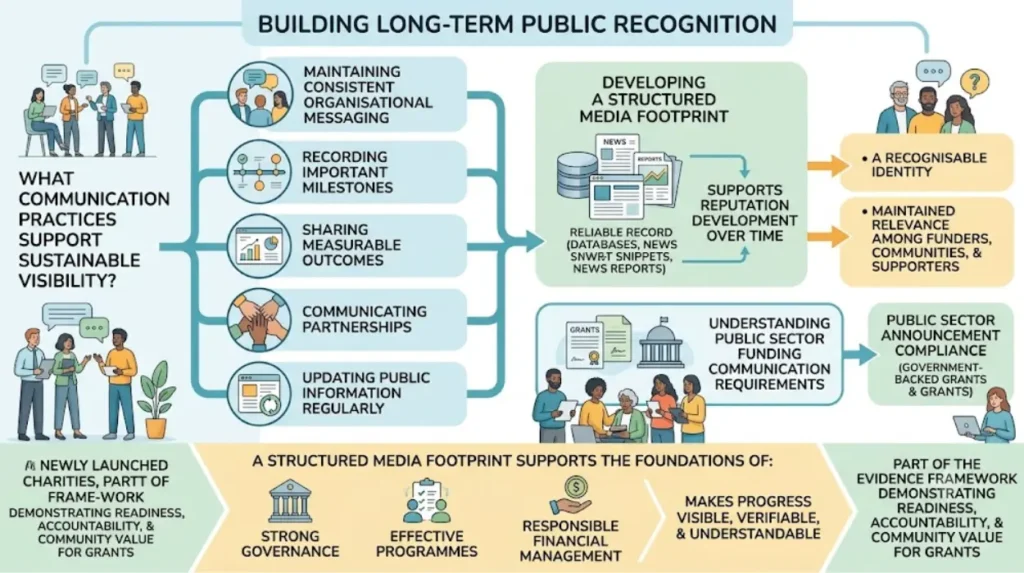
Charities build long-term public recognition through consistent communication, accurate storytelling, documented achievements, and continuous engagement with communities and stakeholders. A structured media footprint creates a reliable record that supports reputation development over time.
Long-term recognition requires planned communication rather than isolated announcements.
A charity’s public presence develops through repeated evidence of activity and impact.
What communication practices support sustainable visibility?
Effective practices include:
- Maintaining consistent organisational messaging.
- Recording important milestones.
- Sharing measurable outcomes.
- Communicating partnerships.
- Updating public information regularly.
These practices help charities develop a recognisable identity and maintain relevance among funders, communities, and supporters.
Understanding public sector funding communication requirements also connects with future considerations around:
Public sector announcement compliance when charities receive significant government-backed grants.
A structured media footprint does not replace strong governance, effective programmes, or responsible financial management. It supports these foundations by making organisational progress visible, verifiable, and understandable to external audiences. For newly launched charities seeking foundational grants, public recognition forms part of the evidence framework that demonstrates readiness, accountability, and community value.



