
Policy advocacy shifts often change public expectations, stakeholder priorities, and community conversations. During these periods, earned media coverage helps organisations communicate verified information through independent editorial channels. This process strengthens transparency, improves public understanding, and supports long-term community trust when communication remains consistent, evidence-based, and relevant.
What is the direct impact of earned media coverage during policy advocacy shifts?
Earned media coverage strengthens community trust by increasing independent visibility, improving public understanding, reinforcing organisational credibility, encouraging transparent communication, and expanding access to verified information through trusted editorial platforms during periods of policy change and public discussion across different stakeholder groups.
Earned media refers to editorial coverage that journalists, broadcasters, or publishers produce independently because they consider a story newsworthy. Unlike advertising, organisations do not purchase editorial decisions.
Policy advocacy shifts refer to changes in legislation, public policy priorities, regulatory frameworks, or government strategies that influence communities, charities, campaign groups, public institutions, and advocacy organisations.
Community trust describes public confidence that an organisation communicates honestly, acts consistently, and provides reliable information.
When these three elements intersect, earned media becomes an important communication channel. Independent reporting gives audiences additional confidence because editorial content passes through journalistic review before publication.
Examples include:
- National newspapers reporting on proposed environmental legislation.
- Local radio stations covering changes to community healthcare services.
- Regional broadcasters explaining housing policy reforms.
- Specialist trade publications analysing education funding updates.
Each example provides audiences with independently verified information rather than organisational self-promotion.
Why does independent media coverage increase community trust?
Independent journalism increases community trust because editorial review adds external verification, factual reporting improves transparency, consistent reporting reduces uncertainty, and recognised news publications provide familiar information sources that audiences regularly use for understanding complex public policy developments and community issues.
Trust develops through repeated exposure to reliable information.
Independent media organisations follow editorial standards that include:
- Fact verification
- Source confirmation
- Editorial oversight
- Corrections policies
- Public accountability
These standards distinguish earned media from promotional communications.
Editorial independence creates additional credibility
Journalists evaluate information before publication. They interview multiple sources, examine evidence, and provide context.
This process creates editorial independence.
Readers understand that publication results from editorial judgement rather than financial payment.
Transparency supports informed communities
Transparent reporting explains:
- Why policy changed
- Who is affected
- What implementation involves
- When changes begin
- How communities respond
Complete explanations reduce confusion during policy transitions.
Repeated exposure reinforces confidence
Trust rarely develops after one article.
Communities often encounter repeated reporting through:
- Local newspapers
- National broadcasters
- Community publications
- Specialist magazines
- Online news websites
Consistent reporting improves familiarity with verified information over time.
How does earned media support policy advocacy communication?
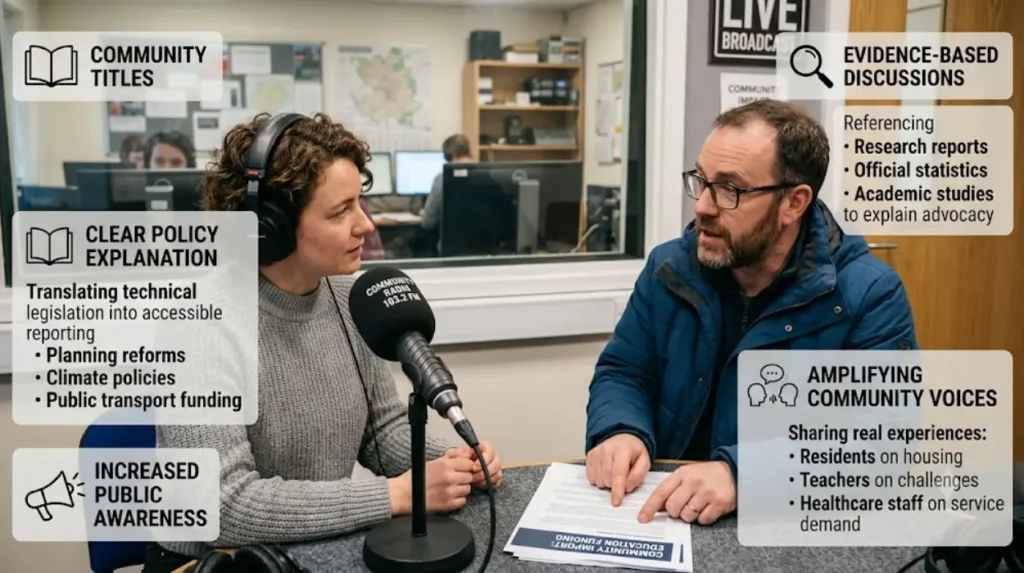
Earned media supports policy advocacy by explaining policy objectives, presenting verified evidence, highlighting community experiences, increasing public awareness, encouraging informed discussion, and connecting expert perspectives with broader audiences through trusted editorial reporting across multiple media formats and regions.
Policy advocacy often involves complex information.
Editorial reporting simplifies technical language while maintaining factual accuracy.
Explaining policy changes clearly
Many policy documents contain technical terminology.
Journalists translate legislative language into accessible reporting that communities understand more easily.
Examples include:
- Planning reforms
- Climate adaptation policies
- Public transport funding
- Social care regulation
- Education policy updates
Accessible reporting increases public understanding.
Presenting evidence
Policy discussions rely on evidence.
Evidence includes:
- Research reports
- Official statistics
- Public consultations
- Independent reviews
- Academic studies
Earned media frequently references these materials to explain why advocacy campaigns exist.
Including community voices
Community trust increases when reporting includes real experiences.
Examples include:
- Residents discussing housing conditions.
- Teachers explaining classroom challenges.
- Healthcare professionals describing service demand.
- Charity leaders discussing community programmes.
These perspectives help audiences understand practical impacts.
Readers seeking practical communication resources can later explore:
NGO Digital Press Kit after understanding the foundations of earned media communication.
What components make earned media trustworthy?
Trustworthy earned media combines editorial independence, factual accuracy, reliable evidence, expert commentary, transparent sourcing, balanced reporting, relevant local context, and consistent publication standards that help audiences evaluate information confidently during public policy discussions and advocacy campaigns across different sectors.
Several components influence credibility.
Editorial standards
Professional journalism includes:
- Verification
- Attribution
- Context
- Corrections
- Accountability
These standards improve reporting quality.
Reliable sources
High-quality reporting cites identifiable sources.
Examples include:
- Government departments
- Universities
- Research institutes
- Professional associations
- Community organisations
Named sources improve transparency.
Expert contributions
Experts explain technical issues.
Examples include:
- Economists interpreting fiscal policy.
- Public health researchers discussing healthcare reforms.
- Environmental scientists explaining biodiversity policies.
- Housing specialists analysing planning regulations.
Expert interpretation improves public understanding.
Local relevance
Local reporting often increases community engagement.
Residents recognise local schools, councils, neighbourhoods, and services.
Local examples make policy impacts easier to understand.
What benefits does earned media provide during policy advocacy shifts?
Earned media delivers measurable communication benefits by increasing public awareness, supporting informed participation, improving organisational credibility, strengthening stakeholder relationships, encouraging transparent dialogue, expanding educational reach, and reinforcing evidence-based public discussion throughout evolving policy environments and community engagement activities.
Several practical benefits emerge.
Better public awareness
Editorial coverage reaches audiences already consuming news.
This expands awareness without relying exclusively on organisational communication channels.
Increased information accessibility
Journalists organise information into structured reporting.
Readers quickly understand:
- Key developments
- Important timelines
- Major stakeholders
- Expected outcomes
Accessible reporting improves comprehension.
Stronger stakeholder engagement
Stakeholders include:
- Residents
- Volunteers
- Policymakers
- Researchers
- Local authorities
- Civil society organisations
Shared media coverage creates common reference points for discussion.
Improved accountability
Public reporting encourages transparent decision-making.
When developments receive sustained coverage, organisations and policymakers explain decisions more clearly.
Greater visibility supports accountability.
How do organisations prepare information that attracts earned media attention?
Information attracts earned media attention when it contains verified evidence, clear public relevance, credible spokespersons, timely updates, accurate supporting data, local significance, and transparent documentation that enables journalists to report confidently on policy-related developments affecting communities and public services.
Journalists evaluate stories using established news values.
Several factors increase newsworthiness.
Evidence
Supporting evidence includes:
- Official reports
- Survey findings
- Independent research
- Government datasets
- Public consultation results
Evidence strengthens reporting accuracy.
Timeliness
Policy announcements often align with:
- Parliamentary sessions
- Government consultations
- Budget statements
- Annual reports
- Regulatory updates
Current information receives greater editorial attention.
Human impact
Communities experience policy directly.
Stories explaining practical consequences often receive greater public engagement than abstract policy summaries.
Credible spokespersons
Recognised experts improve reporting quality.
Examples include:
- Researchers
- Community leaders
- Policy specialists
- Sector experts
Knowledgeable contributors provide context and factual interpretation.
How is earned media used across different advocacy sectors?
Earned media supports multiple advocacy sectors by improving awareness, explaining evidence, strengthening transparency, increasing public participation, and communicating policy developments through trusted journalism that connects specialised knowledge with diverse communities and decision-makers across local, regional, and national environments.
Different sectors use earned media differently while following similar communication principles.
Healthcare advocacy
Coverage explains:
- Public health programmes
- NHS service developments
- Mental health initiatives
- Vaccination campaigns
Editorial reporting improves public understanding of healthcare policies.
Environmental advocacy
Environmental reporting covers:
- Climate adaptation
- Biodiversity protection
- Flood resilience
- Air quality
- Renewable energy
Scientific evidence often supports these stories.
Education advocacy
Education coverage discusses:
- School funding
- Teacher recruitment
- Curriculum reform
- Skills development
- University policy
Parents, educators, and policymakers rely on verified reporting.
Housing advocacy
Housing journalism reports on:
- Affordable housing
- Planning reform
- Homelessness initiatives
- Tenant rights
- Regeneration projects
Community perspectives provide valuable context.
Explore More Expert Insights:
Why organic social media posts fail to reach major philanthropic donors for new NGO campaigns
How can community trust be maintained after policy changes receive media attention?

Community trust remains strong when organisations communicate consistently, provide factual updates, publish measurable outcomes, respond transparently to developments, maintain stakeholder engagement, and support ongoing public understanding through accurate information shared across trusted communication channels and independent reporting.
Trust requires continuous communication rather than isolated announcements.
Effective long-term communication includes:
- Publishing progress updates.
- Sharing verified performance data.
- Explaining implementation milestones.
- Responding to public questions.
- Correcting factual inaccuracies promptly.
These practices reinforce transparency.
Communities also benefit from consistent reporting over extended periods. Follow-up journalism helps audiences understand implementation rather than only initial announcements.
Those comparing structured communication approaches later in the decision-making process can explore:
Enterprise Non-Profit PR for further context on evaluation frameworks without affecting the educational purpose of this article.
Earned media coverage plays a direct role in building community trust during policy advocacy shifts by delivering independently verified information through established editorial processes. It improves transparency, strengthens public understanding, supports evidence-based discussion, and connects policy developments with community experiences.
Editorial independence, reliable evidence, expert interpretation, and consistent reporting form the foundation of trustworthy communication. Across healthcare, education, housing, environmental policy, and other advocacy sectors, earned media helps communities understand change through factual reporting rather than promotional messaging.
As policy environments continue evolving, transparent communication supported by credible journalism remains an essential component of informed public participation and sustained community trust.