Property listing portals are online platforms that display homes, commercial buildings, and development projects for sale or rent. They help buyers search properties by location, price, size, and features. While these platforms remain important in the United Kingdom property market, depending on them alone creates visibility, marketing, and business risks for new property developers. A broader communication strategy strengthens market reach, improves brand recognition, and supports long-term project success.
Why is relying only on traditional listing portals a risky strategy for new property developers?
Traditional listing portals provide property visibility but limit control over audience engagement, brand recognition, search visibility, and long-term marketing performance. New property developers achieve stronger market exposure by combining multiple communication channels instead of depending on a single source of buyer traffic.
Property portals concentrate thousands of developments in one location. This creates intense competition for buyer attention. Every listing competes with similar projects based on location, pricing, photography, and search filters.
A new developer often lacks established market recognition. Buyers comparing multiple listings frequently focus on price or location because little information distinguishes unfamiliar developers.
Search algorithms within listing portals also influence visibility. Featured listings, sponsored placements, and user behaviour affect which developments appear first.
Developers relying exclusively on portal traffic remain dependent on rules they do not control.
What are traditional listing portals?
Traditional listing portals are digital marketplaces where estate agents, developers, and property owners advertise residential or commercial properties.
Examples include:
- New-build housing developments
- Apartment complexes
- Commercial office units
- Mixed-use developments
These platforms simplify property searches but do not replace wider marketing communication.
How do property buyers discover new developments today?
Property buyers use multiple information sources before making purchasing decisions. Search engines, news coverage, developer websites, social media, local publications, professional recommendations, and property portals all contribute to property research across different buying stages.
Buyer behaviour has changed significantly over the past decade.
A purchaser rarely visits one website before arranging a viewing. Instead, they gather information from multiple trusted sources.
Common buyer research channels
Buyers regularly use:
- Search engines
- Property portals
- Local news websites
- Industry publications
- Social media platforms
- Estate agent websites
- Developer websites
- Community forums
For example, a buyer researching a new housing development in Manchester often searches planning updates, local transport improvements, developer history, and neighbourhood information before contacting the sales office.
Multiple discovery channels create a more complete understanding of a project.
What limitations do traditional listing portals create?
Traditional listing portals standardise property presentation through fixed templates, reducing opportunities to explain project background, development quality, construction expertise, or community benefits. Limited storytelling restricts differentiation between competing developments within the same market segment.
Portal listings usually contain:
- Images
- Floor plans
- Property specifications
- Prices
- Location maps
These elements communicate essential facts but leave little room for broader project context.
Limited project storytelling
A development often includes features beyond individual homes.
Examples include:
- Regeneration initiatives
- Sustainability programmes
- Community facilities
- Local employment creation
- Architectural design principles
Portal templates rarely allow detailed explanation of these factors.
Competition within identical search results
A buyer searching for “three-bedroom homes in Birmingham” receives dozens or hundreds of comparable listings.
Projects appear beside competitors using nearly identical formats.
This reduces opportunities for meaningful differentiation.
Why is brand visibility important for new property developers?
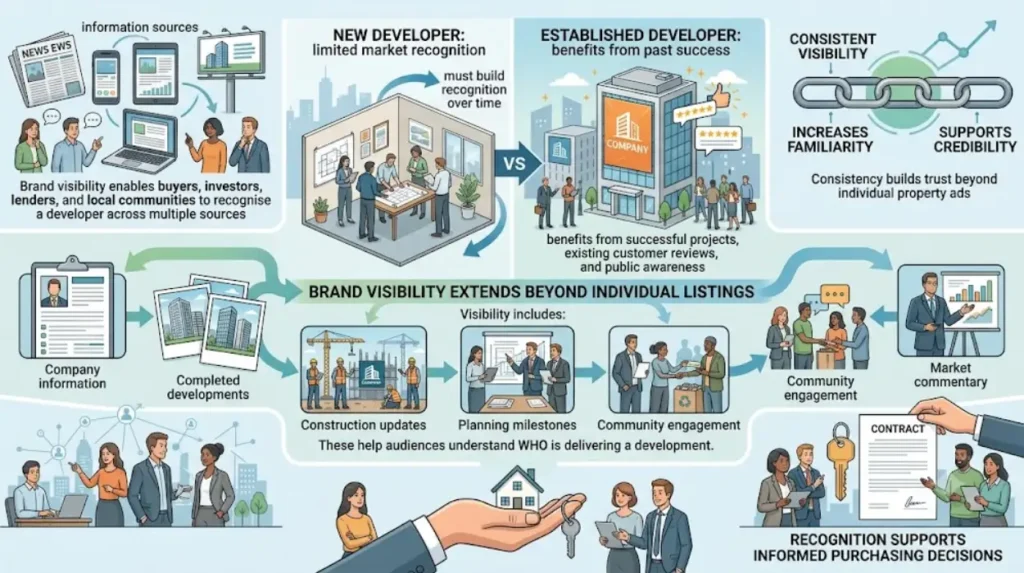
Brand visibility enables buyers, investors, lenders, and local communities to recognise a developer across multiple information sources. Consistent visibility increases familiarity, supports credibility, and helps audiences identify projects beyond individual property advertisements.
New developers begin with limited market recognition.
Established developers often benefit from previous successful projects, existing customer reviews, and public awareness.
New entrants must build recognition over time.
Brand visibility extends beyond individual listings
Strong visibility includes:
- Company information
- Completed developments
- Construction updates
- Planning milestones
- Community engagement
- Market commentary
These elements help audiences understand who is delivering a development.
Recognition supports informed purchasing decisions.
How does search visibility affect property marketing?
Search visibility determines how easily people find development information through online searches. Strong search presence increases opportunities for buyers to discover projects during independent research instead of relying entirely on property portal searches.
Many buyers begin research using search engines rather than property portals.
Typical searches include:
- New homes in Leeds
- Apartments near Bristol city centre
- Sustainable housing developments in Kent
Search engines display multiple content types.
These include:
- News articles
- Maps
- Company websites
- Planning announcements
- Property listings
Developers appearing across several search results gain broader exposure.
Search diversity reduces dependence on a single platform.
What happens when one marketing channel becomes the only source of enquiries?
Single-channel marketing increases business risk because enquiry volumes depend entirely on one platform’s policies, algorithms, pricing structure, and audience behaviour. Diversified communication channels create more stable and resilient lead generation over time.
Business resilience depends on multiple customer acquisition paths.
If a portal changes:
- Ranking systems
- Pricing models
- Advertising policies
- Listing requirements
Developer visibility changes immediately.
Traffic concentration also creates operational risk.
Multiple communication channels distribute exposure across different audiences.
How do buyers evaluate trust before purchasing a property?
Property buyers evaluate trust by reviewing consistent information across independent sources. Company history, planning information, project updates, professional coverage, customer feedback, and transparent communication contribute to informed purchasing decisions.
Buying property represents one of the largest financial commitments most households make.
Buyers therefore verify information carefully.
Common trust indicators
Buyers often examine:
- Planning approvals
- Construction progress
- Previous developments
- Professional credentials
- Independent news coverage
- Customer reviews
For example, purchasers researching a regeneration project in Liverpool often compare planning documents, council announcements, transport improvements, and developer information before arranging a viewing.
Independent information improves confidence.
What communication channels complement property listing portals?
Property listing portals perform one marketing function. Additional communication channels expand audience reach, improve search visibility, and support broader public awareness throughout the property development lifecycle from planning through project completion.
Different channels serve different purposes.
Examples include:
- Company websites
- Search engine content
- Local newspapers
- Trade publications
- Planning authority announcements
- Email newsletters
- Social media updates
- Industry events
Each channel reaches different audiences.
Combined communication improves overall market visibility.
Readers interested in strategic communication planning can continue with:
Integrating Strategic Press Distribution.
How does communication change during different stages of a property development?
Property communication evolves from planning approval through construction, launch, sales, completion, and occupation. Different stakeholders require different information at each stage, making varied communication methods more effective than a single listing platform.
Property development follows several stages.
Planning stage
Key information includes:
- Planning applications
- Community consultation
- Environmental assessments
Construction stage
Updates often include:
- Project milestones
- Infrastructure progress
- Sustainability initiatives
Sales stage
Communication focuses on:
- Property availability
- Pricing
- Specifications
- Viewing opportunities
Completion stage
Information often includes:
- Resident occupation
- Community facilities
- Project outcomes
Different communication objectives exist throughout the development lifecycle.
Explore More Expert Insights:
How Modern Real Estate Industry Analysts and Joint-Venture Partners Discover Breakthrough Startups
What Happens to a Developer’s Brand Reputation During Project Delays or Supply Chain Crises?
How can developers build a balanced property marketing strategy?
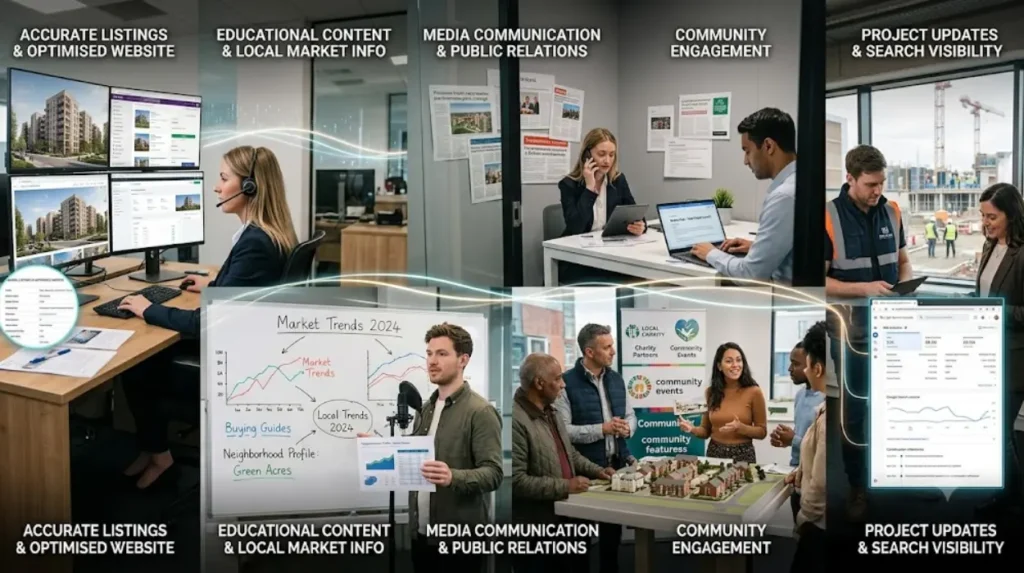
Balanced property marketing combines listing portals with search visibility, educational content, media communication, community engagement, and project updates. Multiple communication channels improve audience reach while reducing dependence on a single digital platform.
Balanced marketing distributes information across several trusted sources.
Important components include:
- Accurate property listings
- Optimised developer websites
- Local market information
- Planning updates
- Educational property content
- Community engagement
- Search engine visibility
Each element supports different stages of buyer research.
Integrated communication improves consistency.
Readers exploring practical evaluation methods for communication approaches can refer to:
Full-Service Property PR Agencies vs. Time Intelligence Media Group.
Traditional listing portals remain an important part of property marketing in the United Kingdom. They simplify property discovery and connect buyers with available developments. However, they represent only one stage of the buyer research journey.
Modern property buyers gather information from search engines, news sources, company websites, planning authorities, social platforms, and independent publications before making purchasing decisions. Developers relying exclusively on listing portals reduce their visibility across these additional information sources.
A balanced communication strategy strengthens brand recognition, expands search visibility, supports trust, and reduces dependence on any single marketing platform. Diversified communication also aligns with the way buyers research, compare, and evaluate new developments throughout the entire property purchasing process.