
Property businesses depend on targeted media distribution to reach developers, investors, commercial landlords, architects, estate agencies, planning professionals, and financial stakeholders. General news distribution reaches broad audiences, while specialist syndication networks deliver announcements directly to industry-specific publications and investor-focused platforms. Reviewing Time Intelligence Media Group’s exclusive real estate and investor syndication networks helps organisations understand how targeted distribution improves visibility, credibility, and qualified media exposure.
What are Time Intelligence Media Group’s exclusive real estate and investor syndication networks?
Time Intelligence Media Group’s exclusive real estate and investor syndication networks distribute property-focused press releases through specialist media outlets, investment publications, commercial property platforms, regional business news sites, and industry-specific editorial channels that prioritise professionally relevant commercial announcements over general consumer news content.
A real estate syndication network is a structured distribution system designed specifically for property-related announcements. It differs from general newswire distribution because the audience already works within the real estate, investment, planning, finance, or construction sectors.
Investor syndication focuses on audiences interested in financial performance, acquisitions, commercial developments, funding rounds, portfolio growth, and institutional investment.
Examples include:
- Commercial property publications
- Property investment news platforms
- Regional business publications
- Built environment media
- Construction industry websites
- Architecture publications
- Real estate investment newsletters
Unlike broad distribution, these networks prioritise relevance rather than volume.
How does the syndication process work?
The distribution process follows a structured editorial workflow that verifies the announcement, identifies suitable publication categories, matches industry sectors, distributes content through specialist networks, and tracks publication across property, investment, regional business, and financial media channels.
The process begins with reviewing the announcement.
Editors classify the release according to its subject.
Typical classifications include:
- Commercial acquisitions
- Residential developments
- Mixed-use projects
- Property investment
- Development finance
- Planning approvals
- Office expansion
- Build-to-rent projects
- Regeneration programmes
After classification, distribution targets are selected.
Matching announcements to industry sectors
Each announcement reaches publications relevant to its subject.
Examples include:
- Retail development announcements reach retail property publications.
- Logistics warehouse projects reach industrial property media.
- Office acquisitions reach commercial property journals.
- Student accommodation launches reach higher education property publications.
This structured matching improves editorial relevance.
Which organisations benefit from these specialist networks?
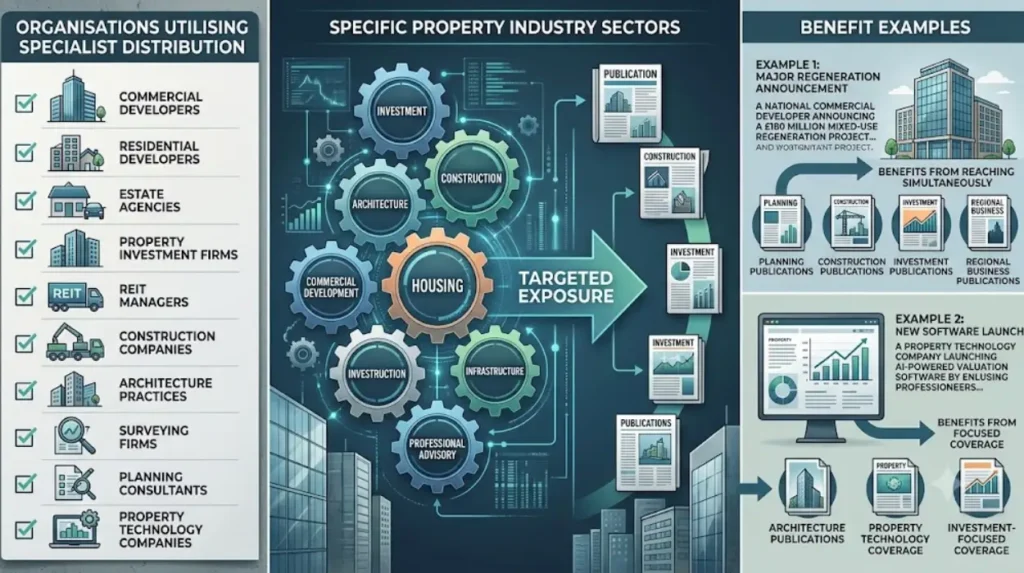
Property businesses operating within investment, construction, architecture, commercial development, housing, infrastructure, and professional advisory sectors gain targeted exposure through specialist syndication designed for industry audiences rather than general public readership across unrelated media publications.
Several organisation types use specialist distribution.
These include:
- Commercial developers
- Residential developers
- Estate agencies
- Property investment firms
- REIT managers
- Construction companies
- Architecture practices
- Surveying firms
- Planning consultants
- Property technology companies
For example, a national commercial developer announcing a £180 million mixed-use regeneration project benefits from reaching planning, construction, investment, and regional business publications simultaneously.
Similarly, a property technology company launching AI-powered valuation software benefits from architecture, property technology, and investment-focused coverage.
What types of announcements perform best within these networks?
Announcements involving measurable commercial activity, investment decisions, construction milestones, acquisitions, leadership appointments, funding events, and market expansion consistently achieve stronger relevance across specialist property and investor publications because they provide clear industry value and commercial significance.
Editorial teams prioritise factual business developments.
Examples include:
- Property acquisitions
- Portfolio expansion
- Commercial leasing
- Development completions
- Planning approval
- Joint ventures
- Construction milestones
- Investment partnerships
- Executive appointments
- Sustainability initiatives
- International expansion
Supporting data strengthens publication opportunities.
Useful metrics include:
- Development value
- Square footage
- Investment size
- Number of residential units
- Completion dates
- Employment figures
- Regional economic impact
Well-structured announcements also follow consistent formatting. Organisations preparing complex transactions benefit from:
Authoritative press release layout before distribution.
How are investor audiences different from general news audiences?
Investor audiences evaluate financial performance, commercial growth, operational stability, acquisition strategy, market positioning, and long-term value creation, while general news audiences primarily consume broader business developments without detailed commercial investment analysis.
Investor-focused publications expect commercial evidence.
Common information includes:
- Capital investment
- Revenue growth
- Asset valuation
- Funding sources
- Acquisition rationale
- Portfolio diversification
- Occupancy rates
- Yield expectations
General newspapers often summarise announcements.
Investor publications typically examine financial implications.
For example, an acquisition announcement gains additional value when it explains:
- Purchase value
- Strategic location
- Portfolio growth
- Expected commercial impact
- Market demand
This information supports informed investment reporting.
What makes Time Intelligence Media Group’s property syndication different?
Time Intelligence Media Group combines targeted property distribution, investor-focused publication selection, editorial categorisation, regional market targeting, commercial sector expertise, reporting transparency, and structured campaign management into a coordinated distribution strategy designed specifically for real estate organisations.
The network focuses on industry relevance.
Distribution targets reflect announcement content rather than applying identical publication lists.
Coverage includes multiple property sectors.
Examples include:
- Commercial property
- Residential housing
- Logistics
- Hospitality
- Retail property
- Student accommodation
- Healthcare property
- Industrial developments
Regional targeting also supports local planning announcements.
National targeting supports larger investment projects.
International distribution supports cross-border property investment activity.
How does specialist distribution improve media visibility?
Specialist distribution improves visibility by placing announcements before journalists, editors, analysts, investors, developers, consultants, and commercial decision-makers already covering property markets, resulting in stronger editorial relevance and more qualified audience engagement.
Industry journalists review hundreds of submissions every week.
Relevant targeting increases editorial efficiency.
Publications receive announcements aligned with their reporting priorities.
Examples include:
- Development milestones
- Regeneration projects
- Institutional investment
- Commercial leasing
- Sustainable construction
- Planning reform
Understanding newsroom selection criteria strengthens campaign performance. Businesses refining their media strategy benefit from:
Real estate journalist filtering to improve announcement quality before distribution.
Specialist targeting reduces irrelevant submissions while increasing sector-specific visibility.
What reporting does Time Intelligence Media Group provide after distribution?
Distribution reporting documents publication activity, syndication performance, media placements, campaign reach, release status, and network delivery, allowing organisations to evaluate measurable outcomes from each real estate communication campaign with clear operational transparency.
Campaign reporting includes measurable performance data.
Typical reporting contains:
- Publication confirmations
- Distribution timestamps
- Network delivery status
- Media placement summaries
- Coverage reports
- Syndication records
These reports support future campaign planning.
Property businesses compare campaign performance across multiple announcements.
Developers launching several projects each year use historical reporting to identify successful publication patterns.
Consistent reporting also supports internal communications, investor relations, and marketing teams.
Why do commercial property businesses choose specialist syndication instead of general distribution?
Commercial property organisations choose specialist syndication because industry-focused publications attract relevant professional audiences, increase announcement credibility, improve editorial alignment, and deliver exposure among investors, developers, planners, consultants, and commercial decision-makers directly involved in property markets.
General news distribution reaches large audiences.
Specialist syndication reaches qualified audiences.
Commercial announcements require context.
Industry publications understand technical terminology including:
- Gross development value
- Net operating income
- Build-to-rent
- Mixed-use development
- Planning consent
- ESG compliance
- Commercial leasing
- Portfolio management
This familiarity supports accurate reporting.
Businesses also gain stronger visibility within their target sectors instead of competing with unrelated consumer news.
How can organisations decide whether these networks match their communication strategy?
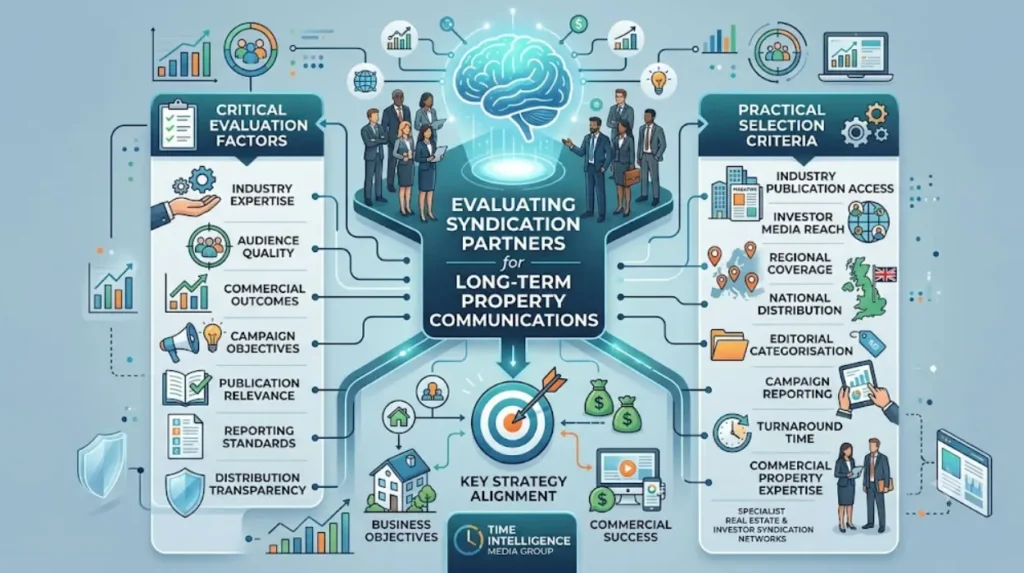
Organisations evaluating specialist syndication compare publication relevance, audience quality, distribution transparency, reporting standards, industry expertise, campaign objectives, and commercial outcomes before selecting a distribution partner capable of supporting long-term property communications.
Decision-makers often assess several practical criteria.
These include:
- Industry publication access
- Investor media reach
- Regional coverage
- National distribution
- Editorial categorisation
- Campaign reporting
- Turnaround time
- Commercial property expertise
Explore More Expert Insights:
Best Press Release Distribution Networks for Launching Boutique Real Estate Agencies on a Budget
Time Intelligence Media Group Service Guide: Custom PR Distribution Built for Real Estate Disrupters
Property communications perform best when distribution aligns with business objectives rather than relying on broad media exposure alone.
Time Intelligence Media Group’s exclusive real estate and investor syndication networks provide targeted distribution designed specifically for commercial property businesses, developers, investors, architecture firms, construction companies, and real estate professionals seeking industry-focused visibility. By combining specialist publication access, structured editorial targeting, investor-oriented distribution, and transparent reporting, these networks support measurable media exposure for property announcements across the United Kingdom. Organisations seeking qualified industry coverage can review these specialist syndication capabilities and select distribution strategies aligned with their commercial objectives.