

The property sector generates thousands of announcements every week across the United Kingdom. Residential developments, commercial projects, regeneration schemes, planning approvals, funding rounds, sustainability initiatives, and executive appointments compete for editorial attention. Real estate and architecture journalists receive a constant flow of pitches, making selection a structured editorial process rather than a random decision.
Understanding how journalists evaluate submissions helps organisations produce clearer, more relevant announcements. It also explains why many project pitches receive little or no coverage despite representing significant business activity.
Why do real estate and architecture journalists receive so many project pitches?
Real estate and architecture journalists receive hundreds of project pitches because developers, architects, investors, consultants, local authorities, and construction companies announce new developments throughout the year. Editors filter submissions using relevance, credibility, timing, evidence, and audience interest before assigning editorial coverage.
Property is one of the UK’s largest economic sectors. Every planning application, acquisition, refurbishment, infrastructure project, office development, housing scheme, and regeneration programme creates potential news.
Journalists cover multiple industries connected to property, including:
- Residential housing
- Commercial property
- Architecture
- Construction
- Urban planning
- Infrastructure
- Sustainability
- Investment
- Hospitality
- Student accommodation
Examples include a mixed-use regeneration project in Manchester, a logistics warehouse expansion in Birmingham, and a Grade II listed building restoration in London.
Editors receive material from numerous sources every working day. These include press releases, direct email pitches, planning documents, government announcements, industry reports, and exclusive interviews.
The volume of information makes editorial filtering essential.
What counts as a project pitch?
A project pitch is a structured news proposal explaining why a property or architecture development deserves editorial coverage.
Common project pitches include:
- Planning permission granted
- Project completion
- Construction milestone
- Major investment secured
- Design competition won
- Sustainable building certification
- Commercial property acquisition
- Regeneration programme launch
Each pitch competes against dozens of similar announcements published on the same day.
How do journalists decide which property stories deserve coverage?
Journalists prioritise property stories using measurable news value. They assess significance, originality, verified facts, geographic relevance, financial scale, community impact, architectural importance, and current public interest before deciding whether an announcement merits editorial attention or further reporting.
Editorial selection follows consistent criteria rather than personal preference.
News significance
Large projects naturally receive greater attention.
Examples include:
- 2,000-home residential developments
- £500 million mixed-use regeneration projects
- New railway station developments
- National infrastructure schemes
Projects with wider economic impact attract stronger editorial interest.
Public relevance
Journalists ask whether readers benefit from understanding the announcement.
Relevant topics include:
- Housing supply
- Affordable homes
- Urban regeneration
- Employment creation
- Environmental performance
- Local investment
A warehouse refurbishment affecting thousands of local jobs has stronger public relevance than a routine office refurbishment.
Verified information
Editors favour announcements supported by evidence.
Evidence includes:
- Planning references
- Investment figures
- Completion dates
- Named organisations
- Technical specifications
- Independent certification
Specific facts increase credibility.
Timeliness
News loses value when events happened weeks earlier.
Journalists prioritise announcements linked to recent milestones such as planning approval, project completion, funding confirmation, or construction commencement.
What information makes a property pitch credible?
Credible property pitches include verified facts, accurate figures, named organisations, precise locations, confirmed timelines, planning references, project specifications, and attributable quotations. These elements allow journalists to verify information quickly before publication without conducting unnecessary background research.
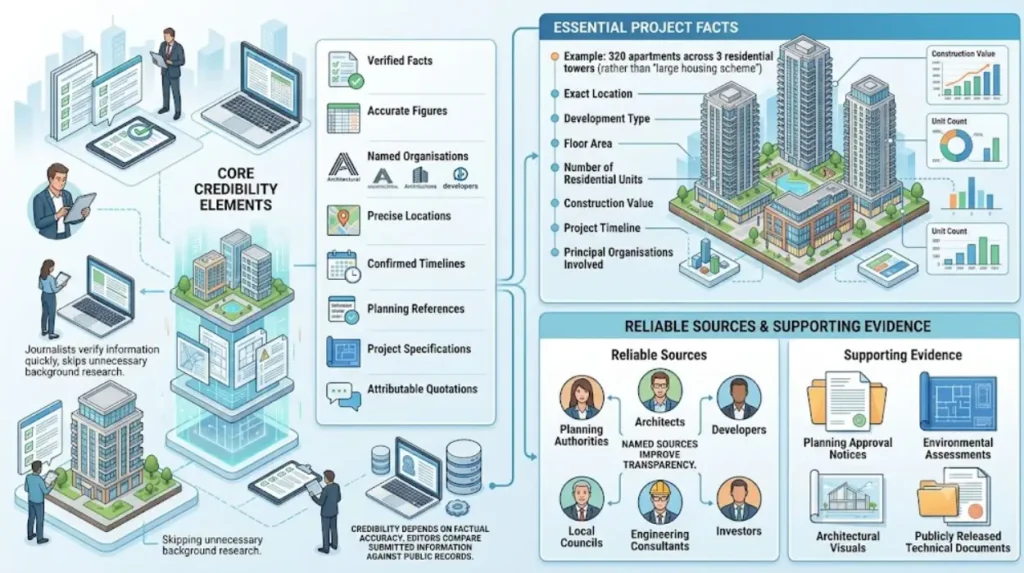
Credibility depends on factual accuracy.
Editors compare submitted information against publicly available records where possible.
Essential project facts
Every project announcement benefits from including:
- Project name
- Exact location
- Development type
- Floor area
- Number of residential units
- Construction value
- Project timeline
- Principal organisations involved
For example, stating that a development contains 320 apartments across three residential towers provides greater clarity than describing it as a large housing scheme.
Reliable sources
Information carries greater authority when attributed.
Examples include:
- Planning authorities
- Architects
- Developers
- Local councils
- Engineering consultants
- Investors
Named sources improve transparency.
Supporting evidence
Supporting documents strengthen factual reporting.
Examples include planning approval notices, environmental assessments, architectural visuals, and publicly released technical documents.
Why do many architecture project pitches fail to gain attention?
Many architecture project pitches fail because they lack news value, factual detail, audience relevance, clear structure, or timely publication. Generic language, unsupported claims, missing statistics, and unclear project significance reduce editorial interest immediately during initial review.
Editors spend limited time evaluating each submission.
Announcements that require extensive clarification often move aside for clearer alternatives.
Generic descriptions
Broad statements communicate little information.
Examples include:
- Innovative design
- Exciting development
- Landmark project
- World-class architecture
These descriptions lack measurable evidence.
Specific information performs better.
For example:
- BREEAM Outstanding certification
- 18-storey office tower
- 240,000 square feet
- Net-zero operational carbon target
Facts replace promotional language.
Missing context
Editors need to understand why the announcement matters.
Useful context includes:
- Local housing demand
- Economic investment
- Planning significance
- Heritage restoration
- Infrastructure improvements
Context transforms isolated facts into meaningful news.
Poor organisation
A disorganised announcement slows editorial review.
Clear headings, logical sequencing, and concise paragraphs improve readability.
Readers interested in:
Crafting an Authoritative Press Release Layout
How does timing influence editorial decisions?
Timing determines whether property announcements match current news priorities. Journalists prefer announcements linked to confirmed milestones, planning decisions, investment approvals, construction progress, or completed developments rather than outdated events or speculative future activity.
Editorial calendars constantly change.
Competing national events influence available newsroom resources.
Project milestones
Editors frequently cover:
- Planning approval
- Construction start
- Topping out ceremony
- Project completion
- Occupancy launch
- Investment confirmation
These events provide clear reporting angles.
Industry events
Major exhibitions, planning conferences, housing reports, and government policy announcements create additional editorial opportunities.
Relevant announcements fit naturally into existing news coverage.
Seasonal activity
Property reporting patterns shift throughout the year.
Budget announcements, infrastructure funding decisions, and planning reforms increase demand for sector-specific reporting.
What role do facts, images, and technical details play?
Facts, professional images, and technical project information improve editorial efficiency. Journalists understand developments faster when announcements include accurate visuals, architectural specifications, verified measurements, sustainability data, and construction milestones supported by clear documentation.
Visual information helps explain complex developments.
Editors value images that illustrate completed work or approved designs.
Useful project visuals
Examples include:
- Architectural renderings
- Site photography
- Completed buildings
- Masterplans
- Location maps
Professional images support digital publication.
Technical information
Property journalism frequently includes measurable specifications.
Examples include:
- Gross internal floor area
- Building height
- Residential unit numbers
- Commercial space
- Sustainability ratings
- Energy performance
Specific figures improve reporting accuracy.
Sustainability information
Environmental performance increasingly appears within property reporting.
Relevant information includes:
- Operational carbon reduction
- Renewable energy systems
- Green roofs
- Biodiversity improvements
- Water efficiency
- Circular construction methods
These details support factual reporting rather than promotional messaging.
How can organisations present project information more clearly?
Clear project information follows a logical structure with verified facts presented first, followed by supporting context, technical specifications, stakeholder quotations, and background information. This organisation improves readability for journalists evaluating multiple submissions within limited editorial time.
Editors scan information rapidly.
Important facts belong near the beginning.
Prioritise essential information
A logical sequence includes:
- Project announcement
- Location
- Development details
- Financial information
- Timeline
- Stakeholder quotations
- Background
This structure reduces unnecessary searching.
Keep language precise
Short factual sentences improve comprehension.
Replace broad marketing expressions with measurable information.
For example:
Instead of writing that a project transforms an area, explain that it delivers 450 residential units, 12 retail spaces, and a new public square.
Maintain consistency
Consistent terminology improves understanding.
For example, use the same project name, organisation names, measurements, and planning references throughout the announcement.
Readers seeking further information about:
Real Estate and Investor Syndication Networks
What lessons can organisations learn from editorial filtering?
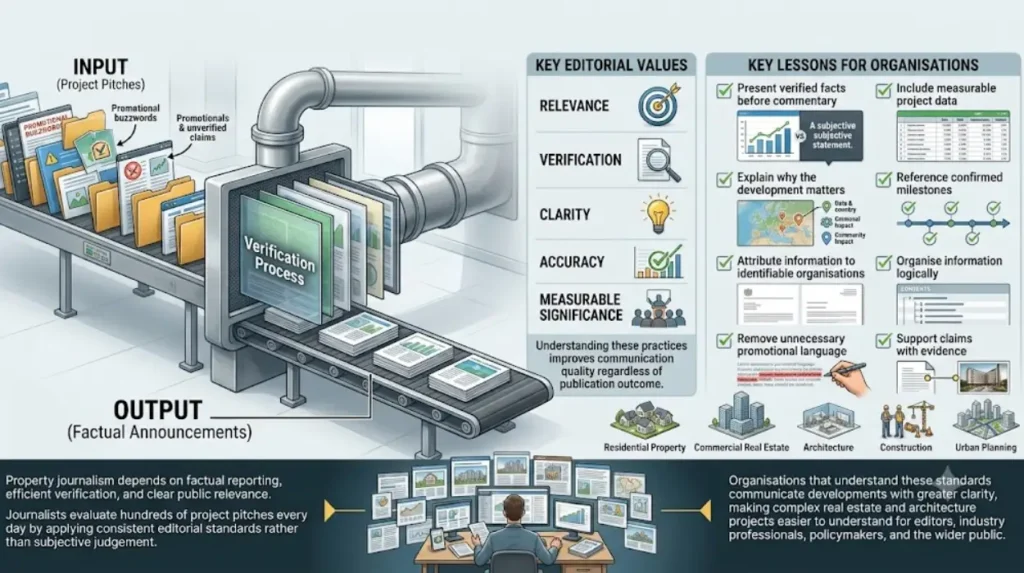
Editorial filtering demonstrates that journalists value relevance, verification, clarity, accuracy, and measurable public significance. Organisations communicating property developments achieve greater informational quality by presenting structured evidence instead of promotional statements or unsupported claims throughout project announcements.
Editorial selection follows identifiable principles.
These principles remain consistent across residential property, commercial real estate, architecture, construction, and urban planning reporting.
Key lessons include:
- Present verified facts before commentary.
- Include measurable project data.
- Explain why the development matters.
- Reference confirmed milestones.
- Attribute information to identifiable organisations.
- Organise information logically.
- Remove unnecessary promotional language.
- Support claims with evidence.
Explore More Expert Insights:
Why Continuous Media Exposure is Vital for Real Estate Agencies Facing Market Slumps
How Under-the-Radar Development Firms Build Credibility Against Massive Construction Giants
Understanding these practices improves communication quality regardless of publication outcome.
Property journalism depends on factual reporting, efficient verification, and clear public relevance. Journalists evaluate hundreds of project pitches every day by applying consistent editorial standards rather than subjective judgement. Organisations that understand these standards communicate developments with greater clarity, making complex real estate and architecture projects easier to understand for editors, industry professionals, policymakers, and the wider public.



