Public trust influences the success of controversial projects across the United Kingdom. Infrastructure developments, housing schemes, renewable energy facilities, transport upgrades, and waste management sites often receive significant public attention. Media authority plays a measurable role in shaping how local communities understand these projects. Trusted reporting improves access to verified information, reduces misinformation, and supports informed public discussion.
What is media authority, and why does it influence community trust?
Media authority refers to the recognised credibility, accuracy, editorial standards, and public reputation of a news source. High-authority media organisations provide verified reporting, transparent sourcing, and consistent editorial processes, increasing public confidence when covering controversial local projects across different communities in the United Kingdom.
Media authority describes the level of trust audiences place in a publication or broadcaster. It develops through consistent factual reporting, editorial independence, transparent corrections, and professional journalism.
Community trust refers to the confidence local residents place in information and institutions. Trust increases when people receive accurate, balanced, and evidence-based reporting.
Projects that commonly attract public debate include:
- Housing developments
- Wind farms
- Road expansions
- Railway infrastructure
- Energy facilities
- Flood defence schemes
For example, a regional housing development often raises questions about traffic, schools, healthcare capacity, and environmental effects. Trusted local reporting explains these issues using verified evidence rather than speculation.
How does media authority affect public perception of controversial projects?
Authoritative journalism improves public understanding by presenting verified facts, expert evidence, multiple viewpoints, and official documentation. Reliable reporting reduces uncertainty, limits misinformation, and enables communities to evaluate controversial developments using factual information rather than rumours or incomplete claims.
Public perception develops through repeated exposure to information.
When authoritative media publishes accurate reporting, audiences receive:
- Verified planning information
- Official consultation outcomes
- Expert commentary
- Environmental assessments
- Local authority responses
Low-quality information often produces confusion.
Examples include:
- Unverified social media claims
- Edited videos without context
- Anonymous online rumours
- Misleading headlines
Authoritative reporting provides context. Instead of presenting isolated facts, journalists explain planning processes, legal requirements, consultation stages, and regulatory decisions.
This broader context helps residents understand why decisions occur.
Why does factual reporting reduce misinformation?
False information spreads quickly during high-profile planning debates.
Trusted journalism verifies:
- Planning applications
- Environmental reports
- Government statements
- Independent research
- Public consultation records
Verification limits the spread of incorrect information and improves public understanding.
Why do local communities trust established news sources more than unverified information?
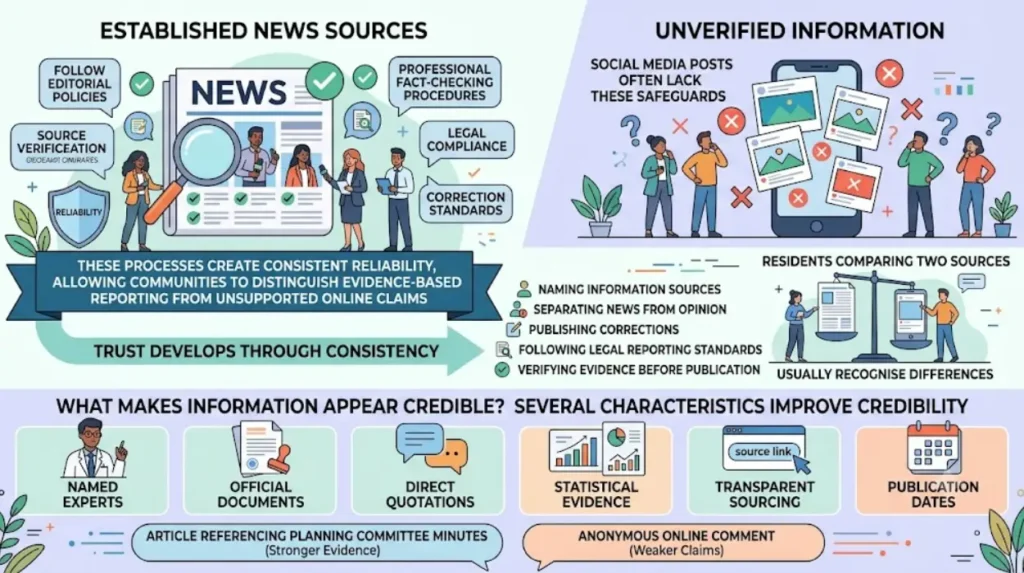
Established news organisations follow editorial policies, professional fact-checking procedures, source verification, legal compliance, and correction standards. These processes create consistent reliability, allowing communities to distinguish evidence-based reporting from unsupported online claims during controversial public discussions.
Trust develops through consistency.
Established publications demonstrate reliability by:
- Naming information sources
- Separating news from opinion
- Publishing corrections
- Following legal reporting standards
- Verifying evidence before publication
Social media posts often lack these safeguards.
Residents comparing two sources usually recognise differences between documented reporting and anonymous claims.
What makes information appear credible?
Several characteristics improve credibility.
These include:
- Named experts
- Official documents
- Direct quotations
- Statistical evidence
- Transparent sourcing
- Publication dates
For example, an article referencing planning committee minutes provides stronger evidence than an anonymous online comment.
How does balanced media coverage improve public understanding?
Balanced reporting presents verified information from multiple stakeholders, including local authorities, residents, developers, environmental specialists, and independent experts. Comprehensive coverage enables audiences to understand competing viewpoints without relying on incomplete or one-sided information during complex planning debates.
Balanced coverage does not give equal weight to unsupported claims.
Instead, it presents verified positions supported by evidence.
Common stakeholders include:
- Local councils
- Planning inspectors
- Residents’ associations
- Environmental organisations
- Transport authorities
- Academic specialists
Each group contributes different information.
For example:
A transport authority explains projected traffic changes.
Environmental specialists explain ecological assessments.
Residents discuss neighbourhood concerns.
Planning officers explain legal requirements.
Together, these perspectives create a more complete understanding.
Why is context important?
Individual facts rarely explain an entire project.
Context includes:
- Historical background
- Previous consultations
- Planning regulations
- Environmental obligations
- Construction timelines
- Economic objectives
Context enables audiences to interpret information accurately.
What role does transparency play in strengthening community confidence?
Transparency increases confidence by providing accessible information, explaining decision-making processes, publishing supporting evidence, and documenting project updates openly. Clear communication enables communities to evaluate developments using complete information rather than assumptions or speculation throughout every project stage.
Transparency means information remains accessible throughout the project lifecycle.
Important information includes:
- Planning applications
- Environmental impact assessments
- Consultation summaries
- Technical reports
- Construction schedules
- Regulatory approvals
Public access improves accountability.
Residents gain opportunities to review evidence independently.
How does transparency improve communication?
Transparent communication includes:
- Regular project updates
- Public consultation announcements
- Published meeting outcomes
- Accessible planning documents
- Clear timelines
Each update reduces uncertainty.
Communities understand what changes occur and why those changes happen.
Which communication mistakes reduce community trust?
Trust declines when communication lacks accuracy, consistency, evidence, transparency, or timely updates. Conflicting statements, missing information, exaggerated claims, delayed responses, and unexplained project changes increase public uncertainty and reduce confidence in official information sources.
Several communication failures repeatedly appear during controversial developments.
Common mistakes include:
- Delayed announcements
- Inconsistent messaging
- Missing evidence
- Technical language without explanation
- Ignoring community concerns
- Unclear consultation processes
Each mistake increases uncertainty.
For example, publishing revised project information without explaining the reason creates confusion.
Communities expect clear explanations for significant project changes.
Why does consistency matter?
Consistent communication prevents contradictory information.
Consistency includes:
- Matching official documents
- Regular publication schedules
- Accurate project statistics
- Uniform terminology
- Updated factual information
Reliable communication strengthens long-term confidence.
How can organisations support informed public discussion during controversial projects?
Effective public communication relies on verified information, accessible documentation, timely updates, expert evidence, and structured engagement opportunities. These practices encourage informed discussion while reducing confusion and improving public understanding throughout planning, consultation, and construction activities.
Public discussion becomes more productive when accurate information remains easily accessible.
Useful communication practices include:
- Publishing consultation dates
- Explaining planning procedures
- Sharing environmental evidence
- Providing project timelines
- Clarifying regulatory requirements
Accessible information enables residents to prepare informed questions.
It also improves participation during consultation events.
How do digital resources improve information access?
Digital communication provides continuous public access.
Examples include:
- Planning portals
- Consultation documents
- Frequently asked questions
- Interactive project maps
- Published technical reports
These resources improve transparency and information availability.
Readers seeking practical communication resources can explore:
Decision-makers evaluating advanced public communication strategies can later review:
What are the long-term benefits of trusted media coverage for local communities?
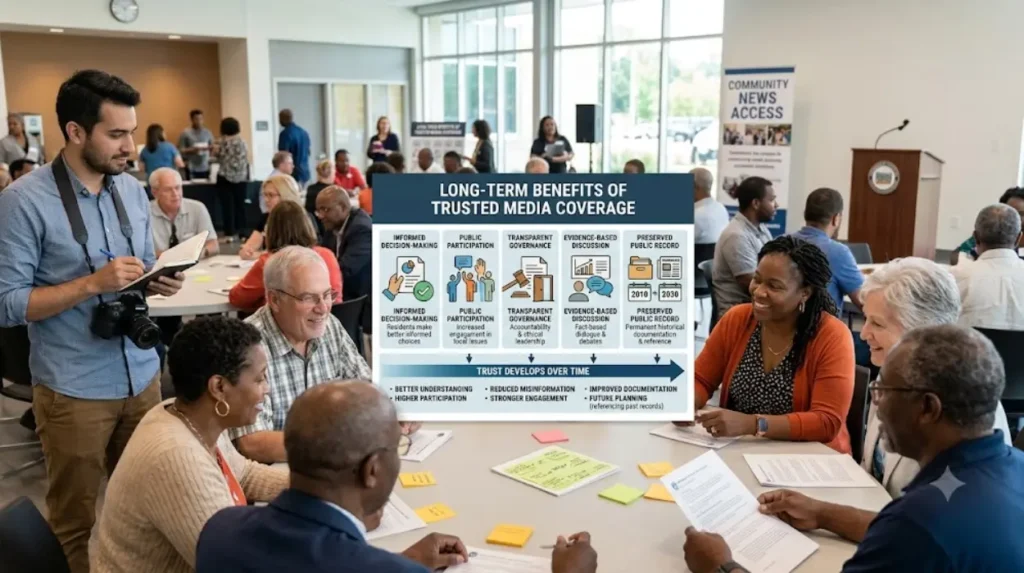
Trusted media strengthens informed decision-making, improves public participation, supports transparent governance, encourages evidence-based discussion, and preserves accurate public records. Reliable journalism contributes to healthier relationships between communities, institutions, and public infrastructure projects over extended periods.
Long-term trust develops gradually.
Consistent factual reporting produces several measurable benefits.
These include:
- Better public understanding
- Higher consultation participation
- Reduced misinformation
- Increased accountability
- Stronger civic engagement
- Improved historical documentation
Reliable reporting also creates a permanent public record.
Future planning discussions often reference previous reporting, consultation outcomes, and regulatory decisions.
Why does accurate reporting remain valuable after project completion?
Completed projects continue affecting local communities.
Archived reporting documents:
- Original objectives
- Community concerns
- Planning decisions
- Construction milestones
- Environmental commitments
- Final project outcomes
These records support future public discussion and policy evaluation.
Explore More Expert Insights:
How High-Authority Business Backlinks Resurrect Online Visibility for Struggling Construction Brands
Why Local Advertising Alone Fails to Attract Out-of-State Investors to New Property Developments
Media authority plays a direct role in building local community trust during controversial projects. Authoritative journalism provides verified facts, transparent sourcing, balanced reporting, and clear context. These qualities improve public understanding and reduce misinformation throughout planning and construction processes.
Communities benefit from accurate information because informed residents participate more effectively in consultations and public discussions. Transparent communication, reliable reporting, and accessible evidence strengthen confidence in the information surrounding complex developments. As controversial projects continue shaping communities across the United Kingdom, trusted media remains an essential foundation for informed public engagement and long-term community trust.