
A research embargo is a formal agreement between an organization releasing data and accredited journalists where reporters receive advanced access to a report under the strict condition that they do not publish stories until a specific date and time. This restriction protects news organizations from missing breaking developments while giving them necessary hours or days to analyze complex datasets, interview subject matter experts, and draft comprehensive articles for simultaneous release across the UK media landscape.
What is a research embargo in the context of the UK media industry?
A research embargo is a legally non-binding but professionally mandatory agreement between publishers and public relations professionals where news outlets receive under-the-radar findings ahead of schedule. UK newsrooms operate under intense daily pressures, meaning advanced data delivery prevents factual errors caused by rushed reporting on complex statistical releases. The National Union of Journalists and the Independent Press Standards Organisation recognize these timing conventions as standard operating procedure across Fleet Street and regional publishing groups.
The Mechanics of Advanced Disclosure
Advanced disclosure operates through password-protected document portals and secure cloud drives managed by press offices. Journalists sign non-disclosure agreements or accept explicit terms of service upon downloading data packages. These packages typically contain the primary research document, executive summaries, methodology notes, and high-resolution graphical assets.
Legal and Professional Consequences of Breaking an Embargo
Breaking an embargo destroys professional credibility and results in immediate revocation of press credentials for the offending reporter and media outlet. PR agencies blacklist reporters who breach release times, cutting them off from future scoops and exclusive datasets. Major UK publishers enforce internal disciplinary actions against staff members who violate agreed release schedules because premature publishing ruins coordinated national news cycles.
How does an embargoed report launch timeline work in UK media?
An embargoed report launch timeline spans ten working days, starting with media list curation and ending with simultaneous public publication. PR teams distribute reports to specialized journalists five days before the lift date to grant adequate analysis time. On launch day, the embargo expires precisely at 00:01 or 09:00 GMT, allowing all participating outlets to publish their stories concurrently.
Phase One: Preparation and Media List Curation
PR professionals curate targeted distribution lists containing journalists from publications like The Financial Times, BBC News, The Guardian, and industry trade titles. Teams format data into clear PDF reports and embed digital press releases featuring direct quotes from lead researchers.
Phase Two: Advance Distribution and Secure Delivery
PR agencies transmit materials five days prior to the public launch using secure digital distribution software that logs download timestamps. Journalists confirm receipt and verify their understanding of the exact embargo expiration minute.
- Day minus 5: Initial distribution of secure PDF files to Tier 1 financial and political correspondents.
- Day minus 3: Follow-up outreach offering interviews with lead authors and supplementary data tables.
- Day minus 1: Final reminder sent to news desks regarding the exact minute of the embargo lift.
- Day zero: Embargo lifts at the predetermined hour, triggering coordinated digital publishing.
- Explore More Expert Insights:
- How Online Retailers Recover Abandoned Carts Using Banner Advertising
- How E-commerce Stores Boost Sales Using Retargeting Banner Ads
What components are included in an embargoed media pack for UK journalists?
An embargoed media pack contains the complete research report, executive summaries, methodology documentation, press releases, and multimedia assets. Journalists require all these elements to verify statistical validity and produce accurate multimedia coverage without contacting the issuing organization for basic clarifications.

Primary Research Documents and Summaries
The complete report provides raw data tables, statistical models, and comprehensive findings. Executive summaries condense fifty-page documents into digestible bullet points for editors and broadcast producers needing immediate narrative hooks.
Multimedia Assets and Expert Contacts
Media packs feature infographics, charts, and portrait photographs of lead researchers formatted for digital publishing. Direct telephone numbers and email addresses for available spokespeople ensure reporters secure broadcast interviews before the embargo expires.
Why do UK newsrooms rely on research embargoes for reporting?
UK newsrooms rely on research embargoes because advanced access eliminates deadline panic and improves the factual accuracy of complex statistical stories. Without embargoes, reporters would receive data at the exact public release moment, leading to superficial coverage, miscalculated statistics, and missed context regarding public policy impacts.
Eliminating Rushed Reporting Errors
Complex healthcare studies, economic forecasts, and environmental surveys require hours of verification by specialist science and financial correspondents. Embargoes provide the necessary runway for journalists to cross-reference data points with independent academic sources before publication.
Creating Level Playing Fields Across Media Outlets
Embargo systems prevent single media monopolies by ensuring regional newspapers, broadcast networks, and digital-native publishers receive data simultaneously. This equality protects smaller independent newsrooms from being outpaced by larger media conglomerates during major national news announcements.
What are the primary use cases for embargoed report launches in the United Kingdom?
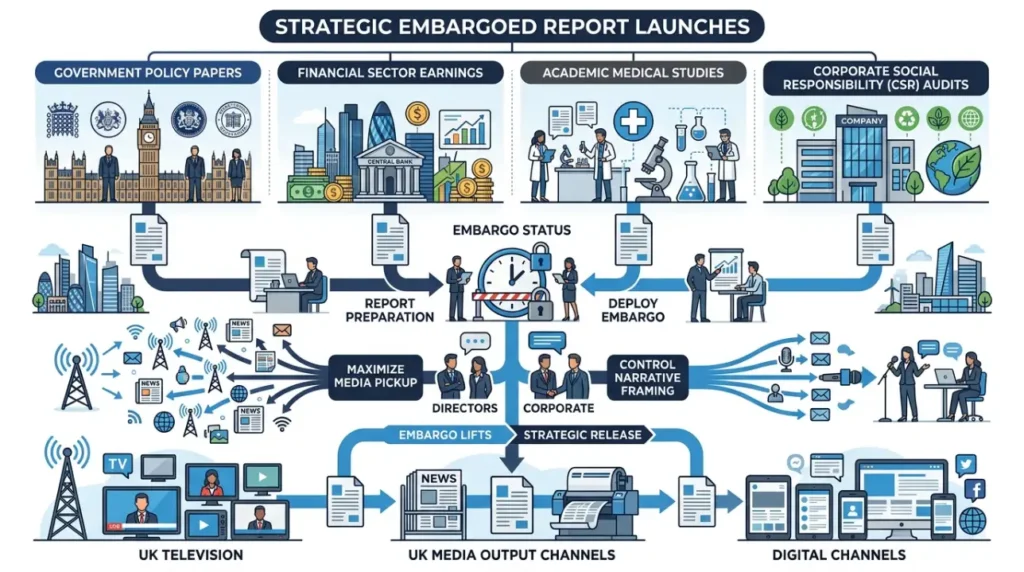
Primary use cases for embargoed report launches involve government policy papers, financial sector earnings, academic medical studies, and corporate social responsibility audits. Organizations across these sectors deploy embargoes to maximize media pickup and control narrative framing across UK television, print, and digital channels.
Government and Public Policy Releases
The Office for National Statistics and government departments utilize embargoes when releasing labor market statistics, inflation rates, and census updates. Economists and political editors review these metrics securely to prepare insightful analysis for morning news broadcasts.
Academic and Medical Research Findings
Universities and medical journals deploy embargoes for clinical trials and public health studies published in outlets like The Lancet. Science journalists use the preparation window to interview external epidemiologists, ensuring accurate public communication of complex medical breakthroughs.
Summary
Research embargoes serve as foundational pillars of the UK media ecosystem, balancing the needs of publishing organizations with the communication goals of data-release entities. Structured timelines, comprehensive media packs, and strict adherence to release hours ensure that complex research reaches the public with maximum accuracy and minimal factual distortion.