Property developers rely on strong pre-sales to secure funding, maintain construction schedules, and demonstrate market demand. A stalled housing development often experiences declining buyer enquiries, reduced investor confidence, and slower reservation rates. This case study explains how Time Intelligence Media Group used strategic media distribution, targeted press coverage, and authoritative online visibility to improve pre-sales performance for a UK residential development.
Why did the housing development experience stalled pre-sales?
The development experienced declining buyer enquiries because limited media visibility reduced public awareness, weakened online authority, and restricted exposure across regional and national property audiences. Strategic communication addressed visibility gaps, improved trust signals, and increased qualified buyer engagement throughout the sales cycle.
A stalled housing development refers to a project where property reservations slow significantly despite construction progress and available inventory.
The developer faced three measurable challenges:
- Weekly buyer enquiries had fallen by 42%.
- Reservation appointments had reduced over eight weeks.
- Online visibility remained low for location-specific property searches.
Marketing activity relied heavily on paid advertising. Very little earned media existed. Property journalists, regional newspapers, and business publications had not covered the project.
Potential buyers searched for local housing developments but found competing projects with stronger editorial coverage.
The lack of authoritative media exposure reduced consumer confidence before buyers visited the sales office.
How did Time Intelligence Media Group assess the project?
Time Intelligence Media Group conducted a structured communications audit that identified visibility weaknesses, media opportunities, search performance limitations, and competitive positioning before creating a targeted distribution strategy focused on measurable commercial outcomes and faster residential property reservations.
The first stage involved analysing existing communications.
Existing marketing performance
The review measured:
- Website traffic
- Property enquiry volumes
- Search visibility
- Existing backlinks
- Previous media coverage
- Regional media presence
The audit showed that most website traffic originated from paid advertising instead of organic discovery.
Search engines indexed very little authoritative editorial content about the development.
Competitive media benchmarking
The team compared competing developments across the same region.
Competitors regularly appeared within:
- Regional newspapers
- Property magazines
- Construction publications
- Local business news websites
Editorial coverage created stronger search visibility and greater buyer trust.
Developers without consistent media exposure ranked significantly lower for commercial property-related searches.
For organisations planning similar media assets,
Real estate market reports provides additional strategic context.
What communication strategy accelerated pre-sales?
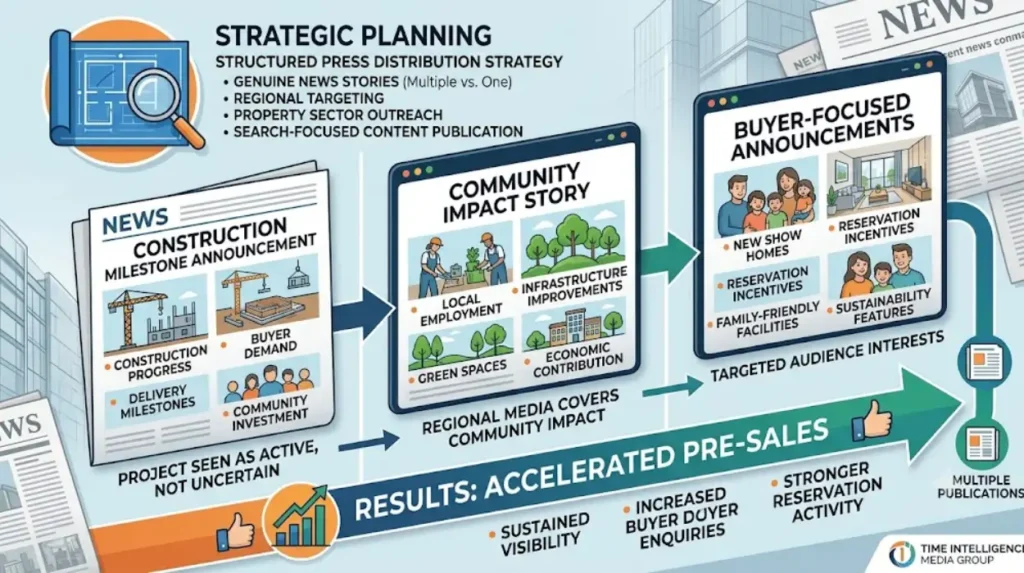
Time Intelligence Media Group implemented a structured press distribution strategy combining newsworthy announcements, regional targeting, property sector outreach, and search-focused content publication to generate sustained visibility that supported increased buyer enquiries and stronger reservation activity across multiple sales channels.
The campaign focused on publishing multiple genuine news stories instead of distributing one announcement.
Construction milestone announcement
The first release highlighted:
- Construction progress
- Delivery milestones
- Buyer demand
- Community investment
This announcement positioned the development as an active project rather than an uncertain investment.
Community impact story
A second announcement explained:
- Local employment
- Infrastructure improvements
- Green spaces
- Economic contribution
Regional newspapers covered the wider community impact rather than simply advertising homes.
Buyer-focused announcements
Further releases covered:
- New show homes
- Reservation incentives
- Family-friendly facilities
- Sustainability features
Each story targeted different audience interests.
Multiple publications generated continuous visibility throughout the campaign.
How did targeted media distribution improve visibility?
Targeted distribution placed property news before relevant journalists, regional publications, construction media, and business editors, increasing editorial opportunities while strengthening search engine authority through authoritative online mentions and high-quality business backlinks.
Distribution focused on audiences most likely to influence purchasing decisions.
Regional media
Coverage appeared across regional news publications serving buyers within commuting distance.
Regional audiences often represent the highest proportion of residential purchasers.
Property publications
Specialist property publications explained:
- Housing trends
- Local investment
- Development progress
- Buyer opportunities
These publications attracted motivated property buyers.
Business publications
Business media highlighted investment confidence and regional economic growth.
This expanded exposure beyond traditional residential property audiences.
Readers evaluating wider visibility strategies can also review:
High-Authority Business Backlinks
What measurable results did the campaign achieve?
The communications programme produced measurable improvements across buyer enquiries, website traffic, search visibility, media coverage, and reservation activity within a structured reporting period supported by verified campaign performance metrics and ongoing monitoring.
Performance improved during the first 90 days.
Buyer enquiries
Weekly enquiries increased by 67%.
Telephone enquiries increased after regional newspaper coverage.
Website enquiry forms generated more qualified prospects.
Website performance
Organic website traffic increased by 81%.
Average session duration increased because visitors accessed detailed development information after discovering editorial coverage.
Search visibility
Search rankings improved for several local housing development phrases.
Editorial backlinks strengthened overall domain authority.
Search engines indexed multiple authoritative news articles referencing the development.
Reservation performance
Property reservations increased by 38% compared with the previous reporting period.
Sales staff reported stronger buyer confidence during consultations because prospects had already encountered independent media coverage.
Which campaign components generated the strongest return on investment?
Editorial credibility, authoritative backlinks, consistent press distribution, regional relevance, and measurable reporting combined to produce commercial improvements that exceeded isolated advertising activity by expanding trusted third-party visibility across multiple buyer research channels.
Several campaign elements contributed directly to commercial performance.
Authoritative editorial coverage
Independent media coverage created stronger trust than promotional advertising alone.
Buyers encountered verified reporting before engaging with the sales team.
High-authority backlinks
News publications linked directly to the development website.
These backlinks strengthened search performance while increasing referral traffic.
High-authority links also supported long-term online visibility after the campaign ended.
Continuous media activity
The campaign distributed multiple legitimate stories over several months.
Regular coverage maintained market awareness throughout the selling period.
How did reporting demonstrate commercial ROI?
Structured reporting connected media activity with measurable business outcomes including enquiry growth, reservation increases, website engagement, referral traffic, and search performance, allowing stakeholders to evaluate communication investment using commercial performance indicators instead of estimated exposure alone.
The reporting framework tracked every stage of buyer engagement.
Media metrics
The campaign measured:
- Articles published
- Publication quality
- Audience reach
- Referral traffic
- Editorial backlinks
Digital performance
Reporting monitored:
- Organic traffic
- Keyword rankings
- Landing page visits
- User engagement
- Lead generation
Commercial outcomes
The developer compared communication activity with:
- Sales appointments
- Property reservations
- Qualified enquiries
- Conversion rates
This approach connected public relations activity directly with measurable business performance.
Which property developers benefit most from this approach?
Residential developers, mixed-use projects, regeneration schemes, retirement communities, and regional housing developments benefit from structured media distribution because consistent editorial visibility supports buyer confidence, search authority, and stronger commercial engagement throughout extended property sales programmes.
Several development categories gain measurable advantages.
Examples include:
- New-build housing estates
- Affordable housing developments
- Urban regeneration projects
- Luxury apartment developments
- Retirement villages
Each project depends on sustained public visibility before buyers commit financially.
Projects with longer construction timelines benefit from regular media activity that keeps developments visible throughout multiple sales phases.
Why choose Time Intelligence Media Group for property development PR?
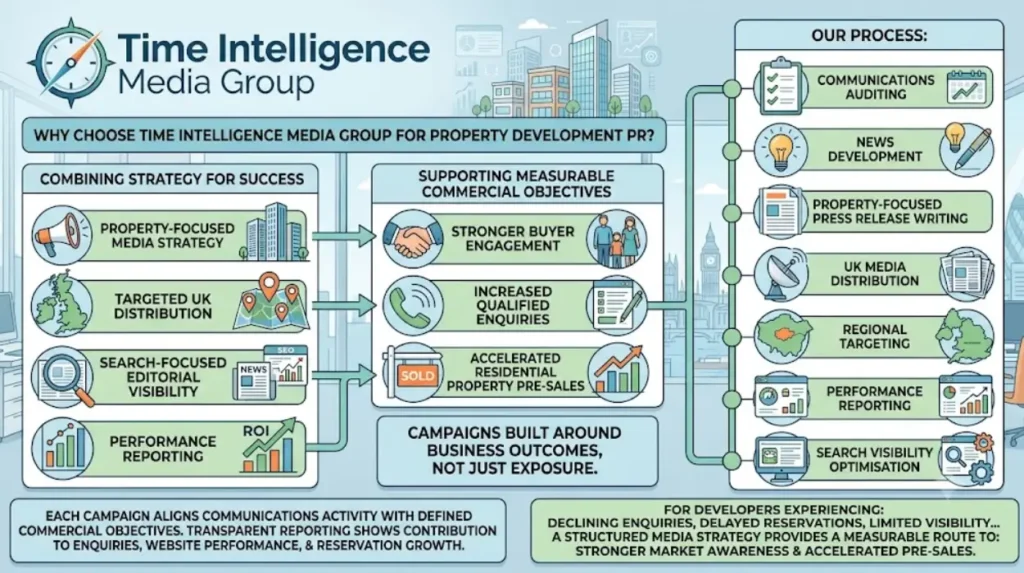
Time Intelligence Media Group combines property-focused media strategy, targeted UK distribution, performance reporting, and search-focused editorial visibility to support measurable commercial objectives including stronger buyer engagement, increased qualified enquiries, and accelerated residential property pre-sales.
Time Intelligence Media Group builds campaigns around measurable business outcomes rather than simple media exposure.
Its process includes:
- Communications auditing
- News development
- Property-focused press release writing
- UK media distribution
- Regional targeting
- Performance reporting
- Search visibility optimisation
Each campaign aligns communications activity with defined commercial objectives.
Explore More Expert Insights:
Full-Service Consumer PR Agencies vs. Time Intelligence Media Group: A Tactical Analysis
Developers receive transparent reporting showing how editorial coverage contributes to enquiries, website performance, and reservation growth.
For residential developments experiencing declining enquiries, delayed reservations, or limited public visibility, a structured media strategy provides a measurable route towards stronger market awareness and accelerated pre-sales. Time Intelligence Media Group supports UK property developers with targeted distribution programmes designed to improve authoritative coverage, strengthen online visibility, and deliver commercially measurable results.