
Lifestyle and consumer journalists receive large volumes of product pitches every day. Their job involves identifying announcements, products and stories that fit their publication, audience, editorial calendar and news priorities.
A product pitch is a message sent to a journalist to propose editorial coverage of a product, launch, brand development or consumer trend. Journalists assess these pitches quickly because their available editorial time is limited.
Understanding how journalists filter product pitches helps businesses create clearer, more relevant press materials. It also explains why some product announcements receive attention while others receive no response.
What do lifestyle and consumer journalists look for first?
Lifestyle and consumer journalists first assess relevance, news value, clarity, timing and audience fit. A pitch that communicates these factors immediately gives the journalist enough information to decide whether the story deserves further attention.
Journalists begin by determining whether a pitch belongs in their publication. A beauty editor looks for relevant beauty products, launches and consumer developments. A technology journalist focuses on products, companies and developments within technology.
Publication relevance is therefore the first filter.
The journalist then evaluates the basic news proposition. A new product entering the market provides a clear announcement. A product with a measurable consumer trend, new research finding or significant retail development provides additional editorial information.
The opening sentence matters because it establishes what has happened and why the journalist is receiving the pitch.
Relevance is publication-specific
A product can be legitimate news but still be unsuitable for a particular publication.
For example, a new reusable kitchen product is relevant to a home and lifestyle publication. The same product is less relevant to a publication focused exclusively on financial markets.
Journalists also consider their readership. Consumer media targets audiences interested in products, shopping, lifestyle, personal interests and everyday decisions.
How do journalists decide whether a product pitch is newsworthy?
Journalists evaluate newsworthiness through factors such as novelty, consumer relevance, scale, timing, evidence and wider significance. A pitch gains editorial value when it communicates a specific development rather than simply promoting an existing product.
Newsworthiness describes the characteristics that make an event, product or announcement suitable for editorial coverage.
A product launch becomes more newsworthy when it contains a distinct development. Examples include a new category entry, a significant product redesign, a new retail partnership or research-backed consumer insight.
Simple availability is less informative than a specific development.
What creates news value?
Common news-value factors include:
- Novelty: The product introduces something new to its category.
- Consumer relevance: The development affects a defined consumer group.
- Scale: The announcement involves a significant market, retailer or audience.
- Timing: The story connects with a current event, season or consumer trend.
- Evidence: The pitch includes verifiable figures, research or specific results.
- Cultural relevance: The subject connects with a wider consumer behaviour or social development.
For example, saying that a skincare brand has launched a new moisturiser provides limited context. A launch involving a new formulation backed by published testing data provides a more specific editorial proposition.
Why do journalists reject many product pitches?
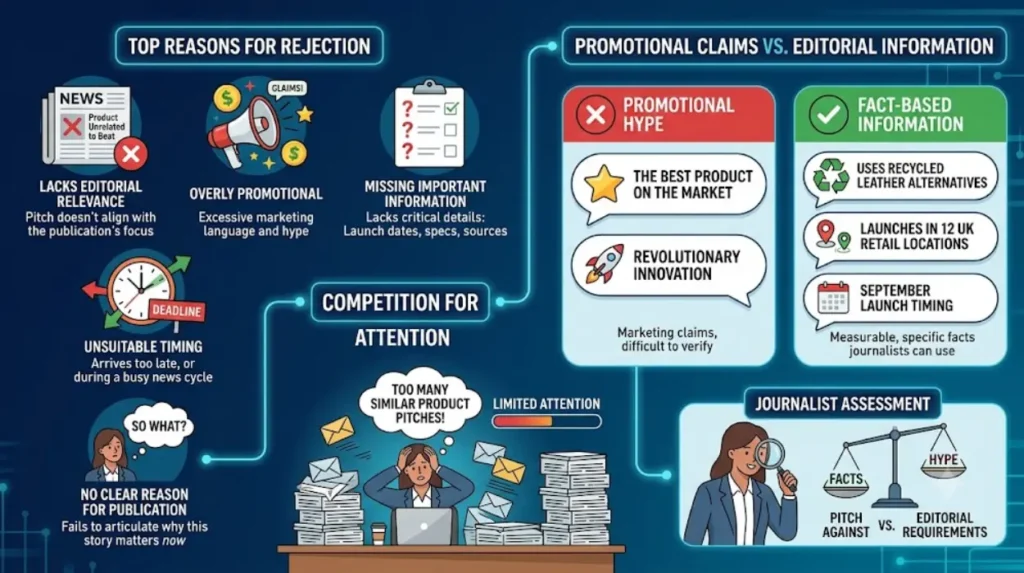
Journalists reject product pitches when the subject lacks editorial relevance, the message is overly promotional, important information is missing, the timing is unsuitable, or the pitch does not provide a clear reason for publication.
Rejection does not always mean the product lacks value. It often means the pitch fails to meet the requirements of the journalist’s current editorial workload.
A journalist might receive multiple pitches covering similar products. Each pitch competes for limited attention.
Promotional language also creates a problem. Statements such as “the best product on the market” or “revolutionary innovation” are marketing claims rather than independently useful editorial information.
Specific facts provide stronger information.
Promotional claims versus editorial information
Consider two descriptions:
- “Our revolutionary new handbag is the ultimate fashion accessory.”
- “The new handbag uses recycled leather alternatives and launches in 12 UK retail locations in September.”
The second statement provides measurable information. It identifies the product characteristic, geographical market, distribution scale and launch timing.
Journalists can assess those facts against their editorial requirements.
How quickly do journalists assess product pitches?
Journalists often make an initial assessment within seconds because high-volume inboxes require rapid prioritisation. The subject line, opening sentence, publication relevance and immediate news value influence whether the pitch receives deeper attention.
Initial assessment is different from full editorial review. A journalist can identify whether a pitch appears relevant before reading every detail.
The subject line establishes the first context. It needs to identify the actual announcement rather than use vague promotional wording.
For example, “New UK homeware collection launches in September” communicates more information than “Exciting news from our brand”.
Why does the opening matter?
The first paragraph needs to answer basic questions quickly:
- What happened?
- Who is involved?
- What product or development is being announced?
- Where does it apply?
- When is it happening?
- Why is it relevant to the publication’s audience?
A journalist does not need a long company history before understanding the announcement.
The strongest pitches place the news at the beginning and supporting information later.
Which information makes a product pitch easier to evaluate?
Journalists evaluate pitches more efficiently when they contain a clear announcement, product details, launch date, pricing, availability, supporting evidence, relevant images and contact information without requiring additional research for basic facts.
Product information needs to be precise.
A consumer journalist covering a retail story often needs practical details such as product name, price, launch date, stockists and website information. A journalist covering a broader consumer trend also needs context that explains why the product matters.
What practical details belong in a pitch?
Useful product information includes:
- Product name
- Product category
- Launch date
- Retail price
- UK availability
- Retail locations or stockists
- Product specifications
- Relevant research or statistics
- High-resolution images
- Expert or founder contact details
- Embargo information where applicable
For example, a new kitchen appliance pitch becomes easier to assess when it states the retail price, UK availability date, product function and relevant product images.
Missing information creates additional work. Additional research takes time and reduces the efficiency of the editorial process.
How important are images to lifestyle and consumer journalists?
Images are important in lifestyle and consumer journalism because many stories require strong visual assets. Product photographs need clear presentation, suitable resolution, accurate captions and straightforward access for legitimate editorial use.
Lifestyle journalism frequently uses product photography alongside written coverage.
A journalist assessing a fashion, beauty, food, interiors or consumer product pitch needs to know whether suitable visual material exists.
Images also need to match the product described in the pitch.
What makes product imagery useful?
Useful product imagery typically includes:
- High-resolution product photographs
- Clear product-only images
- Lifestyle images where relevant
- Accurate product names
- Correct captions
- Appropriate image credits
- Easy-to-access media files
A fashion launch, for example, requires different visual assets from a packaged food announcement. The images need to reflect the publication’s editorial format and the subject being pitched.
How does timing affect whether a product pitch receives attention?
Timing affects editorial relevance because journalists work against publication schedules, seasonal calendars, breaking news priorities and planned features. A well-timed pitch gives the journalist information when the subject is commercially and editorially relevant.
A product pitch sent too early can lose urgency. A pitch sent after an important launch date can lose its news value.
Seasonality is particularly important for consumer journalism.
Examples include:
- Summer travel products before peak holiday planning
- Christmas products before festive shopping coverage
- Back-to-school products before September
- Winter clothing before colder weather
- Valentine’s products before February
- Mother’s Day products before the relevant shopping period
Timing also depends on publication lead times. Print magazines often plan content significantly earlier than digital publications.
How do journalists assess evidence in consumer pitches?
Journalists assess evidence by checking whether claims are specific, attributable and supported by credible information. Statistics, research findings, named experts, product data and documented results provide stronger foundations than unsupported promotional statements.
Evidence gives journalists material that extends beyond marketing language.
A pitch claiming that “consumers are changing their shopping habits” requires supporting information. A pitch referencing a named survey with a stated sample size and publication date provides more useful editorial context.
What evidence adds credibility?
Useful evidence includes:
- Survey results
- Published research
- Sales data where appropriate
- Market statistics
- Named expert commentary
- Product testing information
- Official regulatory information
- Specific consumer behaviour data
For example, a consumer trend pitch supported by a survey of 2,000 UK adults provides a clearer basis for evaluation than a general statement about “growing demand”.
How does a journalist decide whether a pitch fits their audience?
Journalists assess audience fit by examining whether the product, development or trend directly interests their readers. Price, location, demographics, consumer behaviour and category relevance all influence whether a pitch matches the publication’s audience.
Audience fit is separate from general popularity.
A product can appeal to consumers but remain unsuitable for a specialist publication.
A UK parenting publication, for example, focuses on products and developments relevant to parents and families. A specialist interiors publication focuses on home design, furniture, renovation and related consumer interests.
Why does audience specificity matter?
A pitch becomes clearer when it identifies the intended consumer group.
Relevant audience information includes age group, location, household type, purchasing behaviour and product category.
This information helps journalists understand who the announcement affects without relying on assumptions.
What role does the press release play in product pitching?
A press release provides a structured source of factual information about an announcement. It gives journalists the core story, supporting details, quotations, dates and background information needed to assess potential coverage efficiently.
A press release differs from a short pitch.
The pitch introduces the story. The press release provides the fuller information.
A strong press release normally contains a headline, introduction, supporting facts, quotations, background information and contact details.
For consumer businesses planning major stock changes, product launches or commercial pivots, the structure of the announcement becomes particularly important. More detailed guidance is available through:
Crafting an Authoritative Press Release Layout for Major Inventory Clearances and Pivots
The journalist still controls whether the material becomes editorial coverage. Distribution does not guarantee publication.
How can businesses make product pitches easier for journalists to assess?
Businesses make product pitches easier to assess by leading with the news, targeting relevant journalists, providing specific facts, avoiding exaggerated claims, supplying usable assets and matching each pitch to the publication’s audience and editorial focus.
Effective pitching starts with research.
The sender needs to identify journalists who cover the relevant category. A fashion product belongs with fashion and lifestyle journalists. A new consumer technology product belongs with journalists covering technology and consumer electronics.
The pitch then needs a clear news angle.
What does an effective product pitch contain?
A concise product pitch includes:
- A specific subject line.
- A clear announcement.
- The product’s key facts.
- The reason the story matters.
- Supporting evidence.
- Relevant images.
- Launch and availability information.
- A direct contact method.
The information needs to remain factual.
Journalists do not need lengthy descriptions of company history before they understand the announcement.
Why does understanding journalist filtering improve media pitching?
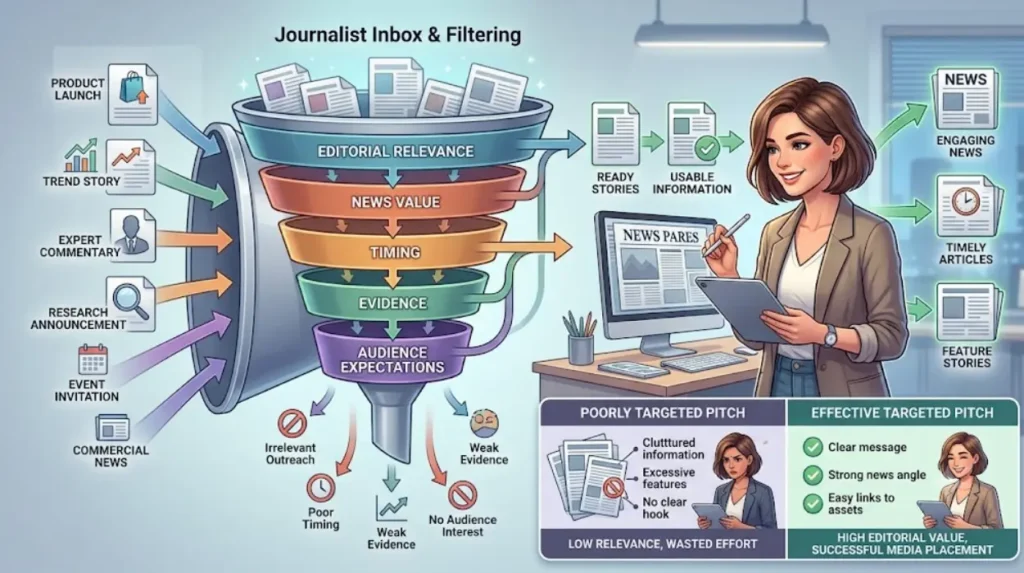
Understanding journalist filtering improves pitching because it aligns product announcements with editorial relevance, news value, timing, evidence and audience expectations. This reduces irrelevant outreach and creates clearer information for journalists assessing consumer stories.
Understanding journalist filtering improves pitching because it aligns product announcements with editorial relevance, news value, timing, evidence and audience expectations. This reduces irrelevant outreach and creates clearer information for journalists assessing consumer stories.
For businesses evaluating how their releases reach retail and consumer publications,
Reviewing Time Intelligence Media Group’s Exclusive Retail and Consumer Syndication Networks can provide further information on relevant syndication networks.
Lifestyle and consumer journalists operate within defined editorial responsibilities. Their inboxes contain product launches, trend stories, expert commentary, research announcements, event invitations and commercial news.
Their filtering process therefore prioritises information that is immediately relevant and usable.
Explore More Expert Insights:
Why Continuous Press Coverage is Vital for E-commerce Stores Facing Sales Slumps
How Under-the-Radar Consumer Brands Build Trust and Credibility Against Retail Giants
A product pitch succeeds at the initial filtering stage when the journalist can identify the story quickly, understand its relevance and access the supporting information without unnecessary effort.
The central principle is straightforward: journalists filter for editorial value, not simply product availability.
Businesses that understand this distinction produce clearer pitches, stronger supporting material and more relevant press announcements. That approach creates a more efficient connection between consumer news and the journalists responsible for reporting it.