
Consumer brand trust is the confidence customers place in a company’s products, claims, service, and reputation. Smaller brands build this confidence through consistent evidence, transparent communication, credible reviews, expert validation, and reliable customer experiences.
Trust reduces uncertainty before purchase. This matters when a lesser-known brand competes with established retailers that already have widespread recognition.
Retail giants benefit from familiarity, extensive distribution, large customer bases, and years of market presence. Under-the-radar consumer brands often lack these advantages. Their credibility therefore depends on evidence that customers can verify.
Trust has several components:
- Product credibility: Evidence that the product performs as described.
- Business credibility: Clear information about the company, leadership, location, and operations.
- Customer credibility: Reviews, ratings, testimonials, and repeat purchases.
- Media credibility: Coverage from recognised publications and relevant industry outlets.
- Digital credibility: Consistent information across websites, marketplaces, social platforms, and search results.
A consumer brand is under-the-radar when it has limited public awareness despite having an established product, business operation, or customer base. It does not necessarily mean the brand is new.
Why do retail giants have an immediate trust advantage?
Retail giants start with established recognition, broad distribution, extensive customer reviews, visible physical or digital presence, and repeated exposure. Under-the-radar brands must establish these trust signals through consistent evidence across customer, media, search, and retail channels.
Brand familiarity influences purchasing decisions. Customers recognise names they encounter frequently through shops, advertising, search results, packaging, social media, and previous purchases.
Large retailers also create multiple points of reassurance. A customer can find product information, reviews, delivery policies, customer service details, and third-party coverage within a single purchasing journey.
Smaller consumer brands need to create comparable levels of information without copying the scale of larger competitors.
Which trust signals matter most?
Trust signals are observable indicators that help customers assess whether a company is credible.
Important examples include:
- Independent product reviews
- Verified customer ratings
- Expert commentary
- Detailed product information
- Transparent pricing
- Clear returns policies
- Secure payment information
- Recognised media coverage
- Awards and certifications
- Founder or leadership profiles
- Accurate business information
- Consistent brand claims
The value of each signal depends on the product category. A skincare brand, food producer, electronics company, and financial technology business require different forms of evidence.
How can smaller consumer brands establish credibility through evidence?
Smaller consumer brands establish credibility by publishing specific evidence about products, customers, operations, and performance. Clear claims, documented results, independent reviews, certifications, customer feedback, and transparent company information provide verifiable reasons to trust the business.
Evidence converts brand claims into information customers can evaluate.
A statement such as “high quality” provides limited information because it lacks measurable detail. A statement explaining a product specification, testing process, certification, or independently verified result provides stronger evidence.
What product evidence supports consumer trust?
Product evidence includes measurable information about what customers receive.
Examples include:
- Materials and ingredients
- Product dimensions
- Technical specifications
- Testing standards
- Manufacturing information
- Usage instructions
- Warranty terms
- Product certifications
- Performance measurements
Claims must remain accurate and consistent across product pages, packaging, press materials, marketplaces, and advertising.
Why does transparency matter?
Transparency gives customers information before they make a purchasing decision.
An effective consumer brand explains who operates the business, where products originate, how products are made, what customers receive, and how problems are handled.
Transparency also applies to negative information. Clear delivery restrictions, return conditions, product limitations, and availability details prevent mismatched expectations.
How does earned media strengthen credibility for lesser-known brands?

Earned media strengthens credibility by placing a consumer brand within independent editorial environments. Coverage in relevant publications provides third-party context, increases discoverability, supports branded search visibility, and gives customers additional evidence beyond the company’s own marketing channels.
Earned media refers to editorial coverage that a company does not directly control as paid advertising.
Relevant coverage can include product features, founder interviews, business stories, expert commentary, industry analysis, and announcements.
Media relevance matters more than publication volume. A specialist publication covering a brand’s category can provide useful context for a specific audience.
What makes media coverage credible?
Credible coverage normally contains identifiable information about the company, product, event, or person being discussed.
Useful characteristics include:
- A recognised publication
- Relevant editorial context
- Accurate company information
- Specific product or business details
- Named sources
- Independent editorial presentation
- A clear publication date
Media coverage also creates additional information that search engines and customers can discover when researching a brand.
Brands developing a structured approach to media visibility can later explore:
Designing a Press Distribution Strategy for Strategic Co-Branded Retail Partnerships for more detailed distribution strategy information.
How can customer reviews compete with established retail reputations?
Customer reviews provide direct evidence from people who purchased or used a product. Smaller brands strengthen credibility by collecting authentic reviews, responding to feedback, presenting balanced ratings, and making review information easy to find throughout the customer journey.
Reviews reduce uncertainty because they provide experiences outside the company’s own communications.
The quality of review information matters. A collection of detailed reviews provides more context than a simple average rating.
What makes reviews useful?
Useful reviews contain specific information about the customer experience.
Examples include comments about:
- Product quality
- Ease of use
- Delivery
- Packaging
- Durability
- Customer support
- Product performance
- Value for money
Brands also need a clear process for handling negative reviews.
A professional response acknowledges the issue, provides relevant information, and explains the available resolution. Removing legitimate criticism without explanation can damage credibility.
How does consistent brand information build consumer confidence?
Consistent brand information ensures customers encounter the same factual details across websites, marketplaces, media coverage, social channels, and retail listings. Consistency reduces confusion and strengthens recognition because product names, claims, specifications, and business information remain aligned.
Consumers often research products across several platforms before purchasing.
A customer can encounter a brand website, Google result, marketplace listing, social profile, review page, and news article within one buying journey. Contradictory information creates uncertainty.
Which information needs to remain consistent?
Core information includes:
- Brand name
- Product names
- Product specifications
- Pricing information
- Business description
- Founder information
- Contact details
- Availability
- Delivery information
- Product claims
This consistency also supports search visibility. Search engines use information from multiple sources to understand entities, businesses, products, and relationships.
How can consumer brands use expertise to establish authority?
Consumer brands establish authority by demonstrating relevant expertise through accurate educational content, expert commentary, research, product knowledge, and transparent explanations. Expertise gives customers useful information while positioning the business as a credible source within its category.
Authority differs from popularity.
A brand does not need the largest audience to demonstrate specialist knowledge. It needs accurate information that addresses relevant questions and supports claims with evidence.
What forms of expertise are useful?
Depending on the category, useful expertise includes:
- Product education
- Industry research
- Technical explanations
- Expert interviews
- Founder commentary
- Manufacturing knowledge
- Regulatory information
- Consumer guidance
For example, a home technology company can explain compatibility standards and installation requirements. A food brand can explain ingredients, sourcing, preparation, and storage.
Educational content also creates material that search engines can associate with relevant consumer queries.
How does a strong digital presence improve credibility?
A strong digital presence gives consumers accessible, consistent information about a brand and its products. A complete website, accurate search listings, active customer support, useful content, and consistent social profiles reduce uncertainty during product research and purchase decisions.
Digital credibility begins with the company website.
A credible website provides clear product information, contact details, company information, policies, frequently asked questions, and customer support routes.
Search visibility also matters because consumers frequently begin research through search engines.
What should a credible consumer brand website contain?
A practical structure includes:
- Clear product pages
- Company information
- Contact details
- Delivery information
- Returns and refund policies
- Customer support information
- Frequently asked questions
- Reviews or testimonials
- Relevant educational content
- Privacy and legal information
Each section addresses a different form of customer uncertainty.
How can smaller brands demonstrate credibility through partnerships?
Strategic partnerships provide external validation when the relationship has clear relevance and verifiable substance. Retail partnerships, professional collaborations, distribution agreements, expert relationships, and co-branded initiatives demonstrate that other organisations recognise the brand’s products or capabilities.
Partnerships become useful credibility signals when their details are clear.
For example, a consumer brand entering a retail partnership can communicate the participating organisations, product range, launch date, locations, and customer availability.
A partnership announcement without meaningful details provides limited evidence. Specific information gives customers something they can verify.
What makes a partnership credible?
A credible partnership announcement identifies:
- The organisations involved
- The purpose of the partnership
- Products or services included
- Relevant dates
- Distribution locations
- Customer availability
- Named representatives where appropriate
These details also provide useful material for media coverage and search discovery.
How can under-the-radar brands measure trust and credibility?
Brands can measure credibility through branded search activity, direct traffic, review volume and quality, media mentions, referral traffic, repeat purchases, conversion rates, customer support trends, and visibility across relevant search results. Measurement connects trust-building activity with observable consumer behaviour.
No single metric represents trust.
A practical measurement framework combines visibility, engagement, reputation, and commercial indicators.
Which metrics provide useful evidence?
Relevant measures include:
- Branded search impressions
- Organic branded traffic
- Direct website visits
- Review quantity
- Average review rating
- Media mentions
- Referral traffic
- Returning customer rate
- Conversion rate
- Customer acquisition source
- Product return rate
Metrics need a defined period for comparison. For example, a brand can compare branded search activity before and after a major media campaign over 30, 60, and 90 days.
This approach identifies changes rather than relying on isolated numbers.
Why does credibility become a long-term competitive advantage?
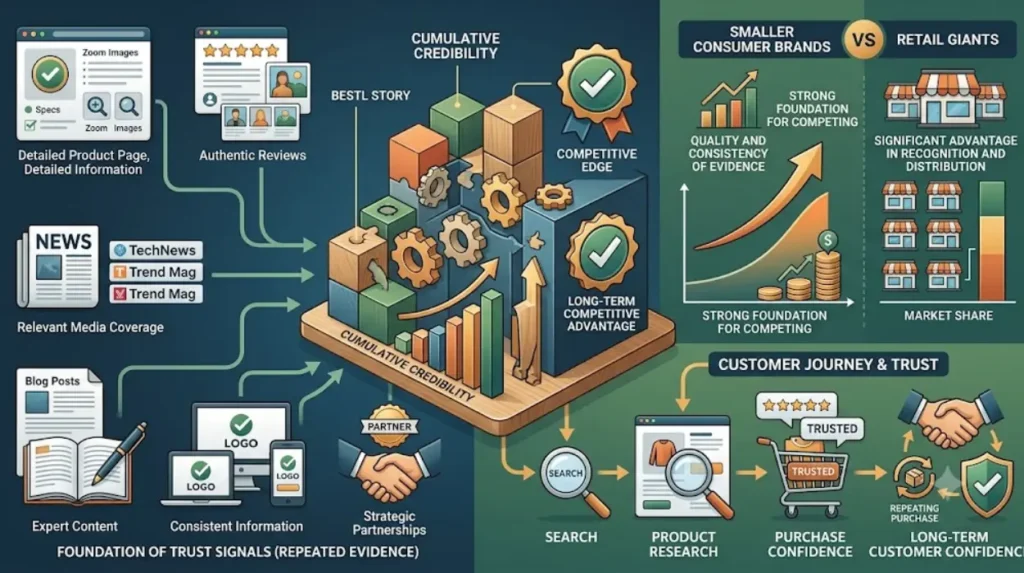
Credibility becomes a competitive advantage when trust signals accumulate across products, customers, media, search results, partnerships, and digital channels. Repeated evidence reduces uncertainty and gives under-the-radar brands a stronger foundation for competing with established retail businesses.
For brands ready to explore a more tailored approach to media visibility,
Custom PR distribution provides a more detailed look at distribution considerations for D2C businesses.
Retail giants retain significant advantages in recognition and distribution. Smaller consumer brands compete through the quality and consistency of their evidence.
The process is cumulative.
A detailed product page supports customer research. Authentic reviews support purchase confidence. Relevant media coverage supports third-party credibility. Expert content demonstrates knowledge. Consistent information strengthens search visibility. Strategic partnerships provide additional external validation.
Together, these elements create a credible public presence.
Explore More Expert Insights:
Why New E-commerce Startups Fail Without an Omnichannel Media Visibility Strategy
The Direct Impact of Brand Awareness on Reducing Customer Acquisition Costs (CAC)
Trust therefore depends on more than awareness. It depends on whether customers can find accurate, specific, and consistent evidence at each stage of their research and purchasing journey.
For consumer brands operating beyond established retail networks, this evidence-led approach provides a measurable foundation for building recognition, credibility, and long-term customer confidence.