Customer acquisition cost (CAC) measures the total cost of gaining one new customer. Brand awareness measures how familiar people are with a business, product, or organisation. These two business metrics influence each other directly. Strong brand awareness reduces marketing inefficiencies, increases trust, improves conversion rates, and lowers the cost required to acquire each new customer.
Businesses across the United Kingdom monitor CAC because it affects profitability, growth, and marketing performance. Understanding how brand awareness influences acquisition costs helps marketing teams allocate budgets more effectively and build sustainable growth strategies.
What is brand awareness, and why does it affect customer acquisition costs?
Brand awareness describes how well consumers recognise and remember a business. Higher recognition increases trust, improves marketing response rates, reduces purchase hesitation, and increases conversion efficiency. These combined effects reduce the average marketing investment required to acquire every new customer over time.
Brand awareness represents the level of familiarity consumers have with a company, product, or service. Recognition occurs when consumers identify a brand through its name, logo, colours, slogan, or reputation.
Customer acquisition cost (CAC) is calculated using the following formula:
CAC = Total marketing and sales costs ÷ Number of new customers acquired
For example:
- Marketing spend: £50,000
- Sales costs: £20,000
- New customers: 1,000
- CAC: £70
Higher awareness improves every stage of the buying journey. Consumers recognise familiar brands faster, spend less time evaluating alternatives, and respond more positively to marketing messages.
Businesses with stronger recognition often generate more direct website visits, branded searches, referrals, and repeat engagement, all of which reduce acquisition costs.
How does brand awareness improve marketing efficiency?
Brand awareness increases marketing efficiency by improving click-through rates, increasing conversion rates, lowering advertising waste, and generating more unpaid customer interactions. Better efficiency enables businesses to acquire more customers while maintaining stable or lower marketing expenditure across multiple channels.
Marketing efficiency measures how effectively marketing investment generates results.
Consumers respond differently to familiar brands than unfamiliar ones.
Higher click-through rates
Consumers click recognised brands more frequently.
For example:
- Paid search advertisements
- Social media advertisements
- Display advertising
- Email campaigns
Higher click-through rates improve advertising performance metrics.
Higher conversion rates
Recognition reduces uncertainty during purchase decisions.
Visitors who already know a brand complete purchases more frequently than first-time visitors with no previous exposure.
Higher conversion rates reduce the cost per acquisition because more visitors become customers.
Lower advertising waste
Advertising waste occurs when campaigns reach audiences that never convert.
Established awareness improves audience quality because recognised brands receive stronger engagement from relevant consumers.
Which marketing channels benefit most from strong brand awareness?
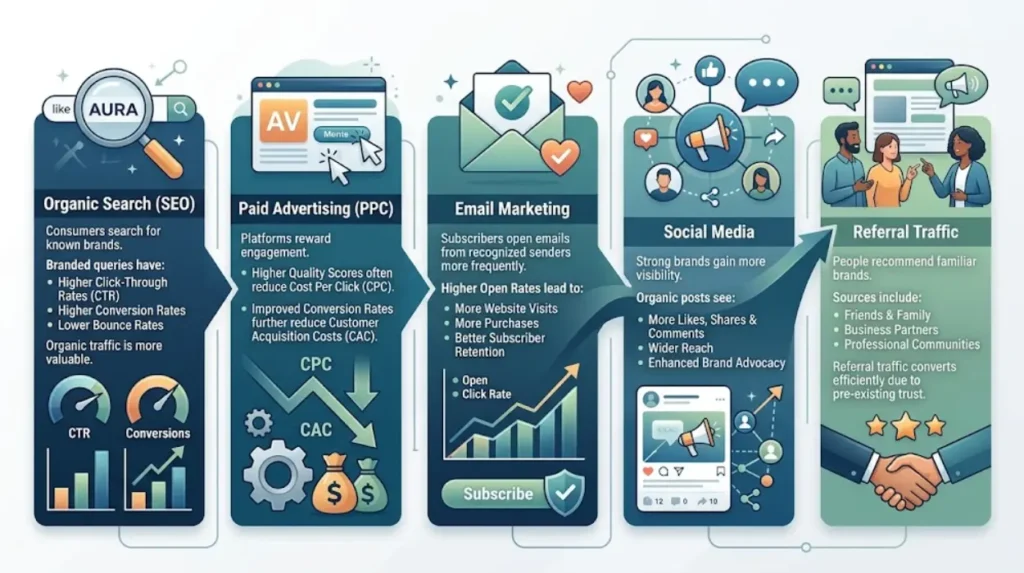
Every major marketing channel benefits from brand awareness because recognition improves engagement before users interact with marketing campaigns. Paid advertising, organic search, email marketing, social media, referrals, and public relations all achieve stronger performance with recognised brands.
Different channels experience different improvements.
Organic search
Consumers frequently search for brands they already recognise.
Branded search queries often have:
- Higher click-through rates
- Higher conversion rates
- Lower bounce rates
Organic traffic therefore becomes more valuable.
Paid advertising
Advertising platforms reward campaigns with stronger engagement.
Higher quality scores often reduce cost per click.
Improved conversion rates further reduce customer acquisition costs.
Email marketing
Subscribers open emails from recognised senders more frequently.
Higher open rates produce:
- More website visits
- More purchases
- Better subscriber retention
Referral traffic
People recommend familiar brands more often.
Examples include:
- Friends
- Family members
- Business partners
- Professional communities
Referral traffic usually converts efficiently because trust already exists before the first website visit.
Why does consumer trust reduce acquisition costs?
Consumer trust reduces acquisition costs because trusted businesses require less persuasion during purchasing decisions. Faster decision-making, higher conversion rates, stronger referrals, and improved customer confidence reduce the marketing investment required to generate each successful sale consistently over time.
Trust removes purchasing friction.
Consumers often compare several businesses before buying.
Recognised brands receive an advantage because consumers already associate them with credibility.
Trust influences:
- Purchase confidence
- Recommendation behaviour
- Review engagement
- Repeat purchasing
Positive reviews strengthen awareness further.
For example, businesses with thousands of verified customer reviews often receive stronger engagement than competitors with limited public recognition.
This creates a reinforcing cycle where visibility supports trust and trust supports lower acquisition costs.
How does brand awareness support long-term business growth?
Brand awareness creates long-term growth by lowering future acquisition costs, increasing customer retention, improving referral activity, strengthening market visibility, and generating consistent demand. These cumulative advantages improve marketing efficiency across multiple financial periods rather than individual campaigns alone.
Short-term marketing focuses on immediate conversions.
Brand awareness supports both current and future performance.
Benefits include:
- Lower long-term advertising dependence
- Increased branded search traffic
- Stronger customer loyalty
- Higher repeat purchase rates
- Greater customer lifetime value
Businesses that balance immediate performance marketing with long-term awareness often achieve more stable acquisition costs.
Marketing performance becomes less dependent on continuously increasing advertising budgets.
Which metrics measure the relationship between brand awareness and CAC?
Businesses evaluate brand awareness alongside acquisition costs using measurable marketing indicators. Tracking multiple metrics identifies whether increased recognition improves campaign efficiency, customer behaviour, and overall acquisition performance across digital and traditional marketing channels throughout successive reporting periods.
Several metrics provide useful evidence.
Customer Acquisition Cost (CAC)
This measures total acquisition efficiency.
Lower CAC indicates improved marketing performance.
Brand search volume
Brand search volume measures how often consumers search for a company’s name.
Higher branded searches indicate increasing awareness.
Direct website traffic
Direct traffic measures visitors entering a website directly without another referring source.
Increasing direct traffic often reflects stronger recognition.
Conversion rate
Conversion rate measures the percentage of visitors completing a desired action.
Higher conversion rates often accompany increased familiarity.
Customer Lifetime Value (CLV)
Customer lifetime value estimates the total revenue generated throughout a customer relationship.
Comparing CLV with CAC helps businesses evaluate long-term profitability.
Readers seeking practical strategies for improving media visibility can explore:
Digital Press Kit.
What practical activities increase brand awareness?
Brand awareness increases through consistent communication, valuable content, positive customer experiences, public visibility, and repeated audience exposure. Businesses combining several awareness activities create broader recognition that supports lower customer acquisition costs across multiple marketing channels and customer segments.
Awareness develops through repeated exposure.
Common activities include:
- Educational content publishing
- Industry event participation
- Media interviews
- Community sponsorships
- Customer success stories
- Social media engagement
- Search engine optimisation
- Consistent visual identity
For example:
Educational articles answer customer questions.
Industry conferences increase professional visibility.
Customer testimonials reinforce credibility.
Search engine optimisation improves discoverability through organic search.
Combining multiple activities creates repeated exposure, which strengthens recognition over time.
Explore More Expert Insights:
How High-Authority Backlinks from Retail Media Resurrect Declining Organic Shop Traffic
Why Paid Ads Alone Are No Longer Enough for Struggling E-commerce Brands to Survive
What common mistakes prevent brand awareness from lowering CAC?
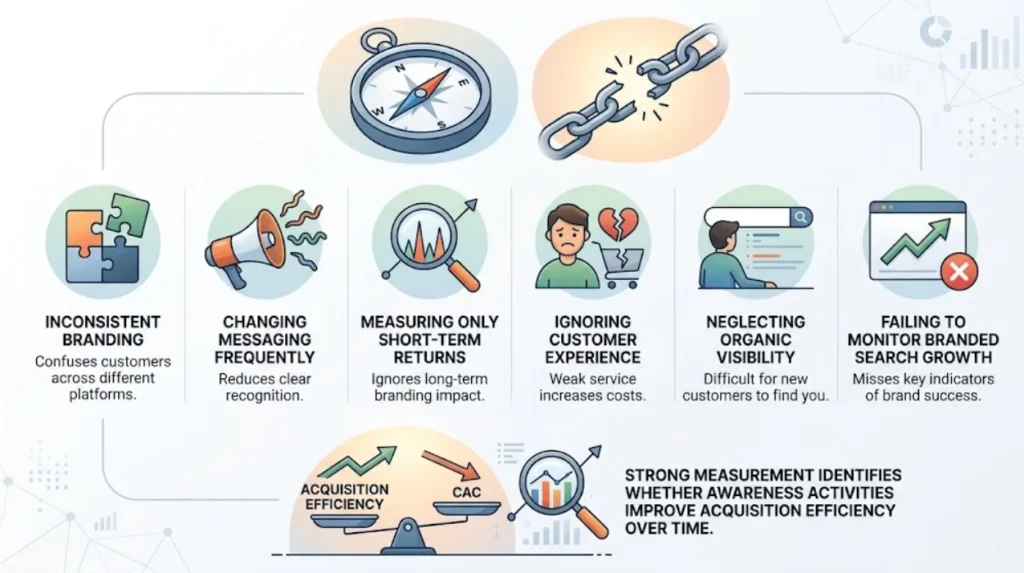
Several common mistakes reduce the impact of brand awareness on acquisition efficiency. Inconsistent messaging, poor measurement, fragmented marketing activity, and weak customer experiences limit recognition and increase acquisition costs despite continued marketing investment across different channels.
Businesses often focus only on immediate sales.
This approach ignores long-term recognition.
Common mistakes include:
- Inconsistent branding across platforms
- Changing messaging frequently
- Measuring only short-term advertising returns
- Ignoring customer experience
- Neglecting organic visibility
- Failing to monitor branded search growth
Strong measurement identifies whether awareness activities improve acquisition efficiency over time.
Businesses comparing awareness-building approaches with implementation frameworks can later explore:
Enterprise Retail PR.
Brand awareness directly influences customer acquisition cost by improving recognition, increasing trust, strengthening marketing efficiency, and supporting higher conversion rates. Familiar brands generate more branded searches, stronger referral activity, better advertising performance, and higher customer confidence. These measurable improvements reduce the average cost required to acquire new customers.
Monitoring CAC alongside brand search volume, direct traffic, conversion rates, customer lifetime value, and referral growth provides a clear picture of marketing performance. Businesses that build consistent brand awareness create more efficient customer acquisition systems and stronger long-term commercial growth.