
A holiday gift guide pitch is a concise media proposal that presents a product as a relevant seasonal recommendation. It gives editors the product details, audience fit, price, availability, imagery, and deadline information required to assess inclusion quickly and accurately.
A holiday gift guide is a curated editorial list of products recommended for a specific audience, occasion, budget, or need. UK publications publish guides across national news, lifestyle, fashion, technology, parenting, home, food, and specialist retail categories.
A holiday gift guide pitch is not a standard company announcement. It focuses on the product’s usefulness to the publication’s audience. The retailer’s business story remains secondary.
High-conversion pitches make editorial evaluation faster. They answer the questions an editor asks during product selection:
- What is the product?
- Who is it for?
- Why does it fit this guide?
- What does it cost?
- Where is it available?
- Is it in stock?
- Are product images ready?
- Can a sample be supplied?
- Is the information accurate?
What does “high conversion” mean in gift guide PR?
In gift guide PR, conversion means moving a pitch through a defined editorial process. The process includes:
- Pitch opened
- Product reviewed
- Sample or images requested
- Product selected
- Listing published
- Referral traffic or sales tracked
A strong pitch supports each stage with complete information. An incomplete pitch creates additional editorial work and reduces processing speed.
Why do holiday gift guide pitches matter for online retailers?
Holiday gift guide pitches give online retailers access to editorial audiences beyond paid advertising platforms. A relevant placement creates product discovery, third-party credibility, referral traffic, branded search activity, and reusable media evidence during high-intent seasonal buying periods.
Holiday shopping creates concentrated demand. Consumers search for products by recipient, price, category, and occasion. Common searches include “gifts for dads under £50”, “best Christmas gifts for teenagers”, and “British-made home gifts”.
Gift guides organise products around these purchase decisions. They help consumers compare options before visiting retailer websites.
Paid advertising remains useful, but paid reach ends when campaign spending stops. Editorial coverage creates a separate discovery channel. A published product recommendation can continue generating visits while the article remains indexed and accessible.
This supports the wider issue explained in:
Why Paid Ads Alone Are No Longer Enough for Struggling E-commerce Brands to Survive. Retail growth requires multiple acquisition channels, including organic search, editorial coverage, email, partnerships, and paid media.
What commercial outcomes can gift guide coverage support?

Gift guide placements support measurable outcomes:
- Referral sessions from publication websites
- Product-page visits
- New customer acquisition
- Branded search growth
- Email sign-ups
- Seasonal sales
- Backlinks from relevant publications
- Reusable media mentions
Online retailers need tracking systems before outreach begins. Use unique landing pages, UTM parameters, publication-specific discount codes, and analytics events.
A placement does not guarantee sales. Product relevance, price, website speed, stock availability, delivery terms, and checkout quality affect commercial performance.
When should online retailers begin pitching holiday gift guides?
Online retailers should begin gift guide planning 4 to 6 months before the target holiday period. Early preparation allows time for product selection, editorial research, image production, sample delivery, follow-ups, and publication schedules across national, regional, and specialist media.
Many holiday guides are planned before consumers begin seasonal shopping. Editorial teams often work several months ahead.
For Christmas campaigns, preparation commonly starts in May or June. Outreach often begins between July and September, depending on the publication and guide format.
A retailer that starts in November competes for limited editorial space. Many long-lead print publications have already completed product selection.
What is the difference between long-lead and short-lead outreach?
Long-lead publications work several months ahead. Print magazines often finalise seasonal content before the public shopping period begins.
Short-lead publications work closer to publication dates. Digital news sites, online lifestyle publications, newsletters, and commerce platforms can update guides during October, November, and December.
Retailers need separate outreach schedules for each group.
What preparation timeline supports holiday pitching?
A structured timeline includes:
- May: Review seasonal products and sales data.
- June: Select priority products and define gift audiences.
- July: Produce product photography and media assets.
- August: Build publication and editor lists.
- September: Send long-lead and early digital pitches.
- October: Send targeted short-lead pitches.
- November: Support updates, stock checks, and late opportunities.
- December: Track coverage and analyse results.
How do retailers identify the right gift guide opportunities?
Retailers identify relevant opportunities by matching product attributes with publication audiences and guide categories. Effective targeting uses audience demographics, product price, editorial themes, seasonal deadlines, and previous guide formats rather than sending one generic pitch to every outlet.
A product must fit the guide’s selection criteria.
A £180 premium coffee machine fits a luxury kitchen guide. It does not fit a “gifts under £50” feature. A children’s educational subscription fits a parenting publication more directly than a general technology outlet.
Research published guides from the previous holiday season. Record the product categories, price ranges, writing style, image format, and retailer types included.
Which guide categories create useful targeting groups?
Common holiday gift guide categories include:
- Gifts for women
- Gifts for men
- Gifts for children
- Gifts for teenagers
- Gifts for parents
- Gifts for couples
- Gifts under £25
- Gifts under £50
- Luxury gifts
- Sustainable gifts
- British-made gifts
- Technology gifts
- Home and interiors gifts
- Food and drink gifts
- Beauty and wellness gifts
Each category requires a different product angle.
How should retailers score opportunities?
Use a five-factor relevance score:
| Factor | Score |
|---|---|
| Audience match | 1–5 |
| Product-category match | 1–5 |
| Price-band match | 1–5 |
| Seasonal relevance | 1–5 |
| Publication reach | 1–5 |
Prioritise opportunities with scores of 20 or more. This creates a consistent selection process.
What information belongs in a high-conversion gift guide pitch?
A high-conversion gift guide pitch includes a personalised subject line, product name, recipient fit, retail price, key benefit, availability, product link, image access, sample information, and clear contact details. Every detail must be current and easy to verify.
Editors need product facts in a scannable format.
Place the most important information near the beginning. Avoid long company histories, broad mission statements, and unsupported claims.
What should the subject line include?
A subject line identifies the guide category and product relevance.
Examples include:
- Gift guide idea: British-made leather wallet under £50
- Christmas gift for home cooks: £39 artisan spice set
- Product submission: sustainable gift for children aged 6–10
The subject line must describe the product accurately. It must not use misleading urgency.
What product details should appear in the pitch?
Include:
- Product name
- Product category
- Retail price
- Target recipient
- Key product benefit
- Available colours or sizes
- Product URL
- High-resolution image link
- Stock status
- Delivery information
- Sample availability
- Media contact details
Use one clear sentence for each product benefit.
For example:
The £45 insulated travel mug keeps drinks hot for up to 8 hours and includes a leak-resistant lid.
This sentence gives the price, product type, measurable feature, and practical benefit.
How should retailers write the product angle?
The product angle explains why a specific item belongs in a specific guide. It connects the product’s features with a defined recipient, budget, lifestyle, or seasonal need while avoiding broad promotional claims that lack editorial relevance or evidence.
A product description lists features. A product angle connects features to the guide’s audience.
For example:
Product description:
A stainless-steel lunch container with three compartments.
Gift guide angle:
A practical £32 gift for office workers who prepare lunches in advance.
The second version identifies the recipient, use case, and price.
How can retailers create multiple angles for one product?
One product can support several guide categories.
A £40 personalised blanket can fit:
- Gifts for new homeowners
- Gifts for grandparents
- Personalised Christmas gifts
- British-made gifts
- Gifts under £50
Each pitch needs a category-specific introduction. The product facts remain consistent.
Which claims require evidence?
Retailers need evidence for measurable claims.
Examples include:
- “Made from 80% recycled material”
- “Available in 12 colours”
- “Delivered within 2 working days”
- “Holds 750 ml”
- “Designed and manufactured in the UK”
Avoid unsupported phrases such as “the perfect gift”, “best-selling”, or “must-have”. These phrases provide limited editorial value.
What assets increase the likelihood of editorial selection?
Complete media assets reduce editorial workload and improve product evaluation. Retailers need high-resolution images, accurate product pages, clear pricing, current stock data, sample procedures, and concise product specifications prepared before outreach begins.
Editorial teams often review many products within limited time. Missing assets create delays.
Which images are required?
Prepare at least four image types:
- White-background product image
- Lifestyle image
- Close-up detail image
- Packaging or gift presentation image
Use high-resolution files. Name files clearly.
Example:
brand-product-name-front.jpg
Avoid filenames such as:
IMG_8472-final-new.jpg
Why does the product page matter?
Editors often verify information through the retailer’s website.
The product page needs:
- Current price
- Accurate description
- Product dimensions
- Available options
- Stock status
- Delivery information
- Returns information
- Clear product photography
A pitch and product page must contain matching information.
How can retailers manage samples and stock?
Retailers need a documented sample and stock process before pitching. Fast sample approval, accurate inventory data, reliable delivery, and clear return procedures help editors review products without operational delays during high-volume holiday publishing periods.
Sample requests often require rapid action.
Assign one person to approve and dispatch media samples. Record the editor, publication, product, dispatch date, and expected return status.
What stock information should retailers provide?
State whether the product is:
- In stock
- Available for pre-order
- Available in limited quantities
- Expected to sell out
- Replenished on a specific date
Do not pitch discontinued products. Do not promote products with uncertain fulfilment information.
How should retailers handle product changes?
Update editors when a product price, colour range, or availability changes.
Accuracy protects the publication’s audience and reduces correction requests.
How should retailers follow up without creating unnecessary pressure?
Retailers should send one relevant follow-up after allowing adequate review time. The message must add useful information, such as updated stock, new imagery, sample availability, or a deadline reminder, rather than repeating the original pitch without context.
A follow-up is a new opportunity to provide useful information.
Wait according to the publication’s stated preferences. If no preference exists, allow several working days before contacting the editor again.
What should a follow-up include?
A useful follow-up can state:
The product remains in stock, and a review sample is available for dispatch within one working day.
This gives an editor current operational information.
Avoid repeated follow-ups. Maintain a contact record to prevent duplicate outreach from different team members.
How can retailers measure holiday gift guide performance?
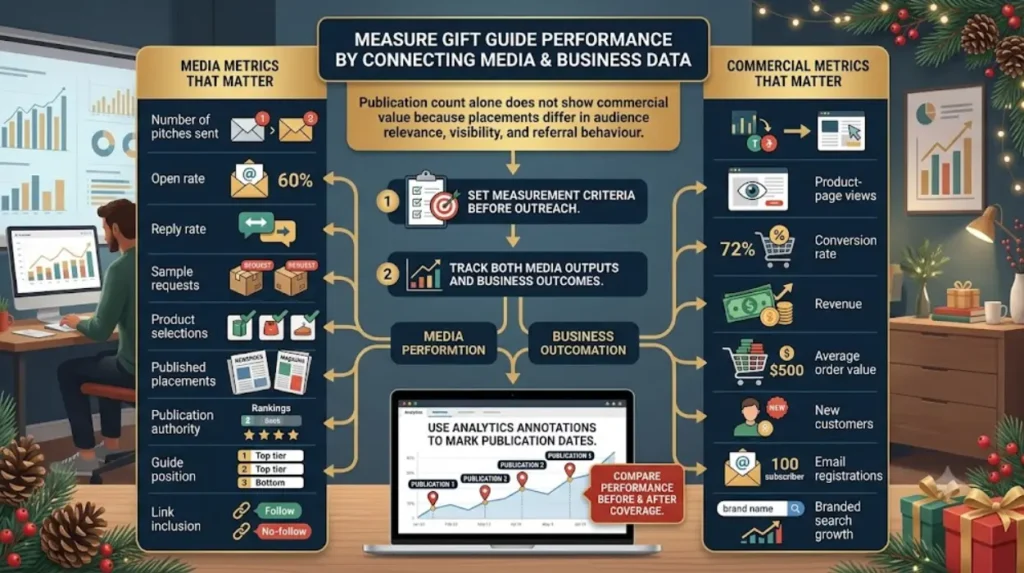
Retailers measure gift guide performance by connecting media placements with traffic, engagement, sales, search activity, and customer acquisition. Publication count alone does not show commercial value because placements differ in audience relevance, visibility, and referral behaviour.
Set measurement criteria before outreach.
Track both media outputs and business outcomes.
Which media metrics matter?
Track:
- Number of pitches sent
- Open rate
- Reply rate
- Sample requests
- Product selections
- Published placements
- Publication authority
- Guide position
- Link inclusion
Which commercial metrics matter?
Track:
- Referral sessions
- Product-page views
- Conversion rate
- Revenue
- Average order value
- New customers
- Email registrations
- Branded search growth
Use analytics annotations to mark publication dates. Compare performance before and after coverage.
What role does managed PR distribution play in holiday campaigns?
Managed PR distribution provides structured support for retailer targeting, editorial timing, media outreach, asset coordination, and coverage reporting. It suits online brands that need repeatable campaigns across multiple product launches, seasonal periods, or UK publication categories.
Retailers can manage gift guide outreach internally or use specialist PR support.
Internal outreach provides direct control. It requires editorial research, contact management, writing resources, media relationships, and reporting systems.
Managed distribution centralises these activities. The service model varies by provider.
Retailers evaluating scalable support can review:
Why D2C Startups Partner with Time Intelligence Media Group for Scalable PR Distribution
When does external support become relevant?
External support becomes relevant when a retailer has:
- More than 10 seasonal products
- Multiple target audiences
- National and specialist media targets
- Limited internal PR capacity
- Frequent product launches
- Complex reporting requirements
The selection process needs clear service criteria. Review targeting methods, editorial support, turnaround times, asset requirements, reporting, and sector experience.
How can online retailers build a repeatable holiday gift guide process?
A repeatable holiday gift guide process combines product selection, audience mapping, editorial research, asset preparation, targeted outreach, sample management, follow-up, and performance reporting. Documented workflows improve consistency across campaigns and reduce avoidable operational delays.
Create one campaign document for every holiday period.
The document needs product data, target guides, editorial deadlines, pitch versions, sample status, coverage links, and performance results.
Review the campaign after the holiday season.
Explore More Expert Insights:
Integrating Compliant Press Distribution into Your National Financial Rollout Strategy
Leveraging Regulatory Press Releases to Catch the Attention of Venture Capital Analysts
Identify:
- Products receiving the most editorial interest
- Guide categories producing the highest referral traffic
- Price points generating the strongest conversion rates
- Publications producing new customers
- Assets requested most frequently
- Operational delays affecting placement
Use the findings to improve the next campaign.
A high-conversion holiday gift guide pitch is accurate, targeted, and easy to evaluate. It connects one product with one defined audience and one relevant editorial category. Strong preparation supports faster editorial decisions, clearer product representation, and measurable commercial outcomes.