
A full-service financial PR agency manages broad communications programmes, while Time Intelligence Media Group focuses on targeted press distribution, compliant announcement delivery, media reach, timing, and measurable coverage. The choice depends on campaign scope, internal resources, urgency, regulatory requirements, and commercial objectives.
A full-service financial PR agency provides strategic communications across several disciplines. These often include media relations, corporate positioning, investor communications, executive profiling, crisis communications, stakeholder engagement, and content development.
Time Intelligence Media Group operates with a more concentrated distribution model. Its service focuses on preparing, optimising, timing, distributing, and reporting financial announcements across relevant media networks.
The two models address different operational needs.
A full-service agency often manages the wider reputation programme. Time Intelligence Media Group supports the execution and distribution of specific financial news. Examples include investment fund launches, funding rounds, regulatory updates, partnership announcements, market expansions, and corporate milestones.
What does a full-service financial PR agency deliver?
A full-service financial PR agency typically combines strategy, content, media engagement, and reputation management within one account structure.
Common services include:
- Corporate communications strategy
- Financial media relations
- Investor and stakeholder communications
- Executive thought leadership
- Crisis and issues management
- Financial content development
- Analyst engagement
- Long-term reputation management
The agency team often includes an account director, account manager, media relations specialists, writers, and sector advisers. The scope varies according to the client contract.
What does Time Intelligence Media Group deliver?
Time Intelligence Media Group focuses on financial press release distribution and campaign execution.
Its delivery process includes:
- Announcement review
- Compliance-focused content checks
- Press release optimisation
- Distribution planning
- UK and international media targeting
- Timing analysis
- Newswire and syndication delivery
- Coverage monitoring
- Post-distribution reporting
This structure suits organisations that already control their corporate messaging but require specialist support for distribution, visibility, and reporting.
How do the two service models operate during a financial announcement?
Full-service agencies manage financial announcements through broader account programmes, while Time Intelligence Media Group uses a focused workflow covering content readiness, compliance review, targeting, timing, distribution, and coverage reporting. Both models require approved facts, defined audiences, and clear publication objectives.
Financial announcements require structured preparation. The process normally begins with a verified information set.
This set includes the announcement date, approved figures, named entities, legal wording, executive quotations, target markets, and publication restrictions.
A full-service agency often integrates the announcement into a wider communications plan. The agency can connect the release with executive interviews, media briefings, investor messaging, social content, and ongoing reputation activity.
Time Intelligence Media Group concentrates on the announcement distribution workflow. The service aligns the release with relevant media categories, publication timing, and distribution channels.
How does a full-service agency manage the process?
A full-service agency generally begins with strategic planning.
The team identifies the communication objective. It then develops key messages and audience priorities. Media relations staff can conduct direct journalist outreach where this activity forms part of the retained scope.
The agency can also coordinate multiple communication outputs. For example, a new investment fund launch can include a press release, founder commentary, investor materials, media interviews, and follow-up content.
This model requires broader account coordination. It often includes recurring meetings, approval stages, and long-term planning.
How does Time Intelligence Media Group manage the process?
Time Intelligence Media Group uses a focused delivery sequence.
The process starts with the announcement details and distribution objective. The release then receives structural and compliance-focused review. The content is prepared for media distribution and search visibility.
The distribution plan defines the relevant geography, sector, publication category, and timing.
For example, a UK investment firm announcing a new fund can select national business distribution, financial media reach, investment-sector targeting, and international syndication where the announcement supports global relevance.
Coverage data is collected after publication. The client receives a record of distribution and identified media placements.
Which option provides stronger strategic financial communications support?
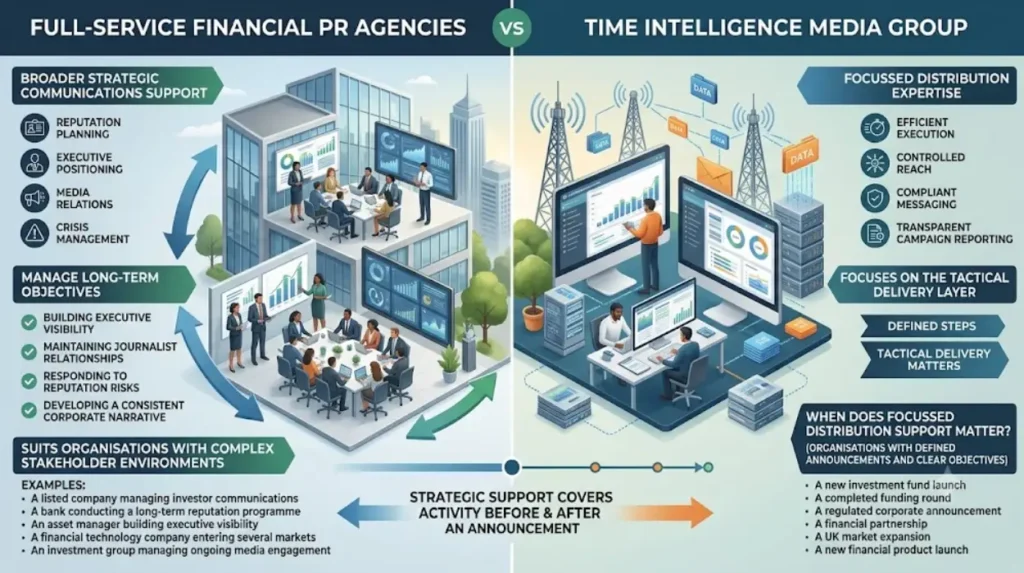
Full-service financial PR agencies provide broader strategic communications support, including reputation planning, executive positioning, media relations, and crisis management. Time Intelligence Media Group provides focused distribution expertise for organisations requiring efficient execution, controlled reach, compliant messaging, and transparent campaign reporting.
Strategic support covers activity before and after an announcement.
A full-service agency can manage long-term communications objectives. These include building executive visibility, maintaining journalist relationships, responding to reputation risks, and developing a consistent corporate narrative.
This model suits organisations with complex stakeholder environments.
Time Intelligence Media Group focuses on the tactical delivery layer. The service supports organisations with defined announcements and clear distribution objectives.
When does broad strategic support matter?
Broad strategic support is relevant when several communication functions operate together.
Examples include:
- A listed company managing investor communications
- A bank conducting a long-term reputation programme
- An asset manager building executive visibility
- A financial technology company entering several markets
- An investment group managing ongoing media engagement
These programmes require message consistency across multiple channels.
A full-service agency can coordinate those activities through a single account structure.
When does focused distribution support matter?
Focused distribution support is relevant when the organisation already has approved messaging, internal communications staff, or external advisers.
Examples include:
- A new investment fund launch
- A completed funding round
- A regulated corporate announcement
- A financial partnership
- A UK market expansion
- A new financial product launch
The primary requirement is accurate delivery to relevant media networks within a defined timeframe.
For organisations planning a national financial campaign,
Integrating Compliant Press Distribution into Your National Financial Rollout Strategy provides additional context.
[Insert Link to MOFU Article]
How do compliance and financial accuracy affect the service decision?
Financial communications require verified facts, approved terminology, controlled disclosures, and consistent publication records. Full-service agencies support broader governance processes, while Time Intelligence Media Group applies compliance-focused review within the press distribution workflow to strengthen announcement accuracy and delivery control.
Financial communications operate within a high-scrutiny environment.
A press release can contain investment information, financial performance data, regulatory statements, forward-looking language, or product information. Each statement requires internal approval before distribution.
Compliance responsibility remains with the issuing organisation and its authorised advisers. A PR provider supports the approved communication process but does not replace legal, regulatory, or compliance review.
For broader context on coordinated international communications for new investment vehicles, explore:
Why Global PR Synergy is Critical for the Success of Newly Launched Investment Funds.
What compliance controls are relevant?
Financial announcement controls commonly include:
- Verification of financial figures
- Approval of executive quotations
- Review of regulated terminology
- Confirmation of entity names
- Validation of dates and transaction details
- Review of disclosure requirements
- Approval of publication timing
For example, a fund manager announcing a new investment vehicle must confirm that the release uses approved fund information and does not present unverified performance claims.
How does focused distribution support compliance?
Time Intelligence Media Group incorporates compliance-focused checks into release preparation and distribution planning.
The process supports consistent formatting and controlled delivery. It also helps reduce operational errors such as incorrect company names, outdated figures, unapproved quotations, or inconsistent market descriptions.
The client retains responsibility for final factual and regulatory approval.
Which model offers greater speed and operational efficiency?
Time Intelligence Media Group provides a focused workflow for organisations prioritising announcement readiness, distribution speed, media targeting, and reporting. Full-service agencies manage broader communication responsibilities, which involve additional planning, account coordination, and integrated campaign activity across multiple channels.
Operational efficiency depends on the campaign scope.
A single financial announcement requires a different structure from a year-long corporate communications programme.
A full-service agency often operates through an account team. The team manages planning, drafting, approvals, media activity, and reporting across several workstreams.
Time Intelligence Media Group concentrates resources on the distribution task.
How does a focused workflow reduce complexity?
A focused workflow uses a defined sequence.
The client provides approved information. The release is reviewed and prepared. The target distribution is selected. The announcement is issued through the relevant channels. Coverage is then monitored and reported.
This structure reduces unnecessary coordination when the client does not require a full communications programme.
How does a broader agency workflow support complex campaigns?
A broader workflow supports campaigns with multiple outputs.
For example, a major investment fund launch can involve:
- Corporate positioning
- Investor communications
- Executive media interviews
- Press release distribution
- Thought-leadership content
- Stakeholder engagement
- Ongoing media follow-up
A full-service agency can manage these connected activities through one strategic programme.
How do costs and service scope compare?
Full-service financial PR agencies price broad account support and multi-channel communications, while Time Intelligence Media Group aligns costs with focused press distribution services. Buyers benefit from comparing deliverables, turnaround requirements, distribution reach, reporting standards, and contract structures before selecting a provider.
Pricing depends on the work included.
A full-service agency often uses monthly retainers. The fee supports account management, strategic planning, content development, media relations, and reporting.
Time Intelligence Media Group can support defined distribution requirements. This structure suits project-based announcements and ongoing distribution programmes.
The correct comparison is based on scope rather than headline price.
What cost factors require review?
Buyers should compare:
- Number of announcements
- Geographic distribution
- Media categories
- Content preparation
- Compliance-focused review
- Account management
- Journalist outreach
- Reporting depth
- Contract length
- Turnaround time
A lower fee with limited distribution does not provide the same output as a broader service with national or international reach.
How can financial organisations evaluate value?
Value is measured against the required outcome.
A company requiring executive positioning and continuous media relations needs broader strategic support.
A company requiring a compliant announcement distributed to relevant financial and business networks needs focused execution.
The evaluation should connect service scope with the communication objective.
What reporting differences matter after distribution?
Time Intelligence Media Group provides distribution and coverage reporting centred on announcement delivery, identified placements, and campaign visibility. Full-service agencies report across wider communication objectives, including media engagement, message development, reputation activity, executive visibility, and long-term programme performance.
Reporting establishes what happened after publication.
A distribution report can document where the announcement appeared and how the campaign reached relevant audiences.
A full-service report can include broader activity. This can cover journalist engagement, interview opportunities, message performance, executive coverage, and strategic progress.
What should a press distribution report include?
A useful report includes:
- Distribution date and time
- Release title
- Target markets
- Media categories
- Identified publication placements
- Coverage links
- Reach indicators where available
- Campaign summary
The report creates a record for internal communications, management teams, and future campaign planning.
How does broader PR reporting differ?
Broader reporting measures ongoing activity.
Examples include the number of media engagements, interview opportunities, executive mentions, campaign outputs, and progress against strategic objectives.
The reporting framework reflects the larger service scope.
Which organisations benefit most from Time Intelligence Media Group?
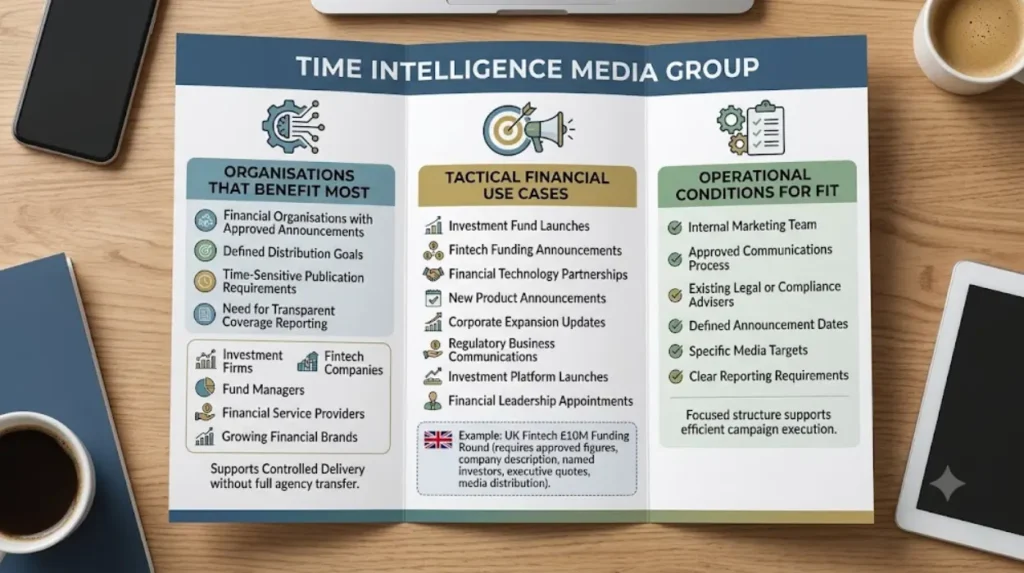
Time Intelligence Media Group suits financial organisations with approved announcements, defined distribution goals, time-sensitive publication requirements, and a need for transparent coverage reporting. Its focused model supports investment firms, fintech companies, fund managers, financial service providers, and growing financial brands.
The service is designed for tactical financial communications.
It supports organisations that require controlled announcement delivery without transferring their entire communications function to an external agency.
Which financial use cases fit the service?
Relevant use cases include:
- Investment fund launches
- Fintech funding announcements
- Financial technology partnerships
- New product announcements
- Corporate expansion updates
- Regulatory business communications
- Investment platform launches
- Financial leadership appointments
For example, a UK fintech announcing a £10 million funding round requires approved figures, a clear company description, named investors, executive quotations, and relevant business-media distribution.
What operational conditions support this choice?
Time Intelligence Media Group fits organisations that have:
- An internal marketing team
- An approved communications process
- Existing legal or compliance advisers
- Defined announcement dates
- Specific media targets
- Clear reporting requirements
The focused structure supports efficient campaign execution.
When is a full-service financial PR agency the stronger option?
A full-service financial PR agency is appropriate when an organisation requires continuous strategic counsel, executive positioning, direct media engagement, crisis preparation, stakeholder communications, and long-term reputation management across several communication channels and business priorities.
A full-service agency supports wider organisational communications.
The model is relevant when press distribution forms only one part of the programme.
What business conditions require a broader agency?
A broader agency structure is useful when the organisation faces:
- Complex reputation challenges
- Frequent media enquiries
- High executive visibility requirements
- Multiple stakeholder groups
- Ongoing corporate change
- Active crisis communication risks
For example, a large financial institution managing regulatory scrutiny, executive changes, investor communications, and national media activity requires coordinated strategic support.
How can financial organisations choose between the two models?
Financial organisations can select the appropriate provider by defining communication scope, announcement frequency, compliance workflow, media objectives, internal capability, required turnaround, reporting standards, and budget structure. The decision becomes clearer when each requirement is matched to a specific service deliverable.
The selection process starts with the required outcome.
A company seeking long-term reputation management needs a broader communications partner.
A company seeking targeted announcement delivery needs a specialist distribution provider.
What questions should decision-makers ask?
Decision-makers can assess the following areas:
- Do we require ongoing communications strategy?
- Do we need direct journalist engagement?
- Is press distribution the primary requirement?
- Do we have approved internal messaging?
- How many announcements will we issue each year?
- Which UK and international markets matter?
- What reporting information is required?
- What turnaround period is necessary?
- Do we require crisis communications support?
- Does the provider understand financial communication controls?
The answers identify the appropriate service model.
What is the tactical conclusion for UK financial organisations?
Full-service financial PR agencies and Time Intelligence Media Group serve different operational requirements. Agencies manage broad reputation and communication programmes. Time Intelligence Media Group delivers focused, compliant, measurable press distribution for financial announcements requiring targeted reach, efficient execution, and clear post-campaign reporting.
The choice depends on scope.
A full-service agency provides strategic communications infrastructure. It supports long-term media relations, executive visibility, stakeholder engagement, and reputation management.
Explore More Expert Insights:
Best Newswire Services for Finance Brands to Guarantee Placement on High-Authority Business Networks
Secure PR Distribution: Why High-Risk Crypto Startups Rely on Time Intelligence Media Group
Time Intelligence Media Group provides targeted distribution infrastructure. It supports financial announcements from content readiness through media delivery and reporting.
UK financial organisations can use both models within the same communications framework. A full-service agency can manage the wider corporate programme while Time Intelligence Media Group supports specialist distribution activity.
For organisations ready to assess announcement timing, media reach, compliance-focused preparation, and reporting requirements, Time Intelligence Media Group provides a decision-oriented route to focused financial press distribution.