
Financial technology companies compete in one of the most competitive digital sectors in the United Kingdom. Many FinTech websites publish valuable content but still struggle to rank for competitive search terms. One important reason is backlink quality. Search engines evaluate both content relevance and the authority of websites linking to that content.
High-authority business backlinks strengthen domain credibility, improve search visibility, and increase trust signals. Understanding how these backlinks influence FinTech SEO helps marketing teams build sustainable organic growth strategies.
What are high-authority business backlinks?
High-authority business backlinks are hyperlinks from trusted business publications, financial websites, industry associations, government resources, or respected corporate websites. These backlinks transfer credibility, strengthen topical relevance, improve search engine trust, and help FinTech websites compete for valuable commercial keywords across competitive search results.
A backlink is a hyperlink from one website to another. Search engines treat backlinks as signals of trust when they originate from reputable websites.
A high-authority website has established credibility through consistent publishing, editorial standards, technical quality, and a strong backlink profile.
Examples include:
- National business publications
- Financial news websites
- Government business resources
- Banking associations
- Economic research organizations
- University finance departments
These websites carry stronger authority than low-quality directories or unrelated blogs.
How search engines interpret backlinks
Search engines evaluate multiple factors, including:
- Source authority
- Topic relevance
- Editorial context
- Anchor text
- Link placement
- Spam indicators
A backlink placed naturally inside an editorial article provides stronger trust signals than a link placed inside unrelated website footers or user-generated spam.
Why do struggling FinTech websites need authoritative backlinks?
Many FinTech websites publish useful information but lack sufficient external authority. High-authority backlinks strengthen trust, improve keyword competitiveness, accelerate content discovery, support ranking improvements, and increase organic visibility for financial topics requiring strong credibility signals across search engines.
Financial services belong to a high-trust category. Search engines apply stricter quality evaluation to topics involving money, investments, banking, taxation, insurance, and payments.
A website without trusted references often struggles to rank even when content quality is high.
Strong competition limits visibility
The UK FinTech sector includes:
- Digital banks
- Payment providers
- Lending platforms
- Wealth management firms
- Cryptocurrency platforms
- Open banking companies
Each organization competes for valuable search terms such as:
- business banking
- payment gateway
- digital lending
- investment platform
- online accounting
Authoritative backlinks help search engines distinguish trustworthy businesses from newer competitors.
Backlinks strengthen topical authority
Topical authority refers to consistent expertise across one subject area.
A FinTech website covering:
- payment compliance
- anti-money laundering
- digital identity verification
- embedded finance
- regulatory technology
develops stronger topical relevance than a website covering unrelated industries.
High-authority backlinks reinforce that expertise.
How do high-authority business backlinks influence search rankings?
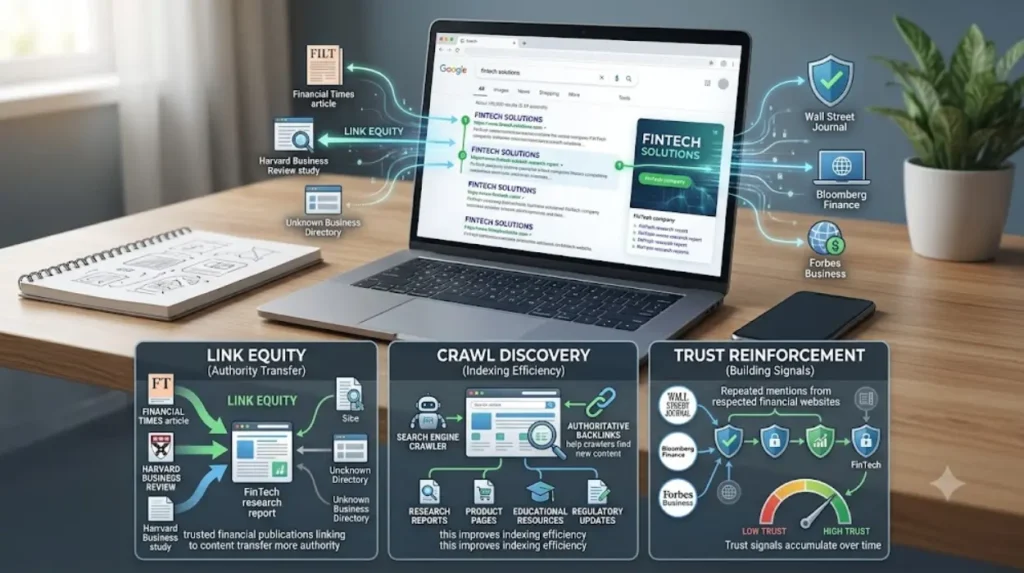
Authoritative backlinks improve ranking signals by increasing website trust, strengthening page authority, supporting faster indexing, distributing link equity, and validating topical expertise. These combined factors help search engines rank relevant FinTech pages for competitive business and financial search queries consistently.
Search rankings depend on hundreds of signals. Backlinks remain one of the strongest external ranking factors.
Link equity
Link equity describes the authority transferred from one page to another through hyperlinks.
A trusted financial publication linking to a FinTech research report transfers more authority than an unknown directory listing.
Crawl discovery
Search engine crawlers discover new content through links.
Authoritative backlinks help crawlers find:
- research reports
- product pages
- educational resources
- regulatory updates
This improves indexing efficiency.
Trust reinforcement
Repeated mentions from respected financial websites strengthen trust.
Trust signals accumulate over time instead of appearing after one backlink.
Which types of business websites provide valuable backlinks?
Business websites offering editorial oversight, financial expertise, industry relevance, and established credibility produce the strongest backlinks. Relevant publications, professional organizations, academic institutions, government resources, and respected corporate websites contribute meaningful authority for FinTech search engine optimization efforts.
Different backlink sources carry different levels of value.
Financial publications
Examples include:
- Banking news websites
- Investment publications
- Financial research portals
These websites provide highly relevant contextual authority.
Professional associations
Industry organizations publish:
- compliance guidance
- market reports
- member directories
- educational resources
These backlinks reinforce industry relevance.
Government resources
Government agencies publish:
- regulatory guidance
- procurement information
- economic reports
Government domains carry significant institutional trust.
Universities
Business schools and finance departments publish:
- research papers
- innovation studies
- economic analysis
Academic references strengthen credibility.
Corporate resources
Large businesses often publish:
- case studies
- partnership announcements
- supplier resources
- technology documentation
These editorial links contribute additional authority.
What makes one backlink stronger than another?
Backlink quality depends on authority, relevance, editorial placement, contextual relationship, natural anchor text, and website trustworthiness. Search engines prioritize links that appear naturally within valuable content instead of manipulative or artificially generated linking schemes across unrelated websites.
Not every backlink contributes equal value.
Topical relevance
A finance publication linking to a lending platform provides stronger relevance than a gardening website linking to the same page.
Editorial review
Editorially approved content undergoes quality control before publication.
Search engines assign greater trust to editorial links.
Context
Links surrounded by relevant financial discussion carry stronger semantic relationships.
Anchor text
Anchor text explains what the destination page covers.
Examples include:
- digital payments
- SME lending
- financial regulation
- payment security
Natural wording performs better than repetitive keyword stuffing.
How do high-authority backlinks improve FinTech credibility?
Authoritative backlinks reinforce external validation. Search engines recognize independent references from trusted organizations as evidence of expertise, reliability, and subject relevance. These signals support stronger credibility across financial topics where trust remains an essential ranking consideration online.
Credibility extends beyond search rankings.
Users also evaluate trust before sharing financial information.
Brand recognition grows
Repeated references across respected publications increase visibility.
Users become familiar with organizations appearing consistently in reliable financial sources.
Industry validation increases
Editorial mentions demonstrate that independent organizations consider published information valuable enough to reference.
This strengthens perceived expertise.
Reputation develops over time
Authority grows through continuous publication and consistent external citations.
A single backlink does not establish long-term credibility.
What backlink practices damage FinTech SEO?
Low-quality backlinks from spam websites, irrelevant directories, automated networks, and manipulative link schemes weaken trust signals. Search engines identify unnatural linking patterns and reduce ranking performance when websites prioritize quantity instead of editorial quality and topical relevance.
Poor backlink practices create long-term SEO problems.
Link farms
Link farms exist primarily to exchange backlinks.
These websites provide little editorial value.
Private link networks
Artificial website networks attempt to manipulate rankings through controlled linking structures.
Search engines actively detect these patterns.
Irrelevant backlinks
Examples include:
- casino websites linking to banking content
- fashion blogs linking to payment platforms
- unrelated coupon directories linking to investment resources
These links reduce topical consistency.
Excessive keyword anchors
Repeating identical keyword-rich anchor text across hundreds of backlinks creates unnatural patterns.
Natural anchor variation supports healthier backlink profiles.
How can FinTech websites earn authoritative backlinks naturally?
Natural backlink acquisition depends on publishing valuable financial resources, original research, regulatory analysis, educational content, market statistics, and expert commentary. Useful information encourages trusted organizations to reference content because it provides measurable value for their audiences.
Editorial links develop through content quality.
Publish original research
Examples include:
- payment adoption studies
- lending market analysis
- SME finance surveys
Original data attracts citations.
Produce regulatory resources
Compliance guides explain complex financial regulations.
Professional audiences frequently reference reliable regulatory information.
Create educational content
Educational resources include:
- glossary pages
- industry explainers
- technical documentation
- implementation guides
These pages answer recurring industry questions.
Share statistical reports
Verified statistics strengthen citations across:
- journalists
- researchers
- analysts
- business publications
Readers interested in the next stage of SEO-driven media strategy can explore:
How should FinTech companies evaluate backlink quality?
Backlink evaluation requires measuring authority, relevance, editorial standards, traffic quality, referring domains, contextual placement, and historical consistency. Comprehensive analysis identifies valuable relationships while excluding harmful backlinks that reduce long-term search performance across financial search environments effectively.
Regular backlink audits improve SEO health.
Important evaluation metrics include:
- referring domains
- topical relevance
- editorial quality
- domain authority indicators
- spam indicators
- anchor diversity
- link placement
A balanced backlink profile includes multiple authoritative referring domains rather than repeated links from one website.
Explore More Expert Insights:
How Pre-Revenue FinTech Startups Secure Placements in Premium Business Outlets
Why Local PR is Critical for the Launch Success of New Physical Medical Clinics
Monitor backlink growth
Healthy backlink acquisition appears gradual.
Sudden spikes from unrelated websites often indicate manipulation.
Review referral traffic
Quality backlinks frequently generate qualified visitors alongside SEO benefits.
Referral traffic demonstrates practical value beyond rankings.
Why do high-authority backlinks remain important for long-term FinTech SEO?
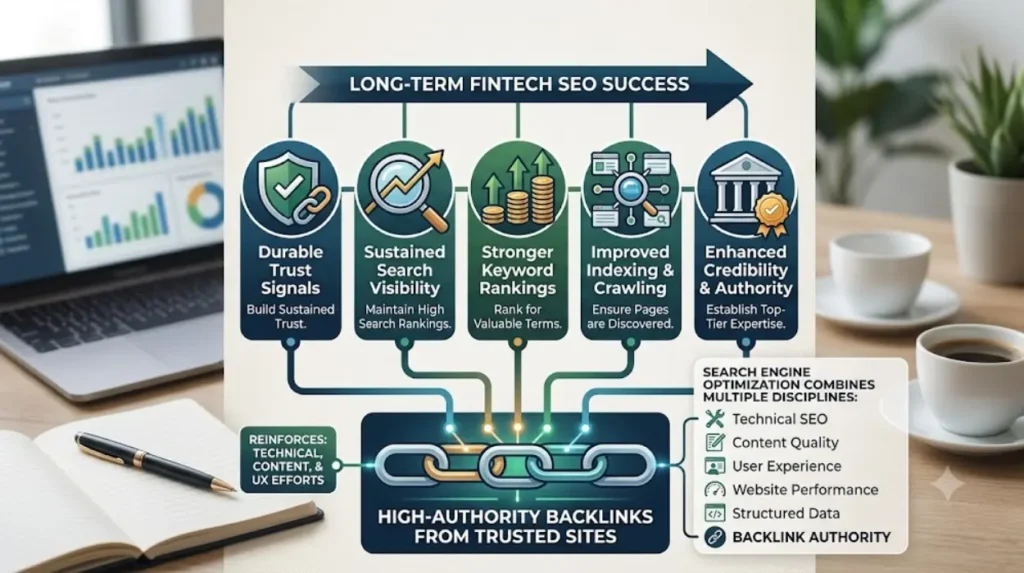
Authoritative backlinks create durable trust signals supporting sustained search visibility, stronger keyword rankings, improved indexing, enhanced credibility, and long-term organic growth. Combined with quality content, technical optimization, and topical expertise, backlinks remain a foundational component of successful FinTech SEO strategies.
Search engine optimization combines multiple disciplines:
- technical SEO
- content quality
- user experience
- website performance
- structured data
- backlink authority
High-authority business backlinks reinforce every other optimization effort by increasing external trust.
As search engines continue emphasizing expertise, authority, and credibility across financial topics, editorial backlinks from trusted business organizations remain an essential indicator of quality. Websites that consistently earn relevant, authoritative references build stronger visibility, maintain higher levels of trust, and compete more effectively for valuable FinTech search terms over the long term. Readers seeking practical implementation and measurable business outcomes can continue with: