
Opening a new physical medical clinic requires more than a completed building, qualified staff, and medical equipment. Public awareness determines whether residents know the clinic exists and understand the healthcare services it provides. Local public relations (PR) creates structured communication between a clinic and its surrounding community. It increases visibility, establishes credibility, and supports informed healthcare decisions through accurate public information.
Why is local PR important when launching a new physical medical clinic?
Local public relations informs nearby communities about a new medical clinic through trusted local communication channels. It increases awareness, explains available healthcare services, builds public familiarity, encourages early patient engagement, and strengthens relationships with local healthcare stakeholders before routine patient visits begin.
Launching a medical clinic introduces a new healthcare provider into an existing community. Residents need reliable information about the clinic’s location, services, operating hours, healthcare professionals, and appointment process.
Local PR distributes verified information through newspapers, local news websites, community publications, radio stations, healthcare newsletters, and regional online platforms. These channels focus on people living within the clinic’s service area.
Unlike national communication, local PR concentrates on geographic relevance. A dental clinic in Manchester communicates with Manchester residents. A physiotherapy clinic in Bristol targets nearby employers, sports clubs, and local healthcare professionals.
Early communication reduces uncertainty and helps residents understand available healthcare options.
How does local communication improve community awareness?
Local communication delivers information through media outlets that residents already trust.
Examples include:
- Regional newspapers
- Community magazines
- Local radio stations
- Borough council newsletters
- Local healthcare directories
These sources reach audiences interested in developments within their own neighbourhoods.
What does local PR communicate before a clinic opens?
Local public relations explains essential operational information before opening day. It informs residents about healthcare services, medical specialties, clinic facilities, accessibility, appointment procedures, opening dates, and community health objectives using accurate, consistent, and publicly accessible information across local communication channels.
Patients often search for practical healthcare information before choosing a provider.
Important launch information includes:
- Official opening date
- Clinic address
- Public transport access
- Parking availability
- Opening hours
- Medical specialties
- Available diagnostic services
- Accessibility features
- Appointment booking methods
Providing complete information reduces confusion and increases understanding.
Why do healthcare service descriptions matter?
Healthcare terminology varies between specialties.
Clear explanations help residents understand the clinic’s role.
For example:
- A dermatology clinic treats skin conditions.
- A cardiology clinic focuses on heart health.
- A physiotherapy clinic supports rehabilitation and mobility.
- A diagnostic imaging centre performs MRI, CT, ultrasound, and X-ray examinations.
Precise descriptions improve public understanding.
How does local PR help build trust within a community?
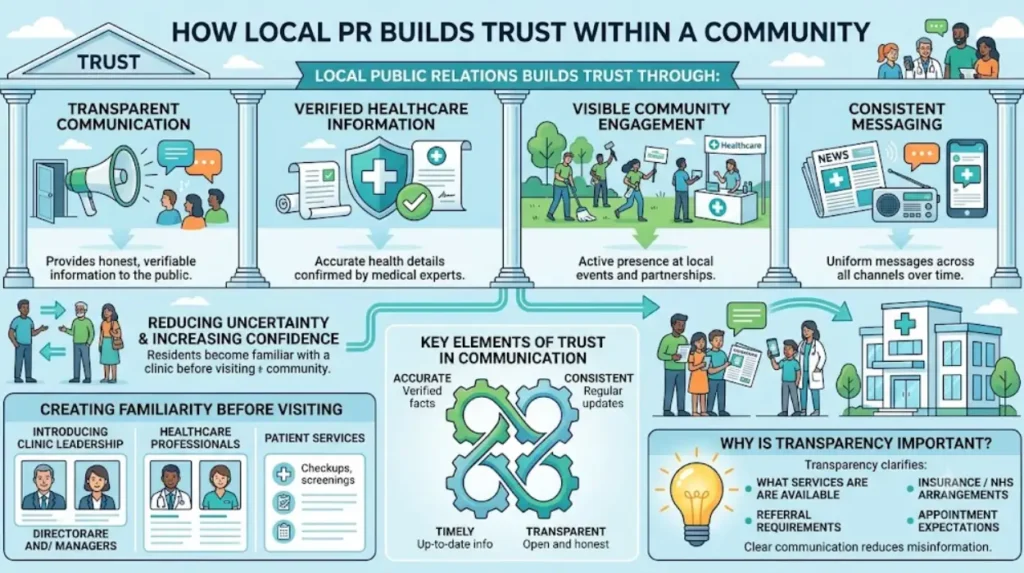
Local public relations builds trust through transparent communication, verified healthcare information, visible community engagement, and consistent messaging. Residents become familiar with a clinic before visiting, reducing uncertainty and increasing confidence in available local healthcare services and medical professionals.
Healthcare depends heavily on public confidence.
Residents often prefer healthcare providers they recognize through familiar local sources.
Trust develops when communication remains:
- Accurate
- Consistent
- Timely
- Transparent
Introducing clinic leadership, healthcare professionals, and patient services creates familiarity before the first appointment.
Why is transparency important?
Transparency explains:
- What services are available
- Which services are unavailable
- Referral requirements
- Insurance or NHS arrangements
- Appointment expectations
Clear communication reduces misinformation.
How does local PR support relationships with healthcare stakeholders?
Local public relations strengthens communication between new clinics and healthcare stakeholders including general practitioners, pharmacies, community organisations, employers, schools, and local authorities. These relationships improve information sharing and increase awareness of available healthcare resources throughout the surrounding community.
Healthcare operates through connected organisations.
New clinics interact with multiple stakeholders.
Examples include:
- General practitioner practices
- Community pharmacies
- Care homes
- Schools
- Universities
- Employers
- Local councils
- Charitable healthcare organisations
Each stakeholder benefits from accurate information regarding new healthcare services.
Why are referral relationships important?
Healthcare providers often refer patients to appropriate specialists.
Examples include:
- General practitioners referring patients to diagnostic centres.
- Dentists referring patients for oral surgery.
- Physiotherapists referring patients for imaging.
- Optometrists referring patients for ophthalmology services.
Local awareness supports appropriate referral pathways.
What communication channels support local medical clinic launches?
Local public relations combines traditional media, digital media, community publications, healthcare directories, local events, and social communication platforms. Using multiple communication channels increases information accessibility and reaches different population groups within a defined geographic service area effectively.
Different population groups consume information differently.
Older adults often read printed newspapers.
Working professionals frequently use local news websites.
Families monitor community Facebook groups and council announcements.
Healthcare communication benefits from broad distribution.
Which channels commonly reach local communities?
Common communication channels include:
- Local newspapers
- Community magazines
- Regional news websites
- Local radio
- Healthcare directories
- Community noticeboards
- Local authority publications
- Educational institution newsletters
Using several channels increases overall reach.
How does local PR improve search visibility for nearby patients?
Local public relations creates consistent public information that search engines index across trusted regional sources. Accurate local coverage strengthens geographic relevance, helping residents discover nearby medical clinics while searching for healthcare providers and related medical services online.
Many patients begin their healthcare journey with online searches.
Examples include:
- “Medical clinic near me”
- “Private GP Birmingham”
- “Children’s clinic Leeds”
- “Physiotherapy Nottingham”
Search engines evaluate location relevance alongside authoritative public information.
Consistent local coverage reinforces:
- Clinic name
- Address
- Telephone number
- Healthcare services
- Opening information
These details improve information consistency across online sources.
Why does consistent information matter?
Inconsistent business information creates confusion.
Matching addresses, contact details, and operating hours across multiple public sources improves data accuracy.
What role does local media play in healthcare awareness?
Local media informs residents about healthcare developments affecting their communities. News coverage introduces new medical facilities, explains healthcare services, highlights public health initiatives, and increases awareness through established editorial standards and locally relevant reporting.
Local journalism focuses on community developments.
Healthcare openings represent important public interest stories.
Coverage often includes:
- Opening announcements
- Healthcare service explanations
- Facility information
- Community health programmes
- Recruitment updates
- Public health initiatives
Editorial reporting increases information accessibility.
Why do residents trust local news?
Local journalism reports events affecting nearby communities.
Residents regularly follow trusted regional publications for developments in healthcare, education, transport, and public services.
What challenges does local PR help reduce during a clinic launch?
Local public relations reduces misinformation, public confusion, inaccurate expectations, and limited community awareness before opening. Structured communication answers common questions early, improving operational readiness and helping residents understand available healthcare services from the beginning.
Every clinic launch generates public questions.
Common examples include:
- Is the clinic accepting new patients?
- Which medical services are available?
- Does the clinic treat children?
- What are the opening hours?
- Is parking available?
- Are appointments required?
Providing verified answers before opening reduces uncertainty.
How does proactive communication improve operations?
Patients receive accurate information before contacting reception staff.
This reduces repetitive enquiries and supports efficient administrative processes during the launch period.
How does local PR contribute to long-term clinic development?
Local public relations establishes ongoing communication between healthcare providers and surrounding communities. Continuous public information supports awareness of new services, healthcare programmes, seasonal campaigns, educational initiatives, and operational updates throughout the clinic’s long-term development.
Communication continues after opening day.
Medical clinics regularly introduce:
- New healthcare professionals
- Expanded treatment services
- Vaccination programmes
- Preventive screening initiatives
- Community health education events
Local PR keeps residents informed about these developments.
As healthcare services evolve, consistent communication maintains public awareness.
Healthcare organisations expanding into multiple locations often incorporate broader communication planning alongside:
Integrating Compliant Press Distribution as part of regional rollout strategies. Larger operational evaluations frequently examine:
Full-Service Health PR Agencies vs. Time Intelligence Media Group when comparing different organisational communication approaches, although those topics extend beyond introductory healthcare awareness.
What are the key lessons about local PR for new medical clinics?
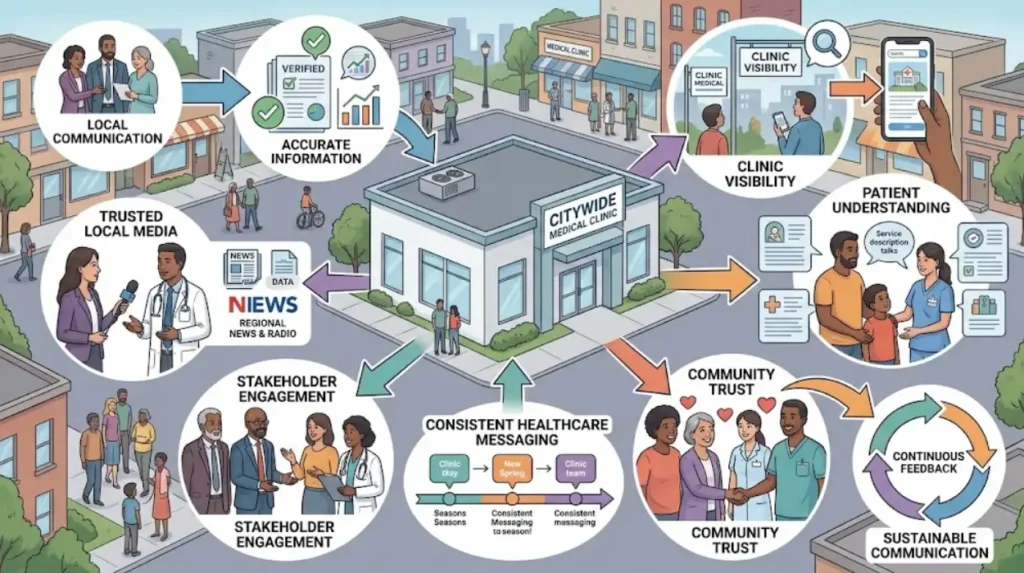
Local public relations creates informed communities through accurate communication, trusted local media, stakeholder engagement, and consistent healthcare information. Effective local awareness supports clinic visibility, patient understanding, community trust, and sustainable healthcare communication throughout every stage of a clinic’s development.
Launching a physical medical clinic involves more than opening a healthcare facility. Residents require clear, accessible information about available services and how those services benefit the local community.
Explore More Expert Insights:
How Industry Analysts Discover and Evaluate Disruptive HealthTech Innovators
What Happens to a Healthcare Brand’s Reputation During a Misinformation Crisis?
Local PR delivers verified healthcare information through trusted regional channels. It strengthens community awareness, supports healthcare transparency, improves search visibility, and establishes productive relationships with local stakeholders.
When communication remains accurate, consistent, and geographically relevant, new medical clinics become more visible within their communities and residents gain a clearer understanding of the healthcare resources available to them.