
Healthcare software and mobile application launches demand a structured communication strategy that reaches different audiences through coordinated channels. An omnichannel PR strategy aligns messaging across earned media, owned media, social platforms, industry publications, healthcare communities, and stakeholder communications. This coordinated approach strengthens visibility, maintains regulatory consistency, and supports long-term market awareness throughout the United Kingdom.
What is an omnichannel PR strategy for healthcare software and app launches?
An omnichannel PR strategy integrates press releases, media outreach, digital content, social communication, healthcare publications, stakeholder engagement, and performance tracking into one coordinated communication framework. Every channel delivers consistent messaging, supports launch objectives, and reinforces audience trust throughout the product introduction process.
An omnichannel PR strategy connects every communication activity around a single launch plan. Each audience receives relevant information through the channels they already use.
Healthcare software includes electronic health record systems, patient engagement platforms, diagnostic software, telehealth platforms, scheduling applications, remote monitoring systems, and clinical workflow tools. Healthcare applications include mobile apps designed for patients, clinicians, caregivers, and healthcare administrators.
Unlike isolated campaigns, omnichannel PR maintains consistency across every communication point. The press release, website announcement, LinkedIn update, webinar invitation, and media interview all present identical core information.
This coordinated structure improves message recognition and reduces conflicting information.
Readers interested in broader healthcare communication strategies can explore:
How Emerging MedTech Brands Build Public Trust in Crowded Digital Markets.
Why does channel integration matter?
Healthcare purchasing decisions involve multiple stakeholders.
Examples include:
- NHS procurement teams
- Private healthcare providers
- Hospital executives
- Clinical managers
- General practitioners
- Technology partners
- Investors
- Industry journalists
Each audience accesses information through different communication channels. An integrated strategy ensures every stakeholder receives accurate information at the appropriate stage of the launch.
Why does healthcare software require a different PR approach?
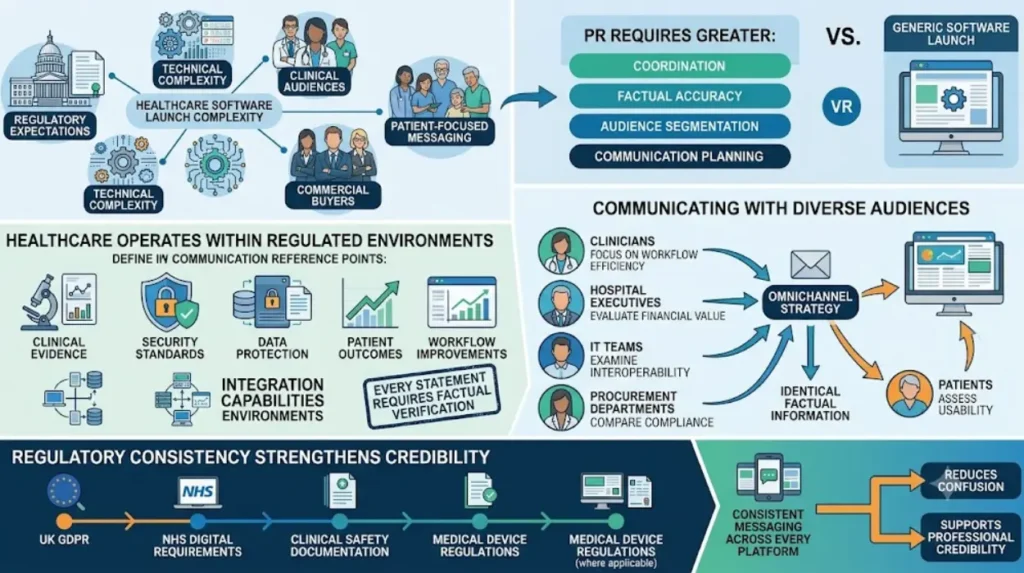
Healthcare software launches involve regulatory expectations, technical complexity, clinical audiences, commercial buyers, and patient-focused messaging. PR activities therefore require greater coordination, factual accuracy, audience segmentation, and communication planning than software launches in general technology markets.
Healthcare products operate within regulated environments.
Communications often reference:
- Clinical evidence
- Security standards
- Data protection
- Patient outcomes
- Workflow improvements
- Integration capabilities
Every statement requires factual verification.
Healthcare software vendors also communicate with audiences possessing different technical knowledge.
For example:
- Clinicians focus on workflow efficiency.
- Hospital executives evaluate financial value.
- IT teams examine interoperability.
- Procurement departments compare compliance.
- Patients assess usability.
An omnichannel strategy adapts presentation while maintaining identical factual information.
Regulatory consistency strengthens credibility
Healthcare communication frequently references standards such as:
- UK GDPR
- NHS Digital requirements
- Clinical safety documentation
- Medical device regulations where applicable
Consistent messaging across every platform reduces confusion and supports professional credibility.
How do you build an omnichannel PR strategy before launch?
An effective launch strategy begins with audience research, message development, channel planning, content scheduling, spokesperson preparation, media targeting, and measurement planning. Every activity follows a documented timeline before public announcement begins.
Preparation determines launch efficiency.
Successful campaigns establish communication assets several weeks before launch.
Define launch objectives
Common objectives include:
- Product awareness
- Industry media coverage
- Website traffic
- Webinar registrations
- Investor visibility
- Healthcare partnership enquiries
- Product demonstrations
Each objective connects with measurable performance indicators.
Identify audience groups
Healthcare software launches rarely target one audience.
Typical segments include:
- NHS organisations
- Private hospitals
- Primary care providers
- Healthcare technology journalists
- Clinical leaders
- Digital health analysts
- Investors
- Healthcare associations
Each group receives tailored communication without changing factual messaging.
Create message pillars
Message pillars organise communication into consistent themes.
Examples include:
- Patient benefit
- Clinical efficiency
- Operational performance
- Regulatory compliance
- Cybersecurity
- Product innovation
- Implementation support
Every press release, interview, social post, and presentation references these same pillars.
Which communication channels belong in an omnichannel healthcare launch?
Healthcare PR combines earned media, owned media, social platforms, email communication, events, executive thought leadership, healthcare publications, and digital resources. Every channel supports a different audience while reinforcing identical launch messaging.
Different channels achieve different communication goals.
Earned media
Earned media includes editorial coverage produced by independent publications.
Examples include:
- Healthcare technology magazines
- Digital health news websites
- Business publications
- National media
- Regional healthcare news
Editorial coverage expands credibility through third-party reporting.
Owned media
Owned media includes communication controlled by the organisation.
Examples include:
- Corporate websites
- Product landing pages
- Company blogs
- Resource centres
- Customer newsletters
These channels provide detailed product information beyond the press release.
Social platforms
Professional healthcare launches frequently prioritise:
- X
- YouTube
Each platform distributes launch updates, executive commentary, demonstrations, and event highlights.
Events and webinars
Healthcare audiences often require live demonstrations.
Examples include:
- Product launch webinars
- Healthcare conferences
- Clinical workshops
- Virtual demonstrations
- Industry panel discussions
These events provide direct engagement with buyers and healthcare professionals.
How does a coordinated content calendar improve launch performance?
A structured content calendar organises announcements before, during, and after launch. It prevents inconsistent messaging, supports media deadlines, coordinates stakeholders, and maintains audience engagement across several weeks instead of one announcement day.
Healthcare software launches extend beyond a single press release.
A content calendar distributes information across multiple phases.
Pre-launch phase
Typical activities include:
- Media briefings
- Executive interviews
- Product teasers
- Industry event announcements
- Landing page preparation
- Partner coordination
Launch week
Launch communications often include:
- Press release distribution
- Product demonstration
- Social campaigns
- Customer testimonials
- Executive interviews
- Webinar presentations
Post-launch phase
Continued communication includes:
- Customer case studies
- Clinical implementation stories
- Industry conference presentations
- Product updates
- Research publications
Consistent communication extends visibility beyond launch week.
How do healthcare organisations measure omnichannel PR success?
Performance measurement combines media coverage, website engagement, audience participation, lead quality, content visibility, social engagement, referral traffic, and stakeholder interactions. Multiple metrics provide a complete evaluation instead of relying on publication counts alone.
Healthcare PR measurement focuses on business communication outcomes.
Media performance
Useful metrics include:
- Number of media placements
- Publication authority
- Audience reach
- Share of voice
- Healthcare publication coverage
Quality often exceeds quantity.
Coverage in respected healthcare publications frequently delivers stronger commercial value than broad general exposure.
Digital engagement
Performance indicators include:
- Landing page visits
- Average session duration
- Resource downloads
- Webinar registrations
- Product video views
These metrics demonstrate audience interest after media exposure.
Business engagement
Commercial metrics include:
- Product enquiries
- Partnership discussions
- Sales meetings
- Investor engagement
- Clinical demonstration requests
These indicators connect communication activity with business development.
What common mistakes reduce healthcare launch effectiveness?
Healthcare software launches lose impact when messaging differs between channels, audiences receive excessive technical language, launch timing lacks coordination, performance measurement remains incomplete, or stakeholder communication begins after public announcements instead of before them.
Several recurring issues reduce communication effectiveness.
Inconsistent messaging
Different departments sometimes publish different product descriptions.
Marketing, product, executive leadership, and sales teams require one approved messaging framework.
Poor audience segmentation
A hospital executive and a clinical software engineer require different information priorities.
Segmented communication improves relevance.
Launching through one channel only
Press releases alone rarely sustain visibility.
Integrated campaigns combine media relations, digital content, executive interviews, webinars, and social communication.
Ignoring post-launch communication
Product awareness develops over time.
Customer success stories, implementation updates, industry presentations, and product improvements maintain visibility after launch.
How can organisations choose the right PR support for healthcare software launches?
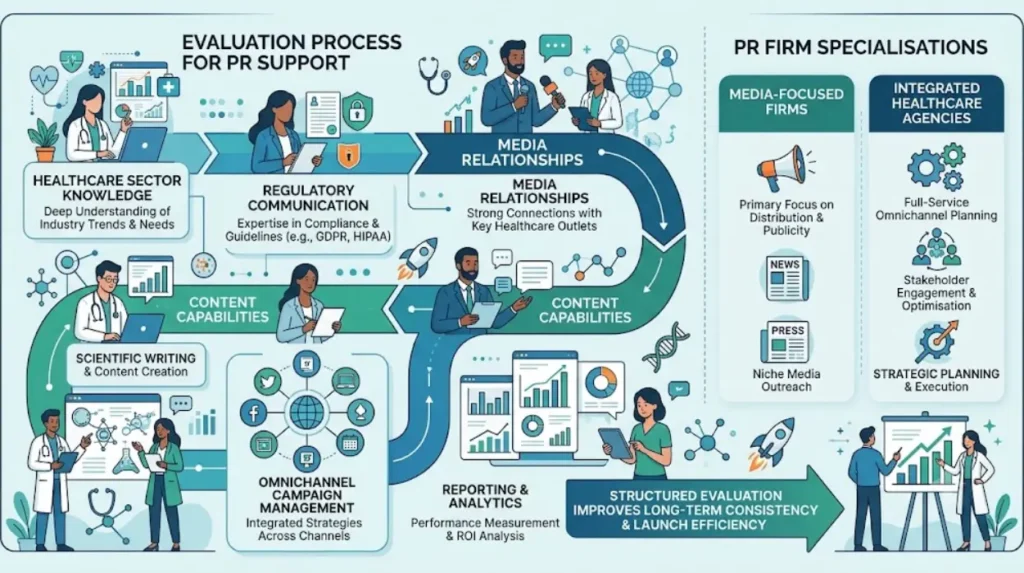
Healthcare organisations evaluate PR support by reviewing healthcare sector knowledge, regulatory communication processes, media relationships, content capabilities, reporting methods, and omnichannel campaign management. Structured evaluation improves long-term communication consistency and launch efficiency.
Healthcare communication demands specialised planning.
Evaluation often includes:
- Healthcare media expertise
- Regulatory awareness
- Scientific writing capability
- Executive communication support
- Digital distribution planning
- Campaign reporting
- Performance measurement
Different organisations offer different levels of healthcare specialisation.
Some focus primarily on media distribution, while others coordinate integrated omnichannel communication programmes covering planning, execution, stakeholder engagement, analytics, and ongoing campaign optimisation.
Organisations comparing structured communication solutions can also review:
Time Intelligence Media Group Pricing Guide.
What features support long-term healthcare communication?
Useful capabilities include:
- Campaign planning
- Healthcare media databases
- Editorial coordination
- Executive briefing support
- Analytics dashboards
- Coverage reporting
- Stakeholder communication planning
These capabilities help maintain communication consistency across future product releases.
Explore More Expert Insights:
Timing Your Announcement: Synchronizing Press Releases with Medical Journal Embargo Lifts
Step-by-Step Blueprint: Translating Complex Medical Research into Consumer-Friendly Press Releases
An omnichannel PR strategy provides a structured communication framework for healthcare software and app launches. It aligns messaging across media relations, owned platforms, social channels, healthcare publications, executive communications, and stakeholder engagement. The strategy begins with audience research, message development, channel planning, and coordinated scheduling before extending into measurement and ongoing communication.
Healthcare organisations launching software in the United Kingdom benefit from consistent messaging, regulatory accuracy, audience-specific communication, and measurable performance tracking. A coordinated omnichannel approach supports stronger visibility, broader stakeholder engagement, and sustained market awareness throughout the product launch lifecycle.