
Medical research announcements attract stronger attention when press releases align with medical journal embargo lifts. Correct timing protects publication agreements, supports accurate reporting, and increases media visibility. Healthcare organisations, research institutions, and biotechnology companies benefit from structured planning that connects publication schedules with media distribution.
Research findings often appear first in peer-reviewed medical journals before reaching the public. Many journals apply embargo policies that prevent public disclosure until a specific date and time. Press teams must coordinate publication schedules, media outreach, regulatory communications, and digital distribution around these embargoes.
Understanding this process helps healthcare communicators achieve accurate coverage while maintaining compliance with journal requirements.
What is a medical journal embargo, and why does it matter?
A medical journal embargo is a publication restriction that prevents public disclosure before an approved release time. It protects scientific integrity, allows journalists to prepare accurate reporting, and ensures all media organisations receive research findings simultaneously under identical publication conditions.
A medical journal embargo defines the exact date and time when research becomes public. Journals provide embargoed access to accredited journalists before publication. During this period, journalists analyse the research, interview experts, and prepare balanced news coverage.
Peer-reviewed journals use embargoes to maintain fairness across media outlets.
Examples include:
- Clinical trial publications
- Public health research
- Pharmaceutical studies
- Medical technology evaluations
Embargoes also reduce misinformation by allowing reporters sufficient preparation time before publication.
How does an embargo differ from publication?
Publication refers to the official release of research.
An embargo controls communication before publication.
Both occur together when the embargo expires.
Healthcare organisations must avoid publishing:
- Press releases
- Social media posts
- Website articles
- Email announcements
before the embargo lift.
How do press releases align with journal embargo schedules?
Press release timing begins with the journal’s embargo date. Communication teams create backward planning schedules covering drafting, legal review, scientific approval, media preparation, and distribution so every activity finishes before the embargo expires without violating publication restrictions.
Successful coordination follows a structured timeline rather than a last-minute release.
Step 1: Confirm the embargo schedule
The journal provides:
- Publication date
- Publication time
- Time zone
- Embargo conditions
These details become the foundation for communication planning.
Step 2: Prepare the press release
The press release includes:
- Research summary
- Clinical significance
- Investigator quotations
- Supporting statistics
- Funding disclosures
- Institutional information
Every scientific statement matches the published paper.
Step 3: Complete internal approvals
Healthcare announcements often require approval from:
- Principal investigators
- University communications offices
- Hospital communications teams
- Legal departments
- Regulatory affairs teams
Approval delays directly affect publication readiness.
Step 4: Schedule distribution
Most professional distribution platforms allow releases to publish automatically at the embargo lift.
Automation removes manual publishing delays.
Healthcare communication teams frequently compare scheduling workflows before selecting distribution approaches. Organisations evaluating broader planning strategies can refer to:
Which teams participate in embargo planning?
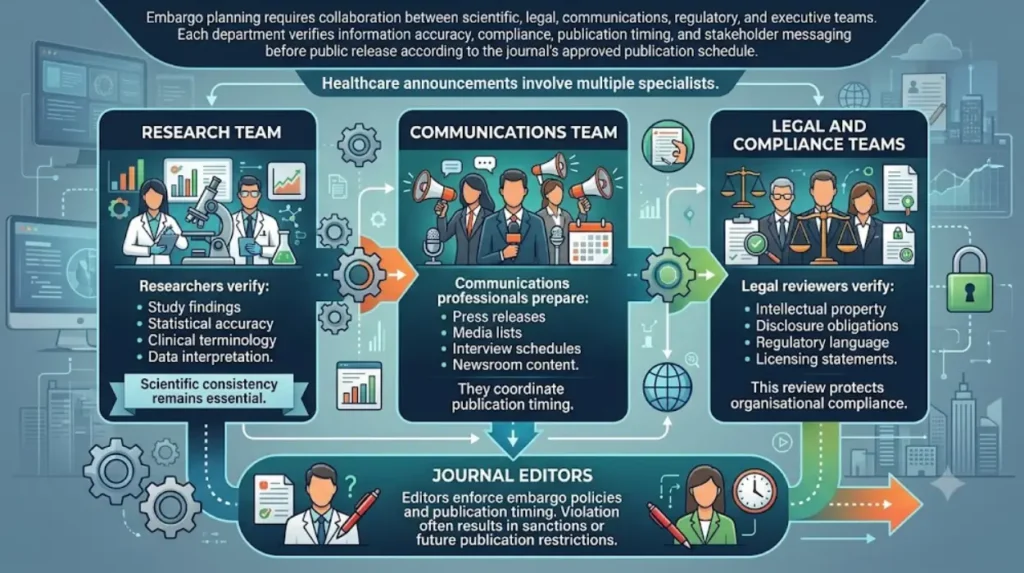
Embargo planning requires collaboration between scientific, legal, communications, regulatory, and executive teams. Each department verifies information accuracy, compliance, publication timing, and stakeholder messaging before public release according to the journal’s approved publication schedule.
Healthcare announcements involve multiple specialists.
Research team
Researchers verify:
- Study findings
- Statistical accuracy
- Clinical terminology
- Data interpretation
Scientific consistency remains essential.
Communications team
Communications professionals prepare:
- Press releases
- Media lists
- Interview schedules
- Newsroom content
They coordinate publication timing.
Legal and compliance teams
Legal reviewers verify:
- Intellectual property
- Disclosure obligations
- Regulatory language
- Licensing statements
This review protects organisational compliance.
Journal editors
Editors enforce embargo policies and publication timing.
Violation often results in sanctions or future publication restrictions.
What factors influence the ideal release time?
The ideal announcement time combines journal publication schedules, newsroom activity, target audience availability, regional time zones, and organisational readiness. Every timing decision supports maximum reporting accuracy while maintaining full embargo compliance across multiple communication channels.
Journal timing always takes priority.
Beyond that, communication teams evaluate several practical factors.
Geographic distribution
International journals frequently publish according to:
- Greenwich Mean Time (GMT)
- British Summer Time (BST)
- Eastern Time (ET)
Global healthcare companies convert schedules across every operating region.
Newsroom activity
Healthcare journalists work around editorial deadlines.
Morning publication often supports:
- Breaking news coverage
- Online articles
- Television reporting
- Industry newsletters
Digital publication
Press releases normally appear simultaneously across:
- Corporate websites
- Newsrooms
- Distribution networks
- Investor pages
Consistency prevents conflicting publication times.
How does embargo timing improve media coverage?
Embargo timing gives journalists preparation time before publication. Prepared journalists produce faster reporting, stronger scientific accuracy, broader expert commentary, and higher-quality articles immediately after the embargo expires across multiple media channels.
Embargoes create organised reporting rather than rushed coverage.
Journalists gain time to:
- Read research papers
- Contact independent experts
- Verify statistics
- Prepare interviews
The result includes more complete news stories.
Improved scientific accuracy
Healthcare reporting depends on precise terminology.
Advance preparation reduces factual errors.
Simultaneous global visibility
Research reaches multiple audiences together.
Examples include:
- National newspapers
- Medical publications
- Healthcare trade media
- Science websites
Large announcements often receive coordinated international coverage.
What mistakes disrupt synchronized healthcare announcements?
Most timing failures result from poor planning, incomplete approvals, inconsistent publication schedules, or accidental early disclosure. These avoidable errors reduce media trust, create compliance risks, and weaken communication effectiveness during important healthcare announcements.
Several recurring problems affect healthcare communications.
Early publication
Publishing before the embargo expires represents the most serious mistake.
Examples include:
- Scheduled social posts
- Website updates
- Newsletter emails
All communication channels require coordinated timing.
Inconsistent messaging
Research papers and press releases must contain matching information.
Differences create confusion among journalists.
Missing approvals
Late scientific review often delays publication readiness.
Approval timelines require structured project management.
Ignoring time zones
International organisations frequently publish across several regions.
Incorrect time conversion creates accidental embargo breaches.
Which tools help synchronise press releases with embargo lifts?
Healthcare organisations use editorial calendars, project management platforms, automated distribution systems, approval workflows, and monitoring software to coordinate every publication activity around journal embargo schedules with consistent operational control.
Technology improves coordination across complex research announcements.
Editorial calendars
Editorial calendars track:
- Draft completion
- Review deadlines
- Publication dates
- Distribution schedules
Shared visibility reduces scheduling conflicts.
Project management software
Project management systems assign responsibilities.
Examples include:
- Draft review
- Scientific approval
- Legal approval
- Distribution scheduling
Every task receives a deadline.
Automated press distribution
Distribution systems publish announcements automatically at the embargo lift.
Automation improves consistency across multiple publication channels.
Teams preparing for provider selection often compare scheduling capabilities alongside compliance features. Additional evaluation guidance appears under:
How do clinical trial announcements require additional coordination?
Clinical trial press releases involve extra regulatory, ethical, and scientific review because patient safety, study accuracy, financial disclosures, and regulatory communications require complete consistency before publication under journal embargo conditions.
Clinical trials receive extensive public attention.
Communication teams coordinate multiple obligations simultaneously.
Regulatory disclosures
Clinical trial announcements frequently include:
- Trial registration numbers
- Study phases
- Safety outcomes
- Primary endpoints
These details require accuracy.
Investor communications
Public healthcare companies often coordinate:
- Investor announcements
- Regulatory filings
- Journal publication
- Press releases
Timing remains consistent across every channel.
International coordination
Global trials involve multiple countries.
Regional communication teams publish according to one central embargo schedule.
How can organisations build a repeatable embargo communication process?

Repeatable communication processes standardise planning, approvals, publication scheduling, and post-release monitoring. Documented workflows improve operational efficiency, reduce timing errors, and support consistent healthcare communications across future research announcements.
Healthcare organisations benefit from documented procedures.
A repeatable workflow includes:
- Receive embargo notification.
- Create publication timeline.
- Draft the press release.
- Complete scientific review.
- Complete legal review.
- Schedule automated distribution.
- Prepare media responses.
- Monitor publication after release.
- Record campaign performance.
Documented workflows simplify future announcements.
Performance metrics often include:
- Publication accuracy
- Media pickup
- Journalist engagement
- Website traffic
- Research downloads
- Social media reach
These measurements support continuous improvement.
Explore More Expert Insights:
Step-by-Step Blueprint: Translating Complex Medical Research into Consumer-Friendly Press Releases
The Biotech Founder’s Guide to Crafting Media Pitches That Clinical Journalists Trust
Synchronizing press releases with medical journal embargo lifts strengthens healthcare communications through disciplined planning and accurate execution. Embargo policies protect scientific integrity while giving journalists time to prepare detailed, evidence-based reporting. Successful coordination depends on verified publication schedules, structured approvals, consistent messaging, automated distribution, and close collaboration between researchers, communications professionals, legal reviewers, and journal editors. Organisations that establish repeatable embargo workflows improve compliance, support reliable media coverage, and maximise the visibility of important medical research without compromising publication standards.